
ITIL-160 · Lesson 10 of 12 · 21 min
Practising ITIL and AI, other frameworks and digital products
The Version 5 syllabus includes two small areas that ITIL 4 Foundation did not: ITIL and AI, and ITIL and other frameworks. Each is worth about 2.5 %, roughly one question. Version 5 also threads products, experience and digital ways of working through the whole syllabus, so questions in other areas often use digital settings. This lesson covers what you need for the two small areas and recaps the digital-product ideas that most often appear in Foundation-style questions. If you are sitting ITIL 4 Foundation, read the frameworks section, which helps with questions on how ITIL fits alongside agile and DevOps, and skim the rest.
The right amount of effort here is modest. Two marks are not worth a week of study. But they are also not worth throwing away, and the ideas are straightforward once you know the angle the exam takes: ITIL is designed to work with other approaches, and AI must be used with clear governance and human oversight.
ITIL and AI: what Foundation expects
ITIL-150 covered AI in service management and AI governance in depth. At Foundation level, published syllabus summaries suggest you need to understand, at a recall or understanding level, how AI can support products and services and service management practices, what kinds of benefit and risk it brings, and why governance and human oversight matter. Version 5 also offers a separate extension module on AI governance for people who need more.
| Idea | What to remember | Larchmont example |
|---|---|---|
| AI supports practices | AI can help with tasks such as classifying and routing incidents, suggesting knowledge, predicting failures, answering simple requests and analysing trends | An AI model suggests a category and assignment group for each new incident |
| AI is used across the value chain | AI can help discover needs, design and build products, operate them and support users | Generative AI drafts knowledge articles that agents review |
| AI brings new risks | Errors and hallucinations, bias, privacy and security risks, over-reliance, lack of transparency | A chatbot gives a customer a wrong delivery promise |
| Governance and oversight | Organizations need policies, roles, risk assessment and human oversight proportionate to the risk | Larchmont's AI governance group approves each new AI use and its controls |
| Four dimensions apply | AI affects people and skills, information and technology, suppliers and value streams | Staff need training; data quality matters; the model supplier's terms matter |
Foundation questions on AI usually reward balanced answers. An option that says AI should replace human judgment in all decisions is extreme and almost certainly wrong. An option that says AI should be avoided because it carries risk is also wrong; ITIL's position is that AI can create value when it is used deliberately and governed well. The best answer usually combines value with control: use AI where it helps, assess the risks, keep humans involved where the impact is significant and monitor results.
Worked problem
An AI question in the Foundation style
Larchmont plans to let an AI assistant answer customer questions about shipment status. Which approach is most consistent with ITIL guidance? A) Deploy it to all customers immediately to maximize savings. B) Avoid AI because it can make mistakes. C) Assess the risks, start with a limited scope, keep a clear route to a human agent and monitor its answers. D) Let the supplier decide how it should be governed.
Show solution
- A ignores risk assessment and progressive rollout.
- B rejects value entirely; ITIL does not ask organizations to avoid AI.
- D hands accountability to a supplier; governance stays with the organization.
- C combines value with risk assessment, iterative rollout, human oversight and monitoring.
Answer: C. It also reflects two guiding principles: progress iteratively with feedback, and focus on value.
AI and the law: context, not exam content
The Foundation exam does not test national law, but knowing the context helps you understand why AI governance matters to organizations. Rules on AI are changing quickly in both countries, and organizations must track them.
In Canada there is no federal AI statute: the proposed Artificial Intelligence and Data Act died when Parliament was prorogued in January 2025. Organizations still face privacy law (PIPEDA and provincial laws, including Quebec's Law 25 rules on automated decisions), human rights law, the federal Directive on Automated Decision-Making for government institutions, and Ontario's requirement, in force from January 2026, to disclose AI use in public job postings. Many organizations follow voluntary frameworks such as the NIST AI Risk Management Framework or ISO/IEC 42001.
ITIL and other frameworks
ITIL has always been designed to work alongside other frameworks, methods and standards, and Version 5 makes this a named syllabus area. The idea the exam tests is simple: ITIL is guidance that organizations adopt and adapt, and it complements rather than competes with approaches such as agile, DevOps and Lean. A question might ask how ITIL relates to another framework, or which statement about combining them is correct.
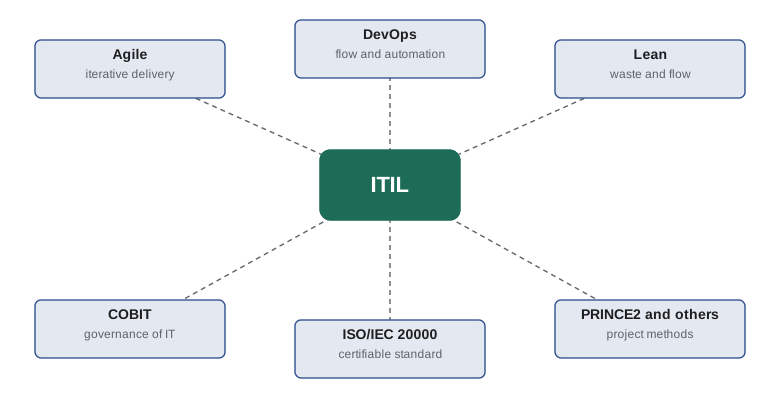
| Framework or standard | What it focuses on | How it relates to ITIL |
|---|---|---|
| Agile | Iterative, incremental delivery with frequent feedback | Matches progress iteratively with feedback; ITIL practices adapt to agile teams |
| DevOps | Collaboration between development and operations, flow and automation | Supports optimize and automate and collaborate and promote visibility; ITIL practices such as change enablement are automated in pipelines |
| Lean | Removing waste and improving flow | Underpins value stream mapping and keep it simple and practical |
| COBIT | Governance and management of enterprise information and technology | Complements ITIL's governance component with detailed control objectives |
| ISO/IEC 20000 | International standard for a service management system, against which organizations can be certified | ITIL guidance can help meet it; organizations are certified to ISO/IEC 20000, not to ITIL |
| Project methods (for example PRINCE2) | Structured management of projects | Projects can deliver changes that ITIL practices then manage in operation |
One distinction catches many candidates: organizations cannot be certified as ITIL-compliant. People earn ITIL certificates; organizations can be audited and certified against ISO/IEC 20000. If an option says 'an organization can obtain ITIL certification for its service management system', it is a distractor.
Another common theme is that frameworks should not be applied rigidly or all at once. ITIL's own principles warn against complexity, and using several frameworks together needs care so that they reinforce one another rather than creating duplicate processes. The best exam answer usually describes combining frameworks where each adds value, adapted to the organization's context.
Digital products and experience in exam questions
Version 5 places products and experience at the centre, so expect them in scenarios even in other syllabus areas. Several ideas from ITIL-150 appear in simplified form at Foundation level. You should recognize them, not apply them in depth.
| Idea | Foundation-level summary |
|---|---|
| Products and services | Products are configurations of resources; services enable outcomes; one product can support many offerings |
| Experience | Customer, user and employee experience are part of value, alongside outcomes, costs and risks |
| Persistent teams | Digital products are improved continually by teams that stay with them, not handed over at the end of a project |
| Value streams | Organizations map and manage the steps from demand to value to find and remove delay |
| Automation | Optimize first, then automate; automation in pipelines supports change enablement and deployment |
| Feedback | Usage data and user feedback drive discovery and continual improvement |
Scenario questions with a digital setting still test the usual concepts. A question about a mobile app team that releases weekly and studies usage data before deciding the next feature is testing progress iteratively with feedback, or the discover activity, not app development. Look past the digital setting to the ITIL concept underneath.
Practising the small areas
Lena found these areas easy because they match her DevOps experience. Her risk was overconfidence: she sometimes chose answers that described good modern practice in DevOps language instead of the ITIL framing. Kofi had the opposite issue: he found AI unfamiliar and initially chose cautious answers that rejected AI. Both improved by practising questions and reading the reasoning for each answer.
# Flag extreme or one-sided wording, a common feature of distractors in AI and framework questions
import re
extreme = re.compile(r"\b(always|never|all|only|must replace|eliminate|avoid entirely|guarantee)\b", re.I)
options = [
    "AI should replace human judgment in all service decisions",
    "Assess AI risks, start small, keep human oversight and monitor results",
    "Organizations should avoid entirely any use of AI because it can make errors",
    "ITIL can be combined with agile and DevOps where each adds value",
    "An organization must replace ITIL with DevOps to deliver faster",
]
for opt in options:
    hit = extreme.search(opt)
    verdict = "suspicious (" + hit.group(0) + ")" if hit else "balanced"
print(f"{verdict:<22} {opt}")suspicious (all) AI should replace human judgment in all service decisions balanced Assess AI risks, start small, keep human oversight and monitor results suspicious (avoid entirely) Organizations should avoid entirely any use of AI because it can make errors balanced ITIL can be combined with agile and DevOps where each adds value suspicious (must replace) An organization must replace ITIL with DevOps to deliver faster
The output shows a pattern worth remembering: in these areas, the options with absolute words are nearly always the distractors, and the balanced option is nearly always the key. This is not a substitute for knowledge, but it is a reliable tie-breaker when you are unsure.
Practice set
| Question | Answer and reasoning |
|---|---|
| Which statement about AI in service management is most consistent with ITIL? A) AI should replace human decision-making. B) AI can create value when used with appropriate governance and human oversight. C) AI should be avoided. D) AI governance is the supplier's responsibility. | B. Value with governance and oversight. |
| Against which can an organization's service management system be certified? A) ITIL. B) ISO/IEC 20000. C) DevOps. D) Agile. | B. Organizations are certified to ISO/IEC 20000; people earn ITIL certificates. |
| How does ITIL relate to DevOps? | They complement each other; ITIL practices can be adapted and automated within DevOps ways of working. |
| A team studies app usage data before deciding the next feature. Which guiding principle is most evident? | Progress iteratively with feedback (also focus on value). |
| Which framework focuses on governance and management of enterprise IT with detailed control objectives? | COBIT. |
Worked scenarios in a digital setting
Because Version 5 uses digital settings throughout, it helps to practise translating a digital scenario into the ITIL concept being tested. Consider three short scenarios from Larchmont. First, a product team uses telemetry to see that most customers abandon the booking form at the customs details step, and redesigns that step. The ITIL ideas are experience as part of value and the discover and design activities. Second, the platform team builds a pipeline that runs automated tests and peer review before every deployment, so most changes no longer wait for a weekly meeting. The ideas are change enablement with an appropriate change authority and optimize and automate. Third, the AI governance group pauses a model that ranked job applicants after testing shows uneven results across groups. The ideas are AI risk, governance and human oversight.
In each case the setting is modern, but the concept is one the syllabus already covers. Exam questions written around digital products rarely introduce new ITIL concepts; they test familiar ones in a contemporary setting. If a scenario feels unfamiliar, ask which principle, dimension, activity or practice it most resembles, and answer from there.
Kofi practised this by taking ten Larchmont stories from the ITIL-150 course and writing one ITIL concept beside each. Doing it once was enough to make digital scenarios feel ordinary, which is the right frame of mind for the exam.
Common mistakes
MistakeSpending days on areas worth one question each.
InsteadGive ITIL and AI and other frameworks a careful evening, not a week.
MistakeChoosing answers that reject AI entirely.
InsteadITIL supports using AI where it adds value, with governance and oversight.
MistakeChoosing answers that let AI replace human judgment everywhere.
InsteadKeep human oversight proportionate to the risk.
MistakeBelieving organizations can be ITIL certified.
InsteadPeople hold ITIL certificates; organizations can be certified to ISO/IEC 20000.
MistakeTreating ITIL as competing with agile and DevOps.
InsteadITIL is designed to work alongside them.
Summary and key terms
- ITIL and AI and ITIL and other frameworks are each worth about one question in the Version 5 exam.
- AI can support practices across the value chain but brings risks; ITIL favours deliberate use with governance and human oversight.
- ITIL complements agile, DevOps, Lean, COBIT, ISO/IEC 20000 and project methods rather than replacing them.
- Organizations are certified to ISO/IEC 20000; individuals earn ITIL certificates.
- Digital product ideas appear in scenarios across the syllabus; look past the setting to the ITIL concept being tested.
- In these areas, options with absolute words are usually distractors.
- Human oversight
- People reviewing, approving or able to override AI outputs, in proportion to the risk.
- ISO/IEC 20000
- The international standard for service management systems, against which organizations can be certified.
- COBIT
- A framework for governance and management of enterprise information and technology.
- DevOps
- An approach that combines development and operations with shared responsibility, flow and automation.
Practice problems
Work each problem on paper first, then reveal the answer to check.
About how many questions do ITIL and AI and ITIL and other frameworks contribute together?
Show answer
About two (roughly one each).
Name three risks AI brings to service management.
Show answer
Any three of errors or hallucinations, bias, privacy and security risks, over-reliance and lack of transparency.
What is the best general answer pattern for AI questions?
Show answer
Use AI where it adds value, assess risk, keep human oversight and monitor results.
Can an organization be certified as ITIL compliant?
Show answer
No. It can be certified to ISO/IEC 20000; individuals earn ITIL certificates.
Which guiding principle does agile most directly reflect?
Show answer
Progress iteratively with feedback.
Which framework underpins value stream mapping and waste reduction?
Show answer
Lean.
Lesson quiz · 5 questions
Score 60% or more to complete this lesson.
Create a free account to save your progress, take quizzes and earn a certificate.