
ITIL-160 · Lesson 1 of 12 · 23 min
The Foundation exam today: editions, format and syllabus
The ITIL Foundation certificate is the most widely held qualification in IT service management. It is often the first certificate a service desk analyst, a junior developer or a new team lead earns, and many employers list it in job postings for service, operations and product roles. This course is the final step in the ITIL track. The earlier courses taught the content: ITIL-110 the key concepts, ITIL-120 the guiding principles and governance, ITIL-130 the value system and value chain, ITIL-140 and ITIL-141 the practices, and ITIL-150 digital products, AI and transformation. ITIL-160 turns that knowledge into a passing score.
The course has three parts. Lessons 1 to 3 explain the exam itself: what it covers, how its questions are built and which definitions carry the most marks. Lessons 4 to 10 work through the syllabus area by area with practice questions written in the Foundation style, each followed by the reasoning behind the answer. Lessons 11 and 12 cover timing, elimination, mock exams, the last two weeks of study and what to do after you pass.
We return one last time to Larchmont Logistics, the invented freight and warehousing company headquartered in Winnipeg, and its IT group, Larchmont Technology Services (LTS). As part of its three-year digital plan, Larchmont has decided that everyone in LTS and every product team member should hold ITIL Foundation within eighteen months. The first cohort of 24 people starts this month. Kofi Mensah, a service desk team lead, and Lena Park, a developer on the booking product team, will be our two learners. Amara Okoye, head of digital products, sponsors the study program, and Ruth Akinyemi, the CIO, has promised that Larchmont pays the exam fee for every first attempt.
Two editions in the market
ITIL has been revised several times since it first appeared in the late 1980s. The edition most people studied from 2019 to 2025 was ITIL 4. In February 2026, PeopleCert, which owns ITIL, released ITIL (Version 5) and a new Foundation exam to go with it. For a transition period the two Foundation exams run side by side, and an ITIL 4 Foundation certificate is still accepted as the entry point to higher Version 5 modules. Published guides also describe an optional bridge course that lets ITIL 4 Foundation holders move to the Version 5 certificate without sitting the full exam again.
Which one should you take? For most new candidates the answer is Version 5, because it is the current edition, its materials will be updated longest and employers increasingly ask for it. ITIL 4 Foundation remains a reasonable choice if your employer has already bought ITIL 4 training vouchers or wants everyone on the same edition for a while. PeopleCert has said that older modules will be retired after the transition; at the time of writing, published guides mention the end of 2027 for parts of the ITIL 4 scheme, but dates can move, so check the PeopleCert website before booking.
The good news is that the two editions overlap heavily. The seven guiding principles keep their names. The four dimensions are still there, now described as dimensions of product and service management. The value system keeps its five components and the value chain is kept. Version 5 adds the eight-activity product and service lifecycle, gives more weight to products, experience and value streams, and adds short sections on AI and on how ITIL works with other frameworks. Everything taught in ITIL-110 to ITIL-150 was written to fit both editions, and this course points out where the exams differ.
| ITIL 4 Foundation | ITIL Foundation (Version 5) | |
|---|---|---|
| Released | 2019 | February 2026 |
| Questions | 40 multiple choice | 40 multiple choice |
| Time | 60 minutes | 60 minutes |
| Pass mark | 65 % (26 of 40) | 65 % (26 of 40) |
| Book | Closed | Closed |
| Delivery | Online with a remote proctor or at a test centre | Online with a remote proctor or at a test centre |
| Main additions | Product and service lifecycle, value streams, ITIL and AI, ITIL and other frameworks |
The exam format
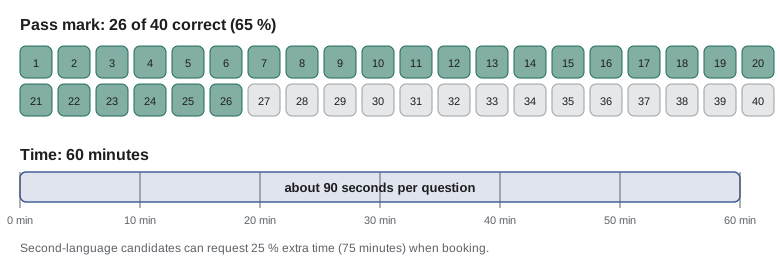
Both Foundation exams use the same simple format. There are 40 multiple-choice questions, each with four options and one correct answer. Each correct answer earns one mark and there is no penalty for a wrong answer, so you should never leave a question blank. You need 26 marks, which is 65 %, to pass. The exam lasts 60 minutes and is closed book: no notes, no second screen, no phone and no web searches.
Candidates who sit the exam in a language that is not their first or working language can usually ask for 25 % extra time, which makes 75 minutes. The extra time has to be requested when you book, not on the day. Candidates who need other accommodations, such as for a disability, should contact the exam provider well before the exam date, because the request needs documentation and time to arrange.
Sixty minutes for forty questions is ninety seconds per question. That sounds tight, but Foundation questions are short, and well-prepared candidates usually finish with ten or fifteen minutes to spare. Lesson 11 builds a timing plan. The bigger risk is not running out of time; it is reading too fast and missing a word such as 'not', 'best' or 'first' that changes the answer. Lesson 2 shows how to read each question slowly enough to catch those words.
The Version 5 syllabus and its weights
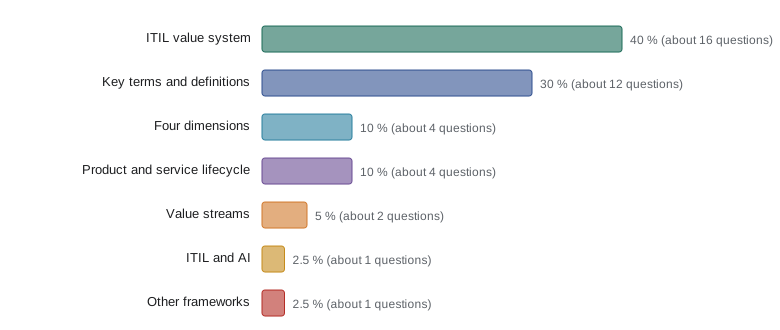
PeopleCert publishes a syllabus for each exam. The Version 5 Foundation syllabus, dated February 2026, divides the content into seven areas and gives each a weight, which tells you roughly how many of the 40 questions to expect. Published summaries of the syllabus give the following breakdown.
| Syllabus area | Weight | About how many questions |
|---|---|---|
| Key ITIL terms and definitions | 30 % | 12 |
| The four dimensions of product and service management | 10 % | 4 |
| The product and service lifecycle | 10 % | 4 |
| The ITIL value system (guiding principles, governance, value chain, practices, continual improvement) | 40 % | 16 |
| Value stream identification, mapping and management | 5 % | 2 |
| ITIL and AI | 2.5 % | 1 |
| ITIL and other frameworks | 2.5 % | 1 |
Two areas dominate. Terms and definitions carry about a third of the exam, and the value system carries another two fifths. Together they are worth about 28 marks, more than the 26 needed to pass. That does not mean you can skip the rest, because nobody answers every question in an area correctly, but it tells you where study time pays off most. A candidate who masters the definitions and the value system and gets half of everything else right will usually pass comfortably.
The weights also tell you what not to over-study. AI and other frameworks are worth about one question each. They deserve a careful read and a few practice questions, not a week of study. Value streams are worth about two questions; you need to know what a value stream is, how it differs from a process and why organizations map them, but not how to run a full mapping workshop.
What the ITIL 4 Foundation exam covers
If you sit the ITIL 4 exam instead, the content is organized differently but overlaps closely. It covers key concepts of service management, the guiding principles, the four dimensions, the service value system, the service value chain, the purpose and key terms of a set of practices, and a smaller set of practices in more detail, such as incident management, problem management, change enablement, service request management, the service desk, service level management and continual improvement. It does not include the product and service lifecycle or the AI and other-frameworks sections.
Because the core is shared, the practice questions in lessons 3 to 9 work for either exam. Where a question depends on Version 5 content, such as the lifecycle activities, the lesson says so. Your study plan should start from the syllabus of the exam you will actually sit. PeopleCert and accredited training organizations make the current syllabus available to candidates, and it is worth reading once at the start and once in the final week.
Levels of understanding: recall and understand
The syllabus does more than list topics. It also says how deeply each topic is tested, using levels from Bloom's taxonomy, a classification of learning objectives that education researchers have used since the 1950s. Foundation tests only the first two levels. Level 1 is recall: can you recognize a definition or a list? Level 2 is understanding: can you explain what a concept means, tell two concepts apart or recognize an example of one? Published summaries of the Version 5 syllabus describe a mix of about 40 % level 1 and 60 % level 2 questions.
This matters for how you study. Foundation does not ask you to design a value stream, write a change policy or calculate availability. It asks whether you know what things are and can recognize them in a short scenario. A question might describe a team that releases small changes and gathers feedback after each one, and ask which guiding principle this shows. You need to understand 'progress iteratively with feedback' well enough to spot it in a sentence, but you do not need to apply it to a real project.
| Level | What it asks | Example question stem |
|---|---|---|
| 1. Recall | Recognize a definition, list or name | Which is a component of the ITIL value system? |
| 2. Understand | Explain, compare, recognize an example | A team asks users for feedback after each small release. Which guiding principle does this show? |
Booking, delivery and results
Candidates usually buy an exam voucher, either on its own or bundled with a training course or eLearning. The voucher is used to book a date and time. Most candidates now sit the exam online from home or work, watched through a webcam by a remote proctor. Others prefer an accredited test centre, which avoids worries about home internet and noise. Either way you need government photo identification whose name matches your booking exactly.
For an online exam, the proctor checks your identification, asks you to show the room and desk through the webcam and stays connected throughout. You must be alone, with a clear desk, no second monitor and no phone within reach. The exam software locks your screen to the exam. If the connection drops, the provider's rules decide whether you can resume, so test your equipment with the provider's system check a few days ahead.
Online candidates usually see a provisional result as soon as they submit. The official result and the digital certificate follow after the provider's checks. If you do not pass, the score report breaks your result down by syllabus area, which shows exactly where to focus before booking again. Some training bundles include a free retake; otherwise a new voucher is needed. Lesson 12 covers what to do in either case.
In Canada, exam fees are usually paid in US dollars or converted at the provider's rate, so the price in Canadian dollars moves with the exchange rate. Many employers, like Larchmont, pay for certification as part of training. If you pay yourself, check whether the fee qualifies for a tax credit or deduction; tuition credits generally apply only to eligible institutions and courses, so keep receipts and confirm with the Canada Revenue Agency's guidance before claiming.
How much study does Foundation need?
Accredited classroom courses for Foundation usually run two or three days, roughly 16 to 21 hours of instruction, followed by the exam. Self-study candidates often spend 20 to 40 hours spread over three to six weeks. Candidates who have finished the earlier courses in this track have already covered the content in far more depth than the exam needs, so their preparation is mainly about exam technique, memorizing the exact wording of definitions and practising with timed questions.
Kofi and Lena both completed ITIL-110 to ITIL-150 over the past year. Kofi knows incident, problem and service desk practice from daily work but finds the value system abstract. Lena understands value streams, DevOps and the product lifecycle well but has never worked in operations. Their plan, which we follow through the course, is four weeks of study at about six hours a week, with a mock exam at the end of weeks two, three and four.
Worked problem
Estimating where a pass comes from
Kofi takes a short diagnostic quiz and estimates his accuracy in each Version 5 area: terms 70 %, four dimensions 75 %, lifecycle 50 %, value system 60 %, value streams 50 %, AI 50 %, other frameworks 50 %. Using the syllabus weights, what score would he expect, and would he pass?
Show solution
- Expected marks per area = questions x accuracy.
- Terms 12 x 0.70 = 8.4; dimensions 4 x 0.75 = 3.0; lifecycle 4 x 0.50 = 2.0; value system 16 x 0.60 = 9.6.
- Value streams 2 x 0.50 = 1.0; AI 1 x 0.50 = 0.5; frameworks 1 x 0.50 = 0.5.
- Total = 8.4 + 3.0 + 2.0 + 9.6 + 1.0 + 0.5 + 0.5 = 25.0.
Answer: About 25 of 40, just under the 26 needed. Raising the value system from 60 % to 75 % alone adds 2.4 marks and gives a likely pass, which is why Kofi starts there.
# Expected Foundation score from estimated accuracy per syllabus area (Version 5 weights)
areas = {
    "Key terms and definitions": (12, 0.70),
    "Four dimensions": (4, 0.75),
    "Product and service lifecycle": (4, 0.50),
    "Value system": (16, 0.60),
    "Value streams": (2, 0.50),
    "ITIL and AI": (1, 0.50),
    "ITIL and other frameworks": (1, 0.50),
}
total = 0
for name, (questions, accuracy) in areas.items():
    marks = questions * accuracy
    total += marks
    print(f"{name:<32}{questions:>3} q  x {accuracy:.0%}  = {marks:4.1f}")
print(f"Expected score: {total:.1f} of 40 (pass mark 26)")
# Which single area gives the biggest gain if accuracy rises by 15 points?
gains = {name: q * 0.15 for name, (q, a) in areas.items() if a + 0.15 <= 1.0}
best = max(gains, key=gains.get)
print(f"Best area to improve by 15 points: {best} (+{gains[best]:.1f} marks)")Key terms and definitions 12 q x 70% = 8.4 Four dimensions 4 q x 75% = 3.0 Product and service lifecycle 4 q x 50% = 2.0 Value system 16 q x 60% = 9.6 Value streams 2 q x 50% = 1.0 ITIL and AI 1 q x 50% = 0.5 ITIL and other frameworks 1 q x 50% = 0.5 Expected score: 25.0 of 40 (pass mark 26) Best area to improve by 15 points: Value system (+2.4 marks)
The code makes the same point as the worked example: because the value system and the definitions carry so many questions, a modest gain there is worth more than mastering a small area. Kofi's and Lena's plans both start with the heavy areas and leave AI and other frameworks for a single evening near the end.
Common mistakes
MistakeBooking the exam without checking which edition it is.
InsteadConfirm whether you are sitting ITIL 4 or Version 5 Foundation and study from that syllabus.
MistakeSpending equal time on every topic.
InsteadUse the syllabus weights: definitions and the value system carry about 70 % of the marks.
MistakeLeaving questions blank when unsure.
InsteadThere is no penalty for wrong answers, so always choose an option.
MistakeAsking for extra language time on the day of the exam.
InsteadRequest the allowance when you book; it cannot be added later.
MistakeStudying to apply concepts in depth.
InsteadFoundation tests recall and understanding; practise recognizing concepts in short scenarios.
Summary and key terms
- ITIL Foundation (Version 5) was released in February 2026 and runs alongside ITIL 4 Foundation during a transition period.
- Both exams have 40 multiple-choice questions, 60 minutes, a 65 % pass mark (26 of 40) and no penalty for wrong answers.
- In the Version 5 syllabus, key terms carry about 30 % and the value system about 40 % of the marks.
- Foundation tests Bloom levels 1 and 2: recall and understanding, not application.
- Exams can be taken online with a remote proctor or at a test centre; extra language time must be requested at booking.
- A study plan should start from the syllabus weights and your estimated accuracy in each area.
- Syllabus
- The published list of exam topics, their weights and the level at which each is tested.
- Pass mark
- The score needed to pass: 26 of 40, or 65 %, for Foundation.
- Remote proctor
- A person who supervises an online exam through the candidate's webcam and screen.
- Bloom level
- A level of learning objective; Foundation tests level 1 (recall) and level 2 (understanding).
- Bridge course
- A shorter route for ITIL 4 Foundation holders to gain the Version 5 Foundation certificate.
Practice problems
Work each problem on paper first, then reveal the answer to check.
How many questions, minutes and correct answers are needed to pass Foundation?
Show answer
40 questions, 60 minutes, 26 correct (65 %).
Which two Version 5 syllabus areas carry the most marks?
Show answer
The ITIL value system (about 40 %) and key terms and definitions (about 30 %).
What is the difference between a level 1 and a level 2 question?
Show answer
Level 1 asks you to recall a definition or list; level 2 asks you to understand, compare or recognize an example.
Why should you never leave a Foundation question blank?
Show answer
There is no penalty for a wrong answer, so a guess can only help.
When must the 25 % extra time for language be requested?
Show answer
At booking, before the exam day.
Kofi expects 60 % accuracy on 16 value system questions. How many marks is that, and how many more would 75 % give?
Show answer
9.6 marks; 75 % gives 12, so 2.4 more.
Lesson quiz · 5 questions
Score 60% or more to complete this lesson.
Create a free account to save your progress, take quizzes and earn a certificate.