
HSE-408 · Lesson 8 of 12 · 21 min
Pre-job briefs, operational learning and other HOP tools
Before the line 3 event, every job at the main plant started with a pre-job hazard assessment card. The card had 26 tick boxes covering hazards from noise to ladders, a space for controls, and two signature lines. Supervisors collected the cards at the end of each shift and filed them. When Elena pulled a month of cards for line 3 changeovers, she found that 41 of the 44 had exactly the same boxes ticked, in what looked like the same pen strokes. Isolation was ticked on every card, including the one from the morning of the event.
Ben said what everyone knew. 'We fill it in because we have to. Nobody reads it. It is the same job every night.' This lesson describes how Harrowgate Foods Ltd. replaced the card with short conversations focused on the steps that matter, and how it added a small set of tools for doing and learning from everyday work.
Critical steps
Most steps in a job can go wrong without serious consequence: a guide set slightly out is caught at the first check, a wrong tool is noticed and swapped. A few steps are different. A critical step is an action that, if done wrong, causes immediate harm that cannot be undone, or starts a chain that cannot be stopped before harm occurs. Isolating the divider before reaching in is a critical step. So is connecting a chemical hose, lifting a die over a hand, or opening a line that may hold pressure.
Tony Muschara and other practitioners from the nuclear industry have argued that the main purpose of human performance tools is to protect critical steps. Spreading attention evenly across every step of a job wastes it. Concentrating attention, checks and design measures on the few steps where an error is irreversible makes the best use of limited effort.
Luis worked with the line 3 crew to identify critical steps in the changeover by asking two questions of each step: could an error here hurt someone immediately, and could it be undone before it did? A step was critical if the answers were yes and no.
# Finding the critical steps in a changeover
steps = [
    ("Stop the line with the changeover stop",     False, True),
    ("Isolate divider and sheeter at disconnects",  True,  False),
    ("Run start test at the divider",               True,  False),
    ("Remove divider guard",                        False, True),
    ("Clear dough with frame scraper",              False, True),
    ("Reach in to clear remaining dough",           True,  False),
    ("Lift sheeter die out",                True,  False),
    ("Fit new die and set guides",                  False, True),
    ("Refit guard and check fastenings",            True,  True),
    ("Remove locks and confirm clear",              True,  False),
    ("Restart and run first product check",         False, True),
]
# (step, error could cause immediate harm, error could be undone before harm)
critical = [s for s, harm, undo in steps if harm and not undo]
print(f"{len(critical)} critical steps out of {len(steps)}:")
for s in critical:
print(" -", s)5 critical steps out of 11: - Isolate divider and sheeter at disconnects - Run start test at the divider - Reach in to clear remaining dough - Lift sheeter die out - Remove locks and confirm clear
Five of eleven summary steps were critical. Refitting the guard was not, because an error there could be caught by the check before restart. The exercise gave the crew a short list of moments at which to slow down, check and, where needed, involve a second person. It also gave the engineers a list of steps where design changes would pay off most.
The pre-job brief
The new pre-job brief replaced the tick-box card with a two- to five-minute conversation at the work location among everyone involved. It was built around critical steps and the precursors from Lesson 3. The DOE handbook offers a mnemonic for such briefs, SAFER, which Harrowgate Foods Ltd. adapted into five questions.
- Summarize the critical steps. Which steps in this job could hurt someone if done wrong?
- Anticipate errors. At each critical step, what mistakes could we make? What is different today, and which precursors are present?
- Foresee consequences. If that mistake happened, what would happen next?
- Evaluate defences. What stops the mistake or limits the harm? Is it in place and working today?
- Review experience. What has gone wrong or nearly gone wrong on this job before, here or elsewhere?
The brief ended with two agreements: what would make the team stop, and who would do what at each critical step. Nothing was written down unless the job was new, rare or changed, in which case the supervisor noted the critical steps and agreed controls on a short form kept with the permit.
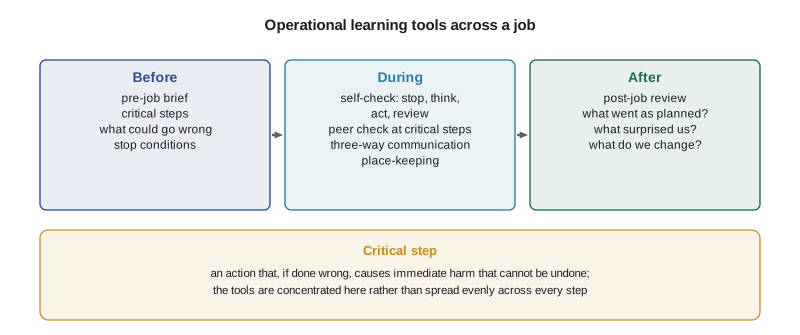
Supervisors were trained to lead briefs as conversations, not lectures. A good brief, in Elena's description, was one in which the crew did most of the talking and the supervisor asked questions. A poor brief was one in which the supervisor read out the hazards and asked whether anyone had questions.
Tools during the work
Several tools from the DOE handbook and from aviation help protect critical steps while the work is being done. Harrowgate Foods Ltd. adopted a small set, trained everyone in them, and asked that they be used at critical steps rather than everywhere.
Self-checking
Self-checking is a deliberate pause before a critical action. The handbook uses the acronym STAR: stop, think, act, review. Stop before the action. Think about what is about to happen and what the expected result is. Act, with attention on the action. Review whether the result matched what was expected. A technician about to lock out the divider stops, reads the disconnect label against the placard and photograph, thinks 'this will isolate the divider, and the test should show no motion', locks it, runs the test and checks the screen.
Peer checking
A peer check is a second person confirming that the right action is about to be taken on the right component, before it is taken. Lesson 5 showed that peer checks add most when they are independent. At Harrowgate Foods Ltd., the peer checker at an isolation step went to the disconnect, read the label and placard independently, and confirmed the test result on the screen, rather than watching the technician do it.
Three-way communication
In noisy plants, misheard instructions are a common source of error. Three-way communication means the sender gives the message, the receiver repeats it back, and the sender confirms it is correct. 'Mei, I am inside the divider. Do not reset the stop.' 'You are inside the divider, do not reset the stop.' 'Correct.' The revised line 3 restart procedure required a three-way exchange before any emergency stop was reset during a changeover.
Place-keeping
Place-keeping means marking each step as it is done, so that an interruption does not lead to a skipped or repeated step. For in-hand procedures, it is a tick or initial against each step. For tasks with a lockout board, the board itself shows which isolation points are locked.
Questioning attitude and stop when unsure
A questioning attitude means noticing when something is not as expected and treating it as a signal to pause. When the beacon flashed, or a test result looked odd, or a label did not match the photograph, the expected response was to stop and find out why. 'Stop when unsure' was the rule that made this practical: nobody would be criticized for stopping a job to check, and supervisors were expected to thank people who did.
Handovers
Shift handovers are a well-known point of failure, because information held by one crew must pass to another. The line 3 event happened in the last hour of a night shift, and part of the time pressure came from the day shift's expectations. The project introduced a short structured handover at each line covering equipment status, jobs in progress, open isolations, anything unusual and anything the incoming crew needed to watch.
Tool fatigue
The risk with tools is that they become rituals. A self-check said aloud at every step, a peer check on every valve, a brief that recites the same hazards every night: all become noise. Harrowgate Foods Ltd. guarded against this in three ways. The tools were required only at critical steps. Supervisors and the joint occupational health and safety committees periodically asked crews whether the tools still felt useful. And any tool that crews said was not helping was reviewed, not enforced harder.
Operational learning
The tools above help people do the work well. Operational learning is about learning from the work as it happens, every day, rather than waiting for an event. The term is widely used in HOP circles for practices that gather what people notice about their work and turn it into small improvements.
The post-job review
A post-job review is a brief conversation at the end of a job, similar to the after-action reviews used by the military and by many emergency services. It asks four questions: what was supposed to happen, what actually happened, why was there a difference, and what should we do differently next time? It takes five minutes. It catches surprises while they are fresh, and it gives the supervisor material to pass on.
On line 3, post-job reviews in the first month produced a steady stream of small findings: a die cart with a sticking wheel, a guide that needed a second person to set, a recurring confusion between two similar product codes on the screen. Each was small. Together they showed where the work was harder than it needed to be, and most were fixed within a week.
What makes work hard
Several supervisors began asking their crews a single question at the start of the week: 'What made your work harder than it needed to be last week?' The answers went on a board at the line, and the supervisor reported back on each one. Mei described it as the first time she felt anyone above her wanted to know.
Learning from success
Operational learning also looks at work that goes well. When a changeover ran smoothly despite a difficult new product, the supervisor asked the crew what had helped, and wrote it down. Over time, these notes showed what conditions supported safe work: pre-staged tools, an experienced technician paired with a newer one, and enough time before restart.
Worked problem
A pre-job brief before a first changeover on a new product
Show solution
- Summarize the critical steps: isolate the divider and sheeter, run the start test, reach in to clear dough, lift the new heavier die, remove locks and confirm clear.
- Anticipate errors: the new die is 6 kg (13 lb) heavier and has a different grip; the relief operator has not done this changeover; the crew is at the end of a night shift.
- Foresee consequences: a dropped die could crush a hand or foot; a reset before the technician is clear could cause an entanglement injury.
- Evaluate defences: the die cart and a second technician for the lift; the start test button and beacon; the three-way exchange before any reset; locks visible on the board.
- Review experience and agree stop conditions: the trial run last week showed the die sticking on its locating pins. If it sticks again, stop and call engineering rather than force it. If not done by 6:15, move the restart.
Answer: The brief took four minutes, named the critical steps and precursors, checked the defences and set clear points at which the crew would stop.
What changed
Six months after the tick-box card was withdrawn, Elena compared the old and new approaches using observation of 40 changeovers and interviews with crews. Briefs happened at 37 of the 40, compared with cards completed at all 44 under the old system, but in 33 of the 37 the crew could name the critical steps when asked afterwards, compared with 9 of 20 crews asked under the old system. Post-job reviews had generated 96 improvement items, of which 71 were closed. And three technicians reported stopping a job because something did not look right, each of which uncovered a real problem.
Common mistakes
MistakeUsing a long tick-box card for every job.
InsteadHold a short conversation focused on critical steps, precursors and defences.
MistakeApplying human performance tools to every step.
InsteadConcentrate them on critical steps, where an error is irreversible.
MistakeHaving the peer checker watch the first person.
InsteadHave the checker confirm the label, placard and test result independently.
MistakeEnforcing tools harder when crews say they are not useful.
InsteadReview the tool and change it if it is not helping.
MistakeLearning only from events.
InsteadUse post-job reviews and weekly questions to learn from everyday work, including success.
Summary and key terms
- A critical step is an action that, if done wrong, causes immediate harm that cannot be undone; tools and design should concentrate on these steps.
- The pre-job brief is a short conversation at the work location covering critical steps, likely errors, consequences, defences and past experience, ending with stop conditions.
- Self-checking, independent peer checking, three-way communication, place-keeping and a questioning attitude protect critical steps during the work.
- Structured handovers reduce errors at shift change.
- Tool fatigue is avoided by using tools only at critical steps and reviewing tools crews say are not helping.
- Operational learning uses post-job reviews, weekly questions about what made work hard, and attention to success to improve everyday work.
- Critical step
- An action that, if done wrong, causes immediate harm that cannot be undone.
- Pre-job brief
- A short conversation before work about critical steps, likely errors, consequences, defences and past experience.
- STAR
- A self-checking sequence: stop, think, act, review.
- Three-way communication
- The sender gives a message, the receiver repeats it, and the sender confirms it.
- Place-keeping
- Marking each step as it is done so that interruptions do not cause skipped or repeated steps.
- Post-job review
- A brief conversation after a job comparing what was planned with what happened, and what to change.
- Operational learning
- Practices for learning from everyday work as it happens, rather than waiting for events.
Practice problems
Work each problem on paper first, then reveal the answer to check.
What two questions did Luis use to identify critical steps?
Show answer
Could an error here hurt someone immediately, and could it be undone before it did? Critical if yes and no.
What do the letters in SAFER stand for?
Show answer
Summarize critical steps, anticipate errors, foresee consequences, evaluate defences, review experience.
Write a three-way exchange for a technician asking an operator not to restart a conveyor.
Show answer
Technician: 'I am inside conveyor 2, do not restart.' Operator: 'You are inside conveyor 2, do not restart.' Technician: 'Correct.'
How did the company avoid tool fatigue?
Show answer
Tools were required only at critical steps, crews were asked whether tools were useful, and unhelpful tools were reviewed rather than enforced harder.
What four questions does a post-job review ask?
Show answer
What was supposed to happen, what actually happened, why the difference, and what to do differently next time.
Lesson quiz · 5 questions
Score 60% or more to complete this lesson.
Create a free account to save your progress, take quizzes and earn a certificate.