
HSE-408 · Lesson 3 of 12 · 21 min
Error traps and precursors
When the line 3 team laid out the conditions behind the event, Tanya Morris noticed something about the timing. The changeover had started at 5:45 a.m., in the last hour of a twelve-hour night shift. Ben had been called to line 3 from another job, which he had left half finished. The new panel had been in service for three weeks. The line was due to restart at 6:30, and the day shift lead had already radioed twice to ask how long it would be. 'Any one of those on its own, fine,' Tanya said. 'All of them at once is a trap.'
She was using the word in the sense the Department of Energy handbook uses it. This lesson explains error precursors and error traps, how to find them before work starts, and how Harrowgate Foods Ltd. used them to decide where to put its effort.
Precursors and traps
An error precursor is a condition that makes an error more likely. It does not cause the error on its own, and most of the time work with precursors present goes well. But each precursor raises the odds, and several together raise them sharply. An error trap is a situation in which precursors combine at a point in the work where an error is easy to make and hard to notice. The term deliberately puts the problem in the situation rather than in the person who falls into it.
The DOE handbook groups precursors into four categories, sometimes remembered by the acronym TWIN: task demands, work environment, individual capabilities and human nature. The categories are a prompt for looking, not a scoring system, and the same condition can sit in more than one.
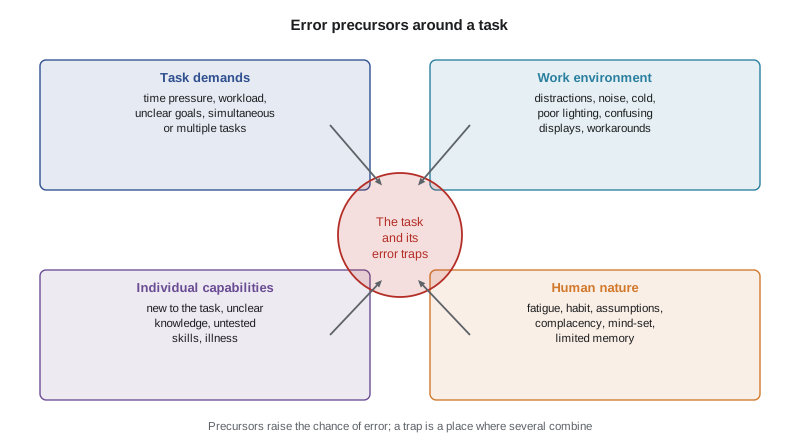
Task demands
Task demands are features of the job itself. Common precursors in this category include:
- Time pressure, real or perceived, including a fixed restart time or a supervisor asking how long the job will take.
- High workload or several tasks at once, which divide attention.
- Repetitive actions that encourage autopilot.
- Irreversible actions, where there is no chance to notice and correct an error.
- Unclear goals, roles or responsibilities, including who is in charge of the line during a changeover.
- Unclear or missing procedures, or procedures that do not match the equipment.
- Interpretation demands, where the worker must work out what an instruction means.
On line 3, the task demands included the 6:30 restart, the radio calls from the day shift lead, the unfinished job Ben had left, and an ambiguity about who controlled the line during changeover: the operator, who ran the checklist, or the technician, who held the lockout.
Work environment
Work environment precursors are features of the place, the equipment and the surroundings. They include:
- Distractions and interruptions, such as radio calls, alarms and people asking questions.
- Changes from the normal arrangement, such as a new panel, a moved control or a temporary layout.
- Confusing displays or controls, including identical boxes, similar labels, and status that cannot be seen.
- Poor lighting, noise, heat or cold, all of which degrade performance.
- Workarounds and out-of-service equipment, which force people off the normal path.
- Hidden system responses, where the effect of an action cannot be seen from where it is taken.
Line 3 had several. The disconnects were identical grey boxes side by side. The panel was new. The emergency stop's latched state showed only as a small light on the operator's screen at the far end of the line, invisible from the divider. Noise from the proofer fans made calling out difficult. And Mei could not see behind the divider from her checklist position.
Individual capabilities
Individual capability precursors concern what the person brings to this task at this time:
- Unfamiliarity with the task or equipment, including the first time on a new panel.
- Gaps in knowledge or skill, or skills that have not been practised recently.
- Unclear understanding of the system, so the person cannot predict how it will respond.
- Illness, injury or medication that affects alertness.
- Language or literacy barriers with written instructions.
Ben had done three changeovers on the new panel, so he was not new to it, but he did not know the labels had been reinstalled. Nobody on the shift knew how the new control system handled a latched emergency stop during a start test, because the upgrade had not changed the procedure and nobody had thought to ask.
Human nature
Human nature precursors are traits everyone shares. They cannot be trained away, so the work has to be designed around them:
- Fatigue and the low point of the body clock, usually between about 2 and 6 a.m.
- Habit, which runs familiar routines in unfamiliar conditions.
- Assumptions and mind-set, seeing what we expect to see.
- Complacency with tasks that have always gone well.
- Limited short-term memory, which drops steps when people are interrupted.
- Overconfidence after many successful repetitions.
- Reluctance to stop the job or question a colleague, especially a senior one.
Ben was near the end of a twelve-hour night shift, in the hours when alertness is lowest. His habit of trusting the label and the start test had been reinforced thousands of times. Mei, in her second year, said later that she would not have thought to question a technician of Ben's experience about whether he was clear of the conveyor.
How precursors combine
Precursors rarely act alone. A new panel on its own is a modest risk; with good labels, a careful check after installation and plenty of time, it causes no trouble. Time pressure on its own is a fact of food manufacturing. The risk comes when several precursors from different categories line up at a step where an error can cause harm. That is why the DOE material encourages looking for precursors as a group, at the specific step, rather than rating a job as high or low risk overall.
Luis wanted a way to make this visible without turning it into a form-filling exercise. He tried a simple scoring approach on four maintenance tasks, counting precursors present at each task's most critical step, and compared the counts with the plant's near-miss reports over the previous two years.
# Counting error precursors at the most critical step of four tasks
tasks = {
    "Line 3 changeover (night)": ["time pressure", "interruptions", "new panel", "identical controls",
                                  "hidden status", "noise", "fatigue", "habit", "unclear control of line"],
    "Line 3 changeover (day)":   ["time pressure", "new panel", "identical controls", "hidden status",
                                  "noise", "habit"],
    "Mixer blade change":        ["heavy part", "awkward reach", "habit"],
    "Freezer door repair":       ["cold", "time pressure", "rare task", "unclear procedure"],
}
near_misses = {"Line 3 changeover (night)": 7, "Line 3 changeover (day)": 3,
               "Mixer blade change": 1, "Freezer door repair": 2}

print(f"{'task':28} {'precursors':>10} {'near misses (2 yr)':>19}")
for name, pre in sorted(tasks.items(), key=lambda kv: -len(kv[1])):
    print(f"{name:28} {len(pre):>10} {near_misses[name]:>19}")

common = set.intersection(*(set(v) for k, v in tasks.items() if k.startswith("Line 3")))
print("shared by both line 3 shifts:", ", ".join(sorted(common)))task precursors near misses (2 yr) Line 3 changeover (night) 9 7 Line 3 changeover (day) 6 3 Freezer door repair 4 2 Mixer blade change 3 1 shared by both line 3 shifts: habit, hidden status, identical controls, new panel, noise, time pressure
The counts were small and the relationship was rough, but it pointed in the expected direction: the night changeover, with the most precursors at its critical step, also had the most near misses. More usefully, the list showed which precursors were permanent features of the equipment, such as the identical disconnects and the hidden status light, and which were features of a particular job, such as fatigue and interruptions. Luis's view was that the permanent ones should be engineered out, while the others had to be managed each time the job was done.
Two ways to deal with traps
That distinction became the core of how Harrowgate Foods Ltd. used precursor thinking.
Remove the trap permanently. Where a precursor is built into the equipment, the layout or the procedure, the best response is to change it. On line 3 the team fitted distinct, engraved labels with the machine name and a photograph to each disconnect, added a large emergency stop status beacon visible from every point on the line, and changed the control logic so that the local start button showed a clear 'emergency stop active' message rather than simply doing nothing. Lesson 5 covers this kind of design change.
Manage the trap on the day. Where a precursor comes and goes, such as fatigue, time pressure or an interruption, the response is to notice it before the critical step and add protection. The pre-job brief covered in Lesson 8 includes a short precursor check: what is different today, what could catch us out, and what will we do about it? If the answer is 'we are tired and rushed and the panel is new', the response might be a peer check at the isolation step, or a call to the day shift lead to move the restart time.
Worked problem
A precursor check before a night changeover
Show solution
- Ask what is different today: a new seasonal product with an unfamiliar die, and the regular operator is on leave.
- Ask which precursors are present at the critical steps: unfamiliar task for the relief operator, time pressure from the 6:30 restart, fatigue at the end of a night shift, and noise.
- Ask where a mistake would hurt: isolating the divider and the sheeter before reaching in, and the die change, where a dropped die could crush a hand.
- Agree the protection: the technician and the operator will both check the isolation at the disconnect and at the machine, the operator will not reset the emergency stop until the technician confirms clear by radio, and a second technician will help with the die.
- Agree the stop condition: if the changeover is not complete by 6:15, the lead will call the day shift and move the restart rather than rush the final steps.
Answer: The check took about two minutes and named the precursors, the critical steps, the protection and a point at which the team would stop rather than rush.
Finding traps before they catch someone
Precursors and traps are easiest to find by asking the people who do the work. Harrowgate Foods Ltd. used several methods.
- Walk-throughs with the crew, at the equipment, asking at each step: where could you get caught out here, and what would happen if you did?
- Near-miss and minor event reviews, grouped by task and step, looking for precursors that recur.
- Changes and new equipment, which always introduce new precursors, reviewed through the management of change process covered in HSE-401 Lesson 10.
- Learning teams on tasks that people describe as tricky, covered in Lesson 7.
- Operator and technician 'trap reports', a simple card on which anyone can note a place where a mistake would be easy.
The trap report card was Sam Pellerin's idea, brought from the Dartmouth distribution centre, where drivers had started using it to flag blind spots. In its first three months at the main plant it produced 64 reports. Thirty-one were fixed within a month, most by small changes: a label, a mirror, a light, a changed sequence. The most common precursors reported were similar-looking controls, interruptions at critical steps and status that could not be seen from where the action was taken.
Latent organizational weaknesses
Some precursors trace back further, to decisions made far from the work. The swapped labels on line 3 were produced by a contractor, but the condition that let them stay wrong for three weeks was organizational: the panel upgrade had gone through management of change as an electrical project, and the checklist for electrical projects did not include verifying lockout labels against drawings. The DOE material calls such conditions latent organizational weaknesses, echoing Reason's latent conditions.
Kevin Doucette in purchasing and the engineering manager added a step to the contractor handover for any work on panels or isolation points: the contractor and a Harrowgate Foods Ltd. technician check every lockout label against the drawings together, and the technician signs the check. The same step was added to the management of change checklist. That fix applied to every future panel job at all three sites, which was far more than retraining Ben could ever have achieved.
Common mistakes
MistakeRating a whole job as high or low risk.
InsteadLook for precursors at the specific steps where an error could cause harm.
MistakeTreating precursors as faults in the worker.
InsteadTreat them as features of the situation that make anyone more likely to err.
MistakeManaging permanent traps through daily vigilance.
InsteadEngineer out precursors built into equipment and layout; manage the variable ones on the day.
MistakeTurning precursor checks into long forms.
InsteadKeep the check short and spoken: what is different, what could catch us out, what will we do.
MistakeStopping at the contractor's slip.
InsteadAsk what organizational weakness let the error stay hidden, and fix it for all future work.
Summary and key terms
- An error precursor is a condition that makes error more likely; an error trap is a point in the work where several precursors combine and an error is easy to make and hard to notice.
- The DOE handbook groups precursors as task demands, work environment, individual capabilities and human nature.
- Precursors combine, so they should be looked for at the specific critical step rather than across a whole job.
- Permanent precursors built into equipment and procedures should be designed out; variable ones such as fatigue and time pressure should be managed on the day.
- Traps are best found by asking the crew, reviewing near misses by step, examining changes and inviting trap reports.
- Latent organizational weaknesses, such as a missing step in management of change, let traps persist and are fixed once for all future work.
- Error precursor
- A condition that raises the likelihood of error without causing it on its own.
- Error trap
- A situation where precursors combine at a point where an error is easy to make and hard to notice.
- TWIN
- A memory aid for the four precursor categories: task demands, work environment, individual capabilities and human nature.
- Latent organizational weakness
- A gap in processes or decisions far from the work that allows precursors and errors to persist.
- Trap report
- A simple card or entry on which anyone can flag a place where a mistake would be easy.
Practice problems
Work each problem on paper first, then reveal the answer to check.
What is the difference between an error precursor and an error trap?
Show answer
A precursor raises the chance of error; a trap is a point where several precursors combine and an error is easy to make and hard to notice.
Name the four TWIN categories.
Show answer
Task demands, work environment, individual capabilities and human nature.
Give two work environment precursors present on line 3.
Show answer
Identical disconnects side by side, and an emergency stop status that could not be seen from the divider; also noise and a new panel.
Why did Luis separate permanent and variable precursors?
Show answer
Permanent ones can be engineered out once; variable ones such as fatigue must be managed each time the job is done.
What organizational weakness let the swapped labels persist?
Show answer
The management of change checklist for electrical projects did not include checking lockout labels against drawings.
Lesson quiz · 5 questions
Score 60% or more to complete this lesson.
Create a free account to save your progress, take quizzes and earn a certificate.