
HSE-408 · Lesson 12 of 12 · 23 min
Leading, measuring and implementing HOP: a capstone for Harrowgate
Two years after the line 3 event, Margaret Doyle asked Rachel Okoye to report to the board's safety and operations committee on what the HOP project had achieved and what it had not. Rachel asked Elena, Luis, Tanya, Sam and Grace to help her prepare. 'Not a celebration,' she said. 'An honest account. What changed, what did not, and what we would do differently.'
This final lesson draws on that account. It covers the leadership practices that HOP depends on, how Harrowgate Foods Ltd. measured whether HOP was working, and how it implemented the approach across three very different sites. It ends with a capstone: an event at the Dartmouth distribution centre in the project's second year, worked through using everything in this course.
What HOP asks of leaders
HOP is often described as a way of leading as much as a way of managing safety. Several leadership practices recurred in the Harrowgate Foods Ltd. experience.
- Ask more than tell. Edgar Schein's idea of humble inquiry, asking questions to which you do not already know the answer, out of genuine interest, was the model. 'What makes this job hard?' and 'What do you need?' replaced 'Are you following the procedure?'
- Go and see work as done. Leaders spent regular, scheduled time at the work, watching to learn rather than to catch, as Lesson 4 described.
- Respond well to bad news. The first words from Lesson 11 applied to leaders at every level. A leader who reacts badly to one report can undo months of trust.
- Remove obstacles. The most visible proof that leaders were listening was that problems raised by crews were fixed, and that people were told what had been done.
- Protect capacity. Leaders decided whether to add the second night technician, whether to keep six people on sanitation crews, and whether to move a restart time. Lesson 10 showed why those decisions mattered.
- Hold the line on critical controls. HOP is not permissive about the controls that prevent death. Leaders made clear that critical controls were not negotiable, while being open about everything else.
Middle managers were the hardest group to bring along. Supervisors and plant managers sat between executives asking for learning and production targets that had not changed. Some heard HOP as another demand on their time, and some heard it as criticism of how they had always managed. The project made progress only after it gave them something: a coach at each site, time released from paperwork that HOP made unnecessary, such as the old pre-job cards, and a seat in deciding which learning teams to run.
Marcus Bell's own change was one of the stories Rachel told the board. In the first year, he had defended the 25-minute changeover target. By the second, he had stopped reviewing changeover times at the morning meeting altogether and replaced the item with one question for each line lead: 'What got in your way yesterday?'
Measuring whether HOP is working
HSE-407 built a measurement framework around serious hazards and critical controls. The HOP project added to it, following the same rules: measure what matters, define it carefully, pair indicators that could be gamed, and act on thresholds rather than chase targets. The project avoided counting HOP activities for their own sake. The number of learning teams held, on its own, would have encouraged shallow sessions.
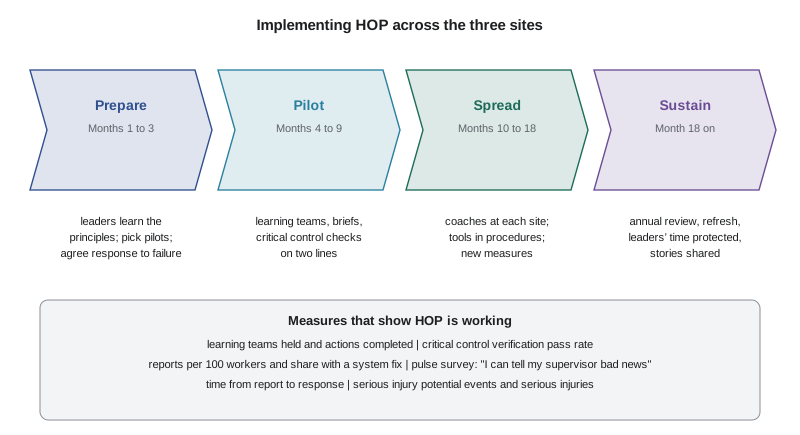
The measures fell into four groups.
- Learning: learning teams held on tasks with critical steps; share of actions completed on time; share of actions that changed the work rather than relying on training or reminders.
- Reporting and response: reports per 100 workers, paired with the share of reports that led to a change in the work; median days from report to first response; share of reports that named a condition rather than only a person.
- Critical controls and capacity: critical control verification pass rates and failed verifications found and fixed; capacity indicators from Lesson 10.
- Culture: pulse survey items such as 'I can tell my supervisor bad news without getting into trouble' and 'When I raise a problem, something is done about it', reported with the margins of error described in HSE-407.
Outcome measures remained, including recordable injuries, SIF-potential events and serious injuries, but the board was reminded each quarter of HSE-407's warning that two years of injury data at a company of Harrowgate Foods Ltd.'s size could not prove or disprove that HOP worked.
Nina produced the two-year summary for the board.
# Two-year summary of selected indicators, all sites
rows = [
    ("Reports per 100 workers per year",               48,   86),
    ("Share of reports leading to a work change (%)",  22,   47),
    ("Median days from report to first response",      19,    6),
    ("Learning team actions that changed the work (%)", None, 64),
    ("Lockout verification pass rate (%)",             81,   97),
    ("Failed critical control checks found and fixed", 38,  112),
    ("Critical roles with one trained person",         27,    9),
    ("Pulse: can tell supervisor bad news (% agree)",  54,   73),
    ("SIF-potential events reported",                  61,   94),
    ("Serious injuries (SIF)",                          2,    0),
]
print(f"{'indicator':50} {'baseline':>9} {'year 2':>7}")
for name, before, after in rows:
    b = "-" if before is None else before
print(f"{name:50} {b:>9} {after:>7}")indicator baseline year 2 Reports per 100 workers per year 48 86 Share of reports leading to a work change (%) 22 47 Median days from report to first response 19 6 Learning team actions that changed the work (%) - 64 Lockout verification pass rate (%) 81 97 Failed critical control checks found and fixed 38 112 Critical roles with one trained person 27 9 Pulse: can tell supervisor bad news (% agree) 54 73 SIF-potential events reported 61 94 Serious injuries (SIF) 2 0
Rachel explained to the board that several numbers had risen on purpose. More reports, more failed verifications found and more SIF-potential events reported were signs that people were seeing and saying more, not that the work had become more dangerous. The fall in median response time from 19 days to 6 was, in her view, the single best measure of whether leaders were listening. Two years without a serious injury was welcome but, as HSE-407 had shown, not yet statistically meaningful on its own.
Implementing across three sites
The three sites differed in size, workforce and history, and the project learned that HOP had to be implemented with each, not delivered to each.
| Site | Starting point | What worked | What was hard |
|---|---|---|---|
| Truro main plant | About 420 workers; strong maintenance craft; history of discipline after events | Line 3 story; learning teams on changeovers; lockout placards | Middle managers squeezed by targets; procedure library size |
| Dartmouth distribution centre | About 110 workers; many agency and seasonal workers; aisle 14 strike history | Trap reports; pre-mortem before peak; driver-led learning teams | High turnover meant constant retraining of tools; agency firms not involved at first |
| Kentville sauces plant | About 60 workers; small, close-knit; one supervisor | Keyed couplings; fast fixes; everyone in learning teams | Too few people to release for sessions; facilitator had to come from Truro |
The roadmap had four phases. In the preparation phase, the executive team and site leaders learned the principles, agreed in writing how the company would respond to failure, and chose two pilot areas: line 3 and the distribution centre's freezer operations. In the pilot phase, the pilots used learning teams, the new pre-job brief, critical control verification and post-job reviews, with coaching. In the spread phase, trained coaches at each site took the practices to other areas, procedures were rewritten to include critical steps, and the new measures were added to reports. The sustain phase, which began at about eighteen months, included an annual review of the approach, refresher sessions, protected time for leaders at the work, and regular sharing of stories at all three sites.
Several lessons from implementation were worth recording for other companies.
- Start with a real story. The line 3 event did more to persuade people than any training session.
- Change the response to failure early. Withdrawing Ben's warning, and saying so publicly, was the moment people began to believe.
- Fix things fast. Small, quick fixes from early learning teams built trust that larger changes needed.
- Involve the agencies and contractors. At the distribution centre, HOP stalled with agency workers until the agency supervisors were trained alongside Harrowgate Foods Ltd. supervisors.
- Embed in the existing system. HOP practices were written into the occupational health and safety program, the investigation procedure, management of change and procedure control, so they would outlast the people who introduced them.
- Expect setbacks. One plant manager reverted to discipline after a costly product loss, and the project had to rebuild trust in that area.
Capstone: an early departure at the docks
In the project's second year, at 11:40 p.m. on a Friday in November, a trailer at dock door 9 of the Dartmouth distribution centre pulled away while an agency forklift driver, Kwame Asante, was reversing out of it with a loaded pallet. The trailer moved about 1 m (3 ft) before the driver stopped. The forklift's rear wheels dropped off the edge of the dock plate, and the truck tipped backward against the dock frame. Kwame was wearing his seat belt and was shaken but unhurt. The event had clear SIF potential: forklift tip-overs and falls from docks are among the most common causes of forklift deaths.
Grace, Sam and Elena led the response. The steps below show how the course's ideas were applied.
Worked problem
Working the dock 9 event through the course
Show solution
- Respond first (Lesson 11): the supervisor used the first words; Kwame and the truck driver were checked by first aid; a peer supporter called Kwame the next morning; the truck driver's carrier was contacted to offer him support too. Nobody was suspended or blamed while the event was understood.
- Error is normal (Lesson 2): the truck driver had received a 'door 9 released' message on the yard system. The dispatcher had meant door 8, and had selected the wrong door on a dense screen near the end of a long shift, a skill-based slip. The truck driver acted correctly on what he was told.
- Precursors and traps (Lesson 3): peak volume, a night shift, a dispatcher covering two roles, adjacent doors with similar trailers, and a screen with small door buttons in a single row.
- Context and drift (Lesson 4): the vehicle restraint at door 9 had been out of service for nine days, 'parts on order'. The written fallback was wheel chocks and keeping the truck keys at the dock desk. Work as done had drifted to chocks only, because collecting keys from drivers delayed departures in the peak and drivers objected.
- Design for error (Lesson 5): the team proposed that the yard system require a dock-side confirmation, from the forklift driver's side of the door, before any release, and that the dock door, restraint and release message be interlocked so that a release could not be sent while the restraint showed engaged or the door was open.
- Procedures (Lesson 6): the fallback procedure for an out-of-service restraint was rewritten with drivers and dock staff, replacing key collection with a lockable glad-hand cover on the trailer's air line, which stops the trailer brakes from releasing, and setting a 48-hour limit for restraint repairs before the door is closed.
- Learning team (Lesson 7): drivers, dispatchers, dock staff and two carrier drivers met twice. They revealed that release messages went to the wrong door about once a week, usually caught by a driver who noticed, and that agency drivers had not been told which doors had out-of-service restraints.
- Pre-job brief and handover (Lesson 8): out-of-service critical controls were added to the shift handover and to the start-of-shift brief, with the affected doors marked on the dock board.
- Critical controls (Lesson 9): the restraint was already a critical control, but its verification checked engagement only on working doors. The performance standard was revised to include repair time limits and the fallback control, and failed verifications were reported daily during the peak.
- Capacity (Lesson 10): the dispatcher covering two roles was a capacity problem in the peak. A second dispatcher was added for the busiest hours, and the yard schedule was spread to reduce departures between 11 p.m. and 1 a.m.
- Leadership and measurement (Lesson 12): the event and its fixes were reported to the executive team and the board as a SIF-potential event, with the days a critical control was out of service added as an indicator for all sites.
Answer: Every part of the course pointed to changes in the work rather than in the people. The two individuals whose actions were part of the event were cared for, and both took part in the learning team. The fixes addressed a weekly wrong-door problem nobody had reported, a drifted fallback procedure and a capacity gap, any of which could have killed someone.
The dock 9 event was the subject of the last story Rachel told the board. She noted that it had happened two years into the project, at the site with the most experience of learning teams, and that some would see it as evidence that HOP had failed. Her view was the opposite. The event was reported within minutes. Nobody tried to hide the out-of-service restraint or the wrong-door messages. The people involved were cared for and spoke freely. And within six weeks, conditions that had existed for years had been fixed at every dock in the company. 'Error is normal,' she said. 'This is what it looks like when the system learns from it.'
Looking back over the course
HSE-408 has followed Harrowgate Foods Ltd. from a near miss on a bakery line to a company-wide way of working. The ideas are not complicated: people make mistakes, context shapes what they do, blame fixes nothing, learning is vital, and the response to failure matters. What is difficult is acting on them consistently, especially under pressure, when the old habits of finding someone to fix are quicker and more familiar.
The practices in this course give those ideas a concrete form. Understanding performance modes, precursors and drift explains why errors happen. Error-tolerant design, usable procedures and critical controls make the work able to fail safely. Learning teams, pre-job briefs and operational learning show how work is really done. Capacity gives the margin to absorb surprises. A restorative response keeps people talking. And leaders who ask, listen, measure what matters and protect capacity keep the whole system moving.
Common mistakes
MistakeTreating HOP implementation as a training rollout.
InsteadImplement with each site, change the response to failure early, fix things fast and embed practices in the management system.
MistakeLeaving middle managers out until the end.
InsteadGive them coaching, time and a role in choosing what to work on.
MistakeMeasuring HOP by activity counts.
InsteadMeasure learning, response, critical control health, capacity and culture, with paired indicators.
MistakeReading rising reports and failed verifications as getting worse.
InsteadExplain that more seeing and saying is the intended effect, and watch quality alongside volume.
MistakeTreating a new event as proof that HOP failed.
InsteadJudge the response: how fast it was reported, how people were treated and how widely conditions were fixed.
Summary and key terms
- HOP depends on leaders who ask more than they tell, go and see work as done, respond well to bad news, remove obstacles, protect capacity and hold firm on critical controls.
- Middle managers need coaching, time and a role if HOP is to take hold.
- Measures of learning, reporting and response, critical control health, capacity and culture show whether HOP is working better than activity counts or short-run injury rates.
- Implementation across sites follows phases of preparation, pilots, spread and sustaining, adapted to each site's size, workforce and history.
- Early changes to the response to failure, fast fixes and embedding practices in the management system make HOP last.
- The dock 9 capstone shows how the principles and tools of the course combine to fix conditions rather than people.
- Humble inquiry
- Edgar Schein's term for asking questions to which one does not already know the answer, out of genuine interest.
- Pilot
- A limited first application of new practices in chosen areas before spreading them.
- Glad-hand lock
- A lockable cover on a trailer's air brake coupling that prevents the brakes from being released.
- Vehicle restraint
- A dock device that engages a trailer's rear impact guard to stop it moving away from the dock.
- Sustain phase
- The stage of implementation focused on keeping practices alive after the initial project.
Practice problems
Work each problem on paper first, then reveal the answer to check.
What did Marcus replace the changeover time review with at the morning meeting?
Show answer
The question 'What got in your way yesterday?' for each line lead.
Why did Rachel describe the rise in reports and failed verifications as good news?
Show answer
They showed people were seeing and saying more, not that work was more dangerous.
What stalled HOP with agency workers at the distribution centre, and what fixed it?
Show answer
Agency supervisors were not involved; training them alongside company supervisors fixed it.
In the dock 9 event, what kind of error did the dispatcher make?
Show answer
A skill-based slip, selecting the wrong door on a dense screen near the end of a long shift.
How had the fallback procedure for an out-of-service restraint drifted?
Show answer
From wheel chocks plus keys held at the dock desk to chocks only, because collecting keys delayed departures.
Lesson quiz · 5 questions
Score 60% or more to complete this lesson.
Create a free account to save your progress, take quizzes and earn a certificate.