
HSE-408 · Lesson 11 of 12 · 23 min
Responding to failure: restorative just culture and second victims
Ben did not sleep the night after the line 3 event. He kept feeling the belt pull at his glove. He told his wife he had nearly lost his arm, and then that he was fine. When he came in the next evening, he heard that a written warning had been drafted, and that the incident report described him as having 'failed to verify zero energy'. He went to his locker and sat there for twenty minutes before starting work. 'Nineteen years,' he told Tanya Morris later. 'I teach this. And now everyone thinks I am the guy who almost killed himself.'
Mei Chen had her own version of the same night. She had reset the emergency stop. In her mind, she had nearly killed a colleague she liked and respected. She told nobody for a week, and then asked her supervisor whether she could move to another line.
This lesson is about what happens after something goes wrong: the response of the organization to the people involved, and what that response teaches everyone else. It builds on the just culture approach introduced in HSE-401 Lesson 6 and goes further, into restorative practice and the care of people who are hurt by their own part in an event.
Why the response matters
The fifth HOP principle says that how leaders respond to failure matters. It matters for three reasons.
- It decides what the organization learns. If the response is blame, people stop reporting, and the organization learns only about the events it cannot hide.
- It affects the people involved. A harsh or careless response can harm people who are already suffering, and can drive skilled people out of the company.
- Everyone is watching. The response to one event is the clearest signal leaders send about what they really value. People remember it for years.
Rachel Okoye put it bluntly to the supervisors: 'The written warning would have been read by every technician in this company. The lesson they would have taken is: if you have a near miss, keep quiet. We would never have heard about the second panel.'
From just culture to restorative just culture
HSE-401 Lesson 6 described just culture as it is usually practised: a framework, drawing on Reason and on David Marx, for separating human error, at-risk behaviour and reckless behaviour, and responding to each differently. Human error is consoled, at-risk behaviour is coached, and reckless behaviour may be sanctioned. A culpability decision tree helps managers decide which category applies.
That approach is a large improvement on blaming whoever was closest. But Dekker and others have pointed to its limits. It still focuses on judging the person after the event. It depends on someone, usually a manager, deciding where the line between categories falls, and that judgement is vulnerable to hindsight and outcome bias. And it asks mainly what the person deserves, rather than what the people affected need and how the organization can repair harm and learn.
Restorative just culture, a term associated with Dekker, borrows from restorative justice. It changes the central questions.
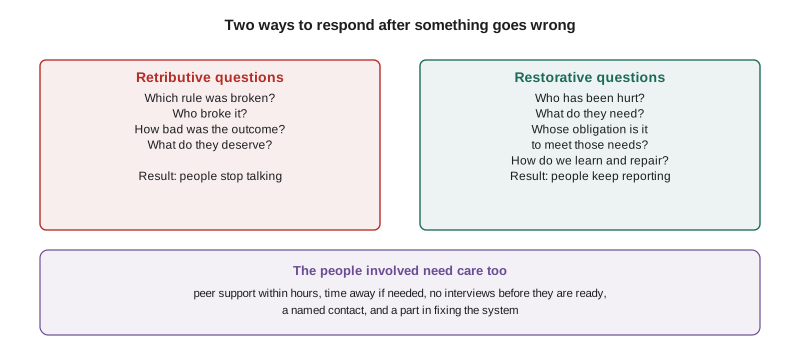
The restorative questions widen the view. 'Who has been hurt?' includes the injured worker, but also the colleague who reset the stop, the supervisor whose report is being questioned, the families, and sometimes the organization's trust in its own systems. 'What do they need?' might be medical care, time, information, an apology, reassurance, or a part in making sure it does not happen again. 'Whose obligation is it?' often points to the organization itself, which designed the work, as much as to any individual.
The approach has been tried most widely in health care. Mersey Care NHS Foundation Trust in England, one of the best-known adopters, has reported that suspensions fell by about 95 % and disciplinary investigations by about 85 % compared with 2014, while reports of adverse events and staff willingness to raise concerns rose. Results like these come from one organization's own reporting and cannot simply be transferred, but they show that a restorative approach can change how an organization handles failure at scale.
Accountability that looks forward
A common worry about restorative approaches is that they let people off the hook. Dekker's answer is that they change the meaning of accountability rather than remove it. Backward-looking accountability asks people to pay for what happened. Forward-looking accountability asks people to give an account of what happened, to take part in understanding it, and to help fix it. HSE-401 Lesson 6 introduced the distinction; restorative practice puts it at the centre.
Ben was accountable in the forward-looking sense. He gave a full account of the event, took part in the learning team, helped redesign the start test, and, in time, rewrote the section of the lockout course on zero-energy verification. That was more demanding than signing a written warning, and far more useful.
How Harrowgate Foods Ltd. responded to the line 3 event
The first response, the drafted written warning, was withdrawn. Elena and Rachel then set out what a restorative response would look like, and the plant followed it.
- Care first. Ben was offered time off with pay, which he declined, and a confidential conversation with the employee assistance program, which he accepted. Mei was offered the same.
- Talk in person. Rachel met Ben and Mei separately within two days. She told each of them that the company did not blame them, that the event had revealed problems in the work that were the company's to fix, and that she was sorry they had been put in that position.
- No interviews before they were ready. The learning team waited until both said they wanted to take part.
- A named contact. Tanya acted as a peer contact for both, checking in regularly for the first month.
- Correct the record. The original report was replaced, and the supervisor who had written it was included in the review rather than criticized for it. He had followed the form and the practice he had been taught.
- Share the story. With Ben's agreement, Rachel told the story at the next all-hands meeting at each site, including the withdrawn warning, and thanked Ben for his part in the review.
- Close the loop. Ben and Mei were told about every change made to line 3 as it happened.
Six weeks after the event, Mei withdrew her request to change lines. Ben went back to teaching the lockout course in the spring, with a new section built around his own story.
Second victims
In 2000, Albert Wu, a physician and researcher, published an editorial in the BMJ titled 'Medical error: the second victim'. He described how doctors and nurses involved in errors that harmed patients often suffer guilt, shame, fear and isolation, with little support from their organizations. The term second victim spread widely in health care and beyond.
The term has also been criticized, especially by patient advocates, who argue that calling clinicians victims can seem to put them on the same footing as the patients and families harmed, and can blur responsibility. Some organizations now prefer phrases such as 'people involved' or 'second victim experience'. This course uses the original term where it describes the phenomenon, while recognizing the concern. In workplace safety, the point is simpler: the person whose action was part of an event, whether or not they were themselves injured, is often hurt by it.
Common reactions reported by people in this position include:
- Intrusive memories of the event, and difficulty sleeping.
- Guilt and shame, often far out of proportion to their actual role.
- Anxiety about returning to the task, and loss of confidence in their own skill.
- Fear of discipline, legal consequences or colleagues' judgement.
- Isolation, feeling unable to talk about it.
- Thoughts of leaving the job or the profession.
Research in health care, including work on recovery stages after adverse events, suggests that many people recover well with timely support, while others carry the effects for years or leave. The quality of the organization's response in the first days appears to matter a great deal.
Peer support
Many hospitals have set up peer support programs in which trained colleagues reach out to people involved in serious events, usually within a day, to listen and offer help. Harrowgate Foods Ltd. adapted the idea. It trained eight peer supporters across the three sites in the first year, including Tanya and Sam, using a short course on listening, recognizing when someone needs professional help, and confidentiality. After any event with SIF potential, and after any serious injury, a peer supporter contacted the people involved within 24 hours, separate from any investigation.
The peer supporters did not investigate, counsel or advise. They listened, explained what would happen next, made sure people knew about the employee assistance program and checked in again over the following weeks. Peer support conversations were confidential, except where someone's safety was at risk.
When conduct is reckless
Restorative practice does not mean that nothing is ever sanctioned. A small number of actions involve a conscious disregard of a substantial and unjustifiable risk, and Harrowgate Foods Ltd. kept discipline as a response to those. What changed was how the company reached that conclusion and what else it did.
In the second year, a forklift driver at the distribution centre was found to have repeatedly disabled the seat belt interlock on his truck with a wire clip and driven at speed through pedestrian aisles, after two conversations with his supervisor and despite the site's critical controls for separation. The review followed the restorative questions. Who had been hurt or put at risk? The pickers in those aisles. What did they need? Assurance that it would stop. It also asked what made the bypass possible: the clips were easy to make, and three other trucks had them. The driver was disciplined. The company also fitted tamper-resistant interlocks, checked every truck, and asked the drivers why the clips existed, which revealed that the interlock had been triggering falsely on rough floor sections, a problem that was then fixed.
The case showed that restorative and accountable responses can coexist. It also showed that even in a case of reckless conduct, the system had a part that needed fixing.
Did it change reporting?
HSE-407 Lesson 3 described reporting health measures. Nina tracked near-miss and hazard reports at the main plant before and after the response to the line 3 event became widely known, to see whether people were more willing to report.
# Did reporting change after the response to the line 3 event? (main plant)
from math import comb

before_months, before_reports = 12, 372     # year before the event
after_months, after_reports = 12, 611       # year after
print(f"before: {before_reports / before_months:.1f} reports per month")
print(f"after:  {after_reports / after_months:.1f} reports per month")

# If the true rate were unchanged, each report would be equally likely to fall in either year.
n = before_reports + after_reports
k = after_reports
p_value = sum(comb(n, i) for i in range(k, n + 1)) / 2 ** n
print(f"chance of {k} or more of {n} reports in the second year if nothing changed: {p_value:.1e}")

# share of reports that named a condition rather than only a person
print(f"reports naming a condition: before {118 / 372:.0%}, after {402 / 611:.0%}")before: 31.0 reports per month after: 50.9 reports per month chance of 611 or more of 983 reports in the second year if nothing changed: 1.2e-14 reports naming a condition: before 32%, after 66%
Reports rose from about 31 to 51 a month, a change far too large to be chance. The share of reports that described a condition, such as a hard-to-read label or a blocked walkway, rather than only naming a person's mistake, more than doubled. Nina was careful to note that other changes, such as the trap report cards and post-job reviews, also contributed. But supervisors at the plant said the story of Ben's withdrawn warning was the thing people mentioned most when explaining why they now reported.
The first words
Elena trained every supervisor in what she called the first words: what to say when someone tells you something has gone wrong. The script was short. 'Are you OK? Thank you for telling me. Let us make it safe. What happened? What do you need?' It deliberately left out 'why did you', 'you should have' and 'who else knew'. Those questions might come later, framed as questions about the work. The first words set the tone for everything that followed.
Worked problem
A restorative response to a chemical splash at the sauces plant
Show solution
- Event: an operator at Kentville received a minor splash of diluted cleaner on the forearm while disconnecting a hose, despite wearing the required gloves.
- Care first: the supervisor used the first words, made sure the eyewash and shower were used, arranged medical assessment, and called a peer supporter, who contacted the operator that afternoon.
- Who was hurt and what do they need: the operator needed treatment and reassurance; a newer colleague who had connected the hose earlier felt responsible and needed to hear that she was not blamed.
- Whose obligation: the review found that the hose coupling released residual pressure when disconnected, a design issue the company had to fix.
- Learn and repair: a bleed valve was fitted upstream of every coupling, both operators helped test it, and the story was shared at the site meeting with their agreement.
Answer: The response cared for both people involved, found the design issue and fixed it, and kept the newer operator from carrying unjustified guilt.
Common mistakes
MistakeDrafting discipline before understanding the event.
InsteadCare for the people involved first, then understand the work, and decide on any sanction only for reckless conduct.
MistakeAsking only what the person deserves.
InsteadAsk who has been hurt, what they need, whose obligation it is to meet those needs, and how to learn and repair.
MistakeAssuming people who were not injured are fine.
InsteadRecognize second victim reactions and offer timely peer and professional support.
MistakeInterviewing people before they are ready.
InsteadGive time, offer a peer contact and involve them when they want to take part.
MistakeStopping at discipline when conduct is reckless.
InsteadAlso ask what in the system made the conduct possible, and fix it.
Summary and key terms
- The response to failure decides what the organization learns, affects the people involved and signals to everyone what leaders value.
- Just culture separates error, at-risk and reckless behaviour; restorative just culture changes the questions to who was hurt, what they need and whose obligation it is to meet those needs.
- Forward-looking accountability asks people to give an account and help fix the system, rather than to pay for the past.
- People involved in events, injured or not, often suffer second victim reactions such as guilt, intrusive memories and loss of confidence.
- Timely peer support, care, a named contact and involvement in fixing the system help people recover.
- Reckless conduct can still be sanctioned, but the system's part should still be found and fixed.
- Restorative just culture
- An approach to responding to failure that asks who was hurt, what they need and whose obligation it is to meet those needs, with a focus on repair and learning.
- Forward-looking accountability
- Accountability expressed by giving an account and helping prevent recurrence, rather than paying for the past.
- Second victim
- A person who is harmed emotionally by their involvement in an event, a term from health care that some now replace with people involved.
- Peer support
- Contact by a trained colleague soon after an event to listen and help, separate from any investigation.
- First words
- The opening response a leader gives when told something has gone wrong.
Practice problems
Work each problem on paper first, then reveal the answer to check.
Give the four restorative questions used at the company.
Show answer
Who has been hurt? What do they need? Whose obligation is it to meet those needs? How do we learn and repair?
Why has the term second victim been criticized?
Show answer
Patient advocates argue it can seem to equate clinicians with those harmed and blur responsibility.
Name three reactions people involved in events commonly experience.
Show answer
Intrusive memories and poor sleep, guilt and shame, anxiety and loss of confidence, fear, isolation, thoughts of leaving.
What did the company also fix in the reckless forklift case?
Show answer
It fitted tamper-resistant interlocks, checked every truck, and fixed false interlock triggering on rough floor sections.
What are the first words supervisors were trained to use?
Show answer
Are you OK? Thank you for telling me. Let us make it safe. What happened? What do you need?
Lesson quiz · 5 questions
Score 60% or more to complete this lesson.
Create a free account to save your progress, take quizzes and earn a certificate.