
HSE-404 · Lesson 9 of 12 · 20 min
Procurement, contractors and emergency preparedness
In the spring of the system's first year, a roofing contractor arrived at the sauces plant in Kentville to replace a section of roof over the mixing room. The purchasing clerk had chosen the lowest of three quotes. Nobody at the plant had seen the contractor's safety program, asked about fall protection, or told the crew that the roof had fragile skylights and an exhaust stack venting hot, moist air from the cookers. Luis Ortega, walking past at 10 a.m., saw two roofers working near an unprotected skylight without harnesses. He stopped the work. Nobody was hurt, but the near miss went straight onto the agenda of the next management review.
This lesson covers three parts of operational control that extend beyond the organization's own employees and everyday work: procurement, contractors and emergency preparedness.
Procurement
Procurement means acquiring products and services: equipment, chemicals, materials, tools, PPE, software, and services such as cleaning, maintenance, transport and staffing. Management system standards require organizations to establish processes to make sure that what they buy conforms to their OHS requirements. Every purchase is a chance to bring a hazard in or to design one out.
Harrowgate Foods Ltd. built safety into purchasing in four ways.
- Safety criteria in specifications. Requests for equipment include requirements such as guarding to the relevant standard, isolation points reachable from the floor, noise levels below a set limit, and lifting aids where loads are heavy.
- Review of high-risk purchases. Purchases in defined categories, such as machinery, chemicals, lifting equipment, PPE and contractor services, require sign-off by someone who can judge the safety implications, often the safety manager or maintenance lead, before the order is placed.
- Acceptance checks. New equipment is inspected and risk-assessed before it is put into service, through the management of change process in lesson 8.
- Chemical approval. No new chemical comes on site without a safety data sheet review, an assessment of whether a safer alternative exists, and updated training and labels.
The chemical approval step had already paid off. The cleaning supplier change in lesson 6 had brought in two products without safety data sheets; under the new process, purchasing could not issue a purchase order for a chemical until the data sheet had been reviewed and filed.
Contractors
Contractors carry out work on behalf of the organization: maintenance, construction, cleaning, pest control, refrigeration servicing, security, waste removal. Contractor workers often face higher risks than employees, because they are unfamiliar with the site, they do non-routine and high-hazard tasks, and coordination between employers is often weak. HSE-406 covers contractor safety management in depth. Here the focus is on how contractors fit into the management system.
Management system standards require the organization to coordinate its procurement process with contractors to identify hazards and assess and control risks arising from the contractor's activities that affect the organization, from the organization's activities that affect contractor workers, and from the contractor's activities that affect other people on site. It must set safety criteria for selecting contractors and make sure contractors and their workers meet the organization's requirements.
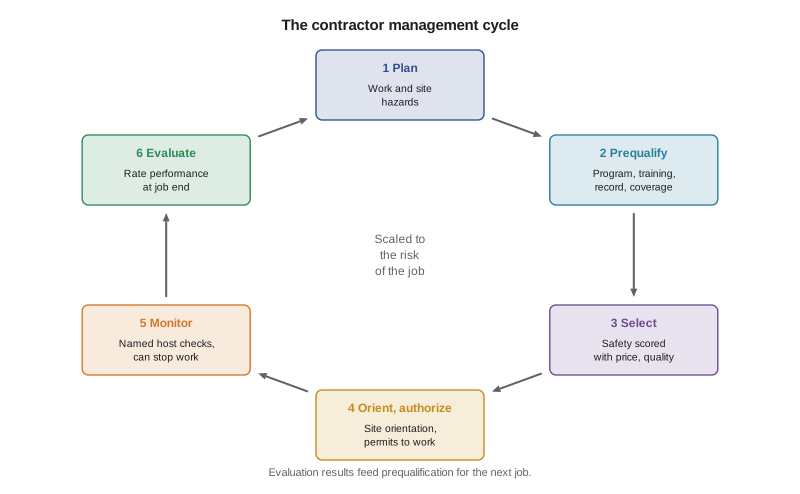
The contractor management cycle
Harrowgate Foods Ltd. adopted a six-step cycle for contractor work, scaled to the risk of the job. A window cleaner working from the ground needed a light touch; the roofing job needed the full cycle.
- Plan. Before seeking quotes, the person requesting the work identifies its hazards and the site hazards the contractor will meet, such as fragile roofs, ammonia lines, forklift traffic and food safety rules.
- Prequalify. Contractors for medium- and high-risk work must provide evidence of their safety program, training, insurance, workers' compensation coverage, safety performance history and, for some work, recognized certification.
- Select. Safety performance is a scored criterion alongside price and quality, not a pass-fail box ticked after the price decision.
- Orient and authorize. Contractor workers receive a site orientation, and high-risk work goes through the permit system.
- Monitor. A named company host checks the work during the job, and stops it if necessary.
- Evaluate. At the end of the job, the host rates the contractor's safety performance, and the rating feeds into future prequalification.
# Scoring three quotes for the roof replacement at the sauces plant.
# Weights: price 40%, quality 25%, safety 35%. Scores out of 10.
quotes = {
    "Contractor A": {"price": 10, "quality": 6, "safety": 3},
    "Contractor B": {"price": 7,  "quality": 8, "safety": 9},
    "Contractor C": {"price": 8,  "quality": 7, "safety": 6},
}
weights = {"price": 0.40, "quality": 0.25, "safety": 0.35}
for name, s in quotes.items():
    total = sum(weights[k] * s[k] for k in weights)
    flag = "  (fails safety minimum of 5)" if s["safety"] < 5 else ""
print(f"{name}: weighted score {total:.2f}{flag}")Contractor A: weighted score 6.55 (fails safety minimum of 5) Contractor B: weighted score 7.95 Contractor C: weighted score 7.05
Contractor A, the lowest price, would have won on cost alone. Under the new scoring, it also failed the minimum safety score, which disqualified it regardless of price. When the roofing job was re-tendered after Luis stopped the work, Contractor B won. Its quote was higher, but it came with a written fall protection plan, trained workers and a record of safe roofing jobs. The extra cost was small next to the cost of a fall.
Shared responsibility at multi-employer workplaces
When contractors and employers share a workplace, legal duties overlap. In Nova Scotia, Nova Scotia's Occupational Health and Safety Act places duties on employers, contractors, constructors, owners and suppliers, and on every employer to coordinate where more than one is present. A management system makes that coordination concrete: who controls the work area, who issues permits, how hazards are communicated each way, and who can stop work.
Agency workers sit in a similar shared space. The agency employs them, but Harrowgate Foods Ltd. directs their work and controls the workplace. The company's system treated agency workers as its own for orientation, competence verification, supervision, hazard reporting and incident investigation, while the agency agreement set out each party's duties, including who reported injuries to whom.
Emergency preparedness and response
Even the best controls can fail. Management system standards require organizations to establish processes to prepare for and respond to potential emergency situations. In plain terms, the organization should:
- identify potential emergencies from its hazard and risk assessments;
- plan responses, including first aid;
- provide training for responders and for everyone else;
- test and exercise the response capability periodically;
- evaluate performance after tests and real events, and revise plans;
- communicate relevant information to workers, contractors, visitors, emergency services, regulators and neighbours; and
- take account of the needs and capabilities of all interested parties, including people with disabilities.
At Harrowgate Foods Ltd., the hazard registers identified a list of potential emergencies at each site: fire, an ammonia release, a serious injury, a chemical spill, a power failure in the freezer, severe weather, a medical emergency, workplace violence and, at the distribution centre, a truck collision at the dock. Each had a response plan that fit on two pages, with roles named by position, not by person.
Ammonia: the emergency that drives the plan
Ammonia refrigeration systems at the main plant and the distribution centre were the hazards with the greatest potential for harm to many people at once, including neighbours. A large release can cause severe injury or death and force evacuation of surrounding areas. Luis's team already ran parts of a process safety program, and the new system tied it to emergency preparedness: detectors and alarms in machinery rooms, emergency ventilation, emergency shutdown switches outside the machinery rooms, an evacuation plan with assembly points upwind and a wind sock visible from every exit, a site emergency response team trained to a defined level, and an agreement with the local fire department, which visited each site each year and kept a copy of the site plan and the refrigeration system's piping diagrams.
Testing the plan
A plan that has never been tested is a hope. Harrowgate Foods Ltd. set a schedule of exercises: evacuation drills on every shift, including nights, twice a year; an ammonia alarm response drill each quarter; a tabletop exercise each year for the leadership team, walking through a scenario such as a release during a night shift with a road closed by a storm; and a full-scale exercise with the fire department every three years.
The first night evacuation drill at the main plant revealed problems no day drill had shown. Two sanitation workers in the spiral freezer area could not hear the alarm over the wash equipment. The night assembly point was in a dark corner of the parking lot. The person responsible for the headcount was on a break, and nobody had been named as backup. Each problem went into the corrective action process: visual alarm beacons in the freezer area, lighting at the assembly point, and a named backup for every emergency role on every shift.
After an emergency
The response does not end when the danger passes. The plans included steps for caring for injured and shaken workers, preserving the scene for investigation (HSE-403), notifying the regulator and the workers' compensation board as required, communicating with workers and families, and reviewing the response itself so that the next one would be better.
Worked problem
Planning contractor work on the ammonia system
Show solution
- Plan: replacing a valve on an ammonia line at the distribution centre; hazards include ammonia exposure, pressure, cold and forklift traffic near the machinery room.
- Prequalify: refrigeration contractor's training records, ammonia safety program and performance history reviewed.
- Authorize: permit to work issued at the machinery room after isolation and pump-down are verified by site maintenance.
- Monitor: Luis acts as host, checks the work twice during the job and confirms the emergency plan is briefed to the crew.
- Evaluate: after the job, the contractor's performance is rated and filed for the next prequalification.
Answer: Every step of the cycle applies, scaled up because the hazard could affect many people.
Outsourcing a whole process
Contractors usually do a defined job and leave. Outsourcing is different: the organization hands a function that is part of its management system to an outside provider on a continuing basis. At Harrowgate Foods Ltd., sanitation at the distribution centre was outsourced to a cleaning company whose crews worked every night, and the delivery fleet in one region was run by a logistics firm. Management system standards expect outsourced functions and processes to stay under the organization's control, and the type and degree of control is defined within the system. Outsourcing transfers the work, not the responsibility for the hazards it creates.
For the night sanitation crew, control took several forms. The contract required the provider to follow Harrowgate Foods Ltd.'s lockout program and permit system on the company's equipment, and to use only approved chemicals. The provider's supervisor joined the distribution centre's monthly safety meeting, and the cleaning crew reported hazards and incidents through the company's reporting system, so that their near misses appeared alongside everyone else's. A quarterly joint inspection walked the cleaning routes, and the provider's safety performance was a standing item at contract reviews, with the right to end the contract for repeated serious breaches.
Lessons from the roofing near miss
The management review that discussed the roofing near miss did not stop at blaming the purchasing clerk. The investigation (HSE-403) found that purchasing had never been told which services counted as high risk, that the request form had no field for site hazards, and that no host had been assigned because nobody owned the job once the purchase order was issued. The fixes were system fixes: a list of high-risk service categories built into the purchasing software, a mandatory hazard field on the work request, and a rule that no purchase order for contractor work on site could be issued without a named host. Rachel Okoye, the vice-president of operations, also asked purchasing to report each quarter on how many contractor jobs went through full prequalification, so the new process would be watched rather than assumed.
Common mistakes
MistakeChoosing contractors on price and checking safety afterwards.
InsteadScore safety as a weighted criterion with a minimum threshold.
MistakeLetting chemicals arrive before their data sheets are reviewed.
InsteadApprove chemicals, with safety data sheet review, before purchase.
MistakeAssuming contractors are responsible for their own safety on your site.
InsteadCoordinate hazards both ways and assign a host who can stop work.
MistakeRunning drills only on day shift.
InsteadExercise the plan on every shift, including nights and weekends.
MistakeNaming individuals instead of roles in emergency plans.
InsteadAssign roles by position with named backups on every shift.
Summary and key terms
- Procurement processes set safety criteria for equipment, chemicals and services before they are bought.
- Contractors face higher risk; coordination must cover hazards in both directions.
- A contractor management cycle runs from planning and prequalification to monitoring and evaluation.
- Safety is a weighted selection criterion with a minimum threshold, not an afterthought.
- Emergency preparedness identifies potential emergencies, plans responses, trains, tests and improves.
- Drills on every shift find problems that day drills miss.
- Procurement
- Acquiring products and services, including equipment, chemicals and contractor services.
- Prequalification
- Checking a contractor's safety capability before inviting or accepting bids.
- Contractor host
- A named company person who oversees a contractor's work on site.
- Multi-employer workplace
- A workplace where workers of more than one employer work at the same time.
- Tabletop exercise
- A discussion-based walk-through of an emergency scenario.
- Emergency response plan
- A documented plan for responding to a potential emergency, with roles and actions.
Practice problems
Work each problem on paper first, then reveal the answer to check.
Name two ways Harrowgate Foods Ltd. built safety into purchasing.
Show answer
Safety criteria in specifications, review of high-risk purchases, acceptance checks, chemical approval.
Why do contractor workers often face higher risk?
Show answer
They are unfamiliar with the site, do non-routine high-hazard work and coordination is often weak.
List the six steps of the contractor management cycle.
Show answer
Plan, prequalify, select, orient and authorize, monitor, evaluate.
What did the first night evacuation drill reveal?
Show answer
Inaudible alarms in the freezer area, a dark assembly point and no backup for the headcount.
Why are emergency roles assigned by position?
Show answer
So the role is covered on every shift, with backups, whoever is working.
Lesson quiz · 5 questions
Score 60% or more to complete this lesson.
Create a free account to save your progress, take quizzes and earn a certificate.