
HSE-404 · Lesson 7 of 12 · 20 min
Support: resources, competence, communication and documents
The forklift investigation in HSE-403 had found that Jordan Reid, the agency driver, had been driving in the freezer for six weeks without a practical evaluation. His file held a classroom certificate from a training provider and a signed orientation checklist. On paper he was trained. In practice nobody had ever watched him reverse a loaded truck out of a staging lane in a freezer aisle with frosted mirrors. The gap was not a missing course. It was a missing process for making sure that people doing a job could actually do it safely.
This lesson covers the support processes that every other part of a management system depends on: resources, competence, awareness, communication and documented information. They are unglamorous, and they are where many systems quietly fail.
Resources
Management system standards require the organization to determine and provide the resources needed for the system: people, time, money, equipment, infrastructure, information and outside expertise. The requirement sounds obvious, but it is the one most often met in theory and missed in practice. A procedure that requires a second person for a task is not resourced if the night crew is short-staffed. A hazard report process is not resourced if maintenance has no capacity to fix what is reported.
Elena tested resources by tracing three high-risk tasks through a full shift and asking, at each step, whether the people, time and equipment needed to follow the procedure were actually there. On nights at the main plant, lockout of the spiral conveyor required one person to walk to the far mezzanine, isolate, lock and try the restart, while a second person waited at the conveyor. The sanitation crew had the people, but the 5:00 a.m. restart left no time to do it properly. The resource missing was time, and the fix was a schedule change, not more training.
Competence
Competence is the ability to apply knowledge and skills to achieve intended results. It is more than training. A competent forklift operator knows the rules, has the practical skill to drive safely in the conditions where they work, recognizes hazards, and has the judgment to stop when something is wrong. Management system standards require the organization to:
- determine the competence needed by workers whose work affects safety, including the ability to identify hazards;
- ensure workers are competent on the basis of education, training or experience;
- take action to acquire and maintain competence where needed, and evaluate whether those actions worked; and
- retain documented information as evidence of competence.
The phrase 'evaluate whether those actions worked' is where Jordan's file fell short. A classroom certificate shows that a course was attended. It does not show that the person can do the job. Harrowgate Foods Ltd. rebuilt its competence process around four steps for every safety-critical role: define what competent looks like, assess the gap for each person, close it through training, coaching and supervised practice, and verify competence by observation before the person works alone.
Building a competence matrix
The tool Elena used was a competence matrix: a grid with roles or people as rows and safety-critical competencies as columns, showing who needs what, who has it, when it was verified and when it expires. Each site built its own, with supervisors and the joint occupational health and safety committee defining the competencies for each role.
# Competence matrix extract: weekend crew at the distribution site.
# Each competency: (required, verified). Practical evaluation counts as verified.
crew = {
    "Ahmed (employee)":  {"forklift": (1, 1), "freezer work": (1, 1), "ammonia alarm response": (1, 1)},
    "Lena (agency)":     {"forklift": (1, 0), "freezer work": (1, 1), "ammonia alarm response": (1, 0)},
    "Jo (agency)":       {"forklift": (1, 0), "freezer work": (1, 1), "ammonia alarm response": (1, 1)},
    "Chris (employee)":  {"forklift": (0, 0), "freezer work": (1, 1), "ammonia alarm response": (1, 1)},
    "Ravi (agency)":     {"forklift": (1, 1), "freezer work": (1, 0), "ammonia alarm response": (1, 0)},
}
gaps = []
for person, comps in crew.items():
    for comp, (req, ver) in comps.items():
        if req and not ver:
            gaps.append((person, comp))
print(f"gaps: {len(gaps)}")
for person, comp in gaps:
print(f" {person}: {comp} not verified")gaps: 5 Lena (agency): forklift not verified Lena (agency): ammonia alarm response not verified Jo (agency): forklift not verified Ravi (agency): freezer work not verified Ravi (agency): ammonia alarm response not verified
Five gaps on one weekend crew, three of them among agency workers, told the site manager exactly where the risk lay. Two agency drivers could not be scheduled on forklifts until their practical evaluations were done. The ammonia alarm gaps were closed the following weekend with a short drill. The matrix became part of the scheduling process: supervisors could not assign a task to someone whose competence for it was not verified.
Agency workers and contractors
Competence requirements apply to everyone doing work under the organization's control, including agency workers and contractors. The organization can rely on an agency's or contractor's training as evidence, but it remains responsible for checking. Harrowgate Foods Ltd. changed its agency contracts to require evidence of training before a worker's first shift, and added a site-specific orientation and a practical evaluation by a company evaluator for any safety-critical task. The agency paid for the training; the company did the verification. Lesson 9 covers contractors more fully.
Awareness
Awareness is different from competence. Every worker, whatever their job, should be aware of a few things: the OHS policy and objectives, how their work contributes to the system, the consequences of not following requirements, incidents and their findings relevant to them, the hazards and risks of their work and the controls, and their ability to remove themselves from work they believe presents an imminent and serious danger without reprisal. That last point is how management system standards express what Nova Scotia's Occupational Health and Safety Act calls the right to refuse unsafe work.
Awareness is built through orientation, toolbox talks, safety boards, briefings after incidents and conversations with supervisors. It is checked by asking workers, not by counting attendance. During the first internal audit, auditors asked a sample of workers at each site three questions: what is one hazard in your job and how is it controlled, what would you do if you thought a job was unsafe, and what happened as a result of the last hazard you reported? The answers measured awareness better than any sign-in sheet.
Communication
Management system standards require the organization to plan its internal and external safety communication: what it will communicate, when, to whom, how, and in which languages. It must take account of diversity, such as language, literacy and disability, and make sure workers' views are considered. Communication runs in every direction: down from management, up from workers, across shifts and sites, and out to contractors, visitors, regulators and the community.
At Harrowgate Foods Ltd., about a quarter of the workforce at the main plant and nearly half at the distribution centre spoke a first language other than English, and some had limited literacy in any language. The communication plan responded with pictorial safety boards, key procedures translated into the four most common languages, bilingual lead hands on each shift, and toolbox talks delivered by demonstration rather than reading. Hazard reports could be made in any language, by phone, by text or by speaking to a supervisor, who wrote them up.
Upward communication got the same attention. A shift handover form at the main plant had a box for safety issues that the next shift needed to know about, such as a guard removed for repair or a leaking valve. Before the system, the box was usually blank. After a few months of supervisors reading it aloud at the start of each shift and acting on it, it was rarely empty.
Documented information
Documented information means the documents and records the system needs, in any format: paper, electronic, photographs, video. Management system standards require two kinds. Some information must be maintained, meaning kept current, such as the policy, procedures and the risk register. Some must be retained as evidence, such as training records, inspection reports, monitoring results, audit reports and management review minutes. Beyond the specific items the standard lists, the organization decides how much documentation its own processes need.
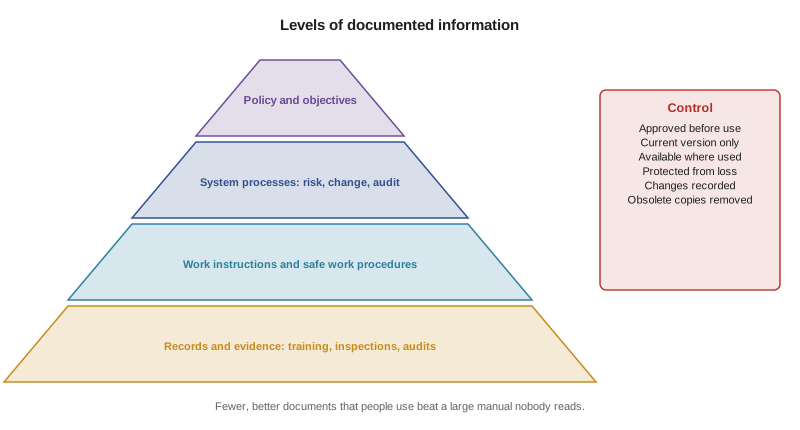
Document control keeps documents useful. The organization must make sure documents are identified, reviewed and approved, available where and when they are needed, protected, distributed, stored, kept current, and retained or disposed of properly. Out-of-date versions are removed from use. At the main plant, the first audit found three different versions of the spiral conveyor lockout procedure in use: one on the wall at the conveyor, one in the sanitation office binder and one on the shared drive. The fix was to keep the master electronically, print controlled copies with a version date and a QR code linking to the current master, and remove all other copies.
How much to write down
The right amount of documentation is the least that makes the process work reliably and provides the evidence the organization needs. Too little, and practices depend on memory and drift. Too much, and nobody reads it. Elena gave the team a test for every proposed document: who will use it, when, and what would go wrong without it? A two-page lockout procedure with photographs of each isolation point passed easily. A twelve-page procedure for using the photocopier did not.
Records deserve the same discipline. A record should be created because someone will use it: to verify competence, to show a control was checked, to track a trend or to demonstrate compliance. Records that nobody reviews are a burden. When the system was launched, Elena retired eighteen old forms whose information nobody had looked at in years, which earned more goodwill with supervisors than any training session.
Worked problem
Verifying competence rather than attendance
Show solution
- Role: night sanitation worker at the main plant, cleaning the spiral conveyor.
- Define competent: can isolate, lock and verify zero energy at every isolation point; recognizes when a disconnect is unreachable and stops work; uses chemicals safely.
- Assess the gap: observe each worker do a full lockout; ask scenario questions.
- Close the gap: coaching on the floor with a lead hand; practice on the actual equipment.
- Verify: a trained evaluator watches each worker perform the task correctly before they work without direct supervision; recorded in the matrix with a renewal date.
Answer: Competence is verified by observing performance in real conditions, not by a course certificate alone.
Competence for leaders and system roles
Competence requirements apply to managers and system roles as much as to operators. A supervisor who leads toolbox talks, investigates incidents and verifies critical controls needs skills that nobody teaches in a forklift course. Harrowgate Foods Ltd. defined competencies for supervisors (hazard recognition, conducting safety conversations, verifying controls, responding to work refusals, leading a first-response to an incident), for joint occupational health and safety committee members (inspections, hazard reporting, participating in investigations), for internal auditors (lesson 10) and for managers (leading the system, reviewing performance, resourcing). Each had a short training path, followed by coaching and observation.
The internal auditor role received particular care. Auditors need to know the standard, understand the processes they audit, interview people fairly and judge evidence. Elena trained a pool of twelve internal auditors drawn from all three sites and all levels, including four workers nominated by the joint occupational health and safety committees, and arranged for each to shadow an experienced auditor before leading an audit.
Keeping competence current
Competence fades without practice and becomes outdated when work changes. The matrix showed renewal dates, and supervisors received a monthly list of upcoming expiries. Changes to equipment or procedures, caught by the management of change process in lesson 8, triggered a check of whether existing competence still covered the new way of working. When the main plant's packaging line was replaced, operators were not treated as competent on the new line until they had been trained and observed on it, even though they had run the old line for years.
Common mistakes
MistakeTreating a training certificate as proof of competence.
InsteadVerify competence by observing people do the job in real conditions.
MistakeWriting procedures that need people or time the shift does not have.
InsteadCheck that resources exist to follow each procedure on every shift.
MistakeRelying on agencies and contractors to verify their own workers.
InsteadAccept their training as evidence but verify safety-critical competence yourself.
MistakeCommunicating only in writing and only in English.
InsteadPlan for language, literacy and disability; use pictures and demonstration.
MistakeKeeping multiple uncontrolled versions of procedures.
InsteadControl documents: one current master, controlled copies, old versions removed.
Summary and key terms
- Resources include people, time, money, equipment and expertise; procedures fail when they are not resourced.
- Competence is the ability to apply knowledge and skill; it must be defined, built and verified.
- A competence matrix shows gaps and can be linked to scheduling.
- Awareness covers the policy, hazards, controls, consequences and the right to remove oneself from danger.
- Communication is planned in every direction, for every language and literacy level.
- Documented information is maintained or retained, kept under control, and limited to what is useful.
- Competence
- The ability to apply knowledge and skills to achieve intended results.
- Competence matrix
- A grid showing the competencies each role needs and who has verified each.
- Awareness
- Knowing the policy, hazards, controls and one's own role and rights in the system.
- Documented information
- Documents and records the system needs, in any format.
- Document control
- Processes that keep documents approved, current, available and protected.
- Retained information
- Records kept as evidence of results achieved or activities performed.
Practice problems
Work each problem on paper first, then reveal the answer to check.
Why was Jordan's classroom certificate not proof of competence?
Show answer
It showed attendance, not that he could drive safely in the conditions where he worked.
What four steps did Harrowgate Foods Ltd. use to build competence?
Show answer
Define what competent looks like, assess the gap, close it, and verify by observation.
Name three things every worker should be aware of.
Show answer
The policy, their hazards and controls, consequences of not following requirements, relevant incidents, and their right to remove themselves from danger.
What is the difference between maintaining and retaining documented information?
Show answer
Maintaining means keeping documents current; retaining means keeping records as evidence.
What test did Elena apply to proposed documents?
Show answer
Who will use it, when, and what would go wrong without it?
Lesson quiz · 5 questions
Score 60% or more to complete this lesson.
Create a free account to save your progress, take quizzes and earn a certificate.