
HSE-404 · Lesson 4 of 12 · 21 min
Policy, objectives and planning
Harrowgate Foods Ltd. already had a safety policy. It hung in a frame by the time clock at each site, dated eleven years earlier and signed by a chief executive who had since retired. It said the company was 'committed to the safety of all employees' and that 'safety is everyone's responsibility'. When Elena asked twenty workers at the main plant what the policy said, two could paraphrase it. None could say how it affected their work.
This lesson covers the policy that sets the direction of the system, the objectives that turn direction into targets, and the planning that decides how to reach them. Together they are the 'plan' in plan, do, check, act.
What a policy must do
An OHS policy is a short statement, from top management, of the organization's intentions and direction for health and safety. Management system standards set out what it must contain, and the requirements are more specific than most framed policies on lunchroom walls. Paraphrased, the policy should:
- include a commitment to provide safe and healthy working conditions to prevent work-related injury and ill health, suited to the organization's size, context and risks;
- provide a framework for setting objectives;
- commit to meeting legal and other requirements;
- commit to eliminating hazards and reducing risks, using the hierarchy of controls;
- commit to continual improvement of the system; and
- commit to consultation and participation of workers and, where they exist, workers' representatives.
The policy must be available as documented information, communicated within the organization, available to interested parties as appropriate, and kept relevant and appropriate through review. A policy that has not been looked at in eleven years fails that last test before anyone reads it.
Writing a policy people can use
Elena drafted the new policy with the two worker co-chairs and Aisha, and set herself a few rules. Keep it to one page. Use plain words a new agency worker would understand on the first day. Make every commitment specific enough that a worker could notice if it was broken. Have it signed by the current chief executive and by Rachel, and review it at every management review.
The draft went to the joint occupational health and safety committees at all three sites for comment, which was consultation in the sense described in lesson 3. Workers at the distribution centre asked for one change: a sentence saying that anyone could stop work they believed was unsafe without being penalized. It went in. The final version included, in the company's own words, the commitments listed above, plus three specific promises: stop-work authority for everyone, the same safety orientation and protection for agency and contract workers as for employees, and an annual report to all workers on progress against the year's objectives.
A policy is judged by behaviour, not wording. Tanya Morris's test from lesson 1 applied here too. The first time a night supervisor at the main plant stopped a sanitation job because the disconnect could not be reached safely, and the plant manager backed him the next morning despite the late restart, workers began quoting the policy to each other. No poster could have done that.
Risks and opportunities
Before setting objectives, the organization works out the risks and opportunities it needs to address. Management system standards use these words in two senses, and it is easy to confuse them.
- OHS risks are combinations of the likelihood of a hazardous event or exposure and the severity of the injury or ill health it could cause. Lesson 5 covers how to identify hazards and assess these risks.
- Other risks to the system are things that could stop the system working as intended, such as a key person leaving, a merger, budget cuts or a production surge that crowds out safety activities.
- OHS opportunities are chances to improve safety performance, such as replacing a manual task with automation, redesigning a layout during a planned renovation, or adapting work to an older workforce.
- Other opportunities for the system are chances to make the system itself work better, such as integrating it with the food safety system or using new software for hazard reports.
The context register from lesson 3 and the hazard and risk assessments from lesson 5 are the main inputs. Harrowgate Foods Ltd.'s planning workshop identified, among other things, the risk that the busy pre-holiday season would push system activities aside each autumn, and the opportunity presented by a planned refit of the sauces plant's mixing room in the following year, which could design out noise and manual handling instead of controlling them after installation.
Setting objectives
Objectives are the measurable results the organization intends to achieve. Management system standards expect OHS objectives to be consistent with the policy, measurable or capable of performance evaluation, monitored, communicated, updated as needed, and to take account of legal requirements, risk assessments and consultation with workers. Many organizations use the SMART test: specific, measurable, achievable, relevant and time-bound.
Objectives should be about the things that create safety, not only about the absence of injuries. An objective of 'zero lost-time injuries' is measurable, but it says nothing about how to achieve it and can drive under-reporting, as Harrowgate Foods Ltd. had already learned. Elena steered the leadership team toward a mix: a few outcome objectives, more objectives about the controls and processes that prevent serious harm, and objectives about the system itself.
| Objective for the first year | Type | Measure | Owner |
|---|---|---|---|
| Every energy-isolation point used in sanitation reachable within 30 seconds from the work position | Control | Percentage of isolation points meeting the standard | Main plant manager |
| Pedestrian and forklift routes separated by physical barriers in all freezer aisles | Control | Aisles completed out of 22 | Distribution manager |
| Noise at the sauces plant measured and mapped, with a reduction plan for areas over 85 dBA | Control | Survey done; plan approved | Sauces plant manager |
| Hazard reports closed within 30 days | System | 80% closed on time | Site managers |
| First internal audit cycle and management review completed | System | All elements audited; review held | Safety manager |
| Serious injuries and high-potential incidents reduced | Outcome | Count, reviewed quarterly | Vice-president, operations |
The first objective came straight from the conveyor investigation in HSE-401. It turned a lesson into a measurable target with an owner and a deadline. The noise objective came from the sauces plant workers' comments during Elena's floor visits. Every objective had an owner in line management, not in the safety department.
Cascading objectives
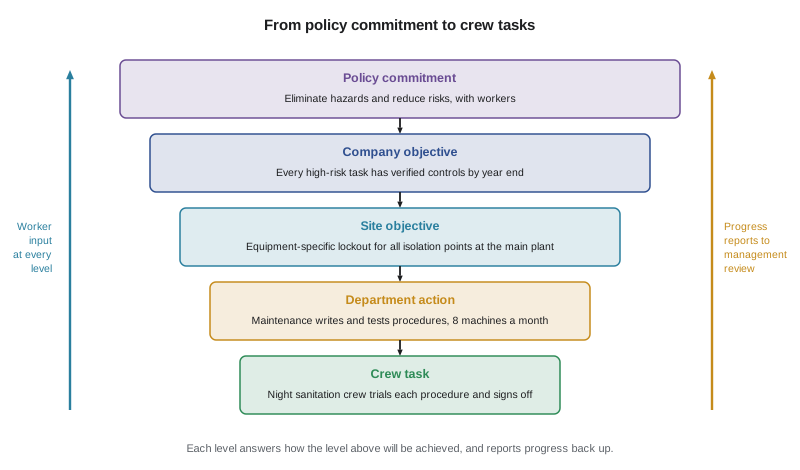
Company objectives become real when they are translated into objectives for each site, department and crew. A company objective to separate pedestrians from forklifts becomes, at the distribution centre, a project with phases, each with a supervisor responsible and a date. The cascade also runs the other way: crews propose local objectives that roll up into the site plan.
Planning to achieve objectives
For each objective, the organization plans what will be done, what resources are needed, who is responsible, when it will be completed, how results will be evaluated (including the indicators used) and how the actions will be integrated into business processes. The last point matters. The freezer barrier project at the distribution centre was built into the site's capital plan and its peak-season schedule, so installation crews worked in aisles during quiet periods instead of competing with picking.
Plans need slack. Elena's experience was that the first year of a management system always takes longer than planned, because building the system reveals problems nobody knew about. She built a buffer of about 20 percent into every timeline and warned the leadership team that the objectives would change during the year as audits turned up new risks.
Tracking progress
Objectives that are not tracked are wishes. Harrowgate Foods Ltd. reviewed progress monthly at each site's leadership meeting and quarterly at the company level, using a simple tracker that the joint occupational health and safety committees could also see.
# Progress against two first-year objectives, checked each quarter.
target_points = 64       # energy-isolation points used in sanitation at the main plant
compliant = [12, 31, 47, 60]
target_aisles = 22       # freezer aisles needing physical barriers
done = [0, 6, 13, 22]
for q, (c, a) in enumerate(zip(compliant, done), 1):
    print(f"Q{q}: isolation {100 * c / target_points:3.0f}%   barriers {a:2d}/{target_aisles}")
gap = target_points - compliant[-1]
print(f"isolation points still to fix at year end: {gap}")Q1: isolation 19% barriers 0/22 Q2: isolation 48% barriers 6/22 Q3: isolation 73% barriers 13/22 Q4: isolation 94% barriers 22/22 isolation points still to fix at year end: 4
By the end of the year the barrier project was complete. Four isolation points were still out of reach: they belonged to a spiral freezer whose disconnect could only be moved during a planned shutdown. Instead of quietly dropping the objective, the leadership team carried it into the second year with an interim control, a portable lockout station and a second person, and a fixed date tied to the shutdown. That is what a system does with an unmet objective.
Worked problem
Rewriting a weak objective
Show solution
- Original: 'Improve forklift safety at the distribution centre.'
- Specific: which aspect? Separation of pedestrians and forklifts in freezer aisles.
- Measurable: physical barriers installed in all 22 aisles that need them.
- Achievable and relevant: funded in the capital plan; directly addresses the cause of the aisle 14 collision.
- Time-bound: complete by the end of the third quarter, outside peak season.
Answer: 'Install physical barriers separating pedestrian walkways from forklift routes in all 22 freezer aisles by the end of the third quarter, owned by the distribution manager.'
Leading and lagging measures for objectives
Each objective needs indicators that show whether it is on track. Lagging indicators measure results after the fact, such as injuries and illnesses. Leading indicators measure activities and conditions that are expected to prevent harm, such as the percentage of isolation points that meet the standard, the percentage of pre-use forklift inspections completed, or the time taken to close hazard reports. HSE-407 covers indicators in depth. For planning, the key is to pair each outcome objective with leading indicators that the people responsible can influence directly.
Elena also asked the leadership team to watch for indicators that could be gamed. A target for the number of safety observations per supervisor, for example, could produce a flood of shallow observations written to meet the count. She preferred measures that were hard to fake: verified field checks of controls, the age of open actions, and the share of hazard reports where the worker who raised it confirmed that the fix worked.
Planning for change during the year
Plans rarely survive a year unchanged. At Harrowgate Foods Ltd., a new automated packaging line arrived at the main plant earlier than expected, a large contract changed the distribution centre's shift pattern, and a new sanitation chemical supplier was chosen for cost reasons. Each of these could have undermined the objectives. The planning process linked to the management of change process described in lesson 8, so that each change triggered a check against the year's objectives and risk assessments, and the plan was updated rather than ignored.
Change also brought opportunities. The early arrival of the packaging line meant its guarding could be reviewed against the new risk assessment process before commissioning, instead of after workers had started using it. The new chemical supplier offered a less corrosive sanitizer that reduced the need for face shields on one task. Both were recorded as opportunities and added to the plan with owners and dates, so that good news was managed as carefully as bad.
Communicating objectives
Objectives work best when people know them. Harrowgate Foods Ltd. posted each site's objectives on the safety boards beside the time clocks, with a simple progress bar updated monthly, and the joint occupational health and safety committees reviewed them at every meeting. The annual report to workers promised in the policy summarized what had been achieved, what had not and why. In the first year's report, Rachel wrote two sentences that workers remembered: 'We said we would fix every disconnect by December. We fixed 60 of 64, and here is exactly when and how we will fix the last four.'
Common mistakes
MistakeKeeping a vague policy because it has always been on the wall.
InsteadWrite specific commitments and review the policy at each management review.
MistakeSetting only injury-count objectives.
InsteadCombine outcome objectives with objectives on controls and system performance.
MistakeAssigning every objective to the safety manager.
InsteadGive objectives to line managers who control the resources.
MistakeQuietly dropping objectives that are not met.
InsteadCarry them forward with interim controls and a realistic date.
MistakePlanning without slack in the first year.
InsteadBuild a buffer; the system will uncover new problems.
Summary and key terms
- The OHS policy states top management's commitments and provides the framework for objectives.
- It must commit to safe conditions, legal compliance, eliminating hazards, continual improvement and worker participation.
- Risks and opportunities include both OHS risks and risks to the system itself.
- Objectives should be consistent with the policy, measurable, monitored and owned by line management.
- Good objectives target controls and system processes, not only injury counts.
- Plans set out what, who, when, with what resources and how results will be evaluated.
- OHS policy
- Top management's statement of intentions and direction for health and safety.
- OHS objective
- A measurable result the organization sets out to achieve for health and safety.
- SMART
- Specific, measurable, achievable, relevant and time-bound.
- OHS opportunity
- A circumstance that could lead to improved safety performance.
- Cascade
- Translating company objectives into site, department and crew objectives.
- Interim control
- A temporary measure used until a permanent solution is in place.
Practice problems
Work each problem on paper first, then reveal the answer to check.
Name three commitments an OHS policy must include.
Show answer
Safe and healthy conditions, legal compliance, eliminating hazards and reducing risks, continual improvement, worker participation.
Why is 'zero lost-time injuries' a weak sole objective?
Show answer
It says nothing about how to achieve it and can drive under-reporting.
Give an example of a risk to the system itself.
Show answer
A key person leaving, budget cuts, a merger or a production surge crowding out safety activities.
What should a plan for each objective specify?
Show answer
What will be done, resources, who is responsible, when, and how results will be evaluated.
What did Harrowgate Foods Ltd. do with the isolation objective it did not finish?
Show answer
Carried it forward with an interim control and a fixed date tied to a shutdown.
Lesson quiz · 5 questions
Score 60% or more to complete this lesson.
Create a free account to save your progress, take quizzes and earn a certificate.