
HSE-404 · Lesson 3 of 12 · 20 min
Context, leadership and worker participation
Elena's project plan began, to the surprise of some of the managers, not with hazards but with a half-day workshop in the training room at the Truro plant. Around the table sat Rachel, the three site managers, Aisha from quality, the two worker co-chairs, a union steward from the bakery, a lead hand from the distribution centre, a maintenance planner and the human resources manager. On the whiteboard Elena had written three questions: What is happening around us that affects safety here? Who cares about how we manage safety, and what do they expect? What exactly is our system going to cover?
Those questions correspond to the first part of any modern management system: understanding the organization's context. They feel abstract at first. By the end of the morning they had produced the most practical list the company had ever made of the forces shaping safety at its sites.
Internal and external issues
Context means the issues, inside and outside the organization, that can affect its ability to achieve the intended outcomes of its OHS management system. External issues come from the world around the company: laws and regulators, the labour market, technology, customers, the economy, the climate, the community. Internal issues come from inside: the organization's structure, culture, workforce, processes, equipment and finances.
The workshop grouped the issues on sticky notes. Some were obvious and some were not.
| Type | Issue raised in the workshop | Why it matters for safety |
|---|---|---|
| External | Tight labour market, heavy use of agency workers at the distribution site | New workers arrive with little experience and short orientations |
| External | Grocery customer asking for evidence of a safety management system | Business pressure supports the project but could push box-ticking |
| External | More frequent summer heat waves | Ovens and fryers already push bakery temperatures high |
| External | Winter storms closing roads | Short-staffed shifts and fatigue when people cannot get home |
| Internal | Two serious injuries in the past year | Trust in management is fragile; workers watch for real change |
| Internal | Aging equipment at the sauces plant | Guarding and noise controls lag behind newer lines |
| Internal | Strong food safety system already in place | A model and shared processes for the new system |
| Internal | Night shift supervisors stretched thin | Supervision of high-risk tasks is weakest when risk is highest |
Heat waves went on the list because of the 2024 climate amendment described in lesson 2, but the bakery crew had raised heat long before anyone mentioned a standard. On the hottest days of the previous summer, the oven area had passed 35 °C (95 °F), and two workers had felt faint. The climate question simply made the company write down what workers already knew.
The output of the context step is not a report to file away. It feeds directly into hazard identification and risk assessment (lesson 5), objectives (lesson 4) and the scope of the system. Elena kept the register as a living list and scheduled a review of it every year at management review.
Interested parties
Interested parties are the people and organizations that can affect, be affected by, or believe they are affected by the organization's safety decisions. Workers are the most important interested party, and management system standards single them out. Others include supervisors and managers, contractors and agency workers, unions, the regulator, the workers' compensation system, customers, insurers, neighbours and the families of workers.
For each interested party, the organization works out what they need and expect, and which of those needs and expectations it will treat as requirements. Some are legal requirements, such as the regulator's. Some the organization adopts voluntarily, such as a customer's request for certification. The workshop's list for agency workers included three expectations that became company requirements: the same site orientation as direct hires, a named supervisor on every shift, and a way to report hazards that did not depend on their agency.
Scope
The scope sets the boundaries of the system: which sites, activities, products and services it covers. Scope must be honest. An organization cannot exclude its riskiest activity to make the system easier to certify, and it must consider activities it controls or influences even if they happen off site. Harrowgate Foods Ltd. wrote its scope to cover all three sites, the company's delivery fleet, contractors working on its premises and agency workers at all sites, with certification at the main plant in the first year.
Leadership: what top management must do
Management system standards put specific responsibilities on top management, the person or group that directs and controls the organization at the highest level. For Harrowgate Foods Ltd., that meant Rachel and the chief executive, with the site managers as part of the top management team for their sites. The responsibilities can be grouped into a few themes.
- Accountability. Top management takes overall responsibility and accountability for preventing work-related injury and ill health and for providing safe and healthy workplaces. It cannot delegate that accountability to the safety manager.
- Integration. Safety requirements are built into the organization's business processes, such as purchasing, planning and hiring, instead of sitting beside them.
- Resources. People, time, money and equipment needed for the system are made available.
- Communication and direction. Leaders explain why the system matters and direct and support people to make it work.
- Protection from reprisal. Workers are protected from reprisals when they report incidents, hazards, risks and opportunities.
- Culture. Leaders develop, lead and promote a culture that supports the system, the subject of HSE-401.
Rachel took the protection-from-reprisal point personally. The previous year's investigation at the distribution centre had found that a no-injury bonus had discouraged reporting. She wrote a one-page leadership commitment, signed by herself and the chief executive, that named the bonus, said it had been a mistake and committed the company to protecting anyone who reported a hazard or injury. It referred to section 45 of the Act, which protects workers from discriminatory action for raising safety concerns.
Roles, responsibilities and authorities
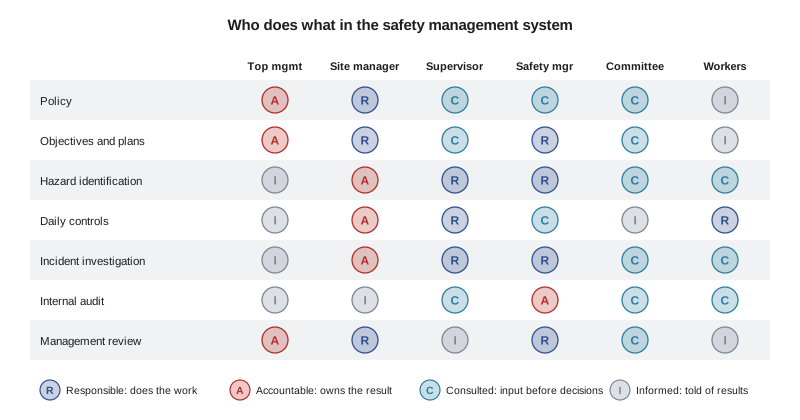
A system works only if everyone knows what they are responsible for and has the authority to do it. Elena used a simple responsibility matrix for each element of the system, showing who is responsible for doing the work, who is accountable for the result, who must be consulted and who must be informed. The matrix exposed problems quickly. At the distribution centre, nobody had clear authority to stop a temporary staging lane being set up; at the sauces plant, the maintenance lead was responsible for contractor safety but had no say in which contractors were hired.
Consultation and participation of workers
Worker participation is the feature that most distinguishes OHS management system standards from other management systems. ISO 45001 distinguishes two levels. Consultation means seeking workers' views before making a decision. Participation means involving workers in the decision itself. Workers who are not managers should be consulted on matters such as determining the needs of interested parties, setting the policy, assigning roles, meeting legal requirements, setting objectives and planning controls. They should participate in identifying hazards and assessing risks, deciding actions to eliminate hazards and reduce risks, determining competence and training needs, deciding what to communicate, choosing control measures, and investigating incidents.
Participation needs mechanisms, time, training and access to information. The standard also expects organizations to remove obstacles to participation, such as language barriers, fear of reprisal, lack of time and policies that penalize people for speaking up.
In Nova Scotia, participation has a legal foundation. Nova Scotia's Occupational Health and Safety Act requires a joint occupational health and safety committee at workplaces with 20 or more regularly employed workers and a health and safety representative at workplaces with 5 to 19, and gives workers the right to know, to participate and to refuse unsafe work. A management system does not replace these structures; it builds on them. At Harrowgate Foods Ltd., the joint occupational health and safety committees became the main channel for consultation, and worker members joined the teams for hazard identification and incident investigation.
Measuring participation
Elena wanted a way to see whether participation was real or decorative. She chose a small set of measures that the joint occupational health and safety committees agreed to track monthly.
# Participation measures at the distribution site, first quarter of the project.
months = ["Jan", "Feb", "Mar"]
workers = 110
hazard_reports = [6, 14, 23]          # reports submitted by workers
closed_within_30_days = [2, 9, 18]    # of those, closed within 30 days
workers_on_risk_teams = [2, 5, 8]     # workers on hazard identification teams
for m, r, c, t in zip(months, hazard_reports, closed_within_30_days, workers_on_risk_teams):
    per100 = 100 * r / workers
    close = 100 * c / r
print(f"{m}: {per100:4.1f} reports per 100 workers, {close:3.0f}% closed in 30 days, {t} workers on teams")Jan: 5.5 reports per 100 workers, 33% closed in 30 days, 2 workers on teams Feb: 12.7 reports per 100 workers, 64% closed in 30 days, 5 workers on teams Mar: 20.9 reports per 100 workers, 78% closed in 30 days, 8 workers on teams
The trend mattered more than any single number. Reporting more than tripled once workers saw that reports were answered quickly, and the share closed within 30 days rose from a third to nearly four-fifths. The measure of workers on risk assessment teams tracked whether participation was more than a meeting.
Worked problem
Consult or involve?
Show solution
- Decision 1: choosing a new type of cut-resistant glove for the bakery's slicing line. Workers should participate: trial gloves on the line and help choose.
- Decision 2: setting next year's safety objectives. Workers should be consulted: review the draft and comment before it is approved.
- Decision 3: investigating a burn at the fryer. Workers should participate: a worker member joins the investigation team.
- Decision 4: changing the shift pattern at the distribution centre. Workers should be consulted on the safety effects, especially fatigue, before the decision.
Answer: Participation for hazards, controls, competence and investigations; at least consultation for policy, objectives and organizational changes.
Leadership in practice
Commitments on paper are easy. Elena asked the leadership team to agree on a small number of visible leadership practices that workers could see for themselves, and to report on them at management review.
- Time on the floor. Each site manager spends at least two hours a week on the floor across all three shifts, including nights, using the safety conversation approach from HSE-401.
- Safety first on the agenda. Every leadership meeting starts with safety, using the same short review: serious incidents and high-potential near misses, open actions past due, and one positive observation.
- Resources decided quickly. Requests for safety resources from the joint occupational health and safety committees receive a written answer within two weeks, including the reason if the answer is no.
- Leaders in investigations. A senior manager sponsors every serious investigation and attends the closing review.
- Leaders in audits. Each member of the leadership team takes part in at least one internal audit a year, as an auditee and as an observer.
The night-shift visits produced the fastest change. Marcus Bell spent his first night walk at the main plant with Dev Sandhu, the night sanitation supervisor. He discovered that the night crew had no first aid attendant on site for two hours each night because of a scheduling gap, something no report had ever mentioned. It was fixed within a week, and the story of the plant manager at 3 a.m. with the sanitation crew went round all three shifts.
Managing the people side of the project
Building a management system changes how people work, and change creates its own risks. Some supervisors saw the new system as extra paperwork. Some long-serving workers saw it as a reaction to two incidents that would fade once the attention moved on. Elena dealt with both by keeping the project tied to real problems the crews had named, by showing results early, such as the first aid gap and the faster closure of hazard reports, and by making sure every new requirement removed at least one older, redundant form. Over the first year, the number of safety forms in use at the main plant fell from 41 to 23, even as the system grew.
Common mistakes
MistakeWriting the context register once to satisfy an auditor.
InsteadKeep it live and use it to drive risk assessment and objectives.
MistakeExcluding the riskiest site or activity from the scope.
InsteadScope honestly, including contractors and agency workers under your control.
MistakeMaking the safety manager accountable for the system.
InsteadTop management keeps accountability; the safety manager advises and supports.
MistakeCalling a briefing 'consultation'.
InsteadConsultation asks for views before deciding; participation involves workers in the decision.
MistakeExpecting participation without time or training.
InsteadProvide paid time, training, information and protection from reprisal.
Summary and key terms
- Context means the internal and external issues that affect the system's outcomes, now including climate change.
- Interested parties include workers, contractors, regulators, customers and communities; their requirements feed the system.
- Scope must be honest about sites, activities and the people covered.
- Top management keeps accountability, integrates safety into business processes and protects workers from reprisal.
- A responsibility matrix makes roles and authorities explicit.
- Consultation seeks views before decisions; participation involves workers in hazard, control, training and investigation decisions.
- Context
- The internal and external issues that can affect an organization's OHS management system.
- Interested party
- A person or organization that can affect, or is affected by, the organization's safety decisions.
- Scope
- The boundaries of the management system: sites, activities and people covered.
- Top management
- The person or group that directs and controls the organization at the highest level.
- Consultation
- Seeking workers' views before making a decision.
- Participation
- Involving workers in making decisions.
Practice problems
Work each problem on paper first, then reveal the answer to check.
Give one external and one internal issue from Harrowgate Foods Ltd.'s context register.
Show answer
External: tight labour market, customer pressure, heat waves or storms. Internal: past injuries, aging equipment, food safety system or stretched night supervision.
Why must scope be honest?
Show answer
An organization cannot exclude risky activities or people it controls to make certification easier.
Name two responsibilities of top management.
Show answer
Accountability, integration, resources, communication, protection from reprisal or culture.
What is the difference between consultation and participation?
Show answer
Consultation seeks views before deciding; participation involves workers in the decision.
Name one obstacle to participation an organization should remove.
Show answer
Language barriers, fear of reprisal, lack of time or penalizing policies.
Lesson quiz · 5 questions
Score 60% or more to complete this lesson.
Create a free account to save your progress, take quizzes and earn a certificate.