
HSE-404 · Lesson 12 of 12 · 20 min
Continual improvement, integrated systems and a capstone gap assessment
Two years after Rachel Okoye's first slide, Harrowgate Foods Ltd. had a working safety management system. It had a policy that workers recognized, a risk register that reflected the floor, critical controls that were verified, contractors who were prequalified, emergency plans that had been tested on nights, an internal audit program with worker auditors, and external recognition. It also had a list of things that were not yet good enough. That list is the subject of this final lesson: the act stage of plan-do-check-act, where an organization deals with what went wrong, improves what works, and keeps the system from going stale.
The lesson closes with a capstone: a gap assessment that brings together everything in the course, applied to a site that has not yet been through the process.
Incidents, nonconformities and corrective action
Management system standards treat incidents and nonconformities through one process. An incident is an occurrence arising out of or in the course of work that could or does result in injury or ill health. A nonconformity is the non-fulfilment of a requirement, whether a legal requirement, a requirement of the standard or one of the organization's own. The organization must react in a timely way, evaluate with the participation of workers whether corrective action is needed to eliminate the root causes, implement the action, review risk assessments where needed, review the effectiveness of the action, and make changes to the system if necessary. Documented information must be kept as evidence.
HSE-403 covered incident investigation in depth. Here the focus is on what the management system does with the results. Every investigation and every audit nonconformity at Harrowgate Foods Ltd. fed one corrective action register, with each action recorded against its source, its cause, its owner, its due date and its verification. The register made patterns visible: when three separate actions from three different investigations all pointed to the same weak handover between day and night maintenance, it was clear that a system change was needed, not three local fixes.
Corrective action that works
Corrective actions fail in predictable ways. They target the person rather than the conditions, such as retraining the worker who was hurt. They rely on the weakest controls, such as a new sign or a memo. They are closed when the work order is issued rather than when the fix is in place. Or they are never checked for effectiveness, so nobody knows whether they worked. Harrowgate Foods Ltd. adopted four rules for its register.
- Address causes, not symptoms. Each action had to name the cause it addressed, drawn from the investigation or audit finding.
- Prefer stronger controls. Actions were tagged by level of the hierarchy of controls, and reviewers challenged any serious finding answered only with training or a procedure change.
- Close on evidence. An action was closed only when the person who raised it, or a committee member, had seen the fix in place.
- Check effectiveness. For high-risk actions, a follow-up check three to six months later confirmed whether the problem had come back.
# Corrective action register summary: closure and effectiveness.
actions = [
    # (id, level of control, closed, effectiveness verified, recurred)
    ("CA-031", "engineering",    True,  True,  False),
    ("CA-032", "administrative", True,  True,  True),
    ("CA-033", "elimination",    True,  True,  False),
    ("CA-034", "training",       True,  False, False),
    ("CA-035", "engineering",    False, False, False),
    ("CA-036", "administrative", True,  True,  True),
]
closed = [a for a in actions if a[2]]
verified = [a for a in closed if a[3]]
recurred = [a for a in verified if a[4]]
print(f"Closed: {len(closed)} of {len(actions)}")
print(f"Effectiveness verified: {len(verified)} of {len(closed)} closed")
print("Recurred after verification:", ", ".join(f"{a[0]} ({a[1]})" for a in recurred))Closed: 5 of 6 Effectiveness verified: 4 of 5 closed Recurred after verification: CA-032 (administrative), CA-036 (administrative)
The summary told its own story. The two actions where the problem came back were both administrative controls. That fed the next management review, which asked for the two problems to be reopened with stronger controls considered first.
Continual improvement
Continual improvement means recurring activity to enhance performance. It does not mean improving everything at once, or that every indicator must improve every month. Management system standards expect the organization to improve the suitability, adequacy and effectiveness of the system by enhancing OHS performance, promoting a culture that supports the system, promoting worker participation in improvement actions, communicating the results, and keeping documented information as evidence.
Improvement opportunities come from everywhere in the system: monitoring trends, audits, management review, worker suggestions, incident investigations, changes in technology, new knowledge about hazards, benchmarking with other companies and changes in standards. Harrowgate Foods Ltd. kept an improvement log separate from the corrective action register, because improvements are not only fixes for failures. Ideas from the floor, such as the sanitation crew's group lockout box or the forklift operators' proposal for one-way aisles, went into the log, were assessed, and if adopted were credited to the people who proposed them.
Keeping the system from going stale
Mature systems face a different risk from new ones. In the first year, everything is new and attention is high. By the third year, procedures can become routine, audits can become predictable and management review can become a ritual. Elena watched for signs of drift: audits that found nothing, hazard reporting that fell without a clear reason, the same names on every improvement team, actions closed without evidence, and management reviews that took less time each year. She changed the internal audit focus each year, rotated auditors between sites, invited a peer from another food company to audit one process, and asked the joint occupational health and safety committees each year what the system was no longer catching.
Integrating with quality and environmental systems
Harrowgate Foods Ltd. already ran a certified food safety system, and Aisha Rahman's team was considering ISO 9001 for quality and ISO 14001 for environmental management. All three standards share a common high-level structure: the same clause numbers and titles for context, leadership, planning, support, operation, performance evaluation and improvement, and much shared text. ISO 9001 and ISO 14001 were both revised in 2026, and ISO 45001 is under revision, with a new edition expected in 2027. The shared structure carries through these revisions, which makes integration practical.
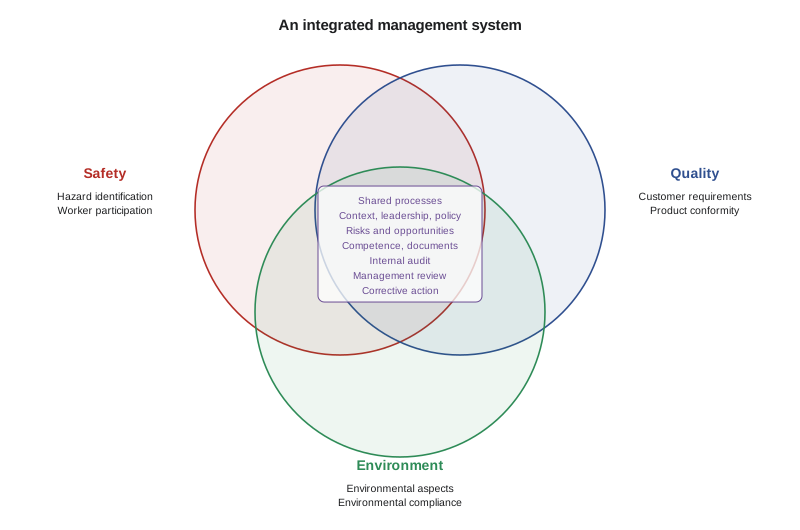
An integrated management system uses one set of processes for the shared elements, such as document control, internal audit, management review, competence, and corrective action, while keeping the content specific to each discipline. Integration saves effort, avoids duplicate and conflicting procedures, and gives leaders one view of the business. A change to a production line, for example, goes through one management of change process that considers safety, quality, food safety and environmental effects together.
Integration has risks. The discipline with the strongest team or the most external pressure can dominate. At many food companies, food safety and quality carry customer and regulatory weight that safety can lose out to. Safety has features the other systems lack, notably the requirement for worker consultation and participation, and an integrated system must not dilute them. Harrowgate Foods Ltd. kept the safety committees' role intact, kept a worker co-chair on the integrated management review, and kept safety-specific objectives separate from quality targets.
| Element | Integrate? | Notes |
|---|---|---|
| Document control | Yes | One system, one format, one approval process |
| Internal audit | Yes, with care | Combined audits need auditors competent in each discipline |
| Management review | Yes | One meeting, with safety given its own agenda time and worker input |
| Corrective action | Yes | One register, tagged by discipline |
| Management of change | Yes | One screen covering safety, quality, food safety and environment |
| Hazard identification | Partly | Shared methods, but safety hazards keep their own register |
| Worker participation | No | Keep the joint occupational health and safety committees and their legal role distinct |
| Objectives | Partly | Shared format, but separate safety objectives |
Capstone: a gap assessment
A gap assessment compares an organization's current system with the requirements of a standard or a target state, element by element, and identifies what needs to be done to close the gaps. It is usually the first step in building a system, and a useful health check for an existing one. Harrowgate Foods Ltd.'s next step was to acquire a small spice blending plant with about 40 workers, a site with basic safety compliance but no management system. Elena used the acquisition as the capstone of the company's learning: a gap assessment that pulled together every lesson.
The assessment rated each element on a scale of 0 to 4: 0 means absent, 1 means informal or partial, 2 means documented but not consistently implemented, 3 means implemented and effective, and 4 means implemented, effective and improving. Evidence came from documents, observation and interviews with a third of the workforce, across both shifts.
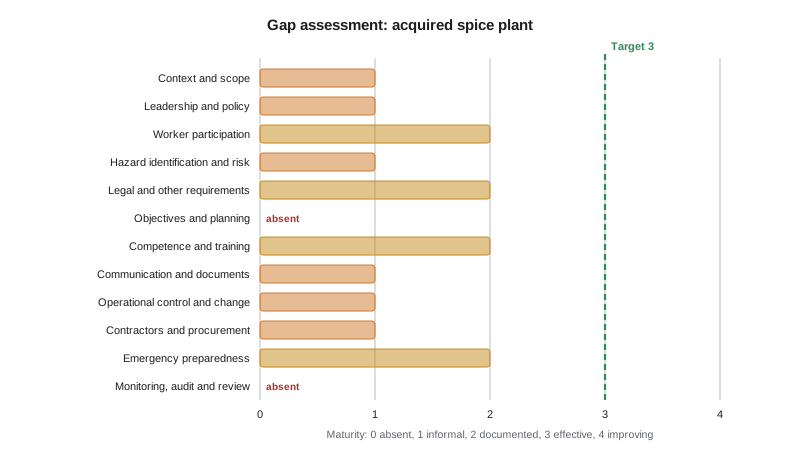
# Gap assessment for the acquired spice plant. Target maturity: 3.
scores = {
    "Context and scope": 1, "Leadership and policy": 1,
    "Worker participation": 2, "Hazard identification and risk": 1,
    "Legal and other requirements": 2, "Objectives and planning": 0,
    "Competence and training": 2, "Communication and documents": 1,
    "Operational control and change": 1, "Contractors and procurement": 1,
    "Emergency preparedness": 2, "Monitoring, audit and review": 0,
}
target = 3
gaps = sorted(scores.items(), key=lambda kv: kv[1])
print(f"Average maturity: {sum(scores.values()) / len(scores):.1f} of 4")
print("Largest gaps:")
for name, s in gaps[:4]:
print(f" {name}: {s} (gap {target - s})")Average maturity: 1.2 of 4 Largest gaps: Objectives and planning: 0 (gap 3) Monitoring, audit and review: 0 (gap 3) Context and scope: 1 (gap 2) Leadership and policy: 1 (gap 2)
From gaps to a plan
A gap list is not a plan. Elena's team prioritized gaps by risk, not by score. The lowest scores were in objectives and in monitoring, audit and review, but these mattered less in the first months than the gaps that could hurt someone soon: the blending room's dust hazard had never been assessed, two mixers had no equipment-specific lockout procedures, and contractors who serviced the dust collector had never been prequalified. Those went first. The plan ran in three phases over eighteen months:
- First 90 days: assess and control the highest risks (dust, lockout, contractors), set up a joint occupational health and safety committee meeting schedule, introduce the hazard reporting system and the company's emergency plan template, and brief leaders on the policy.
- Months 4 to 12: build the risk register with workers, align procedures and training to company standards, add the site to the legal register, set objectives, and include the site in the internal audit program.
- Months 13 to 18: first internal audit, first management review input, and readiness for the site to join the company's external recognition scope.
The gap assessment also produced something less tangible. The workers at the spice plant had been wary of the acquisition. Being interviewed, seeing their concerns written into the plan and having two of their own trained as auditors in the first year did more to build trust than any announcement.
Worked problem
Prioritizing gaps by risk
Show solution
- Gap: no combustible dust hazard assessment in the blending room (score 1 for hazard identification).
- Risk: dust accumulations on beams and the dust collector could support a deflagration; potential for serious injury to several workers.
- Gap: no management review (score 0), but no direct risk of harm in the next few months.
- Decision: the dust assessment and housekeeping controls go in the first 30 days; management review is set for month 13.
- Check: the 90-day review confirms dust controls in place and verified.
Answer: Risk, not score, sets the order: the lowest score is not always the most urgent gap.
Common mistakes
MistakeAnswering every incident with retraining.
InsteadAddress root causes and prefer stronger controls.
MistakeClosing actions when the work order is issued.
InsteadClose on evidence that the fix is in place, then check effectiveness.
MistakeTreating continual improvement as improving everything every month.
InsteadImprove the system steadily, using evidence to choose where.
MistakeLetting the strongest discipline dominate an integrated system.
InsteadKeep safety-specific features, especially worker participation.
MistakeFixing gaps in order of lowest score.
InsteadPrioritize gaps by the risk they leave uncontrolled.
MistakeRunning the same audits and reviews year after year.
InsteadRotate audit focus and auditors, and ask workers what the system is missing.
Summary and key terms
- Incidents and nonconformities share one process: react, find root causes, act, review risks, check effectiveness and update the system.
- Corrective actions work when they address causes, prefer stronger controls, close on evidence and are checked later.
- Continual improvement draws on every part of the system, including ideas from workers.
- Mature systems must be watched for drift and kept challenging.
- ISO 45001, ISO 9001 and ISO 14001 share a common structure, which makes integration practical.
- A gap assessment rates each element, but plans prioritize gaps by risk.
- Corrective action
- Action to eliminate the cause of a nonconformity or incident and prevent recurrence.
- Continual improvement
- Recurring activity to enhance performance.
- Integrated management system
- One system that manages several disciplines, such as safety, quality and environment, through shared processes.
- High-level structure
- The common clause structure shared by ISO management system standards.
- Gap assessment
- A comparison of the current system against requirements, element by element, to identify what must be done.
- Effectiveness check
- A later review confirming that a corrective action solved the problem.
Practice problems
Work each problem on paper first, then reveal the answer to check.
Name two ways corrective actions commonly fail.
Show answer
Targeting the person, relying on weak controls, closing early, never checking effectiveness.
Why did Harrowgate Foods Ltd. keep an improvement log separate from the corrective action register?
Show answer
Improvements are not only fixes for failures; ideas from the floor need a home too.
Name three elements that integrate well across safety, quality and environment.
Show answer
Document control, management review, corrective action, management of change.
What safety feature must an integrated system protect?
Show answer
Worker consultation and participation, including the committees.
In what order should gaps be closed?
Show answer
By the risk they leave uncontrolled, not by lowest score.
Lesson quiz · 5 questions
Score 60% or more to complete this lesson.
Create a free account to save your progress, take quizzes and earn a certificate.