
HSE-370 · Lesson 9 of 12 · 22 min
Cranes, hoisting and working near loads
On a building like Cottonwood Place, the tower crane is the centre of the site. It lifts rebar, formwork, concrete buckets, steel, mechanical units and bins of waste, hundreds of times a day, over the heads of workers on every floor. Most workers will never operate or rig for a crane, but nearly every worker will work near one. The hazards for them are a load or part of a load falling, a load swinging into them, being crushed between a load or a counterweight and a structure, and a crane contacting a power line or tipping over. This lesson explains how lifting is organized on a site, the roles of the people involved and the rules every worker follows around cranes, hoists and other lifting equipment. TRD-105 covers rigging and hoisting for the trades in depth, and HSE-374 covers steel erection.
Lifting equipment on a construction site
Cottonwood Place uses several kinds of lifting equipment, each with its own hazards:
- The tower crane stands on a concrete base inside the building footprint and lifts loads up to the top floor and across the whole site. Its operator works in a cab at the top of the mast or by remote control.
- Mobile cranes are brought in for heavy lifts, such as setting the rooftop mechanical units, and for erecting and dismantling the tower crane. They stand on outriggers on mats or cribbing, and their counterweights swing as they rotate.
- Telehandlers, also called rough-terrain forklifts, carry pallets around the laydown area and lift materials onto the lower floors. With a jib or hook attachment, a telehandler becomes a crane and must be used as one.
- The construction hoist, a temporary elevator on the outside of the building, carries workers and materials between floors.
- Small hoists, such as chain hoists and material hoists, lift loads within the floors.
The people involved in a lift
Every lift involves several people, and each has a defined job. Most crane incidents come from confusion about who is responsible for what, or from someone taking on a role they are not trained for.
| Role | What they do | At Cottonwood Place |
|---|---|---|
| Crane operator | Operates the crane, checks it daily, knows its capacity and limits, and has the authority to refuse a lift that is unsafe. | Ray Lindqvist, a certified tower crane operator. |
| Lift supervisor | Plans lifts, makes sure the right people and equipment are in place, and supervises critical lifts. | Carla Mendes or the crane company's lift supervisor for heavy lifts. |
| Rigger | Selects and inspects rigging, estimates load weights and attaches loads so they are balanced and secure. | Trained riggers from the forming, steel and mechanical crews. |
| Signaller | Communicates with the operator by hand signals or radio when the operator cannot see the load or the landing area. | One trained signaller per lift, identified by a coloured vest. |
| Workers near the lift | Stay out of the load path and the area under the load, and follow the signaller's directions. | Everyone else on site. |
Crane operators in Manitoba must be trained and hold the certification the provincial rules require for the type of crane they operate, and employers must make sure that riggers and signallers are competent for the work. the Workplace Safety and Health Regulation (Man. Reg. 217/2006) also requires cranes to be inspected and maintained to the manufacturer's requirements and the applicable CSA standards, with a logbook kept for each crane.
Only one person signals the operator at a time, so the operator never receives conflicting instructions. There is one exception: anyone who sees danger can give the emergency stop signal, both arms extended with palms down, moved back and forth, or the emergency stop word over the radio, and the operator stops immediately.
Planning lifts
Every lift is planned, even if the plan is short. For routine lifts, such as bundles of rebar or bins of form material, the plan is part of the daily lift schedule and the rigger's pre-lift check: the load weight, the rigging, the path and the landing area. For lifts that are heavier, more complex or more dangerous, Tallgrass Construction Ltd. requires a written critical lift plan approved before the lift. At Cottonwood Place, a lift is treated as critical if it is more than 75 percent of the crane's rated capacity at that radius, involves two cranes, lifts over the occupied office building or the street, lifts workers, or lifts an unusual load such as a mechanical unit with an uneven centre of gravity.
A critical lift plan names the people involved, describes the load and its weight and centre of gravity, the rigging and its capacity, the crane configuration and its capacity at every radius along the path, the ground conditions and outrigger setup for a mobile crane, the power lines and obstructions, the weather limits, the area to be cleared and barricaded, and the communication method. Everyone involved attends a briefing before the lift.
Rules for workers near cranes
The rules that keep workers safe around a crane come down to staying out of the places where a load or part of the crane could hit or crush them.
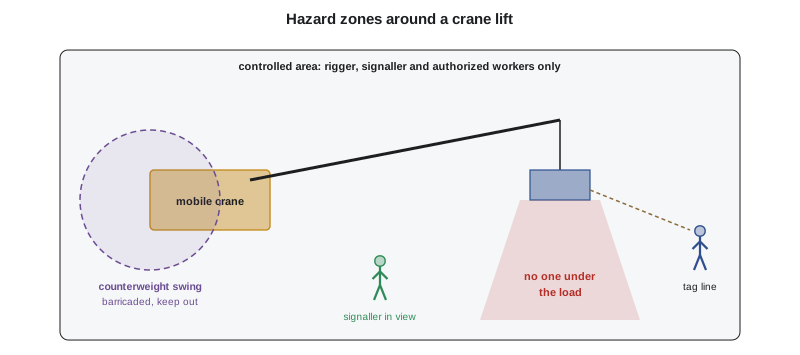
- Never stand or walk under a suspended load. Loads are moved so that they do not pass over workers, and workers stay out of the path of a load being moved. If a load must pass over a work area, the area is cleared first.
- Stay out of the swing radius. The counterweight of a mobile crane swings out behind the machine as it rotates and can crush a worker against another object. The swing area is barricaded.
- Use tag lines to control a load, not your hands. A tag line is a rope tied to the load that lets a worker guide and stop its rotation from a safe distance. Workers do not grab or push suspended loads, and they never put themselves between a load and a fixed object.
- Wait until the load is lowered and stable before approaching to land it or unhook it, and do not unhook until the load is blocked or set so it cannot roll or tip.
- Keep the landing area clear, with enough room for the load and for workers to stand clear while it settles.
- Follow the signaller. When the signaller tells workers to clear an area, they clear it.
- Do not ride a load or a hook. Workers are lifted only in an approved personnel basket under a specific plan.
Things that make loads fall or cranes fail
Most crane incidents have causes that can be seen in advance:
- Overloading, from underestimating the weight of a load or lifting at a longer radius than planned. A crane's capacity drops sharply as the radius increases.
- Rigging failures, from damaged slings, the wrong hitch, sharp edges cutting slings, sling angles that are too flat, or loads that are not balanced. Loose material, such as short pieces of pipe or bundles that are not tied, can slip out of the rigging.
- Ground failures under a mobile crane's outriggers, especially on backfill, near excavations or over buried services.
- Wind, which pushes on large loads such as formwork panels and on the crane itself. Each crane has a wind limit from its manufacturer, and large flat loads may have to stop at much lower wind speeds.
- Contact with power lines, covered in lesson 7.
- Two-blocking, when the hook block is pulled into the boom tip and the load line breaks; anti-two-block devices prevent it.
Ray Lindqvist checks the wind speed shown in his cab before every lift of a large panel and at regular intervals through the day. When the wind approaches the limit, he stops lifting large loads first, then all loads, and the crane is left free to turn with the wind, as the manufacturer requires, so the wind cannot push against a locked jib.
The construction hoist
The construction hoist carries workers and materials between floors. It is a machine, not a lift you push a button for and forget. At Cottonwood Place, the hoist is run by a trained hoist operator. Its capacity is posted on the car and is never exceeded. The landing gates on each floor stay closed unless the car is at that floor, and the hoist cannot move with a gate open. Workers do not lean out of the car or reach through the gates, and long materials are secured so they cannot stick out of the car. The hoist is inspected daily by the operator and on a regular schedule by a qualified person, and it is never used as an emergency exit.
Telehandlers and forklifts used for lifting
A telehandler with a boom extended has a lifting capacity that depends on the boom angle and extension, shown on its load chart. Operators must be trained and authorized on the machine they use, wear a seatbelt, keep loads low while travelling, and never travel with the boom raised or extended. When a telehandler is fitted with a hook or jib to lift a suspended load, it is being used as a crane and the crane rules apply: a rigger, a signaller, a clear area and no one under the load.
How close to capacity is the lift?
Before each lift, the rigger and the operator compare the load with the crane's rated capacity at the radius where the load will be picked up and set down. The program below runs that check for a few lifts in the Cottonwood Place schedule, using an invented, simplified load chart, and flags lifts that are critical under the site rule of more than 75 percent of capacity.
# Lift check against a simplified, invented tower crane load chart (tonnes at radius in metres).
chart = {20: 8.0, 30: 5.4, 40: 3.9, 50: 2.9, 60: 2.2}

def capacity(radius):
    # use the chart value for the next larger radius listed (conservative)
    return chart[min(r for r in chart if r >= radius)]

lifts = [  # (description, load in tonnes including rigging, radius in m, over occupied area?)
    ("Rebar bundle to level 5", 2.1, 34, False),
    ("Formwork table, north face", 3.4, 44, False),
    ("Concrete bucket, full", 3.9, 28, False),
    ("Mechanical unit to roof", 2.0, 58, True),
]
for desc, load, radius, occupied in lifts:
    cap = capacity(radius)
    pct = load / cap * 100
    critical = pct > 75 or occupied
    status = "OVER CAPACITY" if pct > 100 else ("CRITICAL LIFT PLAN" if critical else "routine")
print(f"{desc:28} {load:.1f} t at {radius} m: {pct:5.1f}% of {cap} t -> {status}")Rebar bundle to level 5 2.1 t at 34 m: 53.8% of 3.9 t -> routine Formwork table, north face 3.4 t at 44 m: 117.2% of 2.9 t -> OVER CAPACITY Concrete bucket, full 3.9 t at 28 m: 72.2% of 5.4 t -> routine Mechanical unit to roof 2.0 t at 58 m: 90.9% of 2.2 t -> CRITICAL LIFT PLAN
The formwork table is over capacity at the planned radius, so it must be picked up closer to the mast or split into smaller pieces. The mechanical unit is within capacity, but it is lifted over the occupied office building and is close to the limit, so it needs a critical lift plan. The rebar bundle and concrete bucket are routine lifts, although the concrete bucket is close to the 75 percent threshold, which is a reminder that the load weight must include the rigging and the bucket, not only the concrete.
Worked problem
The spinning formwork panel
Show solution
- A large formwork panel is being lifted to level 6 on a gusty afternoon. The rigger has attached a tag line, but the worker holding it is standing almost under the panel.
- A gust spins the panel. The worker grabs the panel edge with one hand to stop it, and his glove is pinched between the panel and the guardrail post as the panel swings back.
- The signaller gives the emergency stop. Ray holds the load still while the worker frees his hand. His glove is torn but his hand is only bruised.
- Owen Hartley reviews the near miss with the crew. The tag line was too short to let the worker stand clear, the wind was near the limit for large panels, and the landing area was too tight for the panel to turn.
- The crew changes three things: longer tag lines on large panels, a lower wind limit for formwork panels set by Carla and Ray together, and a wider landing area kept clear on each floor before panel lifts.
Answer: Hands on a suspended load put the worker where it could crush him. A tag line long enough to stand clear, a wind limit suited to large flat loads and a clear landing area remove the need to touch the load at all.
Common mistakes
MistakeWalking under a suspended load because it is "only rebar".
InsteadNever pass under a load; wait or take another route.
MistakeGuiding a load by grabbing it with your hands.
InsteadUse a tag line long enough to stand clear of the load.
MistakeSeveral workers giving signals to the operator.
InsteadOne designated signaller at a time; anyone may give the emergency stop.
MistakeGuessing the weight of a load without including the rigging.
InsteadKnow the full weight, including slings, spreaders and buckets, and check it against the chart.
MistakeUsing a telehandler with a hook as if it were still a forklift.
InsteadTreat it as a crane: rigger, signaller, clear area and no one under the load.
Summary and key terms
- Most workers on a site with a crane are at risk from falling or swinging loads, crush zones and crane contact with power lines.
- Crane operators must hold the required certification, and riggers and signallers must be competent.
- Every lift is planned; critical lifts need a written plan and a briefing.
- Workers never go under a suspended load, stay out of the counterweight swing, and use tag lines instead of their hands.
- Overloading, rigging failures, ground failures, wind and power lines cause most crane incidents.
- The construction hoist has a trained operator, posted capacity and gates interlocked with the car.
- Rated capacity
- The maximum load a crane can lift at a given radius and configuration, from its load chart.
- Radius
- The horizontal distance from the crane's centre of rotation to the centre of the load.
- Critical lift
- A lift with higher risk, such as one near capacity, over occupied areas or using two cranes, that needs a written plan.
- Tag line
- A rope attached to a load that lets a worker guide and control it from a safe distance.
- Signaller
- The designated person who communicates with the crane operator during a lift.
- Two-blocking
- Contact between the hook block and the boom tip that can break the load line.
Practice problems
Work each problem on paper first, then reveal the answer to check.
Name four people involved in a crane lift and what each does.
Show answer
The operator runs the crane, the lift supervisor plans and supervises, the rigger attaches the load, the signaller communicates with the operator; workers nearby stay clear.
When is a lift treated as critical at Cottonwood Place?
Show answer
Over 75 percent of capacity, two cranes, over the occupied building or street, lifting workers, or an unusual load.
Why must workers stay out of a mobile crane's swing radius?
Show answer
The counterweight swings out behind the crane and can crush a worker against another object.
Who may give the emergency stop signal?
Show answer
Anyone who sees danger.
What did the capacity check show for the formwork table?
Show answer
It was over capacity at the planned radius, so it must be picked closer to the mast or split up.
Lesson quiz · 5 questions
Score 60% or more to complete this lesson.
Create a free account to save your progress, take quizzes and earn a certificate.