
HSE-370 · Lesson 8 of 12 · 21 min
Excavations and trenches
A trench can look solid and stable one minute and collapse the next, without a sound or a warning crack. When it does, a worker caught in it can be buried to the chest or completely, under soil that weighs as much as a small car per cubic metre. Workers partly buried often cannot breathe because the soil presses on their chest, and rescuers who jump in to dig them out are often caught by a second collapse. Trench collapses are among the deadliest events in construction, and almost every one of them could have been prevented by a protective system that the crew decided was not needed this time. This lesson covers why excavations collapse, how they are protected, the other hazards in and around them, and what every worker on the site, not only the excavation crew, should know.
At Cottonwood Place, the excavation for the underground parking level runs to about 4.5 metres (15 feet) deep. Along the lane and the occupied office building, the walls are held by an engineered shoring system of steel piles and timber lagging, with tiebacks into the soil. Silva Earthworks also digs trenches for the water, sewer and power services, some of them over 2.5 metres (8 feet) deep, across the lane and the laydown area.
Why trenches collapse
Soil holds its shape only for a while after it is cut. The weight of the soil beside the trench pushes toward the open face, and the soil's own strength resists. Many things tip the balance:
- Soil type. Clay holds a cut face longer than sand or gravel, but even stiff clay cracks and slumps once it dries or gets wet. Fill that was placed and compacted recently, such as the backfill around old foundations, is much weaker than undisturbed soil.
- Water. Rain, melting snow, groundwater and leaking pipes soften soil and add weight. Many collapses follow a night of rain.
- Freezing and thawing. Frozen soil can look solid, but it loses strength quickly as it thaws.
- Loads near the edge. Spoil piles, stacked pipe, parked equipment and passing trucks push down on the soil beside the trench.
- Vibration. Traffic in the lane, compactors and pile driving shake the soil loose.
- Previously disturbed ground. Old utility trenches crossing the new excavation create weak zones.
- Time. The longer a trench stays open, the more chance conditions change.
One cubic metre of typical soil weighs about 1.6 to 2 tonnes (about 2,700 to 3,400 pounds per cubic yard). Even a small section of trench wall can bury a worker, and the force on the chest of someone buried to the waist is enough to stop them breathing.
When protection is required
Manitoba's rules require the walls of an excavation or trench deeper than 1.5 metres to be sloped, benched or supported with shoring, a trench box or another protective system before anyone enters it, unless it is cut in sound rock. Provincial guidance for typical soil describes sloping the walls at 1 to 1, or 45 degrees, above the first metre, and an engineered design is needed where the soil, the depth or nearby structures make simple sloping or standard shoring inadequate. Excavated soil and other materials must be kept at least 1 metre back from the edge. A ladder is needed for access in excavations deeper than 1.5 metres, extending at least 1 metre above the top and placed so workers do not have far to go to reach it. Excavation work near buried utilities must follow the locate rules covered in lesson 7.
Depth is measured from the top of the trench wall at its highest point, and the rules apply to anyone entering the trench, including inspectors, surveyors and workers from other trades who need to check a pipe or take a measurement.
Protective systems
There are three main ways to protect workers in an excavation. All of them must be designed for the soil, depth and loads, and installed before anyone enters.
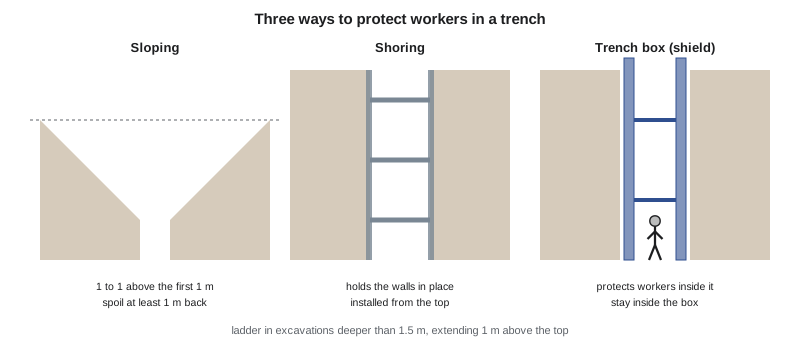
- Sloping and benching cut the walls back at an angle so the soil cannot collapse into the trench. Sloping takes a lot of space, which is often not available on a city site, and the angle depends on the soil: the weaker the soil, the flatter the slope.
- Shoring holds the walls in place with a structure of uprights, walers and cross braces, made of timber, aluminum hydraulic jacks or steel. Shoring actively supports the soil and is installed from the top, so workers do not enter the unprotected trench to install it.
- Trench boxes, also called shields, are steel or aluminum structures placed in the trench to protect workers inside them if the walls collapse. A shield does not hold the soil back; it keeps the soil away from the workers. Workers must stay inside the box, and the box must extend high enough to stop soil from spilling over the top.
Soil classification drives the design. Silva Earthworks has its engineer review the geotechnical report for Cottonwood Place, which describes the stiff clay that is common in the Winnipeg area, a layer of silty fill near the old foundations, and groundwater near the bottom of the deepest excavation. Clay of this kind can stand vertically for a while after it is cut and then fail suddenly as it dries, cracks or softens, which is why no one relies on it standing on its own.
Shoring next to existing buildings
The deep excavation along the office building at Cottonwood Place is a special case. If the soil under the building's foundations moved, the building could settle or crack, and people inside could be hurt. This shoring was designed by a professional engineer, and its movement is monitored with survey targets on the shoring and on the building, read twice a week. If movement exceeds the engineer's trigger levels, work in the area stops until the engineer reviews it. Workers do not remove lagging, cut tiebacks or dig below the design depth next to the shoring without the engineer's approval.
Other hazards in and around excavations
Collapse is the headline hazard, but excavations hold others:
- Falls into the excavation. Workers, equipment and members of the public can fall in. The edges of the Cottonwood Place excavation have guardrails, and trenches are barricaded and covered when work stops for the day.
- Falling material. Loose rocks, spoil and tools can roll in from the edge. Spoil is kept back from the edge, and workers wear hard hats in the trench.
- Equipment at the edge. An excavator or truck too close to the edge adds load to the wall and can tip in. Stop blocks or barriers mark where equipment may go.
- Water. Water in the trench softens the walls and can hide hazards. It is pumped out before entry, and work stops during heavy rain.
- Hazardous atmospheres. Excavations near landfills, fuel tanks, sewers or gas lines, and deep trenches where heavy gases collect, can contain low oxygen, flammable gas or toxic gases such as hydrogen sulfide. The air is tested with a gas monitor before entry where this is possible. An excavation can also be a confined space; HSE-212 and the confined space courses cover entry rules.
- Struck by equipment. Workers in a trench must stay clear of the excavator bucket and the load being lowered, and nobody stays in the trench under a suspended pipe or a bucket.
- Buried utilities. Lesson 7 covers locating and exposing them.
Inspections
Excavations change from day to day, and sometimes from hour to hour. Marco Silva, Silva Earthworks' foreman and its competent person for excavations, inspects every trench and the main excavation at the start of each shift, after rain, after any event that could weaken the walls, such as a heavy truck passing or a water line leak, and whenever the work changes. He looks for:
- Cracks or fissures in the ground near the edge, or in the face of the wall.
- Bulging or sloughing at the bottom of the wall.
- Water seeping from the walls or pooling in the bottom.
- Spoil, materials or equipment too close to the edge.
- Damage to, or movement of, shoring members or the trench box.
- Changes in nearby structures, such as cracks in pavement or walls.
- Access ladders in place and secured.
If he finds a problem, workers leave the trench until it is fixed. He records each inspection on a checklist kept at the trench.
Rescue
When a trench collapses on a worker, the natural reaction of the crew is to jump in and dig. This is how many second victims die: the trench that just collapsed is unstable, and another section falls on the rescuers. The Cottonwood Place emergency plan sets out the steps: call 911 at once and say it is a trench collapse so a technical rescue team is sent; shut down equipment nearby to reduce vibration; keep everyone out of the trench and back from the edge; and, if it can be done from outside the trench, lower a ladder or air line to the victim. Only trained rescuers with the equipment to shore the trench go in.
How heavy is a trench wall?
The program below estimates the weight of soil in a section of trench wall that could collapse, using an invented example of a vertical cut, and shows how much wider a sloped trench must be at the top than a vertical one. The soil density and slope are typical figures for illustration.
# Weight of a collapsing wedge, and top width of a sloped trench (illustrative figures).
DENSITY = 1.8       # tonnes per cubic metre, typical moist clay
depth = 2.5         # m
length = 2.0        # m of trench wall
wedge_width = 0.6   # m, width at the top of a wedge that slumps off a vertical face

wedge = 0.5 * wedge_width * depth * length          # triangular wedge, cubic metres
print(f"Wedge volume {wedge:.2f} m3, weighing about {wedge * DENSITY:.1f} tonnes")

bottom = 1.0         # m, trench width at the bottom
vertical_part = 1.0  # m kept vertical at the bottom before the slope starts
slope = 1.0          # horizontal per vertical, 1 to 1
sloped_height = depth - vertical_part
top = bottom + 2 * slope * sloped_height
print(f"Vertical trench top width: {bottom:.1f} m; sloped trench top width: {top:.1f} m")Wedge volume 1.50 m3, weighing about 2.7 tonnes Vertical trench top width: 1.0 m; sloped trench top width: 4.0 m
Even a narrow wedge slumping off a 2.5 metre wall weighs more than two tonnes, far more than anyone can dig out of by hand. Sloping the same trench means a top width of 4 metres instead of 1, which takes up much of the lane. That is why the service trenches across the lane at Cottonwood Place use hydraulic shoring or a trench box instead of sloping.
Worked problem
The morning after the storm
Show solution
- A heavy thunderstorm passes over the site overnight. The service trench across the lane, 2.4 metres (8 feet) deep, is protected by a trench box, but the soil above the box is cut back only partly.
- At 6:45, Marco Silva inspects the trench before anyone enters. He finds 20 centimetres (8 inches) of water in the bottom, a crack running along the ground about 1 metre (3 feet) back from the east edge, and part of the spoil pile slumped toward the edge.
- He keeps the crew out. The water is pumped out, the spoil pile is moved farther back, and the soil above the box is cut back to a safe slope so the crack zone is removed.
- He re-inspects and records the changes before the crew enters. He also asks Carla to keep trucks out of the lane next to the trench for the day.
- At the morning huddle, he shows the crew the crack and explains why the trench was not safe even with the box in it.
Answer: Rain changed the trench overnight. The inspection before entry caught the water, the crack and the slumped spoil, and the hazards were fixed before anyone went in, rather than discovered by a collapse.
Common mistakes
MistakeEntering a trench "just for a minute" to check a pipe without protection.
InsteadNever enter an unprotected trench that needs a protective system, however short the task.
MistakeTrusting clay to stand because it has stood all morning.
InsteadUse a designed protective system; clay can fail suddenly as it dries or softens.
MistakePiling spoil right at the edge of the trench.
InsteadKeep spoil and materials back from the edge, as the rules require.
MistakeWorking outside the end of a trench box.
InsteadStay inside the protected area of the box at all times.
MistakeJumping in to dig out a buried coworker.
InsteadCall 911 for technical rescue, stop nearby equipment and stay out of the unstable trench.
Summary and key terms
- Trench collapses happen without warning and bury workers under soil weighing well over a tonne per cubic metre.
- Soil type, water, freeze-thaw, loads near the edge, vibration, disturbed ground and time all reduce stability.
- In Manitoba, excavations deeper than 1.5 metres must be sloped, shored or otherwise protected, with spoil at least 1 metre back from the edge.
- Sloping, shoring and trench boxes are designed for the soil and depth and installed before entry.
- Excavations also hold fall, water, atmospheric, equipment and utility hazards.
- Inspections before each shift and after rain catch changing conditions; rescue is left to trained rescuers with shoring.
- Excavation
- Any cut, cavity or depression in the earth made by removing soil.
- Trench
- A narrow excavation that is deeper than it is wide.
- Sloping
- Cutting the walls of an excavation back at an angle so the soil cannot collapse into it.
- Shoring
- A structure of uprights, walers and cross braces that holds trench walls in place.
- Trench box (shield)
- A steel or aluminum structure placed in a trench to protect workers inside it if the walls collapse.
- Spoil
- Soil removed from an excavation and piled nearby.
- Competent person
- A person with the knowledge, training and experience to inspect excavations and identify hazards.
Practice problems
Work each problem on paper first, then reveal the answer to check.
Name four conditions that make a trench wall more likely to collapse.
Show answer
Any four of: weak or disturbed soil, water, thawing, loads near the edge, vibration, crossing old trenches and time open.
At what depth do Manitoba's rules require a protective system?
Show answer
Deeper than 1.5 metres, unless the excavation is in sound rock.
What is the difference between shoring and a trench box?
Show answer
Shoring holds the soil in place; a trench box does not hold the soil back but protects the workers inside it if the walls collapse.
What did Marco find after the storm, and what did he do?
Show answer
Water in the trench, a crack near the edge and slumped spoil; he kept the crew out until the water was pumped, the spoil moved back and the soil cut back, then re-inspected.
Why should workers not jump in to dig out a buried coworker?
Show answer
The trench is unstable and a second collapse can bury the rescuers.
Lesson quiz · 5 questions
Score 60% or more to complete this lesson.
Create a free account to save your progress, take quizzes and earn a certificate.