
HSE-370 · Lesson 4 of 12 · 21 min
Housekeeping, access and egress
Housekeeping sounds like the least important part of construction safety. It is not. A floor covered in form ply offcuts, tangled cords and loose rebar ties is a floor where workers trip, twist ankles and fall into openings they cannot see. Debris on an upper floor becomes a falling-object hazard for everyone below. Piles of packaging and wood scraps feed fires. A blocked stairway can trap workers in an emergency. And a site that is visibly messy tells every worker that corners are being cut. This lesson covers housekeeping, how workers get to and from their work safely, and how they get out quickly when they must.
Why housekeeping matters
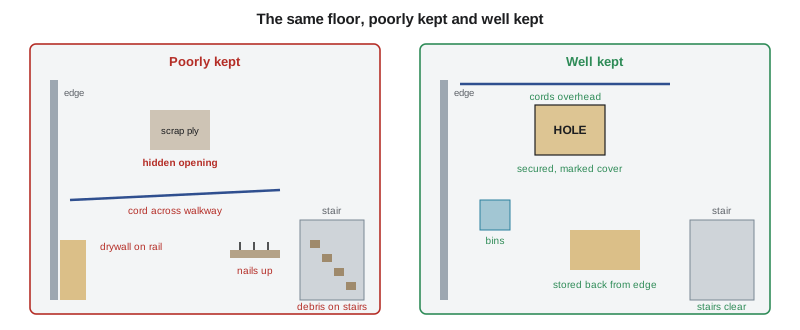
Slips, trips and falls on the same level are among the most common causes of lost-time injuries in construction. Many of them are trips over material left in walkways, cords stretched across floors and debris on stairs. Poor housekeeping also contributes to serious events. Workers have fallen through floor openings that were hidden under scraps of drywall or plastic sheeting. Nails sticking out of boards cause puncture wounds that become infected. A bucket left near a deck edge can be kicked off and fall several floors.
Cottonwood Place treats housekeeping as part of every task, not a separate job. Each crew cleans up as it works, and nobody leaves a work area at the end of the shift until it is clean. Dev Sandhu's main job in his first weeks is clean-up on the structure floors, and his foreman, Luis, tells him why it matters: "You're not the janitor. You're the reason nobody falls through a hole they can't see."
Clean as you go
The most effective housekeeping is done by the crew that makes the mess, while they make it. On each floor, Tallgrass Construction Ltd. provides bins for wood, metal, general waste and recycling, and the forming and drywall subcontractors are responsible for their own scraps. Specific habits matter:
- Pull or bend nails in used lumber and form material before stacking it, and never leave a board with nails pointing up.
- Coil cords and hoses when not in use, and route them overhead or along walls rather than across walkways. Where a cord must cross a walkway, use a cord cover.
- Pick up rebar ties, screws and bolts before they scatter across the deck.
- Keep walkways, stairways and exits clear, with nothing stored on stairs or landings.
- Clean up spills right away, especially form oil, curing compound, hydraulic fluid and water on smooth concrete.
- Remove packaging from the floor as soon as materials are unpacked; plastic wrap and cardboard are slippery and burn easily.
- Cap or bend protruding rebar so that no one can fall onto an exposed end. Impalement on rebar is covered in HSE-371.
Getting debris off the floors
On a multi-storey building, waste has to come down safely. Throwing debris off a floor edge or down an opening is never allowed. Material dropped from height can kill someone below, and the bounce and scatter are unpredictable. Waste comes down from upper floors at Cottonwood Place in one of three ways: in bins lifted by the crane, in the construction hoist, or through an enclosed debris chute that runs down the outside of the building into a covered bin. The area around the bottom of the chute is barricaded, and the chute is kept closed when not in use. Construction regulations in both Canada and the United States restrict dropping material from height and require enclosed chutes or barricaded drop zones where debris is dropped.
Storing materials
Materials stored badly cause their own injuries. Stacks of block, drywall or lumber can tip over and crush feet and legs. Materials stored near a floor edge or opening can be knocked or blown off. Heavy loads placed on a new slab or a scaffold can overload it.
- Store materials on level, firm ground or on a floor that can carry the load, and ask before landing heavy loads on a new deck.
- Stack materials so they are stable, with heavy items at the bottom, and limit the height of stacks.
- Keep materials well back from floor edges, openings and excavations. On the structure floors at Cottonwood Place, nothing is stored within 2 metres of an open edge or opening.
- Secure light materials such as insulation, plastic sheeting and empty buckets against wind, especially on the upper floors.
- Do not store anything on or against guardrails.
- Store pipe and rebar in racks or on dunnage, with ends chocked so they cannot roll.
Access: getting to the work
Workers need a safe way to reach every place they work. On a building under construction, that changes as the building rises. In the excavation phase, access means ramps and ladders into the excavation. In the structure phase, it means temporary stairs, ladders and the construction hoist. In the finishing phase, the permanent stairs are usually in use.
Stairs
Stairs are the preferred way to move between floors because they let workers carry tools and use a handrail. At Cottonwood Place, Tallgrass Construction Ltd. installs temporary stair towers as the structure rises, and the permanent stairs are used as soon as they are poured, with temporary handrails and guardrails on any open sides. Stairs are lit, kept clear of materials and checked for loose treads and missing rails during inspections. Where a stair has pan treads that will be filled with concrete later, the pans are filled with wood or another temporary material so that workers do not step into an empty pan.
Ladders
Ladders are a common way to reach a work area, but they are also a common source of falls. A ladder used for access between levels should extend at least 1 metre (3 feet) above the landing, be secured at the top and bottom, and be set at about 4 to 1: one unit out at the base for every four units of height. Workers face the ladder and keep three points of contact while climbing, with tools carried in a belt or raised with a hand line. Lesson 5 covers ladders and falls in more detail.
Walkways, ramps and runways
Workers also need safe routes across the site at ground level, between the gate, the trailers, the laydown area and the building. Cottonwood Place keeps pedestrians and vehicles apart with a fenced walkway from the pedestrian gate to the trailers and the building entrance, marked crossings where the walkway meets the vehicle route, and a covered walkway where the route passes under the crane. Ramps and runways are built strong enough for their use, with cleats or a non-slip surface on steep sections and guardrails where they are more than a short height above the ground.
Snow and ice
Winter in Winnipeg adds snow, ice and short days. Ice on stairs, ramps, scaffold planks and steel beams causes serious falls. Tallgrass Construction Ltd. clears snow from walkways, stairs and decks at the start of each shift, spreads sand or grit on icy surfaces, and keeps the main routes lit during the dark mornings and late afternoons. Workers wear boots with good tread or add traction aids where conditions call for them, and nobody walks on steel or formwork that is covered in ice. When temporary heat is used to protect concrete in winter, the heaters and fuel cylinders are placed and checked so they do not create fire or carbon monoxide hazards; lesson 10 covers carbon monoxide.
Egress: getting out
Egress means the way out. In an emergency, such as a fire, a structural problem or a gas leak, workers on the upper floors must be able to leave quickly and safely. A site that is well organized for normal work can still fail at egress if the stairs are blocked, the routes are dark or the only way out passes through the danger.
- Every floor at Cottonwood Place has at least two ways down, normally the two stair towers, with the hoist as an extra route but never counted as an emergency exit.
- Exit routes are marked with signs and kept clear at all times. Nothing is stored in a stair or on a landing, even for a few minutes.
- Routes are lit, with temporary lighting on its own circuit so a tripped breaker on a floor does not plunge the stairs into darkness.
- Doors on exit routes, including temporary hoarding doors, open easily from the inside without a key.
- Fire extinguishers are placed near each stair and at each hot work area, and workers know where they are.
Housekeeping and fire
Construction sites burn more easily than finished buildings. The walls have not been closed in, fire protection systems are not yet working, and there is plenty to burn: wood formwork, packaging, insulation, plastic sheeting, fuel and solvents. Hot work, such as welding, cutting and grinding, and temporary heating add ignition sources. Good housekeeping removes much of the fuel. At Cottonwood Place, combustible waste is removed from each floor daily, flammable liquids are stored in approved containers in a designated area, smoking is allowed only in the designated area near the trailers, and every hot work job has a permit, a fire watch and an extinguisher on hand.
Inspecting housekeeping
Owen Hartley and the workplace safety and health committee score housekeeping on every floor during their weekly inspection. Each floor is checked against ten items, such as clear walkways, secured covers, cords off the floor and no materials near edges, and gets one point for each item in order. The program below calculates scores for one week's inspection with invented results, and flags any floor that scored below eight.
# Weekly housekeeping scores (invented results). One point per item in order, out of 10.
items = ["walkways clear", "stairs clear", "covers secured", "cords off floor", "nails removed",
         "no material near edges", "bins not overflowing", "spills cleaned", "rebar capped", "exits lit"]
results = {
    "Level P1": [1, 1, 1, 0, 1, 1, 1, 1, 1, 1],
    "Level 1":  [1, 1, 1, 1, 1, 1, 0, 1, 1, 1],
    "Level 2":  [0, 1, 0, 0, 1, 1, 0, 1, 1, 1],
    "Level 3":  [1, 1, 1, 1, 1, 0, 1, 1, 0, 1],
}
for floor, r in results.items():
    score = sum(r)
    missed = [items[i] for i, ok in enumerate(r) if not ok]
    flag = "  FOLLOW UP" if score < 8 else ""
print(f"{floor}: {score}/10{flag}" + (f" missed: {', '.join(missed)}" if missed else ""))Level P1: 9/10 missed: cords off floor Level 1: 9/10 missed: bins not overflowing Level 2: 6/10 FOLLOW UP missed: walkways clear, covers secured, cords off floor, bins not overflowing Level 3: 8/10 missed: no material near edges, rebar capped
Level 2 scored six, and two of its misses, a cover that was not secured and a walkway that was not clear, are the kind that lead to serious falls. Owen took the results to the next coordination meeting. Level 2 was where the mechanical and electrical crews had just started, and neither had been given a waste bin. Tallgrass Construction Ltd. added bins, and the two foremen agreed to a fifteen-minute clean-up at the end of every shift.
Worked problem
The icy stair tower
Show solution
- At 6:45 on a January morning, Dev arrives to find that freezing rain overnight has left a glaze of ice on the open treads of the east stair tower.
- He does not climb it. He tells Luis, who stops access to the east stairs with a barricade and a sign, and sends everyone to the west stairs, which are enclosed.
- Luis and Dev chip and salt the treads, spread grit, and check the handrails for ice before reopening the stairs.
- At the morning coordination huddle, Carla adds a rule: on any day with freezing rain or snow overnight, both stair towers are checked and cleared before the first crews go up.
- Owen adds the check to the opening checklist the Tallgrass Construction Ltd. labourers complete each morning.
Answer: A hazard that appears overnight is controlled by a routine check before work starts, not by hoping each worker notices it. Closing one route and opening another kept people moving safely while the stairs were cleaned.
Common mistakes
MistakeLeaving clean-up for the end of the week or for the labourers.
InsteadClean as you go; every crew cleans up its own work area each shift.
MistakeThrowing debris off a floor edge "when no one is below".
InsteadUse bins, the hoist or an enclosed chute with a barricaded drop zone.
MistakeStoring a stack of drywall against a guardrail.
InsteadStore materials on a level surface, well back from edges and openings.
MistakeSetting tools or materials on a stair landing "for a minute".
InsteadKeep stairs and exit routes completely clear at all times.
MistakeRunning cords across walkways.
InsteadRoute cords overhead or along walls, or use a cord cover where they must cross.
Summary and key terms
- Poor housekeeping causes trips, hidden openings, falling objects and fires.
- Each crew cleans as it goes: nails pulled, cords coiled and routed off the floor, spills cleaned and packaging removed.
- Debris comes down in bins, the hoist or an enclosed chute, never thrown from an edge.
- Materials are stored stable, on surfaces that can carry them, and well back from edges and openings.
- Safe access uses stairs with handrails, properly set ladders and separate pedestrian walkways, with weather hazards controlled each shift.
- Egress means at least two clear, lit, marked ways out of every floor.
- Housekeeping
- Keeping a work area clean, orderly and free of debris, spills and obstacles.
- Access
- The safe route a worker uses to reach their work, such as stairs, ladders, walkways and ramps.
- Egress
- The way out of a building or area, especially in an emergency.
- Debris chute
- An enclosed chute used to send waste down from upper floors into a bin.
- Cord cover
- A ramp-shaped cover that protects a cord where it crosses a walkway and reduces the trip hazard.
Practice problems
Work each problem on paper first, then reveal the answer to check.
Name four clean-as-you-go habits.
Show answer
Any four of: pull or bend nails, coil and route cords, pick up ties and screws, keep walkways and stairs clear, clean spills, remove packaging and cap protruding rebar.
How does waste come down from upper floors at Cottonwood Place?
Show answer
In crane-lifted bins, in the hoist or through an enclosed chute with a barricaded area at the bottom.
How far above the landing should an access ladder extend, and at what angle should it be set?
Show answer
At least 1 metre (3 feet) above the landing, set at about 4 to 1.
Why is the construction hoist not counted as an emergency exit?
Show answer
It may not work in an emergency, such as a power failure or fire, so workers need stairs.
What did the housekeeping scores show on level 2, and what fixed it?
Show answer
A low score with an unsecured cover and blocked walkway; new crews had no bins, so bins were added and a daily clean-up was agreed.
Lesson quiz · 5 questions
Score 60% or more to complete this lesson.
Create a free account to save your progress, take quizzes and earn a certificate.