
HSE-370 · Lesson 11 of 12 · 21 min
Personal protective equipment on site
Personal protective equipment, or PPE, is the most visible part of construction safety. Hard hats, safety boots, high-visibility vests and safety glasses are the uniform of a construction site, and a worker without them stands out at once. PPE matters: a hard hat can turn a fatal head injury into a bruise, and safety glasses save eyesight every day. But PPE is also the last line of defence. It does nothing to remove the hazard, it only works if it is the right equipment, fitted, worn correctly and in good condition, and it protects only the person wearing it. This lesson covers the PPE required on construction sites, how to choose and wear it, how to look after it and where its limits are.
PPE in the hierarchy of controls
Every lesson in this course has used the same order of controls: eliminate the hazard if you can, substitute something less hazardous, use engineering controls such as guardrails, shoring and dust capture, then administrative controls such as procedures, training and scheduling, and finally PPE. PPE comes last not because it is unimportant but because it is the least reliable. A guardrail protects every worker at the edge whether they are paying attention or not. A harness protects only the worker who is wearing it, has fitted it, has inspected it and has tied off to a proper anchor. A water-fed saw protects everyone on the floor from silica dust; a respirator protects only the cutter, and only if it fits.
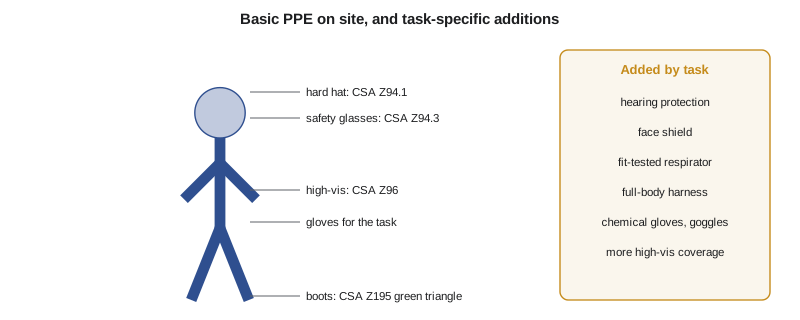
On a construction site, PPE is still essential, because many hazards cannot be fully engineered out: objects can fall even with toe boards and netting, nails can lie in the mud, and fragments fly from even a well-guarded grinder. The basic PPE required everywhere on site protects against those everyday hazards. Task-specific PPE is added where the work calls for it.
Head protection
Hard hats protect the head from falling objects, from bumping into fixed objects and, depending on their class, from electrical contact. In Canada, construction hard hats must meet CSA Z94.1. Type 1 hard hats protect against impacts to the top of the head; Type 2 hard hats also protect against impacts to the front, back and sides, which matters on a site where workers can be struck by swinging loads or fall and hit their heads. The class shows electrical protection: Class E for high-voltage protection, Class G for general use, and Class C for no electrical protection. At Cottonwood Place, Type 2, Class E hard hats are required on the structure floors and near the crane.
A hard hat only works if it is worn properly and in good condition:
- Adjust the suspension so the hat sits level and snug, with space between the shell and the head. The suspension absorbs the energy of a blow; the shell spreads it.
- Wear it facing forward unless the manufacturer marks it as safe to wear backward.
- Use a chin strap when working at height, in wind or bending over, so the hat stays on in a fall.
- Do not drill holes in the shell, paint it or cover it with stickers that hide cracks, unless the manufacturer allows it.
- Inspect the shell and suspension daily for cracks, dents, brittleness and fading. Replace a hard hat that has taken a significant blow, even if no damage shows, and replace shells and suspensions on the manufacturer's schedule.
- Do not store it in the rear window of a vehicle, where sunlight and heat weaken the plastic.
Eye and face protection
Eye injuries are common on construction sites, from dust blown in the wind, chips from concrete, fragments from cutting and grinding, splashes of concrete, form oil and chemicals, and nails from nail guns. Safety glasses with side protection, meeting CSA Z94.3, are required everywhere on site at Cottonwood Place. Goggles are added for dust and chemical splashes, and face shields are worn over safety glasses for grinding, cutting, chipping and handling chemicals. Welders and workers nearby need filter lenses and screens for welding arcs. Workers who need prescription lenses wear prescription safety glasses or protection designed to fit over their glasses.
Foot protection
Construction footwear has to protect against heavy objects dropping on the toes, nails and rebar ties through the sole, and slips and twisted ankles on uneven ground. In Canada, construction boots carry the green triangle mark of CSA Z195, which shows a protective toe cap and a puncture-resistant sole plate. Other marks show electrical shock resistance and other features. Boots should also have good tread, ankle support and, in winter, insulation rated for the cold. Cottonwood Place requires CSA Z195 green-triangle boots at all times outside the trailers.
High-visibility clothing
High-visibility clothing makes workers easier for equipment operators and drivers to see, which matters most around reversing equipment, at the gate and in the lane, and in low light. CSA Z96 sets requirements for the fluorescent background material and the retroreflective stripes, and classes the garments by how much of the body they cover. Cottonwood Place requires a high-visibility vest or shirt meeting CSA Z96 at all times outside the trailers, with garments that have more coverage for traffic control persons and workers in the lane. Vests must be kept clean and replaced when faded, because dirt and fading cut how far away a worker can be seen.
Hand protection
Hands are injured more often than almost any other part of the body in construction, by cuts from sheet metal, rebar and knives, crushing between materials, punctures, burns, chemical contact and vibration. There is no single glove for every job. Cut-resistant gloves are needed for sheet metal, glass and knives; impact gloves with padding on the back of the hand for handling heavy materials; chemical-resistant gloves chosen from the safety data sheet for solvents, adhesives and wet concrete; insulated gloves for cold; and rated rubber insulating gloves only for qualified electrical workers. Gloves are not worn near rotating parts such as drill bits, where a glove can be caught and pull the hand in.
Hearing and respiratory protection
Lesson 10 covered noise and silica. Hearing protection, earplugs or earmuffs, is required wherever noise is above the site's limit or posted. Respirators protect against dust, mist, fumes and some gases and vapours, but only when the right type is chosen for the hazard, and only when tight-fitting respirators have been fit-tested to the worker's face and the worker is clean-shaven where it seals. A dust mask that is not a certified respirator does not protect against silica.
In Canada, respirator selection, fitting and care follow CSA Z94.4, and employers that require respirators must have a written respiratory protection program covering selection, fit testing, training, cleaning and maintenance.
Clothing and fit
Work clothing is also protection. Long sleeves and long pants protect against cuts, abrasion, sun and wet concrete. Loose clothing, long hair and jewellery can be caught in rotating tools and machinery, so they are tied back or removed. Hot work and electrical work may require flame-resistant or arc-rated clothing.
PPE only protects if it fits. A harness that is too large lets a worker slip out in a fall; gloves that are too big get caught; safety glasses that slide down the nose leave gaps; earmuffs that do not seal let noise through. Women and smaller workers in particular have often been handed equipment sized for the average man. Tallgrass Construction Ltd. stocks harnesses, gloves, glasses and vests in a range of sizes, including those designed for women's body shapes, and requires each worker's PPE to fit properly.
Who provides PPE
Employers must make sure workers have and use the PPE their work requires. In Manitoba, the rules on who pays for particular items vary: employers generally provide task-specific equipment such as harnesses, respirators, face shields and hearing protection, while workers commonly supply their own safety boots. At Cottonwood Place, each employer supplies its workers' task-specific PPE and replaces it when it is damaged, and Tallgrass Construction Ltd. keeps a supply of hard hats, glasses, vests, earplugs and gloves at the trailer for visitors and for anyone whose equipment has been damaged.
Inspecting and caring for PPE
PPE wears out and gets damaged. Workers inspect their own PPE before each use and report damage; employers inspect and replace it on a schedule. Simple habits keep it working: store it clean and dry, out of sunlight and away from chemicals; clean glasses and respirators as the manufacturer directs; replace respirator filters and cartridges on schedule or when breathing becomes harder or odours come through; and remove from service anything that has been in an incident, such as a harness that arrested a fall or a hard hat that took a blow.
Choosing PPE by task
Each subcontractor's task hazard assessments list the PPE for each task. Owen Hartley keeps a simple matrix for the common tasks on site. The program below prints the required PPE for a few tasks, combining the basic site PPE with the task-specific items.
# Required PPE by task at Cottonwood Place (site basics plus task-specific items).
BASIC = ["hard hat", "safety boots", "high-vis vest", "safety glasses"]
TASK_PPE = {
    "Cutting block (wet saw)":       ["hearing protection", "face shield", "respirator if the plan requires"],
    "Steel connecting at level 7":   ["full-body harness with SRL", "chin strap", "impact gloves"],
    "Handling sheet metal duct":     ["cut-resistant gloves", "long sleeves"],
    "Applying form release oil":     ["chemical-resistant gloves", "goggles"],
    "Flagging in the lane":          ["Class 3 high-vis garment", "stop/slow paddle"],
    "Grinding concrete wall":        ["hearing protection", "face shield", "fit-tested respirator"],
}
for task, extra in TASK_PPE.items():
    print(f"{task}:")
    print("   basic: " + ", ".join(BASIC))
print(" plus: " + ", ".join(extra))Cutting block (wet saw): basic: hard hat, safety boots, high-vis vest, safety glasses plus: hearing protection, face shield, respirator if the plan requires Steel connecting at level 7: basic: hard hat, safety boots, high-vis vest, safety glasses plus: full-body harness with SRL, chin strap, impact gloves Handling sheet metal duct: basic: hard hat, safety boots, high-vis vest, safety glasses plus: cut-resistant gloves, long sleeves Applying form release oil: basic: hard hat, safety boots, high-vis vest, safety glasses plus: chemical-resistant gloves, goggles Flagging in the lane: basic: hard hat, safety boots, high-vis vest, safety glasses plus: Class 3 high-vis garment, stop/slow paddle Grinding concrete wall: basic: hard hat, safety boots, high-vis vest, safety glasses plus: hearing protection, face shield, fit-tested respirator
The matrix is a starting point, not a substitute for looking at the task. If conditions change, such as cutting indoors instead of outside or working near the street instead of inside the building, the PPE may change too.
Worked problem
The hard hat that took a hit
Show solution
- Dev Sandhu is stripping formwork on level 3 when a short length of 2x4 falls from the deck above and strikes the top of his hard hat.
- He is shaken but unhurt. Luis checks him for any signs of head injury, and they report the incident to Owen.
- The hard hat shows a small dent and a scuff, and nothing else. Luis takes it out of service anyway, because the manufacturer requires replacement after any significant impact, and gives Dev a new Type 2 hard hat from the trailer.
- Owen investigates where the 2x4 came from. The crew stripping the deck above had stacked offcuts near an opening without a toe board.
- Toe boards are added at the opening, the crew above is reminded to keep offcuts in bins, and the area below is barricaded while stripping is underway.
Answer: The hard hat did its job as the last line of defence, but it was the end of the chain, not the solution. The real fixes were at the source: toe boards, bins for offcuts and keeping people out of the area below.
Common mistakes
MistakeTreating PPE as the main control for a hazard.
InsteadUse PPE after elimination, substitution, engineering and administrative controls.
MistakeKeeping a hard hat that took a blow because it looks fine.
InsteadReplace it after any significant impact, as the manufacturer requires.
MistakeWearing a paper dust mask for cutting concrete.
InsteadUse a certified, fit-tested respirator where the control plan requires one.
MistakeWearing gloves while using a drill press or another rotating tool.
InsteadRemove gloves near rotating parts that could catch them.
MistakeUsing a harness or gloves that do not fit because they were the only size available.
InsteadGet PPE that fits; ask for the right size before starting the task.
Summary and key terms
- PPE is the last line of defence: essential, but the least reliable control.
- Hard hats meet CSA Z94.1, with Type 2 protecting the sides as well as the top; Class E protects against electrical contact.
- Safety glasses are required everywhere, with goggles and face shields added for dust, splashes, cutting and grinding.
- Construction boots carry the CSA Z195 green triangle; high-visibility garments meet CSA Z96.
- Gloves, hearing protection and respirators are chosen for the task, and respirators must be fit-tested.
- PPE must fit, be inspected before use and be replaced when damaged or after an incident.
- Personal protective equipment (PPE)
- Equipment worn by a worker to reduce exposure to hazards, such as hard hats, glasses, boots, gloves and respirators.
- Type 2 hard hat
- A hard hat that protects against impacts to the sides, front and back of the head as well as the top.
- Class E hard hat
- A hard hat tested to protect against contact with high-voltage electrical conductors.
- Fit test
- A test that checks whether a tight-fitting respirator seals properly on a particular worker's face.
- Retroreflective
- Material that reflects light back toward its source, such as headlights, making a worker visible in the dark.
Practice problems
Work each problem on paper first, then reveal the answer to check.
Why is PPE the last control in the hierarchy?
Show answer
It does not remove the hazard, protects only the wearer and works only if it is right, fitted, worn and in good condition.
What is the difference between a Type 1 and a Type 2 hard hat?
Show answer
Type 1 protects the top of the head; Type 2 also protects the front, back and sides.
When must a hard hat be replaced?
Show answer
After any significant impact, when damaged or brittle, and on the manufacturer's replacement schedule.
Why should gloves not be worn near rotating parts?
Show answer
A glove can be caught and pull the hand into the machine.
What was the real fix after the 2x4 hit Dev's hard hat?
Show answer
Toe boards at the opening, bins for offcuts and a barricade below the stripping work.
Lesson quiz · 5 questions
Score 60% or more to complete this lesson.
Create a free account to save your progress, take quizzes and earn a certificate.