
HSE-370 · Lesson 10 of 12 · 21 min
Health hazards: silica, noise, heat and cold
Falls and trench collapses kill in an instant. Health hazards work slowly. A worker who breathes silica dust from cutting concrete for years may develop silicosis or lung cancer long after the job is finished. A worker exposed to loud saws and breakers without hearing protection loses hearing a little at a time until conversations become hard to follow. Heat and cold work faster, over hours, and can kill on a single day. Because the effects of dust and noise are delayed and invisible, they are easy to ignore. This lesson covers the main health hazards on a construction site, silica dust, noise, heat and cold, with a look at carbon monoxide, asbestos and chemicals, and the controls that protect workers.
Silica dust
Crystalline silica is a mineral found in sand, stone, concrete, mortar, brick, block, tile and many other building materials. Cutting, grinding, drilling, chipping, sanding or crushing these materials releases fine dust, and the smallest particles, called respirable crystalline silica, can be breathed deep into the lungs. There they cause scarring that cannot be reversed, a disease called silicosis, and they increase the risk of lung cancer, chronic obstructive lung disease and kidney disease. Silicosis can develop after years of moderate exposure or, with very heavy exposure, within months.
On a building like Cottonwood Place, silica exposure comes from many tasks: cutting concrete block and pavers with a cut-off saw, core drilling and drilling anchor holes into concrete, grinding concrete floors and walls, chipping and breaking concrete, cutting fibre cement siding, sweeping dusty floors, and mixing mortar and grout from dry bags.
Manitoba sets occupational exposure limits for airborne contaminants by adopting the limits published by the American Conference of Governmental Industrial Hygienists (ACGIH), and the limit for respirable crystalline silica as quartz is 0.025 milligrams per cubic metre averaged over an eight-hour shift, which is very low. Employers must assess exposure, control it to below the limit using the hierarchy of controls, and provide respirators where other controls cannot get exposure low enough. Tallgrass Construction Ltd. requires each subcontractor whose work creates silica dust to have a written silica control plan for each task.
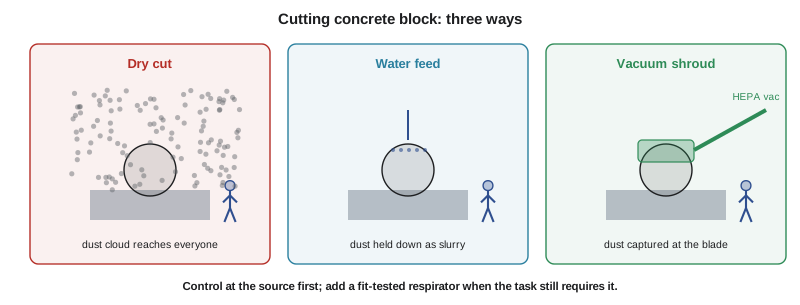
The controls for silica follow the hierarchy, with the most weight on stopping the dust at the source:
- Substitute or design out where possible, such as ordering block cut to size, using materials with less silica, or planning anchor and sleeve locations so fewer holes are drilled after the pour.
- Wet methods, with a water feed on saws, drills and grinders that keeps dust from becoming airborne.
- Local exhaust ventilation, with shrouds on the tool connected to a vacuum with a high-efficiency particulate air (HEPA) filter.
- Work practices, such as cutting outdoors or in a separate area, keeping other workers away from cutting, and cleaning up with a HEPA vacuum or wet methods instead of dry sweeping or compressed air.
- Respirators, chosen for the task and fitted to each worker, used when the other controls cannot keep exposure low enough on their own. Workers who wear tight-fitting respirators must be fit-tested and clean-shaven where the respirator seals.
Noise
Construction is loud. Cut-off saws, jackhammers, concrete breakers, impact wrenches, compactors, heavy equipment and powder-actuated tools produce noise far above the level that damages hearing. Noise-induced hearing loss happens gradually and painlessly, and it is permanent. It often comes with tinnitus, a constant ringing or buzzing in the ears. Noise also makes it harder to hear warnings, backup alarms and instructions, which adds to the risk of other injuries.
Noise is measured in decibels on the A-weighted scale, written dBA. The scale is logarithmic, so small increases in the number mean large increases in noise energy. Typical construction noise levels at the operator's ear include about 85 to 95 dBA for heavy equipment, 95 to 105 dBA for a circular saw or cut-off saw, and 100 to 115 dBA for a jackhammer or concrete breaker.
Manitoba's noise rules use an exchange rate of 3 dBA: every increase of 3 dBA halves the time a worker can be exposed safely. Where exposure exceeds 80 dBA averaged over the shift, the employer must inform workers, provide hearing protection on request and take other steps; above 85 dBA, the employer must reduce noise where practicable, require hearing protection and provide hearing tests. At the 85 dBA limit, a worker can be exposed for 8 hours; at 88 dBA, 4 hours; at 91 dBA, 2 hours; at 100 dBA, only about 15 minutes.
At Cottonwood Place, hearing protection is required wherever posted, within a set distance of saws, breakers and compactors, and on any task the subcontractor's noise assessment identifies. Earplugs only work when inserted correctly, deep enough to seal the ear canal; earmuffs only work when nothing, such as safety glasses arms or a hood, breaks the seal. Quieter tools, mufflers on equipment, and keeping noisy work away from other crews reduce exposure for everyone, not only the worker holding the tool.
Heat
Working hard in heat, especially in direct sun, on a roof or in a building without airflow, makes the body produce and absorb heat faster than it can get rid of it. Heat illness ranges from heat rash and cramps to heat exhaustion and heat stroke. Heat stroke is a medical emergency: the body's cooling system fails, the worker becomes confused, may stop sweating and may collapse, and without fast cooling the worker can die. Workers who are new to the job or returning after time away are at the highest risk, because their bodies have not adjusted to working in heat; many heat deaths happen in a worker's first few days.
Summer in Winnipeg can bring hot, humid days, and workers coming from cold-weather work have little time to adjust. Manitoba's regulation requires employers to assess heat stress where workers may be exposed and to put controls in place, using the ACGIH heat stress guidelines as the reference. Tallgrass Construction Ltd.'s heat plan uses the humidex and the forecast to set work and rest schedules.
The Cottonwood Place heat plan includes:
- Water, rest and shade: cool drinking water on every floor, shaded or cooled rest areas, and scheduled breaks that grow longer as the heat rises.
- Acclimatization: new and returning workers start with shorter exposure and build up over about a week.
- Scheduling: the hardest work, such as concrete placement and roofing, is moved to the early morning on hot days.
- Buddy system: workers watch each other for signs of heat illness, because a worker with heat stroke may not recognize it in themselves.
- Response: any worker showing signs of heat stroke is cooled immediately, by moving to shade, removing extra clothing and soaking with water, while someone calls 911.
Cold
Winter in Winnipeg is long and severe, with extended periods well below -20°C and wind chills much colder. Cold exposure causes frostbite, which freezes skin and the tissue below, and hypothermia, in which the body's core temperature drops until the worker becomes confused, clumsy and eventually unconscious. Wet clothing, wind, and working on steel or concrete speed up heat loss. Tallgrass Construction Ltd. follows a cold stress plan based on the wind chill: heated shelters on site, warm-up breaks that become more frequent as the wind chill drops, layered clothing and spare dry gloves, liners for hard hats, and a buddy system so workers watch each other's faces for the white patches of frostbite. At extreme wind chills, outdoor work stops except for emergencies.
Carbon monoxide
Carbon monoxide is an invisible, odourless gas produced by engines and fuel-burning heaters. On construction sites, it builds up when gas-powered saws, generators, pumps, compactors, floor grinders or propane heaters run in enclosed or partly enclosed spaces, such as the underground parking level or a floor wrapped in tarps for winter heating. It causes headache, dizziness and confusion, and at higher levels unconsciousness and death. At Cottonwood Place, gasoline engines are not allowed inside enclosed areas; temporary heaters are vented or placed where fresh air reaches them; carbon monoxide detectors are used where heaters or engines run indoors; and anyone with a headache or dizziness near running equipment goes to fresh air at once.
Asbestos, lead and chemicals
Asbestos was used in many building materials until the 1990s, such as pipe and boiler insulation, floor tiles, drywall compound, ceiling tiles and cement products. Cottonwood Place is a new building, but its site once held older buildings, and old services and buried debris could contain asbestos. Any work that disturbs older materials, such as demolition, renovation or tying into existing services, requires an assessment for asbestos and other hazardous materials first. Lead in old paint and dust is another concern during renovation. HSE-372 covers these hazards.
Construction also uses many hazardous products: form release oils, curing compounds, solvents, adhesives, sealants, epoxy coatings, fuels and concrete itself, which is strongly alkaline and causes chemical burns when wet concrete sits against skin. WHMIS labels and safety data sheets tell workers the hazards and precautions for each product. Workers should know where the safety data sheets are kept on site, read the label before using a product, and wear the gloves, eye protection and other protection it calls for.
How much noise is too much?
A worker's daily noise exposure is often made up of several tasks at different levels. The noise dose adds up the time spent at each level as a fraction of the time allowed at that level. A dose of 100 percent means the worker reached the limit. The program below calculates the daily dose for a worker who spends part of the day near a cut-off saw, part near a compactor and part at lower levels.
# Daily noise dose with an 85 dBA limit and a 3 dBA exchange rate (Manitoba rules).
def allowed_hours(level, limit=85, exchange=3):
    return 8 / 2 ** ((level - limit) / exchange)

day = [  # (task, dBA at the ear, hours)
    ("Cutting block with a cut-off saw", 100, 0.5),
    ("Running the plate compactor", 94, 1.5),
    ("Placing and finishing near equipment", 88, 3.0),
    ("Breaks and site trailer", 70, 1.0),
]
dose = 0.0
for task, level, hours in day:
    allowed = allowed_hours(level)
    part = hours / allowed
    dose += part
    print(f"{task:38} {level} dBA for {hours} h: allowed {allowed:5.2f} h -> {part:6.1%}")
print(f"Daily dose: {dose:.0%}" + (" (over the limit)" if dose > 1 else ""))Cutting block with a cut-off saw 100 dBA for 0.5 h: allowed 0.25 h -> 200.0% Running the plate compactor 94 dBA for 1.5 h: allowed 1.00 h -> 150.0% Placing and finishing near equipment 88 dBA for 3.0 h: allowed 4.00 h -> 75.0% Breaks and site trailer 70 dBA for 1.0 h: allowed 256.00 h -> 0.4% Daily dose: 425% (over the limit)
The worker's half hour at the saw uses twice the whole day's allowance on its own, and the total dose is 425 percent, more than four times the limit. Hearing protection is needed for the saw and compactor work at the very least, and moving cutting away from the finishing crew would cut everyone else's exposure.
Worked problem
The block cutting station
Show solution
- The masonry subcontractor sets up a cut-off saw on level 1 to cut block for the stair cores. The first morning, the saw runs dry, and a cloud of dust drifts across the floor where the electricians are working.
- Tasha Brooks, the electrical foreman, raises it with Owen Hartley, because her crew is breathing the dust without any protection.
- Owen stops the cutting and meets the masonry foreman. Their silica control plan called for a water-fed saw, but the water tank had not been delivered.
- Cutting resumes the next day at a station outside on the ground floor slab edge, with a water-fed saw, the slurry collected and cleaned up wet, hearing protection for the cutter and a barrier keeping other workers back.
- The masonry crew also orders more block pre-cut to size, cutting the number of cuts on site by about half.
Answer: The dust affected workers who were not doing the cutting, so the fix had to protect everyone: wet cutting at the source, a separate station away from other trades and fewer cuts in the first place.
Common mistakes
MistakeDry cutting or dry sweeping concrete dust because it is faster.
InsteadUse water or a HEPA vacuum shroud, and clean up wet or with a HEPA vacuum.
MistakeAssuming dust or noise is harmless because it does not hurt today.
InsteadSilicosis and hearing loss develop slowly and are permanent; control exposure every day.
MistakeInserting earplugs halfway or wearing earmuffs over a hood.
InsteadFit earplugs deep enough to seal and keep earmuff seals clear.
MistakePutting a new worker on full shifts in heat on the first day.
InsteadBuild up exposure over about a week and use a buddy system.
MistakeRunning a gas-powered saw in the underground parking level.
InsteadUse electric tools indoors, ventilate and monitor for carbon monoxide.
Summary and key terms
- Health hazards act slowly or over hours and are easy to ignore, but they cause permanent disease and can kill.
- Silica dust from cutting, grinding and drilling concrete and masonry causes silicosis and lung cancer; control it at the source with water or vacuum capture.
- In Manitoba, noise limits use 85 dBA and a 3 dBA exchange rate, with action from 80 dBA.
- Heat illness is prevented with water, rest, shade, acclimatization, scheduling and a buddy system; heat stroke is a medical emergency.
- Cold stress is prevented with warm-up breaks, layered dry clothing, shelters and a buddy system.
- Carbon monoxide from engines and heaters, asbestos and lead in older materials, and chemical products need their own controls.
- Respirable crystalline silica
- Fine silica dust small enough to reach deep into the lungs, released by cutting, grinding and drilling stone, concrete and masonry.
- Silicosis
- An incurable lung disease caused by breathing silica dust, in which lung tissue becomes scarred.
- dBA
- Decibels on the A-weighted scale, the unit used to measure workplace noise as the ear hears it.
- Exchange rate
- The increase in noise level, in dBA, that halves the time a worker may be exposed.
- Acclimatization
- The gradual adjustment of the body to working in heat over about a week.
- Heat stroke
- A life-threatening failure of the body's cooling system, with confusion, collapse and very high body temperature.
Practice problems
Work each problem on paper first, then reveal the answer to check.
Name four construction tasks that release silica dust.
Show answer
Any four of: cutting block or pavers, core drilling and anchor drilling, grinding concrete, chipping and breaking, cutting fibre cement, dry sweeping and mixing dry mortar.
List the silica controls in the order they should be considered.
Show answer
Substitute or design out, wet methods, vacuum capture at the tool, work practices, then respirators.
Under an 85 dBA limit with a 3 dBA exchange rate, how long may a worker be exposed at 91 dBA?
Show answer
2 hours.
Why are new workers at the highest risk of heat illness?
Show answer
Their bodies have not adjusted to working in heat; many heat deaths happen in the first few days on the job.
What causes carbon monoxide build-up on construction sites?
Show answer
Gas engines and fuel-burning heaters running in enclosed or partly enclosed spaces.
Lesson quiz · 5 questions
Score 60% or more to complete this lesson.
Create a free account to save your progress, take quizzes and earn a certificate.