
CMP-310 · Lesson 8 of 12 · 20 min
Cache performance and optimizations
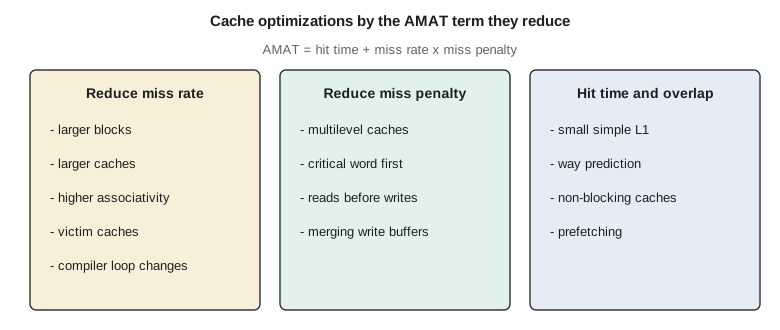
Lesson 7 described how a cache is built. This lesson asks how to make the memory system faster, using average memory access time as the scorecard. Every optimization attacks one of its three terms: it reduces the miss rate, reduces the miss penalty, or reduces the hit time, and many also try to overlap misses with useful work. Some of the most effective optimizations are not in hardware at all but in the order in which software touches memory. By the end of the lesson Jonah has cut the cache misses of the NS-5 radar's most memory-bound step by a factor of four and a half without changing the processor.
Memory stalls in the iron law
Cache misses enter the iron law through CPI. If a fraction of instructions access memory and some of those accesses miss, each miss adds the miss penalty in stall cycles, unless the processor can hide it. For an in-order core, which cannot hide misses, the contribution is straightforward to estimate.
Suppose a core has a base CPI of 1.0, makes 1.3 memory accesses per instruction counting instruction fetches, and misses on 2 percent of them with a 50-cycle penalty. Memory stalls add 1.3 × 0.02 × 50 = 1.3 cycles per instruction, more than doubling CPI. The example shows why even small miss rates matter, and why the gap between processor and memory speeds dominates design.
Multilevel caches
A larger cache misses less, but it is slower, so architects build several levels: a small, fast first level that keeps up with the pipeline, and larger second and third levels that catch most of the first level's misses before they reach main memory. AMAT then nests: the first level's miss penalty is itself the AMAT of the second level.
Two kinds of miss rate are used. The local miss rate of a level is its misses divided by the accesses that reach it; the global miss rate is its misses divided by all accesses from the processor. A second-level cache with a local miss rate of 30 percent may look poor, but if the first level misses only 5 percent of the time, the global miss rate is 1.5 percent, and the second level is filtering out 70 percent of the traffic that would otherwise go to memory. The second level's job is different from the first's: it can be slower and more associative, because it is accessed only on first-level misses, and its size matters more than its speed.
Multilevel hierarchies also choose an inclusion policy. In an inclusive hierarchy, every block in the first level is also in the second, which simplifies coherence checks in multiprocessors; an exclusive hierarchy keeps each block in only one level, making the total effective capacity larger. Many designs are neither strictly inclusive nor exclusive.
Reducing the miss rate
The direct ways to reduce misses follow from the three Cs. Larger blocks exploit spatial locality and cut compulsory misses, until they become so large that they waste bandwidth and reduce the number of blocks. Larger caches cut capacity misses at the cost of hit time, area and energy. Higher associativity cuts conflict misses, with diminishing returns: measurements across many programs have long suggested that an eight-way cache behaves almost like a fully associative one, and that a direct-mapped cache of size N misses about as often as a two-way cache of size N/2. A victim cache, a tiny fully associative buffer that holds recently evicted blocks, catches many conflict misses in a direct-mapped cache at low cost. Way prediction lets a set-associative cache guess which way will hit and read only that one, recovering most of the hit-time and energy advantage of a direct-mapped design.
Reducing the miss penalty
When a miss cannot be avoided, its cost can be cut. Critical word first fetches the word the processor asked for before the rest of the block and lets the pipeline restart as soon as it arrives. Giving reads priority over writes, by draining writes from a write buffer only when the memory bus is idle and checking the buffer for matching addresses on each read miss, keeps write traffic out of the way of loads, which the processor is waiting for. Merging write buffers combine several writes to the same block into one transfer. And the second-level cache itself is the largest single reduction in miss penalty.
Hiding miss latency
A blocking cache stops serving the processor during a miss. A non-blocking, or lockup-free, cache continues to serve hits during a miss, called hit under miss, and can track several outstanding misses at once in miss status holding registers. Out-of-order cores rely on this to overlap many misses, a property called memory-level parallelism: if eight independent loads miss at about the same time, their latencies overlap and the cost per miss falls nearly eightfold. In-order cores benefit less, but even they gain from hit under miss when the instruction after a missing load does not need its value.
Prefetching fetches blocks before they are requested. Hardware prefetchers watch the stream of miss addresses, detect sequential or strided patterns, and request the next blocks ahead of time; nearly every modern cache has at least a next-line or stride prefetcher. Software prefetch instructions let the compiler or programmer request data a known distance ahead in a loop. Prefetching works when it is accurate and timely: a prefetch that arrives too late saves little, and one that fetches unneeded data wastes bandwidth and may evict useful blocks.
Compiler and programmer optimizations
The order in which a program touches memory determines its locality, and simple code transformations can change miss rates dramatically without any new hardware. Loop interchange swaps nested loops so that the inner loop walks along consecutive addresses. C stores two-dimensional arrays in row-major order, so a loop over a[i][j] should have j in the inner loop; with i inner, each access jumps a whole row ahead and may touch a new block every time. Loop fusion combines loops that traverse the same arrays, so data loaded by the first is still cached for the second. Data layout changes, such as padding arrays to avoid the conflict alignment of lesson 7 or switching between arrays of structures and structures of arrays, match the layout to the access pattern.
Blocking, also called tiling, is the most powerful of these. When an algorithm must access a matrix both by rows and by columns, as in matrix multiplication or transposition, no loop order makes both accesses sequential. Blocking restructures the loops to work on small submatrices, tiles, that fit in the cache together, finishing all the work on a tile before moving on. Each block brought into the cache is then used many times before it is evicted. Dense linear algebra libraries are built around tiling at several levels of the hierarchy at once.
Worked problem
Two-level AMAT on Dana's server
Dana's aggregation server has a first-level data cache with a 1 ns hit time and a 5 percent miss rate, a second-level cache with a 4 ns hit time and a local miss rate of 30 percent, and main memory with an 80 ns latency. What is the AMAT, and what would it be without the second level?
Show solution
- \[ \text{AMAT} = 1 + 0.05\,(4 + 0.30 \times 80) = 1 + 0.05 \times 28 = 2.40\ \text{ns}\]
- \[ \text{AMAT}_{\text{no L2}} = 1 + 0.05 \times 80 = 5.00\ \text{ns}\]
- The global second-level miss rate is 0.05 × 0.30 = 0.015, so only 1.5 percent of accesses go to memory.
Answer: The second-level cache more than halves the average access time, even though it misses on 30 percent of the accesses that reach it.
The NS-5 radar computes a range-Doppler map, a 64 by 64 matrix of samples, and must transpose it between two stages of processing, an operation radar engineers call a corner turn. Jonah also sums every element of the matrix to estimate noise. The program below measures the misses for both kernels in an 8 KiB two-way cache with 32-byte blocks, like Core A's, and ends with the two-level AMAT from the example.
# Loop order, blocking and two-level AMAT for a 64 x 64 matrix transpose-and-scale
def misses(trace, size=8192, block=32, ways=2):
    sets = size // (block * ways); cache = [[] for _ in range(sets)]; miss = 0
    for a in trace:
        b = a // block; s = cache[b % sets]; t = b // sets
        if t in s: s.remove(t)
        else:
            miss += 1
            if len(s) == ways: s.pop(0)
        s.append(t)
    return miss

N, A, B = 64, 0x20000, 0x30000          # 64 x 64 matrices of 4-byte samples, row-major
def addr(base, r, c): return base + 4 * (r * N + c)

# Kernel 1: sum every element of A, with the inner loop over columns or over rows
good = [addr(A, i, j) for i in range(N) for j in range(N)]
bad = [addr(A, i, j) for j in range(N) for i in range(N)]
for name, t in (("sum, inner loop over j", good), ("sum, inner loop over i", bad)):
    m = misses(t)
    print(f"{name:24s} misses {m:5d}   miss rate {m/len(t):.3f}")

# Kernel 2: B = transpose of A, three loop structures
row_order = [x for i in range(N) for j in range(N) for x in (addr(A, i, j), addr(B, j, i))]
col_order = [x for j in range(N) for i in range(N) for x in (addr(A, i, j), addr(B, j, i))]
tiled = [x for ii in range(0, N, 8) for jj in range(0, N, 8)
         for i in range(ii, ii + 8) for j in range(jj, jj + 8) for x in (addr(A, i, j), addr(B, j, i))]

for name, t in (("i outer (rows of A)", row_order), ("j outer (columns of A)", col_order), ("8 x 8 tiles", tiled)):
    m = misses(t)
    print(f"{name:24s} misses {m:5d}   miss rate {m/len(t):.3f}")

# Two-level AMAT for a server core: L1 1 ns, L2 4 ns, memory 80 ns
l1_hit, l2_hit, mem = 1.0, 4.0, 80.0
m1, m2_local = 0.05, 0.30
amat = l1_hit + m1 * (l2_hit + m2_local * mem)
print(f"two-level AMAT {amat:.2f} ns, global L2 miss rate {m1*m2_local:.3f}")sum, inner loop over j misses 512 miss rate 0.125 sum, inner loop over i misses 4096 miss rate 1.000 i outer (rows of A) misses 4608 miss rate 0.562 j outer (columns of A) misses 4608 miss rate 0.562 8 x 8 tiles misses 1024 miss rate 0.125 two-level AMAT 2.40 ns, global L2 miss rate 0.015
The sum shows loop interchange at work: with the inner loop running along rows, one miss brings in eight samples and the miss rate is 12.5 percent; with the inner loop running down columns, every access misses, because the 64 blocks of a column do not fit in the sets they map to before the next column needs them again. The transpose is harder. Whichever loop is outermost, one of the two matrices is read or written down a column, and the miss rate stays at 56 percent. Tiling the transpose into 8 by 8 blocks, each exactly one cache block wide, keeps both tiles resident while they are processed and brings the miss rate down to 12.5 percent, the compulsory minimum. The misses fall from 4,608 to 1,024, a factor of four and a half, and because the corner turn spends most of its time waiting on misses, its run time on Core A falls by nearly as much.
Measuring rather than guessing
Cache behaviour is notoriously hard to predict by intuition, because it depends on addresses, alignment and interactions between data structures. Hardware performance counters, available on nearly every modern processor including both NS-5 candidates, count cache accesses, misses, stall cycles and many other events while real code runs. Trace-driven simulation, like the programs in this lesson, lets designers explore configurations that do not yet exist. A good engineering habit is to form a hypothesis from the three Cs, test it with counters or simulation, and only then change code or hardware.
| Optimization | Term reduced | Main cost |
|---|---|---|
| Larger block size | Miss rate (compulsory) | Higher miss penalty; may increase conflicts |
| Higher associativity | Miss rate (conflict) | Hit time, area and energy |
| Multilevel caches | Miss penalty | Area and complexity |
| Read priority over writes | Miss penalty | Address checks in the write buffer |
| Non-blocking caches | Effective penalty, by overlap | Miss tracking hardware |
| Prefetching | Miss rate or penalty, by anticipation | Wasted bandwidth when inaccurate |
| Loop interchange and tiling | Miss rate (capacity and conflict) | Programmer or compiler effort |
Common mistakes
MistakeJudging a second-level cache by its local miss rate alone.
InsteadLook at the global miss rate and the AMAT; a high local miss rate is normal for a level that only sees the first level's misses.
MistakeWriting nested loops with the inner loop striding across rows of a row-major array.
InsteadPut the index of the last dimension in the inner loop so accesses are sequential.
MistakeExpecting loop interchange to fix a transpose.
InsteadTranspose reads by rows and writes by columns; only tiling makes both access patterns cache-friendly.
MistakePrefetching as early as possible.
InsteadPrefetches that arrive too early may be evicted before use; aim for a distance that matches the miss latency.
MistakeIgnoring instruction fetches in memory-stall estimates.
InsteadEvery instruction is fetched; include instruction-cache misses in accesses per instruction.
Summary and key terms
- Memory stalls add accesses per instruction × miss rate × miss penalty to CPI on an in-order core.
- Multilevel caches nest AMAT; global miss rates show how much traffic reaches memory.
- Miss rates fall with larger blocks, larger caches, more associativity and victim caches.
- Miss penalties fall with critical word first, read priority and lower-level caches.
- Non-blocking caches and prefetching overlap or anticipate misses.
- Loop interchange, fusion, padding and tiling improve locality in software.
- Performance counters and simulation turn cache tuning into measurement.
- Local miss rate
- Misses at a level divided by the accesses that reach that level.
- Global miss rate
- Misses at a level divided by all memory accesses from the processor.
- Victim cache
- A small fully associative buffer holding recently evicted blocks.
- Non-blocking cache
- A cache that continues to serve requests while misses are outstanding.
- Memory-level parallelism
- The overlap of several outstanding cache misses.
- Prefetching
- Fetching data into a cache before it is requested.
- Loop interchange
- Swapping nested loops to make the inner loop access consecutive addresses.
- Tiling
- Restructuring loops to work on sub-blocks of data that fit in the cache together.
Practice problems
Work each problem on paper first, then reveal the answer to check.
Base CPI 1.1, 1.25 memory accesses per instruction, 3 percent miss rate, 40-cycle penalty. What is the CPI?
Show answer
1.1 + 1.25 × 0.03 × 40 = 1.1 + 1.5 = 2.6.
L1: 1 cycle hit, 4 percent miss; L2: 10 cycle hit, 25 percent local miss; memory: 150 cycles. What is the AMAT?
Show answer
1 + 0.04 × (10 + 0.25 × 150) = 1 + 0.04 × 47.5 = 2.9 cycles.
A loop reads a[i][j] with i in the inner loop over a 512 by 512 array of 4-byte floats in a 64-byte-block cache. What is the likely miss rate, and how do you fix it?
Show answer
Close to one miss per access, since each access is 2 KiB from the last; interchange the loops so j is inner, giving about one miss per 16 accesses.
Why does tiling a transpose with tiles the width of a cache block reach the compulsory miss rate?
Show answer
Each block of both matrices is brought in once and fully used while the tile is resident, so no block is fetched twice.
Lesson quiz · 5 questions
Score 60% or more to complete this lesson.
Create a free account to save your progress, take quizzes and earn a certificate.