
CMP-200 · Lesson 7 of 12 · 23 min
Binary trees and traversals
Lists, stacks and queues arrange items in a line. Many kinds of data are not linear but hierarchical: a file system, an organization chart, the structure of an arithmetic expression, the sections of a document, a decision process that asks one question and then another depending on the answer. The data structure for hierarchies is the tree. This lesson introduces trees in general and binary trees in particular, the vocabulary used to describe them, how they are stored in memory, and the four standard ways of visiting every node. Lesson 8 then specializes the binary tree into the binary search tree, and lesson 9 into the heap.
Jonah's tree this week is small but real. The NS-4 classifies each vehicle from its measured length, its speed and the number of axles detected by the loops. The classification rules were worked out by Northway's traffic engineers as a decision tree: first ask whether the length is under 6 m, then, on one branch, whether there are more than two axles, and so on, until a leaf names the class. The firmware stores that tree as data, so that a city with different classes can be given a new tree without new code, and evaluates it for every passing vehicle. On the server, a second kind of tree, an expression tree, represents the threshold conditions that technicians type into the maintenance port.
Tree vocabulary
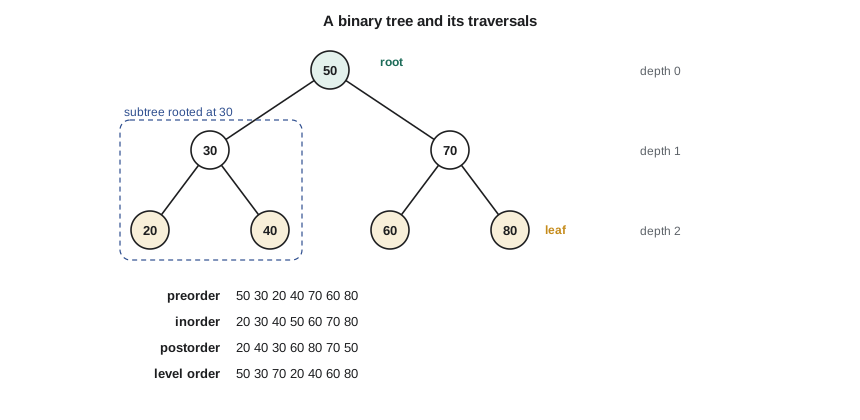
A tree is a collection of nodes connected by edges, with one special node, the root, at the top, and with exactly one path from the root to every other node. Each node except the root has exactly one parent, the node directly above it; the nodes directly below a node are its children. Nodes with no children are leaves; the others are internal nodes. A node's descendants are its children, their children and so on; its ancestors are its parent, its parent's parent and so on up to the root. Any node together with all its descendants forms a subtree, which is itself a tree. This self-similarity is why recursion, from lesson 6, is the natural tool for trees.
Two measurements describe a tree's shape. The depth of a node is the number of edges on the path from the root to it, so the root has depth 0. The height of a tree is the largest depth of any node, the length of the longest path from the root to a leaf. Height matters because most tree operations walk a single path from the root downward, so their cost is proportional to the height. A tree whose nodes are spread evenly is short and bushy; a tree whose nodes form a single chain is tall and thin, and behaves like a linked list.
Binary trees
A binary tree is a tree in which each node has at most two children, called the left child and the right child. The distinction between left and right matters: a node with only a left child is a different tree from one with only a right child. Several special shapes have names. A full binary tree is one in which every node has either zero or two children. A perfect binary tree is full and has all its leaves at the same depth; a perfect tree of height h has 2ʰ⁺¹ − 1 nodes. A complete binary tree has every level full except possibly the last, which is filled from the left; this is the shape a heap uses. The relationship between height and the number of nodes is the central fact about binary trees.
Worked problem
Height and number of nodes
Northway's server keeps an index of 1,000,000 node records in a binary tree. Find the smallest possible height of such a tree, and the largest possible height.
Show solution
- A binary tree of height h has at most one node at depth 0, two at depth 1, four at depth 2, and so on.
- \[n \le 1 + 2 + 4 + \cdots + 2^h = 2^{h+1} - 1\]
- Solve for the smallest h with 2^(h+1) − 1 ≥ 1,000,000.
- \[2^{h+1} \ge 1\,000\,001 \implies h + 1 \ge \log_2 1\,000\,001 \approx 19.93 \implies h \ge 19\]
- The largest height occurs when each node has a single child, forming a chain of n nodes.
- \[h_{\max} = n - 1 = 999\,999\]
Answer: The height can be as small as 19 or as large as 999,999. A search that walks one root-to-leaf path costs about 20 steps in a well-shaped tree and up to a million in the degenerate one; lesson 8 shows how balancing guarantees the short shape.
Storing a binary tree
The usual representation is linked: each node is a small record holding the data and two pointers, left and right, which are null where a child is missing. The tree is reached through a pointer to its root. This representation handles any shape and lets subtrees be attached and detached by changing a pointer. It costs two pointers per node, and like a linked list it scatters nodes across memory. Some implementations add a parent pointer to each node, which makes it easy to walk upward but costs a third pointer.
A complete binary tree can instead be stored in an array with no pointers at all. Put the root at index 0, then the nodes of each level from left to right. The children of the node at index i are then at 2i + 1 and 2i + 2, and its parent is at ⌊(i − 1)/2⌋. Because the tree is complete there are no gaps in the array. This compact, cache-friendly layout is how heaps are stored, and it is also how the NS-4 firmware stores its classification tree: the tree is small and fixed, so it is laid out in flash as an array of nodes, each holding a test and the indexes of its two children, with no pointers that would need fixing up after loading.
Traversals
Visiting every node of a tree exactly once is called a traversal. Because a tree branches, there is more than one natural order. The three depth-first orders are defined recursively and differ only in when the node itself is visited relative to its two subtrees. In a preorder traversal you visit the node, then traverse its left subtree, then its right subtree. In an inorder traversal you traverse the left subtree, visit the node, then traverse the right subtree. In a postorder traversal you traverse both subtrees and visit the node last. The fourth order, level order or breadth-first, visits nodes level by level from the root downward, left to right within each level, and uses a queue instead of recursion.
Each order has typical uses. Preorder visits a parent before its children, so it is used to copy a tree, to print a hierarchy with indentation, or to save a tree to a file in a form that can be rebuilt. Inorder visits a binary search tree's keys in sorted order, which lesson 8 relies on. Postorder visits children before their parent, so it is used whenever a node's result depends on its children's results: computing the size or height of every subtree, freeing every node of a tree in C without touching freed memory, and evaluating an expression tree. Level order finds the shallowest node with some property and prints a tree level by level. All four visit each node once, so they cost O(n) time. The depth-first orders use stack space proportional to the height; level order uses queue space proportional to the widest level.
# Traversals of a small binary tree, recursive and level order
from collections import deque

class N:
    def __init__(self, key, left=None, right=None):
        self.key, self.left, self.right = key, left, right

root = N(50, N(30, N(20), N(40)), N(70, N(60), N(80)))

def preorder(n, out):
    if n: out.append(n.key); preorder(n.left, out); preorder(n.right, out)
    return out

def inorder(n, out):
    if n: inorder(n.left, out); out.append(n.key); inorder(n.right, out)
    return out

def postorder(n, out):
    if n: postorder(n.left, out); postorder(n.right, out); out.append(n.key)
    return out

def level_order(n):
    out, q = [], deque([n])
    while q:
        cur = q.popleft()
        out.append(cur.key)
        if cur.left: q.append(cur.left)
        if cur.right: q.append(cur.right)
    return out

def height(n):            # postorder: children first, then the node
    return -1 if n is None else 1 + max(height(n.left), height(n.right))

print("preorder   ", preorder(root, []))
print("inorder    ", inorder(root, []))
print("postorder  ", postorder(root, []))
print("level order", level_order(root))
print("height ", height(root))preorder [50, 30, 20, 40, 70, 60, 80] inorder [20, 30, 40, 50, 60, 70, 80] postorder [20, 40, 30, 60, 80, 70, 50] level order [50, 30, 70, 20, 40, 60, 80] height 2
Expression trees
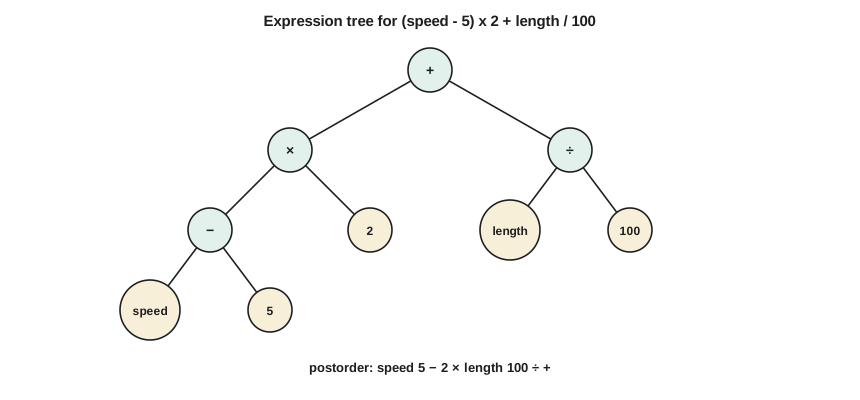
An arithmetic or logical expression can be stored as a binary tree in which every leaf is an operand and every internal node is an operator applied to its two subtrees. The expression (speed − 5) × 2 + length / 100 has + at the root, the subtree for (speed − 5) × 2 on the left and the subtree for length / 100 on the right. Parentheses disappear, because the shape of the tree records the grouping. The three traversals then produce the three notations: preorder gives prefix notation, + × − speed 5 2 / length 100; postorder gives the postfix notation of lesson 5, speed 5 − 2 × length 100 / +; and inorder gives infix, though it needs parentheses added to be unambiguous. Evaluating the tree is a postorder computation: evaluate both children, then apply the operator.
Worked problem
Evaluating an expression tree
Evaluate the expression tree in the figure for speed = 23 and length = 540 using a postorder traversal, and state how many nodes are visited.
Show solution
- Postorder evaluates each subtree before its parent operator.
- Left subtree: the − node evaluates speed and 5, giving 23 − 5 = 18; the × node then gives 18 × 2 = 36.
- Right subtree: the / node evaluates length and 100, giving 540 / 100 = 5.4.
- The root + combines the two results.
- \[36 + 5.4 = 41.4\]
- The tree has four operator nodes and five leaves: 9 nodes, each visited once.
Answer: The value is 41.4, the same as the postfix evaluation in lesson 5, after visiting all 9 nodes once: O(n) for an n-node tree.
Decision trees in firmware
The NS-4 classification tree is a binary tree whose internal nodes each hold a test, such as length < 6,000 mm or axles > 2, and whose leaves each hold a class code. Classifying a vehicle walks a single path from the root, going left when the test is true and right when it is false, until it reaches a leaf. The cost is the depth of the leaf reached, at most the height of the tree. Northway's current tree has 31 nodes and height 5, so every vehicle is classified in at most five comparisons, a fixed and tiny worst case that is easy to verify. Because the tree is stored as an array of fixed-size records in flash, a new set of rules is just a new block of data, checked by a CRC before the firmware accepts it.
/* Classification tree stored as an array in flash (NS-4 firmware) */
#include <stdint.h>

typedef struct {
    uint8_t  field;        /* 0 = length_mm, 1 = axles, 2 = speed_dkmh, 0xFF = leaf */
    uint8_t  leaf_class;   /* class code when field == 0xFF                       */
    uint16_t yes, no;      /* indexes of the children                             */
    uint32_t threshold;    /* test is: value < threshold                          */
} ctnode_t;

uint8_t classify(const ctnode_t *tree, const uint32_t v[3])
{
    uint16_t i = 0;                                   /* start at the root */
    for (int steps = 0; steps < 16; steps++) {        /* bound: no tree is deeper than 16 */
        const ctnode_t *n = &tree[i];
        if (n->field == 0xFF) return n->leaf_class;
        i = (v[n->field] < n->threshold) ? n->yes : n->no;
    }
    return 0;                                         /* malformed tree: unknown class */
}
Common mistakes
MistakeConfusing the depth of a node with the height of the tree.
InsteadDepth counts edges from the root down to one node; height is the greatest depth of any node.
MistakeAssuming every binary tree with n nodes has height about log₂ n.
InsteadThat holds only for well-shaped trees; a chain of n nodes has height n − 1.
MistakeFreeing a tree's nodes in preorder in C.
InsteadFreeing a node before its children loses the pointers to them; free in postorder, children first.
MistakeUsing the array layout for a tree that is not complete.
InsteadMissing nodes leave gaps that waste space; the array layout suits complete trees such as heaps, or small fixed trees.
MistakeWalking a data-driven tree in firmware without a step limit.
InsteadA corrupted tree could loop forever; bound the number of steps and return a defined result.
Summary and key terms
- A tree has a root, and every other node has exactly one parent; leaves have no children.
- Depth is a node's distance from the root and height is the greatest depth; most tree operations cost O(height).
- A binary tree with n nodes has height at least about log₂ n and at most n − 1.
- Trees are stored with left and right pointers, or, when complete, in an array with children at 2i + 1 and 2i + 2.
- Preorder, inorder and postorder traversals are depth-first; level order is breadth-first and uses a queue; all cost O(n).
- Root
- The topmost node of a tree, which has no parent.
- Leaf
- A node with no children.
- Height
- The number of edges on the longest path from the root to a leaf.
- Complete binary tree
- A binary tree in which every level is full except possibly the last, which is filled from the left.
- Inorder traversal
- Visiting the left subtree, then the node, then the right subtree.
- Postorder traversal
- Visiting both subtrees before the node itself.
- Expression tree
- A binary tree whose leaves are operands and whose internal nodes are operators.
Practice problems
Work each problem on paper first, then reveal the answer to check.
How many nodes does a perfect binary tree of height 4 have?
Show answer
2⁵ − 1 = 31.
In the array layout, what are the indexes of the children and parent of the node at index 9?
Show answer
Children at 19 and 20; parent at ⌊8/2⌋ = 4.
Give the inorder traversal of a tree with root 8, left child 3 (whose children are 1 and 6) and right child 10.
Show answer
1 3 6 8 10.
Which traversal would you use to compute the number of nodes in every subtree, and why?
Show answer
Postorder, because each node's count is 1 plus its children's counts, which must be known first.
A decision tree has height 6. What is the worst-case number of tests to classify one vehicle?
Show answer
6 tests, one per edge on the longest root-to-leaf path.
Lesson quiz · 5 questions
Score 60% or more to complete this lesson.
Create a free account to save your progress, take quizzes and earn a certificate.