
CHE-345 · Lesson 6 of 12 · 21 min
Multiple reactions: selectivity and yield
Real reactors rarely run one reaction. Side reactions consume feed, make by-products that must be separated and disposed of, and sometimes foul the catalyst. For the ethylene pilot, the product must meet a polymer-grade purity eventually, so every by-product formed in the reactor adds cost downstream. Ethanol over a solid acid can do several things. It can lose water to give ethylene, which is wanted. Two molecules can condense to give diethyl ether and water, which is not wanted in the product. And ethylene itself can go on to form heavier molecules, oligomers, that end up as fuel or as coke on the catalyst. This lesson shows how the reactor type and its operating conditions decide how much of each forms.
Kinds of multiple reactions
Multiple reactions come in a few basic patterns. Parallel, or competing, reactions consume the same reactant along different paths: \(A \to D\) and \(A \to U\), where D is desired and U undesired. Series, or consecutive, reactions form a product that reacts further: \(A \to D \to U\). Complex reactions combine both, and independent reactions involve different reactants altogether. The dehydration network has all of these: ethylene and ether formation are parallel, and the ethylene-to-oligomer step is in series.
Selectivity and yield
Two measures describe how well a reactor makes what is wanted. Selectivity compares the formation of the desired product with an undesired one. The instantaneous selectivity at a point in the reactor is the ratio of rates, \(S_{D/U} = r_D/r_U\); the overall selectivity is the ratio of the amounts made over the whole reactor. Yield measures the desired product formed per mole of key reactant fed or consumed, again either instantaneously or overall. Definitions vary between textbooks and companies, so every report should state which is used. In this lesson, yield means moles of ethylene formed per mole of ethanol fed.
Parallel reactions: the rule for concentration
For parallel reactions with \(r_D = k_DC_A^{\alpha_1}\) and \(r_U = k_UC_A^{\alpha_2}\), the instantaneous selectivity is
If the desired reaction has the higher order, \(\alpha_1 > \alpha_2\), selectivity rises with reactant concentration: use a batch reactor or a PFR, high pressure for gases, and no diluent. If the desired reaction has the lower order, keep the reactant concentration low: use a CSTR, which runs at the low outlet concentration, dilute the feed, or recycle product. For the dehydration, ethylene formation is first order and ether formation is second order, so \(S_{E/D} = k_1/(k_2C_A)\): low ethanol concentration favours ethylene. That is one reason commercial plants dilute ethanol with steam.
Parallel reactions: the rule for temperature
The ratio \(k_D/k_U\) depends on temperature through the two activation energies:
If the desired reaction has the higher activation energy, raising the temperature favours it; if the lower, a low temperature favours it, at the cost of a slower rate overall. For ethanol over solid acids, ether formation has the lower activation energy, so ether dominates at low temperature and ethylene at high temperature. This is well known in practice: older processes made diethyl ether deliberately from ethanol at around 140 °C with sulfuric acid, while ethylene plants run above 300 °C. The code uses illustrative activation energies of 120 kJ/mol for ethylene and 40 kJ/mol for ether, chosen to reproduce that behaviour.
Series reactions: the rule for residence time
For \(A \to D \to U\), the desired intermediate forms and then disappears. There is an optimum residence time at which its concentration is greatest, and running past it destroys product. A PFR or batch reactor, with a single well-defined residence time, can stop near the optimum. A CSTR mixes fresh feed with fluid that has been in the tank a long time, so some of the product always overstays and is lost; for series reactions a CSTR gives a lower maximum yield than a PFR. For the dehydration, the oligomerisation of ethylene has an illustrative activation energy of 160 kJ/mol, higher than the others, so it becomes important at the high temperatures that favour ethylene over ether. The two rules pull in opposite directions, and the code finds the best compromise.
# Multiple reactions in ethanol dehydration (illustrative kinetics, constant-density approximation in steam)
# 1: A -> E + W        r1 = k1 CA        (ethylene, wanted)
# 2: 2A -> D + W       r2 = k2 CA^2      (diethyl ether, unwanted at the outlet)
# 3: E -> oligomers    r3 = k3 CE        (heavier by-products, unwanted)
import math
R = 8.314
def ks(T):
    f = lambda k623, E: k623 * math.exp(-E / R * (1 / T - 1 / 623.15))
    return f(1.0, 120e3), f(0.004, 40e3), f(0.002, 160e3)   # 1/s, m3/(mol s), 1/s
CA0 = 11.6   # mol/m3 (40 % ethanol in steam at 3 bar)
print("T (C)   k1/(k2 CA0)   instantaneous selectivity of ethylene to ether at the inlet")
for Tc in (250, 300, 350, 400, 450):
    k1, k2, k3 = ks(Tc + 273.15)
    print(f"{Tc:5d}      {k1 / (k2 * CA0):8.2f}")

def pfr(Tc, Xt=0.99):
    k1, k2, k3 = ks(Tc + 273.15); A, E, D, t, h = CA0, 0.0, 0.0, 0.0, 0.002 / k1
    def d(A, E): return (-k1 * A - 2 * k2 * A * A, k1 * A - k3 * E, k2 * A * A)
    while A > CA0 * (1 - Xt):
        a = d(A, E); b = d(A + h * a[0] / 2, E + h * a[1] / 2); c = d(A + h * b[0] / 2, E + h * b[1] / 2); e = d(A + h * c[0], E + h * c[1])
        A += h * (a[0] + 2 * b[0] + 2 * c[0] + e[0]) / 6; E += h * (a[1] + 2 * b[1] + 2 * c[1] + e[1]) / 6
        D += h * (a[2] + 2 * b[2] + 2 * c[2] + e[2]) / 6; t += h
    return t, E / CA0, 2 * D / CA0

def cstr(Tc, Xt=0.99):
    k1, k2, k3 = ks(Tc + 273.15); A = CA0 * (1 - Xt)
    tau = (CA0 - A) / (k1 * A + 2 * k2 * A * A)
    E = k1 * A * tau / (1 + k3 * tau); D = k2 * A * A * tau
    return tau, E / CA0, 2 * D / CA0

print("T (C)  reactor   tau (s)   ethylene yield   ethanol to ether")
for Tc in (300, 350, 400, 450):
    for name, fn in (("PFR ", pfr), ("CSTR", cstr)):
        tau, yE, yD = fn(Tc)
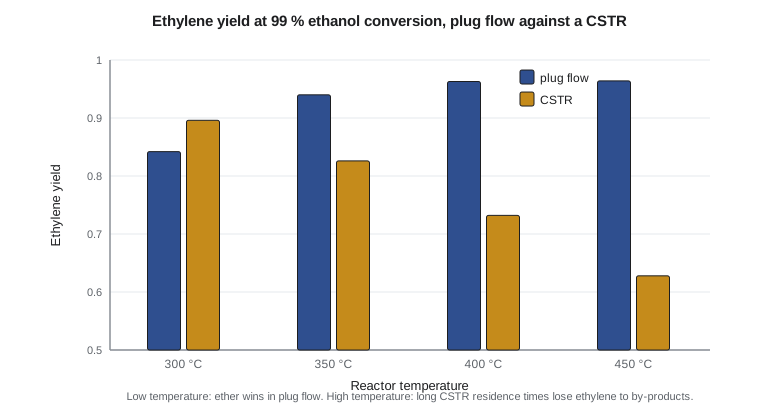
print(f"{Tc:5d} {name} {tau:8.2f} {yE:.3f} {yD:.3f}")T (C) k1/(k2 CA0) instantaneous selectivity of ethylene to ether at the inlet 250 1.13 300 5.60 350 21.55 400 67.86 450 182.32 T (C) reactor tau (s) ethylene yield ethanol to ether 300 PFR 32.46 0.842 0.145 300 CSTR 744.09 0.896 0.004 350 PFR 4.52 0.940 0.044 350 CSTR 98.91 0.826 0.001 400 PFR 0.82 0.963 0.014 400 CSTR 17.71 0.732 0.000 450 PFR 0.19 0.964 0.005 450 CSTR 4.02 0.628 0.000
Reading the results
At the inlet concentration, the instantaneous selectivity of ethylene to ether is about 1 at 250 °C, 5.6 at 300 °C and 22 at 350 °C, rising above 180 at 450 °C. At 300 °C a PFR loses 14.5 % of the ethanol to ether and makes only 84 % ethylene, while a CSTR, by holding the ethanol concentration low, almost eliminates ether and makes 90 % ethylene. At 350 °C and above the picture reverses. The PFR's ether loss falls to a few percent, and its short, defined residence time keeps the oligomerisation small: 96 % ethylene at 400 to 450 °C. The CSTR needs a residence time twenty times longer to reach the same conversion, and during that time much of its ethylene goes on to by-products; its yield falls to 63 % at 450 °C.
The lesson for the pilot is clear: a packed bed, which approaches plug flow, operated at about 400 °C with steam dilution. That is close to what commercial ethanol dehydration plants do, with inlet temperatures commonly in the range of 350 to 450 °C. The illustrative kinetics are not a design basis, but the pattern they show, with competing rules for concentration, temperature and residence time, is the general one.
Worked problem
Selectivity at the reactor inlet
With \(k_1 = 1.0\) per second and \(k_2 = 0.004\) m³/(mol s) at 350 °C, and \(C_{A0} = 11.6\) mol/m³, find the instantaneous selectivity of ethylene to ether. What happens if the steam dilution is halved, doubling \(C_{A0}\)?
Show solution
- \(S_{E/D} = k_1/(k_2C_A) = 1.0/(0.004 \times 11.6) = 21.6\).
- Halving the steam doubles \(C_{A0}\) to 23.2 mol/m³, so \(S_{E/D}\) halves to 10.8.
- More steam also costs energy to raise and condense, so the dilution is an economic optimum, not a free variable.
Answer: About 22 at the design dilution, halving if the ethanol concentration doubles.
Designing for selectivity
Engineers have several levers beyond reactor type and temperature. Feeding one reactant gradually along a tube or into a semibatch tank keeps its concentration low throughout, the approach of lesson 10. Membranes can add a reactant along the length of a reactor. A recycle of unconverted reactant lets a reactor run at low per-pass conversion, where selectivity is often best, while the plant still converts all the feed overall. Catalysts can be chosen or modified for selectivity: for ethanol dehydration, the acid strength and pore size of the catalyst strongly affect how much ether and how many oligomers form, and much catalyst research concerns exactly that.
Selectivity also has an economic measure. Each mole of ethanol turned into ether or oligomers is a mole of feed lost and a separation load added. A one-percentage-point gain in yield on a large plant is worth more than many reactor design refinements, which is why selectivity, not just conversion, drives most reaction engineering decisions in the chemical industry.
Solving multiple-reaction problems
The algorithm of lesson 4 extends directly. Write a mole balance for every species, not just for one reactant, because conversion of a single reactant no longer describes the composition. Write the net rate of each species as the sum of its rates in all reactions, using the stoichiometric coefficients: for ethanol, \(r_A = -r_1 - 2r_2\); for ethylene, \(r_E = r_1 - r_3\). Then integrate all the balances together, as the code does for the PFR, or solve them as simultaneous algebraic equations for the CSTR. Simulators handle large reaction networks this way, with dozens of species and reactions.
Measuring selectivity in the pilot
Selectivity is harder to measure than conversion because the by-products are small and varied. The pilot unit has an online gas chromatograph on the product gas, which measures ethylene, ether, unreacted ethanol, acetaldehyde from a minor dehydrogenation side reaction, and the light oligomers such as butenes. Heavier oligomers condense with the water and are measured in the liquid, and coke is measured by burning a sample of spent catalyst. A carbon balance, comparing the carbon in all the measured products with the carbon in the ethanol fed, checks that nothing significant is missing; Ingrid expects it to close within about 2 %. When it does not, a by-product has been overlooked, and finding it is often the first step to improving selectivity.
Common mistakes
MistakeDescribing a multiple-reaction system by one conversion.
InsteadWrite a balance for each species; selectivity needs the amounts of each product.
MistakeChoosing a CSTR for every case where the desired reaction has the lower order.
InsteadCheck series reactions too; a long CSTR residence time can destroy the product.
MistakeRaising temperature to speed up the desired reaction without checking side reactions.
InsteadCompare activation energies; side reactions with higher E grow faster.
MistakeQuoting selectivity or yield without a definition.
InsteadState whether it is instantaneous or overall, and on what basis.
Summary and key terms
- Parallel reactions: if the desired order is lower, keep the reactant dilute; if higher, keep it concentrated.
- If the desired reaction has the higher activation energy, high temperature favours it.
- Series reactions have an optimum residence time; plug flow beats a CSTR for the intermediate.
- In the dehydration network, ether forms at low temperature and oligomers at high temperature with long residence time.
- With the illustrative kinetics, a PFR at about 400 °C gives about 96 % ethylene; a CSTR is worse above 300 °C.
- Write a balance for every species and sum rates over all reactions.
- Selectivity
- The ratio of the formation of a desired product to an undesired one, instantaneous or overall.
- Yield
- Moles of desired product formed per mole of key reactant fed or consumed.
- Parallel reactions
- Reactions that consume the same reactant along different paths.
- Series reactions
- Reactions in which a product reacts further to another product.
- Oligomers
- Short chains of a few monomer units, such as butenes and hexenes from ethylene.
- Instantaneous selectivity
- The ratio of formation rates at a point in the reactor.
Practice problems
Work each problem on paper first, then reveal the answer to check.
Parallel reactions have \(\alpha_D = 2\) and \(\alpha_U = 1\). Which reactor type and feed condition favour D?
Show answer
A PFR or batch reactor with a concentrated feed.
If \(E_D = 80\) and \(E_U = 50\) kJ/mol, does raising temperature help selectivity?
Show answer
Yes: the desired reaction has the higher activation energy.
For \(A \to D \to U\) with both steps first order and \(k_1 = k_2 = k\), at what PFR space time is D greatest?
Show answer
\(\tau = 1/k\), where \(C_D/C_{A0} = 1/e = 0.37\).
Write the net rate of ether formation in the dehydration network.
Show answer
\(r_D = r_2 = k_2C_A^2\).
Why does a CSTR at 450 °C give poor ethylene yield in the code?
Show answer
It needs a long residence time to reach 99 % conversion, during which ethylene reacts further.
Name two ways besides reactor type to keep a reactant concentration low.
Show answer
Dilute the feed, or add the reactant gradually along the reactor or over time.
Lesson quiz · 5 questions
Score 60% or more to complete this lesson.
Create a free account to save your progress, take quizzes and earn a certificate.