
CHE-345 · Lesson 3 of 12 · 21 min
Rate laws and stoichiometry
Lesson 2 sized a reactor from a rate written as a function of conversion. This lesson shows where that function comes from. It has two parts: a rate law, which gives the rate in terms of concentrations and temperature, and a stoichiometric table, which gives every concentration in terms of conversion. Theo works both examples on the plant's two new reactions: the liquid-phase esterification in the pre-reactor, and the gas-phase dehydration of ethanol to ethylene in the pilot packed bed, where the number of moles changes as the reaction proceeds.
Rate laws
A rate law is an algebraic equation that relates the rate of reaction to the concentrations of the species present. Most can be written as a product of a temperature-dependent rate constant and concentration terms:
The exponents \(\alpha\) and \(\beta\) are the orders with respect to A and B, and their sum is the overall order. Orders are found by experiment, as lesson 5 shows. For an elementary reaction, one that happens in a single molecular step exactly as written, the orders equal the stoichiometric coefficients. Few industrial reactions are elementary; most proceed through several steps, and their rate laws can have fractional orders, inhibition terms in a denominator, or a dependence that changes with conditions. Lesson 7 explains how such rate laws arise from mechanisms on catalyst surfaces.
The rate constant depends on temperature through the Arrhenius equation,
where \(E\) is the activation energy and \(A\) the frequency factor. A useful form compares two temperatures: \(k_2/k_1 = \exp[(E/R)(1/T_1 - 1/T_2)]\). With \(E = 62\) kJ/mol, the value lesson 5 measures for the esterification, the rate roughly doubles for every 10 K rise near 70 °C.
Rates of different species
For a reaction \(aA + bB \to cC + dD\), the rates of the species are tied by stoichiometry: \(-r_A/a = -r_B/b = r_C/c = r_D/d\). Dividing through by the coefficient of A, choosing A as the basis, gives \(A + (b/a)B \to (c/a)C + (d/a)D\). The basis should be the limiting reactant, the one that would run out first; conversion is then defined on it. In the esterification, acetic acid is the basis because it is the purchased and more expensive raw material.
Reversible reactions
For a reversible reaction, the net rate is the forward rate minus the reverse rate. If both directions are elementary,
because at equilibrium the net rate is zero, which makes \(k_f/k_r = K_C\), the equilibrium constant in concentration units. This consistency check is important: a rate law for a reversible reaction must give zero rate at the equilibrium composition predicted by thermodynamics. A fitted rate law that violates it will mislead a design near equilibrium, exactly where the pre-reactor operates.
The stoichiometric table for a liquid
For a batch or flow system, a stoichiometric table lists each species, its feed, its change and its amount after conversion \(X\). With \(\Theta_i = F_{i0}/F_{A0}\) as the feed ratio of species \(i\) to A, and the esterification written on acetic acid:
| Species | Fed | Change | Leaving |
|---|---|---|---|
| Acetic acid, A | \(F_{A0}\) | \(-F_{A0}X\) | \(F_{A0}(1 - X)\) |
| Ethanol, B | \(F_{A0}\Theta_B\) | \(-F_{A0}X\) | \(F_{A0}(\Theta_B - X)\) |
| Ethyl acetate, C | \(F_{A0}\Theta_C\) | \(+F_{A0}X\) | \(F_{A0}(\Theta_C + X)\) |
| Water, D | \(F_{A0}\Theta_D\) | \(+F_{A0}X\) | \(F_{A0}(\Theta_D + X)\) |
For a liquid, the density changes little with reaction, so the volumetric flow stays nearly constant, \(v = v_0\), and each concentration is its molar flow divided by \(v_0\): \(C_A = C_{A0}(1 - X)\), \(C_B = C_{A0}(\Theta_B - X)\) and so on. Substituting into the rate law gives the rate as a function of conversion,
which is the form used in lesson 2 with \(\Theta_B = 1\) and no products in the feed. Setting the bracket to zero gives the equilibrium conversion for any feed. The code solves that quadratic for several feed ratios and for ethanol that contains water.
Gas-phase reactions with changing moles
The dehydration of ethanol to ethylene in the gas phase is
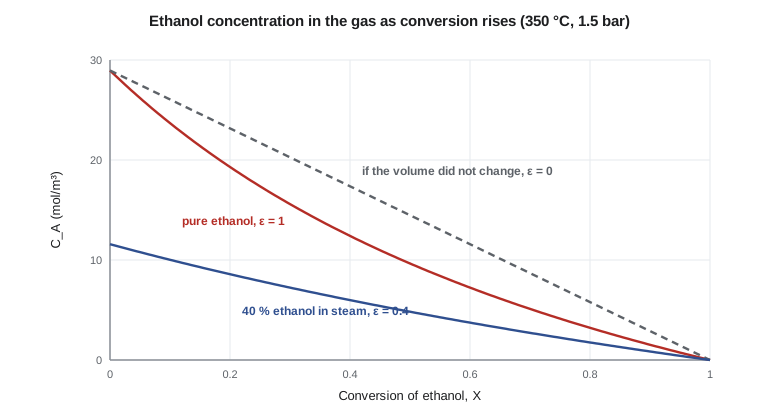
Each mole of ethanol that reacts makes two moles of gas. At constant temperature and pressure, the volumetric flow therefore grows as the reaction proceeds, and every concentration is diluted by the expansion. The change is captured by \(\delta\), the change in total moles per mole of A reacted (here \(\delta = 1 + 1 - 1 = 1\)), and \(\varepsilon = y_{A0}\delta\), the fractional change in volume at complete conversion. For an ideal gas,
Pure ethanol has \(\varepsilon = 1\): its volume doubles at complete conversion. Diluting the feed with steam reduces \(\varepsilon\) in proportion to the ethanol fraction. Industrial dehydration plants use steam both as a heat carrier, because the reaction is strongly endothermic, and to dilute the ethanol, which affects selectivity in lesson 6.
# Stoichiometric tables: liquid esterification (constant volume) and gas-phase ethanol dehydration
import math
# 1. Esterification, A + B <=> C + D, feed ratio theta_B = NB0/NA0, no products in the feed
CA0 = 8.7          # kmol/m3 for the 1:1 mixture (approximate)
def equilibrium_X(thB, K=4.0, thD=0.0):
    # K (1-X)(thB-X) = X (thD + X): solve the quadratic for the root between 0 and 1
    a = K - 1; b = -(K * (1 + thB) + thD); c = K * thB
    if abs(a) < 1e-12: return -c / b
    r = (-b - math.sqrt(b * b - 4 * a * c)) / (2 * a)
    return r
for thB in (1.0, 1.5, 2.0, 3.0):
    print(f"ethanol:acid = {thB:.1f}:1  equilibrium conversion of acid = {equilibrium_X(thB):.3f}")
print(f"95 % ethanol (0.13 mol water per mol ethanol) at 1:1: Xe = {equilibrium_X(1.0, thD=0.13):.3f}")
X = 0.60
print(f"at X = {X} from a 1:1 feed: CA = CB = {CA0 * (1 - X):.2f}, CC = CD = {CA0 * X:.2f} kmol/m3")

# 2. Dehydration in the gas phase, C2H5OH (A) -> C2H4 (E) + H2O (W)
R = 0.08314       # m3 bar/(kmol K)
P, T = 1.5, 623.15  # bar, K (350 C)
for yA0 in (1.0, 0.4):
    eps = yA0 * (1 + 1 - 1)    # delta = 1 mole of gas gained per mole of ethanol
    CA0g = yA0 * P / (R * T)
    print(f"yA0 = {yA0}: epsilon = {eps:.1f}, CA0 = {CA0g * 1000:.1f} mol/m3")
    for X in (0.0, 0.5, 0.9, 0.99):
        CA = CA0g * (1 - X) / (1 + eps * X)
        CE = CA0g * X / (1 + eps * X)
        print(f"   X = {X:4.2f}: CA = {CA * 1000:6.2f} mol/m3, CE = {CE * 1000:6.2f} mol/m3, v/v0 = {1 + eps * X:.2f}")
# equilibrium of the dehydration at 350 C (Kp about 538 bar, approximate)
Kp = 538.0
for yA0 in (1.0, 0.4):
    # Kp = (yE yW P) / yA with yE = X/(1+...), using mole numbers per mole of feed
    lo, hi = 0.0, 0.999999
    for _ in range(100):
        Xm = (lo + hi) / 2
        nA, nE, nW = yA0 * (1 - Xm), yA0 * Xm, (1 - yA0) + yA0 * Xm
        nt = 1 + yA0 * Xm
        f = (nE / nt) * (nW / nt) * P / (nA / nt) - Kp
        lo, hi = (lo, Xm) if f > 0 else (Xm, hi)
print(f"equilibrium at 350 C, 1.5 bar, yA0 = {yA0}: X = {Xm:.4f}")ethanol:acid = 1.0:1 equilibrium conversion of acid = 0.667 ethanol:acid = 1.5:1 equilibrium conversion of acid = 0.785 ethanol:acid = 2.0:1 equilibrium conversion of acid = 0.845 ethanol:acid = 3.0:1 equilibrium conversion of acid = 0.903 95 % ethanol (0.13 mol water per mol ethanol) at 1:1: Xe = 0.646 at X = 0.6 from a 1:1 feed: CA = CB = 3.48, CC = CD = 5.22 kmol/m3 yA0 = 1.0: epsilon = 1.0, CA0 = 29.0 mol/m3 X = 0.00: CA = 28.95 mol/m3, CE = 0.00 mol/m3, v/v0 = 1.00 X = 0.50: CA = 9.65 mol/m3, CE = 9.65 mol/m3, v/v0 = 1.50 X = 0.90: CA = 1.52 mol/m3, CE = 13.71 mol/m3, v/v0 = 1.90 X = 0.99: CA = 0.15 mol/m3, CE = 14.40 mol/m3, v/v0 = 1.99 yA0 = 0.4: epsilon = 0.4, CA0 = 11.6 mol/m3 X = 0.00: CA = 11.58 mol/m3, CE = 0.00 mol/m3, v/v0 = 1.00 X = 0.50: CA = 4.83 mol/m3, CE = 4.83 mol/m3, v/v0 = 1.20 X = 0.90: CA = 0.85 mol/m3, CE = 7.66 mol/m3, v/v0 = 1.36 X = 0.99: CA = 0.08 mol/m3, CE = 8.21 mol/m3, v/v0 = 1.40 equilibrium at 350 C, 1.5 bar, yA0 = 1.0: X = 0.9986 equilibrium at 350 C, 1.5 bar, yA0 = 0.4: X = 0.9980
Reading the output
An equimolar feed reaches two-thirds conversion of the acid at equilibrium. Excess ethanol pushes it up: 78.5 % at 1.5:1, 84.5 % at 2:1 and 90.3 % at 3:1. Water in the feed pushes it down: using 95 % ethanol, which carries about 0.13 mol of water per mole of ethanol, lowers the equilibrium to 64.6 %. These match the equilibrium results of CHE-320 lesson 11, as they must, because both come from the same \(K\). They explain two plant decisions: dry ethanol from the plant's molecular sieves is fed to the ester line rather than the hydrous product, and a modest excess of ethanol is used, with the unreacted ethanol recovered and recycled.
For the gas, pure ethanol at 350 °C and 1.5 bar has a concentration of 29 mol/m³. At 50 % conversion it has fallen to 9.7 mol/m³, not 14.5, because the gas has expanded by half. With 40 % ethanol in steam the starting concentration is only 11.6 mol/m³ and the expansion is milder. The equilibrium conversion at 350 °C is above 99.7 % in either case, so the dehydration is effectively irreversible at these conditions and its rate law needs no reverse term.
Worked problem
Concentrations at 60 % conversion
For the equimolar esterification feed with \(C_{A0} = 8.7\) kmol/m³, find the four concentrations at \(X = 0.60\) and check whether the mixture is at equilibrium.
Show solution
- \(C_A = C_B = 8.7 \times 0.40 = 3.48\) kmol/m³; \(C_C = C_D = 8.7 \times 0.60 = 5.22\) kmol/m³.
- Reaction quotient \(Q = C_CC_D/(C_AC_B) = 5.22^2/3.48^2 = 2.25\).
- \(Q < K = 4\), so the forward reaction still dominates and the net rate is positive.
Answer: 3.48, 3.48, 5.22 and 5.22 kmol/m³; not yet at equilibrium.
Concentration, pressure and the choice of variables
Rate laws for gas-phase catalytic reactions are often written in partial pressures rather than concentrations, because that is how laboratory data are usually taken. For an ideal gas, \(P_A = C_ART\), so the two forms are equivalent once the rate constant's units are converted. Partial pressure depends on total pressure, so pressure drop along a packed bed lowers the rate even at constant conversion. Lesson 4 includes this through the ratio \(P/P_0\) in the concentration equation.
Temperature enters the concentration equation too, through \(T_0/T\). For a non-isothermal gas reactor, the concentrations change with temperature even without reaction, and the energy balance of lesson 8 must be solved alongside the mole balance. For liquids, density changes with temperature are small and usually ignored in a first design.
Choosing the feed ratio
The equilibrium numbers show the effect of excess ethanol, but they do not decide the ratio alone. Every extra mole of ethanol fed must be heated, carried through the reactor and recovered by distillation, and it dilutes the acid, which lowers the rate per unit of reactor volume. A ratio of 1.2:1 raises the equilibrium conversion from 66.7 % to about 72 %, enough to help the pre-reactor, while keeping the ethanol recycle small. Lesson 12 uses that ratio. The choice is a typical reaction engineering trade-off: thermodynamics favours a large excess, while reactor size, separation duty and energy favour a small one, and the economic optimum lies between.
Common mistakes
MistakeUsing \(C_A = C_{A0}(1 - X)\) for a gas reaction that changes the number of moles.
InsteadInclude \((1 + \varepsilon X)\) and the pressure and temperature ratios.
MistakeTaking reaction orders from the stoichiometric equation of a non-elementary reaction.
InsteadOrders come from experiment unless the step is known to be elementary.
MistakeUsing a reversible rate law that does not give zero rate at equilibrium.
InsteadCheck that \(k_f/k_r = K_C\) at the reaction temperature.
MistakeChoosing an excess reactant as the basis for conversion.
InsteadUse the limiting reactant, usually the most valuable one.
Summary and key terms
- A rate law gives \(-r_A\) in terms of concentrations and \(k(T) = Ae^{-E/RT}\); orders are found by experiment.
- For a reversible reaction, \(-r_A = k_f(C_AC_B - C_CC_D/K_C)\), which vanishes at equilibrium.
- A stoichiometric table writes every concentration in terms of conversion and the feed ratios \(\Theta_i\).
- For gases with a change in moles, \(C_A = C_{A0}(1 - X)/(1 + \varepsilon X)\,(P/P_0)(T_0/T)\), with \(\varepsilon = y_{A0}\delta\).
- Esterification equilibrium: 66.7 % at 1:1, 84.5 % at 2:1, 64.6 % with 95 % ethanol.
- Dehydration at 350 °C is effectively irreversible; steam dilution lowers \(\varepsilon\).
- Rate law
- An equation giving the rate of reaction in terms of concentrations and temperature.
- Reaction order
- The exponent of a concentration in a power-law rate law.
- Elementary reaction
- A reaction that occurs in a single step as written, so its orders equal its coefficients.
- Activation energy
- The energy barrier in the Arrhenius equation, which sets how strongly k depends on temperature.
- Stoichiometric table
- A table of each species fed, changed and leaving, written in terms of conversion.
- Epsilon (ε)
- The fractional change in gas volume at complete conversion, y_A0 times δ.
Practice problems
Work each problem on paper first, then reveal the answer to check.
With \(E = 62\) kJ/mol, by what factor does \(k\) rise from 70 to 80 °C?
Show answer
\(\exp[(62{,}000/8.314)(1/343.15 - 1/353.15)] = 1.85\).
Write \(-r_B\) and \(r_C\) for the esterification if \(-r_A = 2\) kmol/(m³ h).
Show answer
\(-r_B = 2\) and \(r_C = 2\) kmol/(m³ h), because all coefficients are 1.
Find \(\varepsilon\) for a feed of 25 % ethanol and 75 % steam.
Show answer
\(\varepsilon = 0.25 \times 1 = 0.25\).
At \(X = 0.9\) with pure ethanol, by what factor has the volumetric flow grown at constant T and P?
Show answer
\(1 + 0.9 = 1.9\).
Why does feeding wet ethanol lower the equilibrium conversion of the esterification?
Show answer
Water is a product, so it shifts the equilibrium back toward the reactants.
What is \(\delta\) for \(\text{N}_2 + 3\text{H}_2 \to 2\text{NH}_3\) on a nitrogen basis?
Show answer
\(\delta = 2 - 3 - 1 = -2\).
Lesson quiz · 5 questions
Score 60% or more to complete this lesson.
Create a free account to save your progress, take quizzes and earn a certificate.