
BLR-210 · Lesson 6 of 12 · 19 min
FCAW in the field
The two long horizontal joints of the Tank 14 insert, top and bottom, hold most of its weld metal. Once the stick root passes are in and the inside has been back-gouged and rooted, Rosa sends up a wire feeder, and J. Okeke switches to flux cored arc welding, FCAW, for the fill and cap. FCAW is a wire process: a tubular wire with flux inside is fed continuously through a gun, so the welder does not stop every minute to change electrodes, and it deposits weld metal several times faster than stick. On tanks, structural steel, coker drums and heavy plate in the field, it does much of the welding boilermakers do.
Two kinds of flux cored welding
Flux cored wires come in two families, and the choice between them is often decided by the wind.
| Gas-shielded (FCAW-G) | Self-shielded (FCAW-S) | |
|---|---|---|
| Shielding | External gas, usually CO2 or argon-CO2 mix, plus the flux | The flux alone makes the shield and deoxidizes the weld |
| Wind tolerance | Poor; a draft blows the gas away | Good; used in the open without a screen in moderate wind |
| Typical wire | E71T-1C or E71T-1M, and metric equivalents | E71T-8 and similar, many made for toughness |
| Polarity | Usually DC electrode positive | Often DC electrode negative; check the wire |
| Welder appeal | Smooth arc, easy slag, high deposition | Harsher arc, more fume, needs more skill |
| Gear | Gas cylinders or bulk gas, regulator, hose | No gas; lighter to carry up a structure |
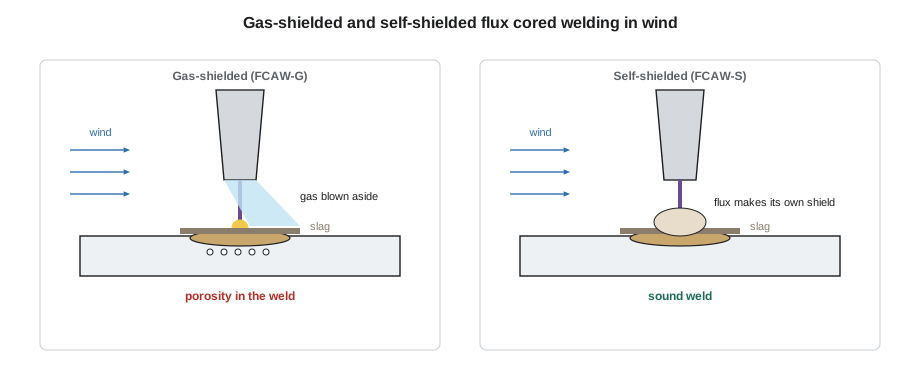
Both kinds leave a slag that must be removed between passes, as in stick welding. And both are wire processes that need their own WPS and their own welder qualification. A welder qualified for SMAW is not qualified for FCAW, and a WPS for gas-shielded wire does not cover self-shielded wire. On Tank 14, J. Okeke's FCAW qualification and the crew's gas-shielded WPS are both current; Harjit checked them on the continuity log in lesson 1.
Wind, screens and habitats
Gas-shielded welding fails in a draft. A wind of only a few kilometres per hour across the joint is enough to blow the shielding gas away from the arc, and the weld fills with porosity that may not show on the surface. Welding codes and owner specifications commonly limit gas-shielded welding to light wind, often about 8 km/h (5 mph) at the arc, unless the joint is protected by a screen or enclosure. On a tank in open country, that limit is passed most afternoons.
There are three answers. The crew can build a windbreak or a full habitat, a tarp enclosure on a frame around the work, which also keeps rain off and helps hold preheat. It can switch to self-shielded wire, which tolerates more wind but needs a WPS and qualified welders for it. Or it can stop when the wind rises. On Tank 14, Rosa has the crew hang tarps on a light frame clamped to the tank's top wind girder, making a three-sided shelter round the joint, and keeps a hand anemometer at the joint. When the wind at the arc rises above the limit despite the screen, J. Okeke switches to stick until it drops.
Kiera compares the three processes for the fill and cap on the horizontal joints, including the crew hours, consumables and gas, and checks the wind reading from the afternoon.
# FCAW or SMAW for the Tank 14 horizontal seams (metric)

weld = 12.0                              # weld metal still to deposit, fill and cap
rate = {"SMAW": 1.4, "FCAW-G": 3.6, "FCAW-S": 3.0}   # deposition while the arc is on
factor = {"SMAW": 0.25, "FCAW-G": 0.40, "FCAW-S": 0.38}   # operating factor in the field
eff = {"SMAW": 0.60, "FCAW-G": 0.85, "FCAW-S": 0.80}      # weld metal per unit bought
price = {"SMAW": 9.0, "FCAW-G": 7.5, "FCAW-S": 11.0}   # consumable price per kg bought
crew_rate = 135                                       # crew cost per welder hour, CAD
gas_hour = 4                                          # shielding gas per arc hour, CAD
for p in rate:
    hours = weld / (rate[p] * factor[p])
    cons = weld / eff[p] * price[p]
    gas = weld / rate[p] * gas_hour if p == "FCAW-G" else 0
    total = hours * crew_rate + cons + gas
    print(f"{p:7} welder hours {hours:5.1f}  consumables {cons:6.0f}  gas {gas:4.0f}  total {total:6.0f} CAD")

wind = 12                               # wind at the seam, measured with a hand anemometer
limit_g = 8                            # common limit for gas-shielded processes without a screen
print(f"wind {wind} km/h:", "FCAW-G OK" if wind <= limit_g else "FCAW-G needs a screen or tent; FCAW-S can run")SMAW welder hours 34.3 consumables 180 gas 0 total 4809 CAD FCAW-G welder hours 8.3 consumables 106 gas 13 total 1244 CAD FCAW-S welder hours 10.5 consumables 165 gas 0 total 1586 CAD wind 12 km/h: FCAW-G needs a screen or tent; FCAW-S can run
Gas-shielded FCAW finishes the horizontal joints in about a quarter of the welder hours stick would take, and at about a quarter of the cost, because the operating factor, the fraction of time the arc is actually on, is higher with wire and the deposition rate is more than twice as high. The wind reading of 12 km/h is above the gas-shielded limit, which is why the screen matters. Self-shielded wire would run in that wind at a modest extra cost, and Rosa keeps a spool of it in the truck for days when the screen is not enough.
Setting up the wire feeder
A flux cored set-up in the field has more parts than a stick set-up, and each can cause trouble. The power source is a constant-voltage machine, or a multiprocess machine set to constant voltage; the wire feeder is placed near the work so the gun cable is short; the gun, liner, contact tip and nozzle are matched to the wire diameter; the drive rolls are the knurled type made for tubular wire, set with just enough pressure to feed without crushing the wire. On a tank, the feeder is hung on the scaffold or placed on the tank floor near the joint, and the long lead from the power source runs along a protected path.
Settings come from the WPS: wire feed speed, which sets the current, voltage, contact-tip-to-work distance and travel speed. The contact-tip-to-work distance, often called stickout, matters more with flux cored wire than with solid wire. A longer stickout preheats the wire, lowers the current at the same wire feed speed and changes penetration; a welder who holds the gun farther away on the last half of a long pass makes a different weld than at the start. J. Okeke runs a test bead on a scrap plate tacked to the scaffold before each shift, checks the arc and the slag, and adjusts within the WPS range.
Technique on the horizontal joints
On the Tank 14 horizontal joints, the fill passes are stringers stacked from the bottom of the groove upward, as with stick, but larger, because the wire's deposition rate is higher. The gun is angled slightly upward, about 5 to 10 degrees, and dragged, pointing back toward the finished weld, at a drag angle of about 10 to 15 degrees, which is the normal technique for flux cored wire because the slag must stay behind the puddle. Each pass is cleaned before the next; FCAW slag usually peels easily, but slag left at a toe is a defect, just as in stick welding.
The vertical joints of the insert are short, and J. Okeke welds them with stick rather than switching back and forth. Many flux cored wires do weld well vertical-up, and on a long vertical tank seam, FCAW vertical-up with a small weave is common practice.
Fume from flux cored welding
Flux cored wires make more fume than stick electrodes at the same current, and self-shielded wires make the most. Inside a tank or vessel, or in an enclosure on the outside, the fume builds up quickly. Imran sets up local exhaust at the joint, a capture hood on a flexible duct within 300 mm (12 in) of the arc, and the welder wears a respirator if the exposure assessment calls for it. The tarps that keep the wind off also keep fume in, so the enclosure has an opening at the top or an exhaust fan.
When FCAW is not used
Flux cored welding is not the answer to every boilermaker weld. Most boiler tube welds are GTAW and SMAW, because tubes are small, thin, welded in fixed positions in tight spaces, and need a root pass that can be controlled to the last millimetre. Some owners do not allow self-shielded wire on certain pressure parts, or require toughness testing for it. And on alloy steels, the choice of flux cored wire is narrower, and the WPS may not include it. The rule, as always, is that the process must be on the WPS for the joint.
Worked problem
Welder hours for the horizontal joints
The fill and cap still need 12 kg (26.5 lb) of weld metal. Gas-shielded FCAW deposits 3.6 kg/h (8.0 lb/h) with the arc on, and the operating factor in the field is 0.40. How many welder hours?
Show solution
- Deposition while working: 3.6 × 0.40 = 1.44 kg/h.
- Hours: 12 ÷ 1.44 = 8.3 h.
Answer: About 8 welder hours, compared with about 34 for stick.
Keeping the wire running
Most of the lost time on a field FCAW job is not welding time, it is feeding trouble. The wire must travel from the spool, through the drive rolls, along several metres of gun cable and through the contact tip, and anything that adds friction along that path makes the arc stutter. The common faults and their fixes are worth knowing before the first shift.
| Symptom | Likely cause | Fix |
|---|---|---|
| Wire stops and starts, arc surges | Dirty or worn liner, too long or kinked gun cable | Blow out or replace the liner; straighten the cable |
| Wire tangles at the drive rolls (bird's nest) | Too much roll pressure, worn tip, wrong roll type | Use knurled rolls, reduce pressure, change the tip |
| Wire burns back into the tip | Stickout too short, tip worn, wire feed speed low for the voltage | Hold the WPS stickout; replace the tip; check settings |
| Porosity with gas-shielded wire | Wind, empty cylinder, leaking hose, spatter in the nozzle | Screen the joint, check the gas, clean the nozzle |
| Porosity with self-shielded wire | Stickout too short, wet wire, wrong polarity | Hold the stickout; keep the spool dry; check polarity |
| Rough bead with heavy spatter | Voltage wrong for the wire feed speed | Adjust within the WPS range on a test plate |
Flux cored wire also absorbs moisture, just as low-hydrogen electrodes do, though more slowly. A spool left on the feeder overnight in a damp tank, or in the back of a truck in the rain, can pick up enough moisture to cause porosity and hydrogen in the weld. J. Okeke's practice is to take the spool off the feeder at the end of the shift, bag it and keep it in the dry trailer, and to keep unopened spools in their sealed packaging until they are needed. The WPS or the wire maker's data sheet says how the wire must be stored, and some owners require that partly used spools exposed for too long be scrapped. On a tank job, those habits cost a few minutes at each shift change and save a cut-out.
When the joint is complete, the welds are cleaned of slag and spatter, examined visually by the welder and by Harjit, and then examined by the methods the tank repair plan requires. On Tank 14, the insert's butt welds are examined by radiography, the same method lesson 11 covers on boiler tubes.
Common mistakes
MistakeRunning gas-shielded wire in wind without a screen.
InsteadMeasure the wind at the arc; screen the joint or change to self-shielded wire on its WPS.
MistakeAssuming an SMAW qualification covers FCAW.
InsteadCheck the WPQ for the process and the WPS for the wire.
MistakeUsing smooth drive rolls on tubular wire.
InsteadUse knurled rolls for flux cored wire and set light pressure.
MistakeLetting the stickout grow along a pass.
InsteadHold the contact-tip-to-work distance steady as the WPS sets it.
MistakeLeaving the enclosure closed with no exhaust.
InsteadCapture the fume at the arc and ventilate the enclosure.
Summary and key terms
- FCAW feeds a tubular wire with flux inside; it deposits weld metal several times faster than stick.
- Gas-shielded wire needs protection from wind; self-shielded wire makes its own shield and tolerates more.
- The higher deposition and operating factor make FCAW much cheaper per kilogram of weld metal.
- Settings come from the WPS: wire feed speed, voltage, stickout and travel speed.
- Drag the gun, stack stringers on horizontal joints and clean every pass.
- Control fume at the arc, especially with self-shielded wire inside enclosures.
- FCAW-G
- Flux cored arc welding with an external shielding gas.
- FCAW-S
- Self-shielded flux cored arc welding, with no external gas.
- Operating factor
- The fraction of a welder's working time that the arc is on.
- Deposition rate
- The weight of weld metal deposited per hour of arc time.
- Contact-tip-to-work distance
- The distance from the end of the contact tip to the work; it changes the current and penetration.
- Habitat
- An enclosure built around a weld to keep out wind and rain and hold heat.
Practice problems
Work each problem on paper first, then reveal the answer to check.
A weld needs 20 kg of metal. FCAW deposits 3.6 kg/h at an operating factor of 0.4. How many welder hours?
Show answer
20 ÷ (3.6 × 0.4) = 13.9 hours.
The wind at the arc is 10 km/h and the limit for gas-shielded welding is 8 km/h. What are the options?
Show answer
Screen or enclose the joint, switch to self-shielded wire on its WPS, or wait.
Why is the gun dragged with flux cored wire?
Show answer
So the slag stays behind the puddle and does not run ahead of it.
What does a longer stickout do?
Show answer
It preheats the wire and lowers the current at the same wire feed speed, changing penetration.
Lesson quiz · 5 questions
Score 60% or more to complete this lesson.
Create a free account to save your progress, take quizzes and earn a certificate.