
AUTO-220 · Lesson 6 of 12 · 20 min
Batteries and battery testing
The first morning below −20 °C brings four tows to Ridgeline before nine o'clock. Dale Fenwick lines them up along the fence, and Bev Ostrowski asks the front counter to tell callers that battery tests are first come, first served. One of the cars belongs to Ines Moreau: her hybrid sat for three weeks at the airport parking lot while she visited family, and it would not power up when she returned. The hybrid's high-voltage pack was fine; the small 12-volt battery in the trunk that wakes up its computers was flat. Marty uses the day to teach Kiran the battery, the component that causes more no-start calls than any other.
This lesson covers how a lead-acid battery stores and delivers energy, the flooded, enhanced flooded and absorbed glass mat types, the ratings printed on a battery, how state of charge and state of health are tested, how cold affects both the battery and the engine it must start, how to charge and replace batteries safely, and why many vehicles must be told when a new battery is fitted.
How a lead-acid battery works
A 12-volt lead-acid battery has six cells connected in series, each producing about 2.1 volts when fully charged. Each cell contains positive plates of lead dioxide and negative plates of spongy lead, separated by porous separators and immersed in an electrolyte of dilute sulphuric acid. As the battery discharges, both plates turn gradually to lead sulphate, and the electrolyte becomes weaker and closer to water. Charging reverses the reaction, turning the lead sulphate back into lead dioxide and lead and returning the acid to the electrolyte.
Two problems follow from that chemistry. First, a discharged battery's electrolyte is mostly water, which freezes at a much higher temperature than strong acid; a fully charged battery will not freeze in any Canadian or US winter, but a flat one can freeze, crack its case and buckle its plates. Second, if a battery is left discharged, the lead sulphate on the plates hardens into crystals that cannot easily be turned back, a process called sulphation, which permanently reduces capacity. A battery that has sat flat for weeks may never recover fully, which is why Marty tells customers that a battery left discharged is a battery being damaged.
Battery types
A flooded battery has its plates immersed in liquid electrolyte. Older designs had removable caps for adding distilled water; most modern flooded batteries are sealed low-maintenance types, though they still vent gas through small openings. An enhanced flooded battery, or EFB, uses thicker plates and additives to survive the frequent deep cycling of stop-start engines better than a standard flooded battery. An absorbed glass mat, or AGM, battery holds its electrolyte in fibreglass mats pressed between the plates. AGM batteries are sealed and valve-regulated, resist vibration, tolerate deep cycling, recharge faster and do not spill, which is why they are fitted to most vehicles with stop-start systems and to many vehicles with the battery in the cabin or trunk, such as Ines's hybrid.
A battery must be replaced with the type the vehicle was built with, or an approved upgrade. Fitting a standard flooded battery in place of an AGM on a stop-start vehicle leads to early failure, because the charging system is programmed for AGM charging voltages and cycling. Fitting an AGM in place of a flooded battery is sometimes allowed, but on many vehicles the battery management system must be told about the change, as described below. Some newer vehicles use lithium-ion 12-volt batteries, which have their own charging and handling rules from the manufacturer.
Battery ratings
Batteries carry several ratings, set out in standards from the Battery Council International (BCI) and other bodies. Cold cranking amps, or CCA, is the current a new, fully charged battery can deliver at −18 °C (0 °F) for 30 seconds while keeping its voltage at or above 7.2 volts, which is 1.2 volts per cell. It is the most important rating for starting in winter. Cranking amps, sometimes called marine cranking amps, is the same test at 0 °C (32 °F) and gives a larger number. Reserve capacity is the number of minutes a battery can deliver 25 amps at 27 °C (80 °F) before falling to 10.5 volts, a measure of how long it could run essential loads if the charging system failed. Ampere-hours, used by many European and Asian manufacturers, is the capacity over a 20-hour discharge. The BCI group size, such as 48, 65 or 94R, sets the case dimensions and post layout, and the replacement must match the group size so that it fits the tray, the hold-down and the cables.
# Available cranking capacity versus temperature (a typical lead-acid battery, illustrative)
UNITS = "metric"
rated_cca = 760                     # amps at -18 C (0 F)
# fraction of rated cranking power available at temperature, typical published curve
curve = [(27, 1.00), (0, 0.65), (-18, 0.40), (-29, 0.30)]
# cranking power the engine needs, relative to a warm engine (thick oil at low temperature)
need = {27: 1.0, 0: 1.65, -18: 2.5, -29: 3.5}
for c, frac in curve:
    label = f"{c:4d} C" if UNITS == "metric" else f"{c * 9 / 5 + 32:4.0f} F"
print(f"{label}: battery delivers about {frac * 100:3.0f} % of its warm power; engine needs {need[c]:3.1f} times its warm power")27 C: battery delivers about 100 % of its warm power; engine needs 1.0 times its warm power 0 C: battery delivers about 65 % of its warm power; engine needs 1.6 times its warm power -18 C: battery delivers about 40 % of its warm power; engine needs 2.5 times its warm power -29 C: battery delivers about 30 % of its warm power; engine needs 3.5 times its warm power
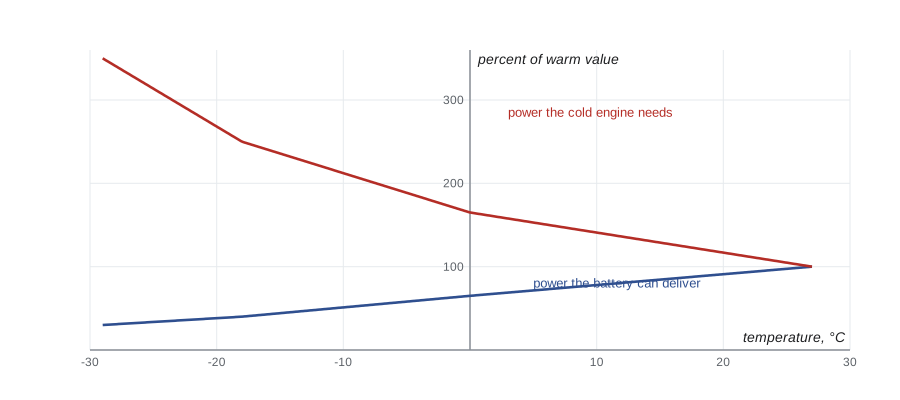
The two columns in that output explain every cold-morning tow. As the temperature drops, the chemical reaction in the battery slows and its internal resistance rises, so it can deliver less power. At the same time, the engine oil thickens and the engine needs far more torque to turn over. A battery that started the engine easily all summer, but has lost some of its capacity with age, is the one that fails on the first deep cold morning.
State of charge
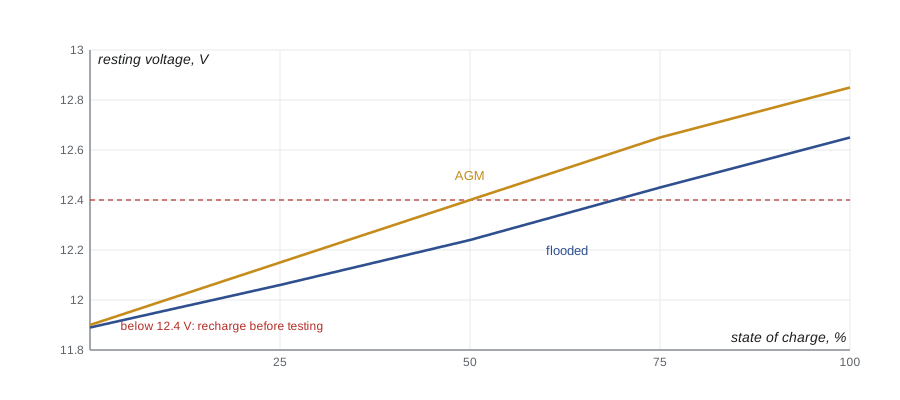
A battery's state of charge can be estimated from its open-circuit voltage, measured with a DMM when the battery has rested with no load and no charging for several hours, or after the surface charge has been removed by switching on the headlamps for a minute and then off. A fully charged flooded battery reads about 12.6 to 12.7 volts at room temperature; AGM batteries read slightly higher, about 12.8 to 12.9 volts. A reading of 12.4 volts is roughly 75 percent, 12.2 volts about 50 percent, and 12.0 volts about 25 percent. Below about 11.9 volts the battery is effectively flat. Testing a discharged battery for its health gives misleading results, so a battery is charged before it is judged.
# State of charge from resting open-circuit voltage (typical tables at about 25 C)
flooded = [(12.65, 100), (12.45, 75), (12.24, 50), (12.06, 25), (11.89, 0)]
agm = [(12.85, 100), (12.65, 75), (12.40, 50), (12.15, 25), (11.90, 0)]
def soc(v, table):
    if v >= table[0][0]: return 100
    if v <= table[-1][0]: return 0
    for (v1, s1), (v2, s2) in zip(table, table[1:]):
        if v2 <= v <= v1:
            return s2 + (v - v2) / (v1 - v2) * (s1 - s2)
for name, v, table in [("Ines, AGM, after 3 weeks parked", 11.71, agm), ("Ines, AGM, after charging", 12.83, agm),
                       ("customer pickup, flooded", 12.31, flooded), ("courier van 1, flooded", 12.58, flooded)]:
print(f"{name:<34} {v:5.2f} V -> about {soc(v, table):3.0f} % charged")Ines, AGM, after 3 weeks parked 11.71 V -> about 0 % charged Ines, AGM, after charging 12.83 V -> about 98 % charged customer pickup, flooded 12.31 V -> about 58 % charged courier van 1, flooded 12.58 V -> about 91 % charged
Testing battery health
Open-circuit voltage shows how much charge is in the battery, not whether it can deliver current. A battery with a dead cell or badly sulphated plates may read 12.5 volts and still collapse as soon as the starter engages. Two kinds of test check its ability to deliver. A carbon pile load test applies a heavy load, traditionally half the battery's CCA rating, for 15 seconds, and reads the voltage at the end; a healthy battery at about 21 °C (70 °F) stays above 9.6 volts, with a lower minimum at colder temperatures. Load testers are effective but heavy, and the test must be done on a charged battery.
Most shops now use a conductance or impedance tester, which passes a small AC signal through the battery and measures how easily it conducts. The tester compares the result with the CCA rating entered by the technician and reports the battery's measured CCA and a verdict, such as good, charge and retest, or replace. Conductance testers are quick and safe and can test a battery still in the vehicle, but they must be set up with the correct battery type and rating, and they too need a charged battery for a reliable verdict. Many print a code or a report that the battery maker requires for a warranty claim.
Ines's AGM battery reads 11.71 volts, almost flat, so Kiran charges it on the shop's battery charger, which has an AGM setting, until its charge current tapers off. After a rest, it reads 12.83 volts, and the conductance tester reports 342 measured CCA against a rating of 360, a good battery. Three weeks of a hybrid's small standby current had simply drained it. Kiran shows Ines the parking feature in her owner's manual and suggests a maintainer if the car will sit for more than two weeks, and she checks the hybrid's standby current the way Lesson 12 describes before releasing it: 28 milliamps once the modules are asleep, which is normal for that model.
Charging and jump-starting safely
Lead-acid batteries give off hydrogen gas when charging, especially near full charge and when overcharged, and hydrogen in air is explosive. The shop charges batteries in a ventilated area, keeps sparks and flames away, wears eye protection and gloves, and connects and disconnects the charger with it switched off. The charger's setting must match the battery type; AGM batteries are damaged by the higher voltages some older chargers use. A frozen battery is never charged or jumped; it can explode. It is thawed and inspected first, and usually replaced.
When jump-starting, the booster or jump pack is connected positive to positive and then negative to an engine or body ground point the manufacturer specifies, away from the battery, so that the last connection, which may spark, is made away from any hydrogen around the battery. Many vehicles with the battery in the trunk or under a seat have remote jump posts under the hood for this purpose. Hybrids and electric vehicles have specific instructions in the owner's manual, and some must never be used to jump another vehicle.
Replacement and battery registration
Replacing a battery on a modern vehicle involves more than swapping it. Many vehicles have a battery monitoring sensor on the negative terminal, which measures current in and out, voltage and temperature, and reports to a battery management function in a module. That function adjusts the charging voltage as the battery ages and decides when to shut off non-essential loads or stop-start. When a new battery is fitted, the system must be told, through a battery registration or reset procedure with a scan tool, so that it stops treating the new battery as old and charges it correctly. If the type or capacity changes, from flooded to AGM or to a larger ampere-hour rating, that must be entered too. Skipping registration can overcharge or undercharge the new battery and shorten its life.
Kiran's battery replacement routine is: check the type, group size, CCA and any special terminals against the original; connect a memory saver if the service information calls for it; disconnect negative first; clean the cable ends and the tray; fit the battery with its hold-down tight and any vent tube connected; reconnect positive first; register the battery if required; and finally run any relearn procedures, such as power window one-touch positions, throttle idle relearns or steering angle resets that the vehicle may need after power loss.
Worked problem
Is this battery good?
A flooded battery rated 650 CCA reads 12.62 V at rest. A carbon pile load test at 325 A for 15 s ends at 8.9 V. The battery and the room are at about 21 °C (70 °F). Is the battery good?
Show solution
- 12.62 V shows the battery is fully charged, so the load test is valid.
- The load is half the CCA rating, as the test requires.
- At about 21 °C a good battery should stay above 9.6 V.
- 8.9 V is well below that, so the battery cannot deliver its rated current.
Answer: No: fully charged but failing under load. Replace it.
Common mistakes
MistakeTesting a discharged battery and condemning it.
InsteadCharge it first; a discharged battery fails load and conductance tests.
MistakeCharging or jumping a frozen battery.
InsteadIt can explode; thaw and inspect it first.
MistakeFitting a flooded battery where an AGM was original.
InsteadUse the original type or an approved upgrade; stop-start systems destroy flooded batteries.
MistakeSkipping battery registration after replacement.
InsteadThe battery management system will charge the new battery as if it were old.
MistakeMaking the last jump connection on the dead battery's negative post.
InsteadConnect to the specified ground point away from the battery.
Summary and key terms
- A 12 V lead-acid battery has six cells; discharge turns the plates to lead sulphate and weakens the acid.
- Flooded, EFB and AGM batteries suit different duties; stop-start vehicles need EFB or AGM.
- CCA is the current a battery delivers at −18 °C (0 °F) for 30 s above 7.2 V.
- Cold reduces the battery's available power while increasing the engine's cranking demand.
- Resting voltage shows state of charge; load and conductance tests show health, on a charged battery.
- Charging gives off hydrogen; ventilate, avoid sparks and never charge a frozen battery.
- Many vehicles need battery registration and relearn procedures after a battery is replaced.
- Cold cranking amps
- The current a battery delivers for 30 s at −18 °C (0 °F) while staying above 7.2 V.
- Reserve capacity
- The minutes a battery can deliver 25 A before falling to 10.5 V.
- AGM battery
- An absorbed glass mat battery, sealed, with its electrolyte held in glass fibre mats.
- EFB
- An enhanced flooded battery built for frequent cycling in stop-start vehicles.
- Sulphation
- Hardening of lead sulphate on the plates of a battery left discharged.
- Conductance tester
- A tester that estimates a battery's cranking ability from its response to an AC signal.
- Battery registration
- Telling the vehicle's battery management system that a new battery has been fitted.
Practice problems
Work each problem on paper first, then reveal the answer to check.
A flooded battery rests at 12.2 V. About how charged is it?
Show answer
About 50 percent.
Why are AGM batteries used on stop-start vehicles?
Show answer
They tolerate frequent deep cycling and recharge quickly.
What should a battery's group size match?
Show answer
The tray, hold-down and cable layout of the vehicle.
Why connect the last jump lead away from the battery?
Show answer
The final connection may spark, and hydrogen may be around the battery.
Lesson quiz · 5 questions
Score 60% or more to complete this lesson.
Create a free account to save your progress, take quizzes and earn a certificate.