
PET-220 · Lesson 6 of 12 · 26 min
Conservation of mass
Mass cannot be created or destroyed, and in a water system that simple fact does a great deal of work. It tells Ray Mendoza how fast the elevated reservoir will rise when the pumps deliver more than the city draws. It tells Hana Lindqvist how fast water moves in each branch of a junction, and how long the backwash tank takes to drain. And it underlies the water balance, the audit that compares water pumped with water billed to find leaks. This lesson turns conservation of mass into a working equation for control volumes, the regions of space through which fluid flows.
Systems and control volumes
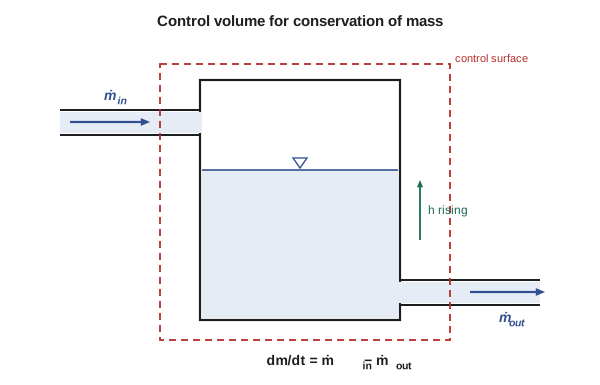
In solid mechanics we follow a fixed piece of material, a system. In fluid mechanics it is usually far more convenient to fix a region of space, a control volume, and watch fluid flow through it. The control volume around a pump has fixed boundaries at its inlet and outlet flanges; the control volume around a draining tank might include the water inside and have one boundary at the outlet. The laws of physics are written for systems, so we need a bridge between them, called the Reynolds transport theorem. For mass, the bridge is intuitive: the rate at which mass accumulates inside a control volume equals the rate at which it flows in minus the rate at which it flows out.
Mass flow rate and volume flow rate
The mass flow rate through a surface is the mass crossing it per unit time. Where fluid crosses a small area \(dA\) with velocity component \(V_n\) normal to the area, it carries mass at a rate \(\rho V_n\,dA\). Integrating over a pipe cross-section gives the mass flow rate. The velocity is not uniform across a pipe, being zero at the wall and highest at the center, so we define an average velocity that, multiplied by the area, gives the same flow.
The volume flow rate \(Q\), also called discharge, is in m³/s. Utilities often quote liters per second, megaliters per day or, in the United States, gallons per minute and million gallons per day. Unless a velocity is described as a local or centerline value, the \(V\) in pipe-flow formulas means the average velocity \(Q/A\). In water mains, average velocities are usually kept between about 0.6 and 2 m/s: slower flows allow sediment to settle, and faster ones waste energy in friction and make water hammer worse.
Unit conversions come up constantly. One cubic meter per second is 1000 L/s, 86.4 ML/d, 15 850 gpm or 22.8 MGD. The Northside pumps deliver up to about 330 L/s (5200 gpm) each, and the station's peak output of 650 L/s is about 56 ML/d (14.8 MGD).
Steady flow: the continuity equation
In steady flow, nothing accumulates inside a fixed control volume, so mass flow in equals mass flow out. For a single stream entering at section 1 and leaving at section 2, this is the continuity equation. For a liquid, density is constant, and continuity says that the volume flow rate is the same at every section. Where the pipe narrows, the water must speed up; where it widens, it slows down, in inverse proportion to the area.
For a circular pipe the area goes as diameter squared, so halving the diameter quadruples the velocity. Reducing the 600 mm main to a 360 mm venturi throat raises the velocity by a factor of \((600/360)^2 = 2.78\), from 1.6 m/s to 4.4 m/s. That jump in velocity, through the energy equation, produces the pressure drop the meter measures.
Worked problem
Flow split at a junction
The 600 mm (24 in) transmission main carries water at an average velocity of 1.60 m/s (5.25 ft/s) to a junction. Branch A sends 280 L/s (4440 gpm) to the elevated reservoir, and branch B, a 400 mm (16 in) pipe, carries the rest toward the north industrial park. Find the flow and velocity in branch B.
Show solution
- Main: \(Q = VA = 1.60\,\pi(0.600)^2/4 = 0.452\ \text{m}^3/\text{s}\).
- Steady incompressible flow, one inlet and two outlets: \(Q_B = Q - Q_A = 0.452 - 0.280 = 0.172\ \text{m}^3/\text{s}\).
- Branch B area: \(\pi(0.400)^2/4 = 0.1257\ \text{m}^2\), so \(V_B = 0.172/0.1257 = 1.37\ \text{m/s}\).
Answer: Branch B carries 172 L/s (2730 gpm) at 1.37 m/s (4.49 ft/s), a comfortable velocity for a distribution main.
Unsteady flow: filling and draining
When inflow and outflow differ, the mass inside the control volume changes. For a tank of constant cross-sectional area \(A_t\) holding liquid to depth \(h\), the mass inside is \(\rho A_t h\), and the mass balance becomes a differential equation for the depth. Operators use its simplest form daily: if the pumps deliver 0.65 m³/s to the elevated reservoir and the city draws 0.45 m³/s, the reservoir, with an area of 1200 m², rises at \(0.20/1200 = 0.000167\ \text{m/s}\), or 0.6 m per hour.
Draining by gravity through an orifice in the bottom is a classic case. The outflow depends on the depth, because the outlet velocity is about \(\sqrt{2gh}\) (a result from Lesson 7), reduced by a discharge coefficient \(C_d\) of about 0.6 for a sharp-edged opening. With \(Q_{\text{out}} = C_d A_o \sqrt{2gh}\) and no inflow, separating variables and integrating gives the time to drain from depth \(h_0\) to empty.
The square root means draining slows down as the tank empties: the last meter takes far longer than the first. The program below simulates the backwash tank draining in half-second steps and compares the result with the exact formula. Stepping methods like this one solve mass balances that have no neat formula, such as a reservoir with time-varying demand, a pump that switches on and off, or a tank whose area changes with depth.
# Conservation of mass: a draining storage tank and a pipe junction
import math
g = 9.81

# Junction on the transmission main: two branches leave a 600 mm main
D_main, V_main = 0.600, 1.60
Q_main = math.pi * D_main**2 / 4 * V_main
Q_a = 0.280                       # m3/s to the elevated reservoir
Q_b = Q_main - Q_a
D_b = 0.400
V_b = Q_b / (math.pi * D_b**2 / 4)
print(f"Main: Q = {Q_main:.3f} m3/s ({Q_main*1000:.0f} L/s)")
print(f"Branch B: Q = {Q_b:.3f} m3/s, V = {V_b:.2f} m/s in a {D_b*1000:.0f} mm pipe")

# Draining the backwash tank through a bottom outlet (unsteady mass balance)
D_tank, d_out, Cd = 6.0, 0.30, 0.62
A_t, A_o = math.pi * D_tank**2 / 4, math.pi * d_out**2 / 4
h, t, dt = 4.0, 0.0, 0.5
print()
print(" t (s)   depth (m)   outflow (L/s)")
while h > 0.05:
    Q = Cd * A_o * math.sqrt(2 * g * h)
    if round(t) % 60 == 0 and abs(t - round(t)) < 1e-9:
        print(f"{t:5.0f}   {h:8.3f}   {Q*1000:10.1f}")
    h -= Q / A_t * dt
    t += dt
t_exact = A_t / (Cd * A_o) * math.sqrt(2 / g) * (math.sqrt(4.0) - math.sqrt(0.05))
t_empty = A_t / (Cd * A_o) * math.sqrt(2 * 4.0 / g)
print(f"Time to fall to 5 cm: simulated {t:.0f} s, exact {t_exact:.0f} s")
print(f"Exact time to empty completely: {t_empty:.0f} s")Main: Q = 0.452 m3/s (452 L/s)
Branch B: Q = 0.172 m3/s, V = 1.37 m/s in a 400 mm pipe
t (s) depth (m) outflow (L/s)
0 4.000 388.2
60 3.218 348.2
120 2.521 308.2
180 1.909 268.2
240 1.382 228.2
300 0.940 188.2
360 0.583 148.2
420 0.310 108.1
480 0.123 68.1
Time to fall to 5 cm: simulated 517 s, exact 517 s
Exact time to empty completely: 583 sWorked problem
Time to drain the backwash tank
The backwash supply tank is 6.0 m (19.7 ft) in diameter and holds water 4.0 m (13.1 ft) deep. It drains through a 300 mm (11.8 in) sharp-edged outlet in its floor with \(C_d = 0.62\). How long does it take to empty?
Show solution
- Areas: \(A_t = \pi(6.0)^2/4 = 28.27\ \text{m}^2\); \(A_o = \pi(0.300)^2/4 = 0.0707\ \text{m}^2\).
- \(t = \dfrac{28.27}{0.62(0.0707)}\sqrt{\dfrac{2(4.0)}{9.81}} = 645(0.903)\).
- \[t = 583\ \text{s} \approx 9.7\ \text{min}\]
Answer: The tank empties in under ten minutes, but the first half of its volume leaves in only about three minutes. In the real system a valve throttles the outlet so the filter receives a steady backwash flow; the mass balance then includes the valve's resistance.
Compressible flows and density changes
For gases, density varies, and continuity must keep \(\rho\) inside: \(\rho_1 V_1 A_1 = \rho_2 V_2 A_2\). Air from the station's blowers, compressed to twice atmospheric pressure, has roughly twice the density of ambient air, so the same mass flow moves at half the velocity in a pipe of the same size. In a gas pipeline, where pressure falls along the length because of friction, density falls too and the velocity rises toward the outlet, even in a pipe of constant diameter. Liquids, by contrast, keep a constant velocity in a constant-diameter pipe no matter how much pressure they lose.
Mass balances for dissolved substances
Conservation of mass applies to each substance carried by the water, not just to the water itself. That is how chemical feed rates are set. If chlorine is dosed at a concentration \(C\) into a flow \(Q\), the mass of chlorine added per unit time is \(CQ\). With \(C\) in mg/L and \(Q\) in L/s, the product is in mg/s, and a factor of 86 400 s per day turns it into a daily mass. Operators rearrange the same balance to find the pump setting that delivers the required dose from a stock solution of known strength.
Worked problem
Hypochlorite feed rate
The station adds sodium hypochlorite to bring the free chlorine in the outgoing water up by 0.8 mg/L at a flow of 450 L/s (7130 gpm). The stock solution contains 120 g of available chlorine per liter. Find the chlorine mass needed per day and the feed pump rate in L/h and gal/h.
Show solution
- Chlorine mass rate: \(CQ = 0.8\ \text{mg/L} \times 450\ \text{L/s} = 360\ \text{mg/s}\).
- Per day: \(360 \times 86\,400 = 31.1 \times 10^6\ \text{mg} = 31.1\ \text{kg/d}\) (68.6 lbm/d).
- Feed rate: \(Q_{\text{feed}} = 0.360\ \text{g/s} \,/\, 120\ \text{g/L} = 0.0030\ \text{L/s} = 10.8\ \text{L/h}\) (2.85 gal/h).
Answer: The feed pump must deliver about 10.8 L/h, and its setting must follow the plant flow. Modern stations pace the feed pump automatically from the flow meter signal, which is a mass balance written into the control system.
The same reasoning tracks contaminants. If a tank receives water containing a substance at one concentration and is well mixed, the concentration inside changes according to a mass balance with inflow, outflow and any reaction terms. Contact tanks, mixing basins and even the elevated reservoir, where chlorine slowly decays, are analyzed this way. Engineers in water quality spend much of their time writing exactly these equations.
The water balance
On the scale of a whole system, conservation of mass becomes an accounting exercise. Water pumped from the treatment plant, minus water sold to customers, minus water used for firefighting, flushing and other authorized purposes, minus the change in storage, leaves the water lost to leaks, meter errors and theft. Utilities across North America use a standard water audit format for this, and the result guides leak detection programs. When Platte Bluffs Water's audit showed losses above its target, crews used acoustic listening devices along the oldest cast-iron mains and found several leaks, each losing a few liters per second continuously. The principle behind the audit is the same one Jun applied to a single junction.
Common mistakes
MistakeUsing the centerline velocity in Q = VA.
InsteadQ = V_avg A; the centerline velocity in a pipe is higher than the average.
MistakeAssuming velocity scales with diameter rather than area.
InsteadV ∝ 1/A ∝ 1/D²; halving the diameter quadruples the velocity.
MistakeApplying V₁A₁ = V₂A₂ to a gas with large pressure changes.
InsteadUse ρ₁V₁A₁ = ρ₂V₂A₂ when density changes.
MistakeForgetting the accumulation term in unsteady problems.
InsteadRate of change of mass inside = inflow − outflow.
MistakeAssuming a tank drains at a constant rate.
InsteadGravity outflow depends on √h, so draining slows as the level falls.
Summary and key terms
- For a control volume, the rate of mass accumulation equals mass inflow minus mass outflow.
- Mass flow rate ṁ = ρV_avg A; volume flow rate Q = V_avg A.
- In steady incompressible flow, Q is the same at every section: V₁A₁ = V₂A₂.
- At junctions, the sum of flows in equals the sum of flows out.
- Tank level changes follow A_t dh/dt = Q_in − Q_out.
- Gravity draining through an orifice takes t = (A_t/(C_dA_o))√(2h₀/g) to empty.
- For gases, density must stay in the continuity equation.
- Control volume
- A fixed region in space through which fluid flows, chosen for analysis.
- Control surface
- The boundary of a control volume.
- Mass flow rate
- Mass crossing a surface per unit time, ṁ = ρV_avg A.
- Volume flow rate
- Volume crossing a surface per unit time, Q = V_avg A; also called discharge.
- Average velocity
- The uniform velocity that would carry the actual flow rate through a section, Q/A.
- Continuity equation
- Conservation of mass for steady flow: ρ₁V₁A₁ = ρ₂V₂A₂.
- Reynolds transport theorem
- The link between a law written for a system and its form for a control volume.
- Discharge coefficient
- The ratio of actual to ideal flow through an opening or meter.
- Water balance
- An accounting of water supplied, used, stored and lost in a system.
Practice problems
Work each problem on paper first, then reveal the answer to check.
Water flows at 2.2 m/s in a 250 mm pipe. Find Q in m³/s and L/s.
Show answer
Q = 2.2 π(0.25)²/4 = 0.108 m³/s = 108 L/s.
A 300 mm pipe reduces to 150 mm. If V₁ = 1.5 m/s, find V₂.
Show answer
V₂ = 1.5(300/150)² = 6.0 m/s.
A junction receives 0.40 m³/s from one pipe and 0.15 m³/s from another and sends flow out through a single 600 mm pipe. Find the outlet velocity.
Show answer
Q = 0.55 m³/s; V = 0.55/0.283 = 1.95 m/s.
A reservoir of area 1500 m² receives 0.50 m³/s and supplies 0.62 m³/s. How fast does the level change?
Show answer
dh/dt = −0.12/1500 = −8.0 × 10⁻⁵ m/s, falling about 0.29 m per hour.
Air flows steadily in a pipe; at section 1, ρ = 2.2 kg/m³ and V = 8 m/s; at section 2 of the same area, ρ = 1.6 kg/m³. Find V₂.
Show answer
V₂ = 8(2.2/1.6) = 11 m/s.
In the program, enlarge the outlet to 400 mm. How long does the tank take to empty?
Show answer
About 328 s, since time scales with 1/A_o.
Lesson quiz · 5 questions
Score 60% or more to complete this lesson.
Create a free account to save your progress, take quizzes and earn a certificate.