
PET-200 · Lesson 8 of 12 · 20 min
Production engineering: inflow, outflow and artificial lift
Sofia Reyes looks after about sixty producing wells. Each morning she checks the overnight data: rates, pressures, pump loads and alarms, sent by radio from each wellsite to the control room. A well whose oil rate has dropped might have a worn pump, a plugged line, a wax buildup in the tubing, rising water or simply a reservoir running down. Production engineering is the work of getting the most oil and gas from each well at the lowest cost, by understanding how fluids flow from the reservoir into the well, up the well to the surface and through the surface equipment. PET-340 Production Engineering covers it in depth.
Inflow: from the reservoir into the well
Fluid flows from the reservoir into the well because the pressure in the wellbore is lower than the pressure out in the reservoir. The average reservoir pressure \(\bar{p}_r\) is set by the reservoir and its drive mechanism. The flowing bottom-hole pressure \(p_{wf}\) is the pressure in the well at the depth of the reservoir while it produces, and the engineer can lower it by pumping or by opening the well wider. The difference between them is the drawdown. For a well producing oil above the bubble point, Darcy's law in radial form shows that the rate is proportional to the drawdown. The constant of proportionality is the productivity index J:
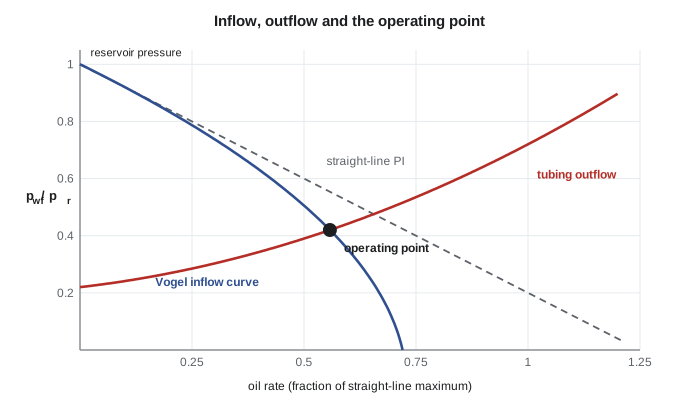
A plot of flowing bottom-hole pressure against rate is called the inflow performance relationship (IPR). For a single-phase oil well it is a straight line from the reservoir pressure at zero rate down to the absolute open flow, the theoretical rate if the bottom-hole pressure could be lowered to zero. Below the bubble point, gas comes out of solution near the well, takes up pore space and reduces the oil's relative permeability, so each extra unit of drawdown yields less oil. The IPR curves. In 1968, J. V. Vogel published an empirical curve, fitted to simulations of solution-gas drive reservoirs, that is still widely used:
# Productivity index and inflow performance (oilfield units)
pr = 4500.0                     # average reservoir pressure, psi
q_test, pwf_test = 220.0, 2400.0  # test rate bbl/d at flowing bottom-hole pressure psi

def vogel_factor(pwf):
    x = pwf / pr
    return 1 - 0.2 * x - 0.8 * x * x

qmax = q_test / vogel_factor(pwf_test)
J = q_test / (pr - pwf_test)              # straight-line index for comparison
print(f"Straight-line productivity index: {J:.3f} bbl/d per psi; open flow {J * pr:.0f} bbl/d")
print(f"Vogel maximum rate: {qmax:.0f} bbl/d\n")
print(" pwf (psi)   straight line   Vogel   (bbl/d)")
for pwf in (4500, 3600, 2700, 1800, 1200, 600, 0):
    print(f"{pwf:9.0f}   {J * (pr - pwf):10.0f}   {qmax * vogel_factor(pwf):8.0f}")
gain = qmax * vogel_factor(1200) / q_test - 1
print(f"\nGas lift down to 1,200 psi raises the rate by {gain:.0%}")Straight-line productivity index: 0.105 bbl/d per psi; open flow 471 bbl/d
Vogel maximum rate: 330 bbl/d
pwf (psi) straight line Vogel (bbl/d)
4500 0 0
3600 94 108
2700 189 196
1800 283 262
1200 346 294
600 409 317
0 471 330
Gas lift down to 1,200 psi raises the rate by 34%Engineers measure J with a production test: the well flows at a steady rate while a gauge records the bottom-hole pressure, and the average reservoir pressure comes from a shut-in build-up test or a nearby observation well. A falling productivity index over time can point to damage such as fines migration, scale or wax near the wellbore, which a stimulation might fix. A falling reservoir pressure points to depletion, which only more energy, from injection, can address.
Outflow: up the well
Once fluid enters the wellbore, it must be lifted to the surface. The pressure at the bottom of the tubing must overcome three things: the weight of the fluid column, friction against the tubing wall and the pressure held at the surface by chokes, separators and pipelines. As oil rises, pressure falls and gas comes out of solution, making the mixture lighter, which helps lift it. Multiphase flow correlations, covered in PET-380, calculate the pressure drop along the tubing for different rates. Plotted on the same axes as the IPR, the required bottom-hole pressure forms the tubing performance curve.
The well produces where the two curves cross: the rate at which the reservoir delivers exactly what the tubing can carry for the bottom-hole pressure it needs. This method, called nodal analysis, lets engineers test changes before making them. A larger tubing size lowers friction at high rates but can let liquid fall back at low rates; a lower separator pressure shifts the tubing curve down and raises the rate; a stimulation shifts the IPR outward. If the curves do not cross at all, the well cannot flow on its own.
Artificial lift
Most oil wells flow naturally only early in their lives. As reservoir pressure falls and water production rises, the fluid column becomes too heavy for the reservoir to push to the surface. Artificial lift adds energy in the well to lower the bottom-hole pressure and keep fluid moving. More than nine in ten oil wells in North America use some form of it, and choosing and optimizing lift is one of the production engineer's main jobs.
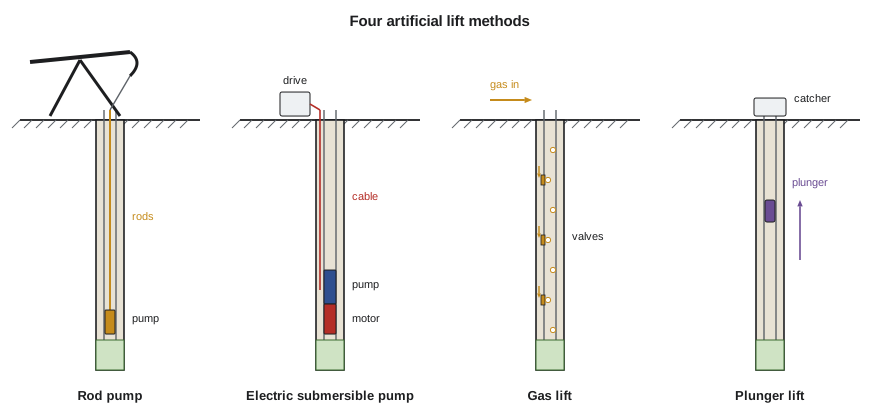
Rod pumping is the oldest and most common method on land. A beam pumping unit, the familiar nodding donkey, moves a string of steel or fiberglass sucker rods up and down, driving a plunger pump at the bottom of the tubing. It is simple, efficient and easy to service, and it can pump a well down to a very low bottom-hole pressure, but it is limited in rate and depth, and deviated wells cause rod and tubing wear. Electric submersible pumps (ESPs) are multistage centrifugal pumps driven by a submerged electric motor, powered through a cable from surface. They lift large volumes, often thousands of barrels a day, and suit high-rate and high-water-cut wells, but they are expensive and sensitive to gas and sand.
Gas lift injects compressed gas into the tubing through valves spaced down the well. The gas lightens the fluid column so the reservoir can push it to surface. It handles sand, gas and deviated wells well and has few moving parts in the hole, but it needs a compressor and a gas supply, and it cannot lower bottom-hole pressure as far as a pump. Plunger lift uses the well's own gas to drive a free piston up the tubing, carrying a slug of liquid, and suits gas wells that are loading up with liquid. Other methods include progressing cavity pumps, which handle viscous and sandy oil, and hydraulic jet pumps.
At Tamarack Lake field, new wells flow for several months to a year after fracturing, often at high rates. As rates fall, most go on gas lift, which copes with the high gas-oil ratio and the deep, deviated wellbores, and later on rod pumps when the rate is low enough. Some operators in the Bakken use ESPs early to capture the high initial rates. Sofia tracks the time between failures closely, because a well that is down is a well that earns nothing.
Keeping wells producing
Many problems reduce production. Water production rises as reservoirs deplete or as water breaks through from an aquifer or a waterflood; handling it costs money, and in many mature fields wells produce ten barrels of water for every barrel of oil. Paraffin wax precipitates from cooling oil and plugs tubing and flowlines, especially in winter; it is removed by scraping, hot oiling or chemical treatment. Mineral scale, such as calcium carbonate or barium sulfate, deposits when waters mix or when pressure and temperature change. Gas hydrates, ice-like solids of water and gas, can block gas lines in cold weather. Sand production erodes equipment and fills wells. Hydrogen sulfide corrodes steel and is deadly to people.
Production engineers watch for these problems through surveillance: regular well tests, pressure data, pump-card analysis for rod-pumped wells and chemical analysis of produced water. Remote monitoring and automation, with sensors and controllers at each well, allow problems to be spotted and fixed quickly. Well interventions such as replacing a pump, cleaning out sand or treating with acid are planned by weighing their cost against the extra production they will bring.
Worked problem
Productivity index and a Vogel curve
A Tamarack Lake field well produces 220 bbl/d of oil with a flowing bottom-hole pressure of 2,400 psi. The average reservoir pressure is 4,500 psi, below the bubble point. Using Vogel's equation, find the maximum oil rate and the rate if gas lift lowers the bottom-hole pressure to 1,200 psi.
Show solution
- Pressure ratio at the test: 2,400/4,500 = 0.533.
- Vogel factor: 1 − 0.2(0.533) − 0.8(0.533)² = 1 − 0.107 − 0.227 = 0.666.
- Maximum rate: 220/0.666 = 330 bbl/d.
- At 1,200 psi: ratio 0.267, factor 1 − 0.053 − 0.057 = 0.890, rate 0.890 × 330 = 294 bbl/d.
Answer: Gas lift raises the rate from 220 to about 294 bbl/d, a 34 percent increase. The engineer weighs that against the cost of compression and injection gas.
Well testing and surveillance tools
Production engineers rely on a few standard measurements. A well test routes a well's production through a separator and meters for a set period, usually 24 hours, to measure its oil, gas and water rates. A pressure build-up test shuts the well in and records the bottom-hole pressure as it recovers; the shape of the recovery curve, analyzed with the methods of PET-360 Well Test Analysis, gives the reservoir pressure, the permeability and the skin. An echometer sends a sound pulse down the annulus of a pumping well and times the echo from the fluid level, which tells the engineer how much liquid stands above the pump and therefore the bottom-hole pressure, without stopping production.
For rod-pumped wells, a dynamometer card plots the load on the polished rod against its position through each stroke. A full, healthy pump gives a near-rectangular card; a pump that is not filling, one with a leaking valve or one striking gas shows a characteristic distorted shape. Modern pump-off controllers read the card continuously and slow or stop the pump when the well is pumped off, saving power and reducing wear. ESPs report motor temperature, current and intake pressure, which reveal gas locking, wear and changes in inflow.
All of this data flows into production databases and dashboards. Engineers review exceptions rather than every well: wells whose rate, water cut or pressure has moved outside its normal band. Increasingly, machine learning models flag likely failures before they happen, so that a pump can be replaced on a planned day rather than after it stops. The skill that matters most is still judgment: knowing which signal is real, which is a measurement error, and which intervention will pay for itself.
Water production and its cost
Water deserves special attention because in mature fields it often dominates the economics. Every barrel of water must be lifted, separated, treated and disposed of, and its cost can exceed the cost of producing the oil. Engineers track the water-oil ratio and the water cut, the fraction of total liquid that is water, for every well. A sudden rise can mean a casing leak, a channel behind the casing, a fracture that has reached a water zone or a breakthrough from a waterflood. Remedies include cement squeezes, mechanical isolation of watered-out intervals, polymer gels that block high-permeability channels and changes to the injection pattern. When water cannot be stopped, the well may still pay if lift and disposal costs are kept low.
Common mistakes
MistakeAssuming the IPR stays a straight line below the bubble point.
InsteadFree gas near the well reduces oil mobility; use a curved relation such as Vogel's.
MistakeTreating the productivity index as fixed for the life of the well.
InsteadJ changes with damage, relative permeability and depletion; measure it regularly.
MistakeChoosing artificial lift only on capital cost.
InsteadCompare total cost, including energy, failures and lost production, over the well's life.
MistakeUpsizing tubing to increase rate without checking low-rate flow.
InsteadLarger tubing can let liquid fall back and load the well as rates decline.
Summary and key terms
- Inflow depends on drawdown; above the bubble point q = J(p_r − p_wf).
- Below the bubble point the inflow curve bends; Vogel's equation describes it.
- Outflow requires enough pressure to overcome the fluid column, friction and surface back-pressure.
- Nodal analysis finds the operating point where inflow and outflow curves cross.
- Artificial lift (rod pumps, ESPs, gas lift, plunger lift, progressing cavity pumps) lowers bottom-hole pressure when wells stop flowing.
- Water, wax, scale, hydrates, sand and corrosion are the common production problems; surveillance catches them early.
- Productivity index
- The oil rate per unit of drawdown, q/(p_r − p_wf).
- Drawdown
- The difference between average reservoir pressure and flowing bottom-hole pressure.
- Inflow performance relationship (IPR)
- The relation between a well's flowing bottom-hole pressure and its production rate.
- Nodal analysis
- A method that finds a well's operating point by matching inflow and outflow performance.
- Artificial lift
- Any method that adds energy in the well to lift fluids to the surface.
- Electric submersible pump
- A downhole multistage centrifugal pump driven by an electric motor.
- Gas lift
- Injecting gas into the tubing to lighten the fluid column.
Practice problems
Work each problem on paper first, then reveal the answer to check.
A well produces 300 bbl/d with p_wf = 1,800 psi and p_r = 2,800 psi, above the bubble point. Find J and the rate at p_wf = 1,000 psi.
Show answer
J = 300/1,000 = 0.30 bbl/d per psi; q = 0.30 × 1,800 = 540 bbl/d.
Which artificial lift method would you consider first for a deep, deviated well producing a lot of gas and some sand?
Show answer
Gas lift, because it tolerates gas, sand and deviation and has few moving parts downhole.
In nodal analysis, what happens to the operating point if the separator pressure is lowered?
Show answer
The tubing curve shifts down, so it crosses the IPR at a higher rate.
Name three common production problems and one remedy for each.
Show answer
Paraffin (scraping or hot oil), scale (inhibitor or acid), sand (screens or gravel packs), hydrates (heating or methanol), water (shut-off treatments or better lift).
Lesson quiz · 5 questions
Score 60% or more to complete this lesson.
Create a free account to save your progress, take quizzes and earn a certificate.