
PET-200 · Lesson 12 of 12 · 19 min
The energy transition and the petroleum engineer
At the end of Ethan's first year, his manager asks him to join a small team studying new business for Prairie Crest. Three ideas are on the table: storing carbon dioxide from a nearby ethanol plant in a deep saline formation under the Tamarack Lake field, extracting lithium from the salty water that the field already produces, and testing whether deep wells could supply heat for a greenhouse or a small power plant. All three use what petroleum engineers already know: how fluids move through rock, how wells are drilled and completed, and how to keep fluids where they belong. This lesson looks at how the energy transition is changing the industry and the profession.
Oil and gas in a changing energy system
The world is trying to cut greenhouse gas emissions while energy demand continues to grow, especially in developing countries. Renewable electricity, electric vehicles and heat pumps are growing quickly, and forecasters disagree widely about how fast oil and gas demand will peak and decline. Most scenarios, including ambitious ones, still show substantial oil and gas use for decades, for transportation, petrochemicals, industrial heat and as backup for electricity grids. At the same time, existing fields decline every year, so new investment is needed simply to hold production steady.
For producers, this means two pressures at once. They must keep producing efficiently and profitably, and they must cut the emissions from their own operations, which come mainly from combustion in engines, heaters and compressors, from flaring, and from methane leaks and venting. Investors, lenders and governments increasingly expect companies to measure and report these emissions, to reduce their intensity per barrel and to plan for a lower-carbon future. Many companies have set targets to eliminate routine flaring and cut methane emissions sharply, as Lesson 11 described.
Carbon capture and storage
Carbon capture and storage (CCS) separates carbon dioxide from an industrial source, compresses it and injects it into deep rock formations where it is trapped permanently. It is the most direct application of petroleum engineering to emissions reduction. Suitable storage sites are deep saline aquifers or depleted oil and gas reservoirs, generally below about 800 m, where pressure and temperature keep the carbon dioxide in a dense, supercritical state that takes up far less space than gas. A thick seal above the formation, the same kind of seal that held oil for millions of years, keeps it in place.
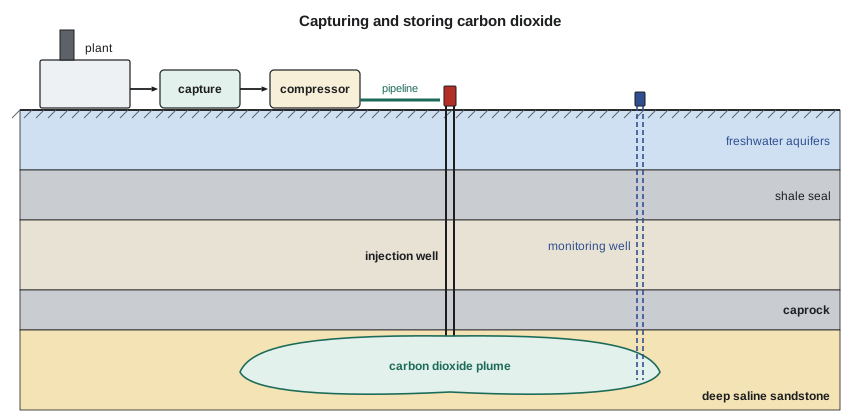
Once injected, carbon dioxide is held by several mechanisms that strengthen over time. Structural trapping holds the buoyant plume beneath the seal, like oil in a trap. Residual trapping strands small bubbles in pore spaces as the plume moves. Solubility trapping dissolves carbon dioxide into the formation water, making it denser so that it sinks. Mineral trapping, over hundreds to thousands of years, converts some of it into solid carbonate minerals. Engineers model the plume's growth, design injection wells, monitor pressure and the plume with seismic surveys and monitoring wells, and plan for the site's eventual closure.
North Dakota was the first state to receive primacy from the EPA to permit Class VI carbon dioxide storage wells, in 2018, and its regulators approved the state's first permanent storage project at an ethanol plant, Red Trail Energy near Richardton, which began injecting in 2022. The federal tax credit under section 45Q pays 85 dollars per metric ton for carbon dioxide permanently stored in saline formations and, since a 2025 law, the same amount for carbon dioxide used in enhanced oil recovery. Several proposed pipelines would carry carbon dioxide from Midwest ethanol plants to storage sites in the state, though some have faced strong landowner opposition.
# Saline-formation storage capacity and years of injection
def capacity_t(area_km2, thickness_m, porosity, efficiency, rho_co2):
    pore = area_km2 * 1e6 * thickness_m * porosity
    return pore * efficiency * rho_co2 / 1000        # metric tons

cases = [  # label, area km2, thickness m, porosity, CO2 density kg/m3, injection Mt/yr
    ('small area, thin sand', 30, 25, 0.18, 650, 0.4),
    ('same area, thick sand', 30, 60, 0.20, 700, 0.4),
    ('regional hub', 400, 60, 0.20, 700, 2.0),
]
for label, a, h, phi, rho, rate in cases:
    print(f"{label}:")
    for eff in (0.01, 0.02, 0.04):
        cap = capacity_t(a, h, phi, eff, rho)
        print(f"   efficiency {eff:4.0%}: {cap / 1e6:6.1f} million metric tons = {cap / 1e6 / rate:5.1f} years at {rate} Mt/yr")

# Volume reduction from surface gas to supercritical storage
rho_surface = 1.87          # kg/m3 at 15 C and 1 atm
print(f"\nOne metric ton of CO2: {1000 / rho_surface:,.0f} m3 as gas at the surface, "
f"{1000 / 700:.2f} m3 at 700 kg/m3 in the formation")small area, thin sand: efficiency 1%: 0.9 million metric tons = 2.2 years at 0.4 Mt/yr efficiency 2%: 1.8 million metric tons = 4.4 years at 0.4 Mt/yr efficiency 4%: 3.5 million metric tons = 8.8 years at 0.4 Mt/yr same area, thick sand: efficiency 1%: 2.5 million metric tons = 6.3 years at 0.4 Mt/yr efficiency 2%: 5.0 million metric tons = 12.6 years at 0.4 Mt/yr efficiency 4%: 10.1 million metric tons = 25.2 years at 0.4 Mt/yr regional hub: efficiency 1%: 33.6 million metric tons = 16.8 years at 2.0 Mt/yr efficiency 2%: 67.2 million metric tons = 33.6 years at 2.0 Mt/yr efficiency 4%: 134.4 million metric tons = 67.2 years at 2.0 Mt/yr One metric ton of CO2: 535 m3 as gas at the surface, 1.43 m3 at 700 kg/m3 in the formation
Carbon dioxide has also been used for decades in enhanced oil recovery. Injected into an oil reservoir at high pressure, it mixes with the oil, swells it and lowers its viscosity, freeing oil that water cannot move. A large share of the injected carbon dioxide remains in the reservoir. Projects in West Texas have used it since the 1970s, and the Weyburn and Midale projects in Saskatchewan stored tens of millions of metric tons while producing oil. Whether such projects reduce emissions overall depends on how the carbon dioxide is sourced and how the produced oil is counted, a question debated by policymakers.
Geothermal energy
Geothermal energy uses the earth's heat. Conventional geothermal power needs hot water close to the surface, found only in volcanic regions. Newer approaches use oilfield techniques to reach heat almost anywhere. Enhanced geothermal systems drill pairs of deep horizontal wells into hot, dry rock, fracture the rock between them and circulate water through the fractures to collect heat; a commercial project in Utah using multistage fracturing borrowed directly from shale development has demonstrated much higher flow rates than earlier attempts. Closed-loop systems circulate fluid through sealed wellbores without contacting the rock. Low-temperature systems use warm water from sedimentary basins for district heating, greenhouses and industrial processes.
In the Williston Basin, formations deeper than about 10,000 ft can exceed 250 °F, and researchers have studied using co-produced hot water from oil wells to generate electricity. The state's drilling expertise, rigs and service companies, and its existing geological data, are major advantages for future geothermal and storage projects.
Hydrogen, lithium and other opportunities
Hydrogen is a fuel that produces only water when burned or used in a fuel cell. Most hydrogen today is made from natural gas by steam reforming, which emits carbon dioxide; capturing and storing that carbon dioxide produces so-called blue hydrogen. Green hydrogen is made by splitting water with renewable electricity. Either way, hydrogen may need large-scale storage, and salt caverns and depleted gas reservoirs, developed and operated with petroleum engineering methods, are candidates. A related topic is natural, or geologic, hydrogen, generated in some rocks and now being explored with wells.
Critical minerals offer another link. Some formation waters contain lithium, used in batteries, at concentrations high enough to extract. Oilfield brines in the Williston Basin and in the Smackover Formation of Arkansas and Texas have attracted lithium projects that would produce brine through wells, extract the lithium with direct extraction technologies and reinject the water. These projects need reservoir engineers to estimate brine volumes and deliverability, drilling and completion engineers to build the wells and facilities engineers to handle large volumes of corrosive water, the same skills used in oil and gas.
| Opportunity | Petroleum engineering skills used | Main technical challenge |
|---|---|---|
| Carbon capture and storage | Reservoir characterization, well design, injection and monitoring | Proving long-term containment and managing pressure |
| Geothermal energy | Deep drilling, hydraulic fracturing, flow testing | Drilling hot, hard rock cheaply and sustaining flow |
| Hydrogen storage | Cavern and reservoir engineering, wells | Leakage, mixing and microbial losses in reservoirs |
| Lithium from brines | Reservoir and water handling, facilities | Producing and reinjecting large volumes economically |
| Well reuse and abandonment | Well integrity, intervention, cementing | Old wells with uncertain construction records |
The petroleum engineer's career
The profession has gone through many booms and busts, driven by oil prices, and it will continue to change. The core skills remain in demand: understanding subsurface uncertainty, designing wells and facilities safely, working with data and economics, and managing risk. Data science and automation are now part of daily work, from machine learning on production data to automated drilling rigs and remote operations. Employers value engineers who can communicate with landowners, regulators, investors and the public, because the industry's license to operate depends on trust.
For Ethan, the first year has covered the whole life of a well, from the geology that made the oil to the plugs that will seal it. Whether he spends his career producing oil and gas, storing carbon dioxide, drilling for heat or cleaning up old wells, the same principles apply: measure carefully, respect the uncertainty, keep fluids where they belong and leave the land as you found it. The rest of the petroleum engineering program, from rock and fluid properties to reservoir simulation and the capstone design, builds those principles into professional competence.
Worked problem
Storage capacity of a saline formation
The team screens a deep saline sandstone under the Tamarack Lake field for carbon dioxide storage. Over the area of interest, 30 km², it averages 60 m thick with 20 percent porosity. At reservoir conditions carbon dioxide has a density of 700 kg/m³, and studies suggest a storage efficiency of 2 percent of the pore volume. How much carbon dioxide could it hold, and for how long could it take the 0.2 million metric tons a year from the ethanol plant?
Show solution
- Bulk volume: 30 × 10⁶ m² × 60 m = 1.8 × 10⁹ m³.
- Pore volume: 1.8 × 10⁹ × 0.20 = 3.6 × 10⁸ m³.
- Usable volume: 3.6 × 10⁸ × 0.02 = 7.2 × 10⁶ m³.
- Mass: 7.2 × 10⁶ × 700 = 5.04 × 10⁹ kg = 5.0 million metric tons.
- Years at 0.2 Mt/yr: 5.04 / 0.2 = 25 years.
Answer: About 5 million metric tons, roughly 25 years of supply, enough for a project at this scale. Detailed studies of the seal, the pressure build-up and old wells that penetrate the formation would come next.
Professional bodies and universities are adapting too. Petroleum engineering programs now include courses on carbon storage, geothermal systems and data analytics, and professional societies publish standards and guidelines for these new applications. Licensing bodies expect engineers to practice only within their competence, so moving into a new field means learning its specific rules and risks, often through formal training and mentoring.
Common mistakes
MistakeAssuming the oil and gas industry will disappear quickly.
InsteadMost scenarios show significant demand for decades, alongside rapid growth of low-carbon energy.
MistakeTreating carbon storage capacity as the whole pore volume.
InsteadOnly a small fraction, often 1 to 4 percent, is effectively usable because of pressure limits and sweep.
MistakeIgnoring old wells in a storage or geothermal project.
InsteadWells that penetrate the seal are the main leakage risk and must be found and checked.
MistakeSeeing new energy fields as unrelated to petroleum engineering.
InsteadThey rely on the same subsurface, drilling, completion and facilities skills.
Summary and key terms
- Oil and gas remain a large part of the energy system while low-carbon sources grow; producers must cut their own emissions.
- Carbon capture and storage injects carbon dioxide below a seal; structural, residual, solubility and mineral trapping hold it.
- North Dakota holds Class VI primacy and hosts operating storage; the 45Q credit pays 85 dollars per metric ton stored.
- Enhanced geothermal and closed-loop systems borrow drilling and fracturing methods from oil and gas.
- Hydrogen storage and lithium from brines draw on reservoir, well and facilities engineering.
- Core petroleum engineering skills, plus data and communication skills, carry into a changing energy industry.
- Carbon capture and storage (CCS)
- Capturing carbon dioxide from industrial sources and injecting it into deep formations for permanent storage.
- Supercritical carbon dioxide
- Carbon dioxide above its critical temperature and pressure, dense like a liquid but flowing like a gas.
- Storage efficiency
- The fraction of a formation's pore volume that can actually be filled with injected carbon dioxide.
- Enhanced geothermal system
- A geothermal system created by fracturing hot, dry rock and circulating fluid between wells.
- Class VI well
- A US category of injection well permitted for long-term geologic storage of carbon dioxide.
- Direct lithium extraction
- Technologies that remove lithium from produced brine before the brine is reinjected.
- Blue hydrogen
- Hydrogen made from natural gas with the resulting carbon dioxide captured and stored.
Practice problems
Work each problem on paper first, then reveal the answer to check.
A formation has 20 km² of area, 40 m thickness, 15 percent porosity and a storage efficiency of 3 percent. Carbon dioxide density is 700 kg/m³. Estimate its capacity.
Show answer
20 × 10⁶ × 40 × 0.15 × 0.03 × 700 = 2.52 × 10⁹ kg, about 2.5 million metric tons.
List the four trapping mechanisms for stored carbon dioxide in order of increasing permanence.
Show answer
Structural (under the seal), residual (stranded in pores), solubility (dissolved in water), mineral (converted to carbonate rock).
Why are old wells the main leakage risk for a storage project?
Show answer
They penetrate the seal, and their cement and casing may have degraded or been poorly placed, offering a path upward.
Name two petroleum engineering skills used in geothermal energy.
Show answer
Deep drilling and well design, hydraulic fracturing, flow testing and reservoir modeling.
Lesson quiz · 5 questions
Score 60% or more to complete this lesson.
Create a free account to save your progress, take quizzes and earn a certificate.