
HSE-375 · Lesson 9 of 12 · 20 min
Inspections, audits and records
Every Thursday afternoon, Owen Hartley walked Cottonwood Place from the bottom of the east lane excavation to the top of the tower crane's mast ladder platform, with a different foreman each week and, once a month, with Lena Petrov, the worker co-chair of the site safety committee. He carried a tablet with the inspection form and took photographs of everything he flagged. Over two years he recorded more than 2,000 findings. About a third were fixed while he was standing there. Most of the rest were fixed within a day. A handful took weeks, and those were the ones that taught the most.
Inspections are how a general contractor finds hazards before they hurt someone, and records are how it proves it looked. This lesson covers both, and the audits that check whether the whole system is working.
Why inspections are required
OSHA's construction rules require inspections at several levels. Under 1926.20(b)(2), employers must provide for frequent and regular inspections of job sites, materials and equipment by competent persons. Specific standards add their own: excavations daily and after rainstorms (1926.651(k)), scaffolds before each shift and after any occurrence that could affect structural integrity (1926.451(f)(3)), personal fall arrest systems before each use (1926.502(d)(21)), cranes each shift, monthly and annually (1926.1412), and ladders periodically and after any occurrence that could damage them (1926.1053(b)(15)). Under the multi-employer policy, a controlling employer's inspection program is a large part of what OSHA examines when deciding whether it exercised reasonable care.
Layers of inspection
No single inspection can find everything. Tallgrass uses layers, from the worker checking a harness before putting it on to the external auditor looking at the whole program once a year. Each layer catches different things at a different frequency.
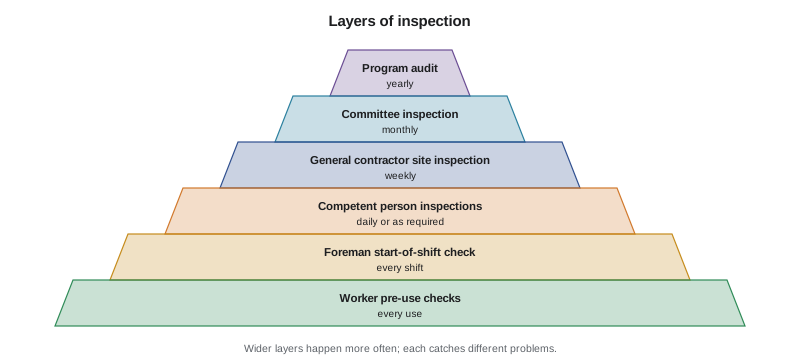
- Pre-use checks by workers. Harnesses and lanyards, ladders, power tools, cords and aerial lifts are checked by the person using them before each use, against a short checklist.
- Start-of-shift checks by foremen. Before the crew starts, the foreman walks the work area: guardrails, openings, access, housekeeping, the condition of the work left the day before.
- Competent person inspections. Excavations, scaffolds, cranes and other equipment that the rules require to be inspected are checked by a designated competent person at the required frequency, with a written or tagged record.
- The general contractor's site inspection. Tallgrass's weekly walk covers the whole site, every trade's work area and the shared hazards, and checks that the lower layers are happening.
- Committee inspections. Once a month, the safety coordinator walks with the worker co-chair or another worker member, who brings a worker's eye to what is happening.
- Audits. Once a year, an internal or external auditor checks the program itself: whether procedures exist, are known and are followed, and whether records are complete.
What makes an inspection useful
A good inspection looks at conditions and at how the work is being done, and talks to the people doing it. Owen's Thursday walks followed a few habits that made them useful rather than routine.
- Follow the work, not a fixed route. Go to where the high-risk work is happening this week, using the look-ahead.
- Look up, look down, look behind. Overhead loads, openings underfoot, and the area behind a worker who is about to step back.
- Ask, don't just look. Ask a worker to explain how they will do the task, what could go wrong and what they would do. The answers reveal whether training and planning are real.
- Fix on the spot where you can. A loose guardrail toe board or a cord across a walkway can be fixed in a minute. Record it anyway.
- Record specifically. 'Housekeeping poor' is useless. 'Level 4, grid C to D: drywall offcuts and banding blocking the stair tower door' can be fixed and checked.
- Rank by risk. Each finding gets a risk class so the most serious get the fastest response.
| Class | Meaning | Response | Example from Cottonwood Place |
|---|---|---|---|
| A | Could cause death or permanent disability | Stop the work or fix immediately | Missing guardrail at a level 6 opening |
| B | Could cause a serious injury | Fix by the end of the shift | Scaffold missing a mid-rail on one bay |
| C | Could cause a minor injury or is a minor breach | Fix within three working days | Extension cord with damaged outer jacket stored in a gang box |
Tracking deficiencies to closure
Finding a hazard is only half the job. Every finding goes into the deficiency log with its class, location, photograph, responsible company and due date. The responsible foreman closes it by fixing the problem and sending a photograph, and Ben Nakamura or Owen verifies the fix on their next walk. Anything overdue is escalated: first to the subcontractor's project manager, then to Tallgrass's project manager, who can use the subcontract's remedies.
Owen runs a short report every Monday to see what is open and what is late.
from datetime import date
today = date(2027, 10, 18)
due_days = {"A": 0, "B": 0, "C": 3}
log = [
    ("D-1182", "A", "Brooks Electric", date(2027, 10, 18), None),
    ("D-1175", "B", "Highline Scaffold", date(2027, 10, 15), date(2027, 10, 15)),
    ("D-1170", "C", "Pinecrest Interiors", date(2027, 10, 11), None),
    ("D-1168", "C", "Lone Star Mechanical", date(2027, 10, 12), date(2027, 10, 14)),
    ("D-1160", "B", "Pinecrest Interiors", date(2027, 10, 8), None),
]
def workdays(a, b):
    n, d = 0, a
    while d < b:
        if d.weekday() < 5:
            n += 1
        d = date.fromordinal(d.toordinal() + 1)
    return n
for ref, cls, firm, found, closed in log:
    if closed:
        continue
    age = workdays(found, today)
    late = age > due_days[cls]
print(f"{ref} class {cls} {firm:20s} open {age} working days {'OVERDUE' if late else ''}")D-1182 class A Brooks Electric open 0 working days D-1170 class C Pinecrest Interiors open 5 working days OVERDUE D-1160 class B Pinecrest Interiors open 6 working days OVERDUE
The report shows two overdue items for Pinecrest, one of them a class B finding open for six working days. That pattern, rather than any single finding, is what triggered a call to Pinecrest's project manager and, eventually, the weekly reviews described in lesson 8.
Looking for patterns
Individual findings get fixed. Patterns tell you what is wrong with the system. Every month, Owen sorts the findings by type, trade, floor and class. In the first winter, a quarter of all findings were housekeeping on the upper floors, which led to the floor-by-floor cleanup schedule described in lesson 4. In the second summer, findings about missing tool tethers rose after a new drywall crew arrived, which led to a toolbox talk series and tethers issued at the gate. A deficiency log that is only used to close items wastes its most valuable information.
Audits
An audit asks a different question from an inspection. An inspection asks whether conditions on the site are safe today. An audit asks whether the safety program is designed properly and working as designed: whether procedures exist for the site's hazards, whether workers and supervisors know them, whether inspections and training happen as scheduled, and whether records are complete and accurate. Tallgrass audits each major project once a year, using a corporate safety manager from another region so the auditor is independent of the site team. The Cottonwood Place audit in its first year found strong inspection and training records but weak follow-up on near-miss reports: a third had no recorded action. Owen added a weekly review of open near misses at the coordination meeting.
Records
Records serve three purposes: they help the site manage its hazards day to day, they let the company learn from patterns over time, and they provide evidence that duties were met. Tallgrass keeps the following for every project.
- Orientation and training records for every worker on site.
- Pre-task plans, foremen's daily reports and toolbox talk sign-in sheets.
- Inspection forms, competent person inspection records and equipment inspection tags and certificates.
- The deficiency log with photographs and close-out dates.
- Permits to work.
- Committee minutes and recommendations, and the responses to them.
- The OSHA 300 log, 301 incident reports and 300A summaries, which must be kept for five years after the year they cover.
- Citations, settlement agreements, abatement certifications and correspondence with OSHA.
- Exposure monitoring results, such as noise and silica sampling, which under 29 CFR 1910.1020 must generally be kept for 30 years, and medical records for the duration of employment plus 30 years.
A record has to be honest to be useful. Tallgrass's rule is that records are made at the time, by the person who did the work, and never altered afterwards except by a dated correction. A missed inspection is recorded as missed, not filled in later. Backdated or invented records have destroyed more companies' defenses than missing ones, because they turn a gap into a lie.
Going digital
Tallgrass moved Cottonwood Place to tablet-based forms in its second month. Inspections, pre-task plans, permits and the deficiency log all went into one system, with photographs, time stamps and automatic reminders for overdue items. Foremen who had resisted at first came round when they found that a deficiency assigned to them arrived on their phone with a photograph and a location, rather than as a vague comment at the Tuesday meeting. Paper forms were kept as a backup for areas with no signal, such as the bottom of the excavation, and entered within a day.
Worked problem
The certificate that nearly lapsed
Show solution
- The tower crane's annual inspection under 1926.1412 was due in October of the second year.
- The crane supplier's office had booked the inspection, but a scheduling error moved it to the following month.
- Adaeze's notice and certificate register, sorted by expiry each Monday, flagged the certificate as expiring in 12 days with no inspection date confirmed.
- Owen called the supplier, the error was found and the inspection was moved back. It found a worn sheave on the trolley, which was replaced before the certificate was renewed.
- Without the register, the crane would have operated for weeks on an expired inspection, with a worn sheave that nobody had looked at.
Answer: A register of inspections and certificates sorted by expiry turns a forgotten date into a phone call.
Inspecting the inspectors
One job of the general contractor's weekly walk is to check that the lower layers are actually happening. On each walk, Owen picks three or four required inspections and checks their records against what he sees: the excavation inspection log at the top of the east lane ladder, the scaffold tags on the bays he passes, the pre-use checklist in the aerial lift's document box, a foreman's start-of-shift sheet. In the second month he found a scaffold tag dated four days earlier on a bay that had clearly been altered since, which led to the rule that only Highline Scaffold LLC may alter scaffolds and that any alteration means a new inspection and a new tag. A record that says an inspection happened, when the conditions show it could not have, is a warning sign about the whole layer.
Inspections by the owner and others
Tallgrass was not the only party inspecting Cottonwood Place. The owner's project manager walked the site monthly, the insurer's loss control consultant visited each quarter, the city's building inspectors came at each permit stage, and the engineer of record inspected the shoring, formwork and structure at set milestones. Owen treated each visit as a free second opinion. He asked each visitor to share their observations in writing and added any safety findings to the deficiency log with the same risk classes and due dates as his own. The insurer's consultant, who had seen hundreds of sites, was particularly good at spotting things the site team had stopped noticing, such as a fire extinguisher hidden behind a pallet of insulation that everyone walked past every day.
Common mistakes
MistakeRelying on one weekly inspection to find everything.
InsteadUse layers, from worker pre-use checks to annual audits.
MistakeWriting vague findings such as 'housekeeping poor'.
InsteadRecord the exact location, the problem, a photograph, a risk class and an owner.
MistakeClosing deficiencies on the foreman's word alone.
InsteadVerify fixes with a photograph and a check on the next walk.
MistakeFilling in missed inspection forms afterwards.
InsteadRecord a missed inspection as missed; backdated records destroy credibility.
MistakeUsing the deficiency log only to close items.
InsteadLook for patterns by type, trade, floor and class each month.
Summary and key terms
- OSHA requires frequent and regular inspections by competent persons and specific inspection frequencies for excavations, scaffolds, fall arrest systems, cranes and ladders.
- Inspection works in layers, from pre-use checks to audits, each catching different problems at different frequencies.
- Useful inspections follow the work, ask workers questions, record findings specifically and rank them by risk.
- Deficiencies are tracked to verified closure, with escalation for overdue items and monthly analysis of patterns.
- Records must be made at the time, kept honestly, and retained for the required periods, which for exposure records can be decades.
- Inspection
- A check of conditions and work practices to find hazards.
- Audit
- A check of whether the safety program is properly designed and working as designed.
- Deficiency log
- A record of inspection findings with risk class, owner, due date and verified closure.
- Risk class
- A rating of a finding's potential severity that sets how quickly it must be fixed.
- Pre-use check
- A check of equipment by the person about to use it.
- Exposure record
- A record of monitoring for a worker's exposure to a hazardous substance or agent.
Practice problems
Work each problem on paper first, then reveal the answer to check.
Name the six layers of inspection at Cottonwood Place.
Show answer
Worker pre-use checks, foreman start-of-shift checks, competent person inspections, the general contractor's weekly inspection, committee monthly inspections and annual audits.
What is the response time for a class B finding?
Show answer
Fix by the end of the shift.
What is the difference between an inspection and an audit?
Show answer
An inspection checks whether conditions are safe today; an audit checks whether the program is designed properly and working as designed.
What did the first-year audit find, and what changed?
Show answer
A third of near-miss reports had no recorded action; open near misses were added to the weekly coordination meeting.
What should happen when a required inspection is missed?
Show answer
Record it as missed and do it as soon as possible; never fill in the form afterwards as if it had been done.
Lesson quiz · 5 questions
Score 60% or more to complete this lesson.
Create a free account to save your progress, take quizzes and earn a certificate.