
HSE-375 · Lesson 6 of 12 · 21 min
Competent, qualified and certified workers
A week before the tower crane was erected at Cottonwood Place, Owen Hartley asked the crane supplier for four things: the operator's certification, the riggers' training records, the signal person's qualification and the inspection certificate for the crane. The certification came the same day. The rigging records took a week and showed that one of the two riggers had only a general awareness course, not the qualification the work required. He was replaced before the first lift.
Laws in both countries rely on the idea that certain work must be done, inspected or supervised by someone with the right knowledge, training and experience. This lesson sorts out the different terms, competent, qualified, certified and licensed, and describes how Tallgrass checks that the people on its site are what their paperwork says.
Four different words
These words are often used loosely, but they mean different things, and the law uses them carefully.
- Competent person. OSHA defines a competent person in 1926.32(f) as one who is capable of identifying existing and predictable hazards in the surroundings or working conditions which are unsanitary, hazardous or dangerous to employees, and who has authorization to take prompt corrective measures to eliminate them. Both parts matter: knowledge and the authority to act. The employer designates its competent persons.
- Qualified person. Defined in 1926.32(m) as one who, by possession of a recognized degree, certificate or professional standing, or by extensive knowledge, training and experience, has successfully demonstrated the ability to solve or resolve problems relating to the subject matter, the work or the project. Many design tasks, such as designing protective systems for excavations deeper than 20 ft, require a registered professional engineer.
- Certified. Holding a certificate issued after an assessment, such as a crane operator certification from an accredited testing organization.
- Licensed. Authorized by state or local law to do regulated work, such as electrical or plumbing work in Texas.
A worker can be certified without being competent for a particular task on a particular site, and a worker can be competent without holding a certificate where none is required. The employer has to decide competence for each task, using certificates as evidence, not as a substitute for judgment.
Where OSHA requires a competent or qualified person
OSHA's construction standards require a competent person for many tasks, including inspecting excavations and protective systems daily and after rain (1926.651(k)), inspecting scaffolds before each shift and supervising their erection (1926.451(f)), supervising work in the presence of silica under a written exposure control plan (1926.1153(g)), inspecting fall arrest equipment and training workers in fall hazards (1926.503), and supervising ladders, cranes and other equipment. Some tasks require a qualified person: designing scaffolds and fall arrest anchorages not otherwise rated, and several crane tasks. Under the crane standard, operators must be certified by an accredited testing organization or qualified through an audited employer program, and employers must evaluate operators for the specific equipment (1926.1427); riggers handling loads during assembly, disassembly and hoisting where workers are in the fall zone must be qualified riggers (1926.1425), and signal persons must be qualified (1926.1428).
| Task at Cottonwood Place | Requirement under OSHA | Who did it |
|---|---|---|
| Inspect the east lane excavation daily | Competent person (1926.651(k)) | Marco Silva, Silva Earthworks LLC |
| Design the shoring (over 20 ft) | Registered professional engineer (1926.652) | Geotechnical engineer hired by Silva |
| Inspect scaffolds before each shift | Competent person (1926.451(f)) | Highline Scaffold LLC foreman |
| Operate the tower crane | Certified operator and employer evaluation (1926.1427) | Ray Lindqvist |
| Rig loads with workers in the fall zone | Qualified rigger (1926.1425) | Crane supplier's rigging crew |
| Signal crane lifts | Qualified signal person (1926.1428) | Tallgrass laborer with documented qualification |
| Supervise silica work under a written plan | Competent person (1926.1153) | Each trade's foreman |
Trades, licenses and certificates
In Texas, electricians are licensed by the Texas Department of Licensing and Regulation, plumbers by the Texas State Board of Plumbing Examiners, and air conditioning and refrigeration contractors by the Department of Licensing and Regulation. Apprentices must be registered and work under the supervision rules for their trade, and San Antonio's permits require licensed contractors for electrical and plumbing work. Texas does not require OSHA 10-hour or 30-hour cards by law, although some other states do and many general contractors, including Tallgrass, require them. On Cottonwood Place, Tallgrass required each electrical and mechanical subcontractor to submit a list of its workers with their licenses and apprentice registrations before they started, and spot-checked cards at the gate.
The training matrix
Tallgrass keeps a training matrix for every worker on the site: Tallgrass employees and subcontractors alike. Each row is a worker, each column a required training or credential, and each cell holds the date completed and the expiry date. The required columns depend on the worker's tasks: every worker needs the site orientation and hazardous products training, while only those who use fall protection need that training, only crane signalers need signal qualification, and so on.
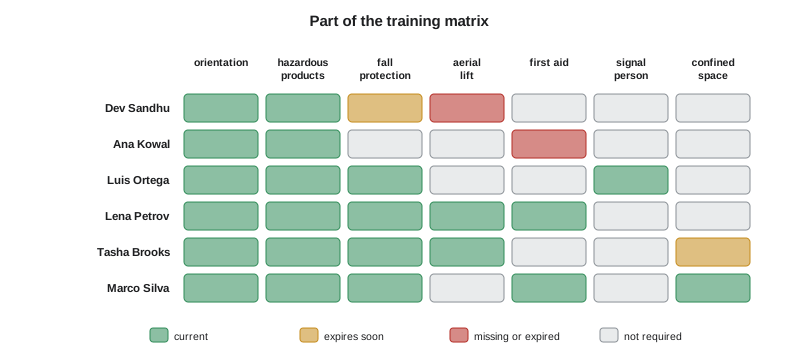
Before each week's work, the matrix is compared with the work planned. If a crew is scheduled to use an aerial lift on Thursday and one member has no lift training, the foreman knows on Monday rather than discovering it on Thursday morning.
from datetime import date
today = date(2027, 9, 6)
required = {"Dev Sandhu": ["orientation", "hazardous products", "fall protection", "aerial lift"],
            "Ana Kowal": ["orientation", "hazardous products", "first aid"],
            "Luis Ortega": ["orientation", "hazardous products", "fall protection", "signal person"]}
record = {("Dev Sandhu", "orientation"): date(2029, 1, 1),
          ("Dev Sandhu", "hazardous products"): date(2028, 3, 1),
          ("Dev Sandhu", "fall protection"): date(2027, 9, 20),
          ("Ana Kowal", "orientation"): date(2029, 1, 1),
          ("Ana Kowal", "hazardous products"): date(2028, 5, 1),
          ("Ana Kowal", "first aid"): date(2027, 8, 30),
          ("Luis Ortega", "orientation"): date(2029, 1, 1),
          ("Luis Ortega", "hazardous products"): date(2028, 2, 1),
          ("Luis Ortega", "fall protection"): date(2028, 6, 1),
          ("Luis Ortega", "signal person"): date(2028, 4, 1)}
for worker, items in required.items():
    for item in items:
        exp = record.get((worker, item))
        if exp is None:
            print(f"MISSING  {worker:12s} {item}")
        elif exp < today:
            print(f"EXPIRED  {worker:12s} {item} ({exp})")
        elif (exp - today).days <= 30:
print(f"SOON {worker:12s} {item} expires {exp}")SOON Dev Sandhu fall protection expires 2027-09-20 MISSING Dev Sandhu aerial lift EXPIRED Ana Kowal first aid (2027-08-30)
The script flags Dev's missing aerial lift training, his fall protection refresher due in two weeks, and Ana's expired first aid certificate. Ana was a designated first aid attendant, so until she recertified the next week, the site's first aid coverage on her shift depended on one other attendant, and Owen moved a third attendant to that shift.
Checking that paper matches people
A certificate proves that someone passed an assessment, sometimes years ago. It does not prove that the person in front of you is that person, that the certificate is genuine, or that the skills are still there. Tallgrass checks competence in three ways.
- Verify the credential. Check the card or certificate against the issuing body's register where one exists, and confirm the name and photo match the worker.
- Observe the work. For high-risk tasks, the foreman or a qualified evaluator watches the worker do the task before signing them off on this site: a rigger rigging a load, an operator doing a pre-use inspection and a test lift, a scaffolder inspecting a scaffold.
- Refresh and reassess. Training expires for a reason. Skills fade, standards change and equipment differs. Refreshers are scheduled before expiry, and anyone involved in an incident or near miss is reassessed.
Fake or borrowed training cards are a real problem in construction in both countries. Tallgrass's gate staff are trained to check cards against photo identification, and suspicious cards are referred to the issuing body.
Competence of supervisors
Supervisors who act as competent persons must actually be competent and must have the authority to correct hazards. Tallgrass's supervisor standard requires every foreman on Cottonwood Place, including subcontractor foremen, to complete the Tallgrass supervisor orientation, to hold an OSHA 30-hour construction card, to hold the training required for the work their crew does, and to know the OSHA standards that apply to it. Each subcontractor must name its competent persons in writing for excavation, scaffolds, fall protection and silica before work starts.
Worked problem
The rigger who was not qualified
Show solution
- The crane supplier's rigging crew for the tower crane erection included two riggers.
- Owen's request for records showed one had a recognized rigging qualification; the other had a half-day rigging awareness course.
- Under 1926.1425 and 1926.1404, rigging during assembly and hoisting with workers in the fall zone must be done by a qualified rigger.
- Owen asked the supplier to replace the second rigger or provide evidence of equivalent training and experience. The supplier sent a qualified rigger the next day.
- The erection went ahead on schedule. The awareness course would have been fine for a worker helping with tag lines, but not for the rigging itself.
Answer: Match the credential to the task: awareness training is not the same as qualification for the task.
Orientation as the first competence check
Every worker's first hour on Cottonwood Place was the site orientation, and it doubled as the first check on competence. Owen or Ben Nakamura covered the site layout, the main hazards, the site rules, the emergency procedures and how to report hazards, injuries and near misses. Then each worker answered a short set of questions in their own words and showed their training cards, which were entered in the matrix on the spot. A worker who could not explain how to report an injury or where the muster point was went through the key points again before going to work. Workers with limited English were oriented with an interpreter from their crew or with translated materials, and the foreman confirmed their understanding in their own language.
OSHA's construction standards require training in many specific areas, and 1926.21(b)(2) requires employers to instruct each employee in recognizing and avoiding unsafe conditions and the regulations that apply. OSHA also expects training to be given in a language and vocabulary workers understand. Tallgrass's site orientation covers the site-wide items; each subcontractor must also train its own workers in the specific hazards of its trade.
New and young workers
Workers in their first months on any job are injured at higher rates than experienced workers, whatever their age, because they do not yet know the hazards, do not know what is normal, and may be reluctant to ask questions. Young workers carry the same risks and often feel even less able to speak up. Tallgrass identifies new workers with a colored sticker on their hard hat for their first 90 days on site, pairs each one with an experienced mentor from their crew, and asks foremen to check in with them at least twice a shift. Apprentices are always supervised by a journeyperson in their trade, as the ratio rules require.
Dev Sandhu, the general laborer who started on Cottonwood Place in its first month, wore the sticker through the excavation phase. His mentor, Luis, showed him how to recognize a shoring panel that was out of place, where to stand when the excavator was swinging, and how to call a stop when something looked wrong. In his third week, Dev called a stop when he saw water seeping through a lagging board in the east lane shoring. The engineer inspected the shoring that afternoon and added a sump and pump. Dev's foreman told the story at the next toolbox talk, with Dev's permission, to show that new workers' questions and stops are welcome.
Competence when things change
Competence is tied to a task and a set of conditions. When the conditions change, competence has to be checked again. A crane operator competent on one crane model needs familiarization on another. A scaffolder competent on frame scaffolds needs training before erecting a suspended platform. A foreman competent to supervise framing may not be ready to supervise work in a confined space. Tallgrass's change procedure asks the supervisor, whenever a new task, new equipment or a significantly different condition arises, whether each worker involved is competent for the new situation, and records the answer in the pre-task plan.
Common mistakes
MistakeTreating any training card as proof of competence for any task.
InsteadMatch the credential to the specific task, and observe high-risk work before signing off.
MistakeAccepting certificates without checking the person and the issuer.
InsteadCheck photo ID and, where possible, the issuing body's register.
MistakeLetting training expire because the crew is busy.
InsteadTrack expiry dates and schedule refreshers before they lapse.
MistakeNaming a competent person who has no authority to correct hazards.
InsteadOSHA's definition requires both knowledge and authority to take prompt corrective measures.
MistakeAssuming subcontractor workers are the subcontractor's problem.
InsteadThe general contractor should verify credentials for high-risk work by everyone on its site.
Summary and key terms
- Competent, qualified, certified and licensed mean different things; the employer must judge competence for each task.
- OSHA's competent person must be able to identify hazards and be authorized to correct them; qualified persons, certified crane operators, qualified riggers and qualified signal persons are required for specific tasks.
- Licensed and certified trades must be checked before work starts, including apprentice registration and supervision.
- A training matrix compares required training with each worker's records and flags gaps before the work is scheduled.
- Credentials must be verified, high-risk work observed, and refreshers scheduled before expiry.
- Competent person
- Someone who can identify existing and predictable hazards and is authorized to take prompt corrective measures (1926.32(f)).
- Qualified person
- Someone with a recognized degree, certificate or professional standing, or extensive knowledge and experience, who has demonstrated the ability to solve problems in the subject (1926.32(m)).
- Qualified rigger
- A rigger who meets the qualified person definition for rigging, required for certain crane work.
- Training matrix
- A table of workers and required training, showing what each has completed and when it expires.
- Operator certification
- Certification of a crane operator by an accredited testing organization or audited employer program.
- Licensed trade
- A trade that state or local law allows only licensed workers to perform.
Practice problems
Work each problem on paper first, then reveal the answer to check.
What is the difference between certified and competent?
Show answer
Certified means holding a certificate after an assessment; competent is the employer's judgment that a person can do a specific task safely on this site.
What two things does OSHA's competent person definition require?
Show answer
The ability to identify existing and predictable hazards, and the authority to take prompt corrective measures.
What three gaps did the training matrix script find?
Show answer
Dev's missing aerial lift training, his fall protection refresher due soon, and Ana's expired first aid certificate.
Name three ways Tallgrass checks competence.
Show answer
Verify the credential against ID and the issuer, observe high-risk work, and refresh and reassess before expiry or after incidents.
Why was the second rigger replaced?
Show answer
He had only an awareness course, not a qualification for rigging tower crane components with workers nearby.
Lesson quiz · 5 questions
Score 60% or more to complete this lesson.
Create a free account to save your progress, take quizzes and earn a certificate.