
HSE-375 · Lesson 4 of 12 · 21 min
The site-specific safety plan
Tallgrass has a corporate safety manual of more than 300 pages. It covers everything from ladders to lockout, and it is the same for every project the company builds. It is not, by itself, a plan for Cottonwood Place. The corporate manual cannot know that the east lane has a 20 ft (6 m) deep shored excavation beside an alley that delivery trucks use, that the tower crane swings over a busy street with overhead power lines, or that an occupied office building shares the west property line. The site-specific safety plan is where the general rules meet this particular site.
Owen Hartley wrote the first version of the Cottonwood Place plan in the six weeks before mobilization, working from the drawings, the schedule, the geotechnical report and a site walk with Carla Mendes. This lesson follows how he built it and how it was kept alive for two years.
What the law requires
No single OSHA standard requires a written site-specific safety plan for a building project. But several pieces of one are required. Under 1926.20(b), each employer must initiate and maintain programs that provide for frequent and regular inspections by competent persons. Many standards require written elements: emergency action plans and fire prevention plans where a standard calls for them (1926.35 and 1926.150), written hazard communication programs (1910.1200 as adopted for construction), written exposure control plans for silica where Table 1 is not fully followed (1926.1153), and fall protection plans for certain leading-edge and precast work (1926.502(k)). Owners, insurers and many public agencies require a written site plan in the contract, and federal projects often follow the U.S. Army Corps of Engineers safety manual, EM 385-1-1, which requires a detailed accident prevention plan. Tallgrass writes one for every project because it is the only practical way to coordinate 18 employers.
What goes into the plan
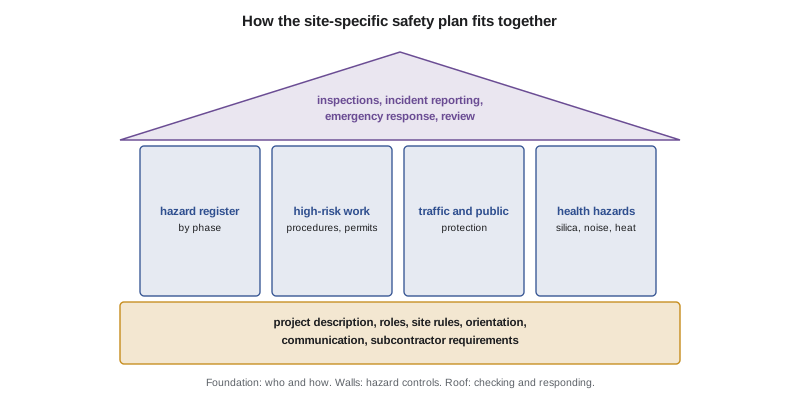
The plan for Cottonwood Place had fourteen sections. The first six describe the project and the organization; the rest describe how hazards will be controlled.
- Project description. Scope, schedule phases, site layout, neighbors and the public.
- Roles and responsibilities. The owner, Tallgrass as the controlling contractor, each subcontractor, the superintendent, the safety coordinator, foremen and workers, with names and phone numbers.
- Site rules. Personal protective equipment, access, smoking, impairment, housekeeping, phones, working hours, visitors.
- Orientation and training. What every worker receives before starting, and what training each trade must have.
- Communication. Committee meetings, foremen's coordination meetings, toolbox talks and how safety information reaches every crew.
- Subcontractor requirements. Documents each subcontractor must submit, and how its own program fits into Tallgrass's.
- Hazard register. The site's significant hazards, by phase, with the controls and who is responsible.
- High-risk work procedures. Permits and procedures for excavation, hot work, confined spaces, crane lifts, energy isolation, work at height and work near power lines.
- Traffic and public protection. Gates, delivery routes, spotters, hoarding, covered walkways and street closures.
- Emergency response. Muster points, first aid, rescue plans for falls, excavations and confined spaces, fire, severe weather and contacts.
- Inspections. Who inspects what, how often, and how deficiencies are tracked to closure.
- Incident reporting and investigation. What must be reported, to whom and when.
- Health hazards. Silica, noise, heat and cold, hazardous products and how exposure will be controlled.
- Review and revision. When the plan is reviewed and how changes are communicated.
Building the hazard register
The heart of the plan is the hazard register. Owen built it by walking through the schedule phase by phase, from mobilization and excavation through structure, envelope, interiors and commissioning, and asking at each phase what could cause a serious injury or death and to whom. For each hazard he recorded the phase, the hazard, who was exposed, the risk before controls, the controls (using the hierarchy: eliminate, substitute, engineer, administrative, personal protective equipment), the risk after controls, and who was responsible.
He then sorted the hazards by their risk before controls and focused the plan's detailed procedures on the top of the list. A plan that gives the same attention to paper cuts and trench collapse helps no one.
# Hazard register ranking for Cottonwood Place (likelihood x severity, 1-5 each).
hazards = [
    ("excavation", "trench or shoring failure", 3, 5),
    ("excavation", "striking buried gas or power", 2, 5),
    ("structure", "falls from slab edges and openings", 4, 5),
    ("structure", "tower crane load drop over street", 2, 5),
    ("structure", "formwork collapse during pour", 2, 5),
    ("envelope", "suspended platform failure", 2, 5),
    ("interiors", "silica dust from cutting", 4, 3),
    ("interiors", "slips and trips on cluttered floors", 4, 2),
    ("all", "struck by delivery vehicles at gate", 3, 4),
]
ranked = sorted(hazards, key=lambda h: h[2] * h[3], reverse=True)
for phase, hazard, l, s in ranked:
    score = l * s
    flag = "detailed procedure" if score >= 10 or s == 5 else "site rules"
print(f"{score:2d} {phase:10s} {hazard:38s} {flag}")20 structure falls from slab edges and openings detailed procedure 15 excavation trench or shoring failure detailed procedure 12 interiors silica dust from cutting detailed procedure 12 all struck by delivery vehicles at gate detailed procedure 10 excavation striking buried gas or power detailed procedure 10 structure tower crane load drop over street detailed procedure 10 structure formwork collapse during pour detailed procedure 10 envelope suspended platform failure detailed procedure 8 interiors slips and trips on cluttered floors site rules
Every hazard with a possible severity of 5, meaning a death or permanent disability, got a detailed procedure regardless of its likelihood. That is why striking a buried gas line, which Owen rated as unlikely, still got a full procedure with hydrovac exposure and a standby plan.
| Phase | Hazard | Main controls | Responsible |
|---|---|---|---|
| Excavation | Shoring failure at the east lane | Engineered shoring; daily competent person inspection; no loads within 5 ft (1.5 m) of the edge | Silva Earthworks LLC |
| Excavation | Buried gas and power | Locates; hydrovac exposure in tolerance zone; spotter | Silva Earthworks LLC |
| Structure | Falls at slab edges and openings | Perimeter guardrail before stripping; opening register; covers marked and secured | Tallgrass and each trade |
| Structure | Crane load over street | Lift plan; swing limits; street closure during critical lifts | Tallgrass and crane operator |
| Envelope | Suspended platform | Engineered rigging; daily inspection; independent lifelines | Highline Scaffold LLC |
| Interiors | Silica dust | Wet cutting or extraction; respirators where required | Each trade |
Getting subcontractors into the plan
Each subcontractor has its own program, its own procedures and its own hazards. Tallgrass's plan does not replace them; it coordinates them. Before starting work, each subcontractor submits its safety program or the relevant parts of it, its job hazard analyses and safe work procedures for its scope, its training records, its insurance certificates and its emergency contacts. Owen reviews these against the site plan and asks for changes where the two conflict.
Conflicts happen. The roofing subcontractor's standard procedure allowed a warning line system 6 ft (1.8 m) from the roof edge for low-slope roofing, with a safety monitor. Tallgrass's site rule required guardrails at all roof edges. The two companies agreed that the roofer would install guardrails as its first task on the roof, and the plan was updated to say so.
Keeping the plan alive
A plan written before mobilization becomes out of date within weeks. The schedule changes, new subcontractors arrive, the crane moves, the street closure ends. Tallgrass's procedure requires the plan to be reviewed at each phase change, after any serious incident or near miss, when a new high-risk activity starts, and at least every three months. Each revision has a number and a date, and changes are explained at the next foremen's meeting and posted at the site entrance.
Over two years, the Cottonwood Place plan went through eleven revisions. Revision 4 added the tower crane's anti-collision limits when a second crane arrived on the neighboring site. Revision 7 changed the traffic plan when the city reopened the street. Revision 9 added a heat stress program before the second summer. Revision 10 added the commissioning phase, with energy isolation procedures for the new electrical and mechanical systems.
Worked problem
The plan that did not match the site
Show solution
- During a monthly walk, Owen found the emergency muster point sign still on the south laydown area, which had been turned into a material storage yard for the curtain wall.
- Workers asked at random gave three different answers about where to muster in a fire.
- The plan itself still showed the old muster point, so the problem was not just the sign.
- Owen and Carla chose a new muster point on the sidewalk across the lane, updated the plan as revision 8, moved the signs and held a muster drill the following week.
- The drill took six minutes to account for everyone, and the foremen agreed to bring daily sign-in lists to the muster point in future.
Answer: A plan only protects people if it matches the site as it is today and the people on the site know what it says.
Emergency response in the plan
The emergency section is the part of the plan most likely to be needed in a hurry, so it has to be specific. For Cottonwood Place, it named the first aid attendants on each shift and where the kits and automated external defibrillator were kept, the nearest hospital and the best route for an ambulance, the gate to which emergency vehicles should be directed, and who would meet them. It set out rescue plans for each high-risk activity: a worker suspended in a harness, a worker injured in the shored excavation, a worker overcome in a confined space such as the elevator pit, and an injured worker on the tower crane. Each rescue plan listed the equipment on site to carry it out and the people trained to use it.
Owen tested the plans with drills: a fire evacuation twice a year, a suspended worker rescue each time the facade crew changed, and a tabletop exercise for a crane incident with the crane supplier. Each drill produced a short list of changes. The first harness rescue drill took eleven minutes, mostly because the aerial lift was parked behind a stack of drywall; the plan was revised to keep the rescue lift clear and fueled at all times, and the second drill took four.
Writing for the people who will use it
A plan written in dense legal language is not read. Owen wrote the Cottonwood Place plan in short sections with plain words, tables and site maps, and kept the full document in the trailer and on the project's shared drive. For the crews, he made a two-page site summary with the site map, the main rules, the emergency instructions and the top ten hazards, and gave it out at orientation. Key pages, such as the emergency map and the traffic plan, were posted at the gate, in the lunchroom and on each floor as the building went up. About a fifth of the workforce spoke Spanish, Punjabi or Tagalog as a first language, so the site summary was translated, and orientation used interpreters from the crews where needed.
Measuring whether the plan works
A plan is a set of promises. Owen checks whether they are being kept with a short monthly review: inspections completed against the schedule, deficiencies closed on time, orientation records against the daily sign-in, drills held, and incidents and near misses reported. When a measure slips, the plan's controls for that area are reviewed with the foremen concerned. In the first winter, the review showed that housekeeping deficiencies on the upper floors were taking an average of four days to close, compared with one day on the lower floors, because no one trade owned the debris on floors shared by four trades. The plan was revised to assign floor-by-floor cleanup to each trade on a rotating schedule, and the average fell to under a day within a month.
Common mistakes
MistakeUsing the corporate manual as the site plan.
InsteadThe site plan applies the corporate program to the hazards, neighbors and schedule of this site.
MistakeGiving every hazard equal attention.
InsteadRank hazards and write detailed procedures for anything that could kill or permanently disable.
MistakeCollecting subcontractor programs without reading them.
InsteadReview them against the site plan and resolve conflicts before work starts.
MistakeWriting the plan once at mobilization.
InsteadRevise at phase changes, after incidents, for new high-risk work and at set intervals.
MistakeKeeping the plan in the trailer.
InsteadExplain changes at foremen's meetings and toolbox talks, and post key parts where workers see them.
Summary and key terms
- A site-specific safety plan applies the company's safety program to the hazards, neighbors and schedule of one site.
- OSHA has no single site-plan standard, but inspection programs, emergency and fire plans, hazard communication and other written elements are required, and contracts often require a full plan.
- The hazard register lists hazards by phase with controls and responsible parties, and drives where detailed procedures are needed.
- Subcontractors' programs are reviewed and coordinated with the site plan, and conflicts are resolved before work starts.
- The plan must be revised at phase changes, after incidents, for new high-risk work and at regular intervals.
- Site-specific safety plan
- The written plan that sets out how safety will be managed on one particular project.
- Hazard register
- A list of the site's significant hazards by phase, with their risk, controls and responsible parties.
- Hierarchy of controls
- The order of preference for controls: eliminate, substitute, engineering, administrative, personal protective equipment.
- Muster point
- The place where workers gather to be counted in an evacuation.
- Revision
- A numbered, dated update to the plan, explained to the people it affects.
- Safe work procedure
- Step-by-step instructions for doing a hazardous task safely.
Practice problems
Work each problem on paper first, then reveal the answer to check.
Why is a corporate safety manual not enough on its own?
Show answer
It cannot know the specific hazards, neighbors, schedule and layout of a particular site.
Which hazards got a detailed procedure in the Cottonwood Place plan?
Show answer
Any with a risk score of 10 or more, and any whose severity could be a death or permanent disability, whatever the likelihood.
How was the roofing conflict resolved?
Show answer
The roofer agreed to install guardrails as its first task, and the plan was updated.
Name four events that should trigger a review of the plan.
Show answer
A phase change, a serious incident or near miss, a new high-risk activity and the regular interval (at least every three months).
What did the muster point check reveal?
Show answer
The sign and the plan were out of date and workers gave different answers; the plan was revised, signs moved and a drill held.
Lesson quiz · 5 questions
Score 60% or more to complete this lesson.
Create a free account to save your progress, take quizzes and earn a certificate.