
HSE-375 · Lesson 3 of 12 · 21 min
Project notices, permits and registrations
Three weeks before the first excavator arrived at Cottonwood Place, Adaeze Okoro, the Tallgrass project manager, pinned a sheet to the trailer wall titled 'Before we dig'. It listed every notice, permit and registration the project needed, who was responsible for each, the lead time, and a box for the confirmation number. Some were obvious, like the building permit. Others were easy to forget: the locate request for buried utilities, the notice before workers entered a deep excavation, the asbestos notice for the old garage on the lot, the confirmation that every subcontractor was registered for workers' compensation. A missed notice can stop a job, bring a penalty, or, in the case of a locate, kill someone.
This lesson walks through the paperwork that comes before and during construction on Cottonwood Place, and why each piece exists.
Why notices matter
Regulators cannot inspect every site all the time. Notices tell them where high-risk work is happening so they can target their inspections: deep excavations, demolition of buildings with asbestos, work in compressed air, suspended platforms on tall buildings. Utility locates tell the owners of buried cables and pipes where someone is about to dig. Building permits let the municipality check that the design meets the building code and that inspections happen at the right stages. Workers' compensation registration makes sure injured workers will be covered. Each notice is a small step that connects the project to a system designed to catch problems the contractor might miss.
What OSHA does and does not require
OSHA has no general notice-of-project requirement. A contractor does not have to tell OSHA it is starting a construction job, and there is no federal requirement to notify OSHA before excavation, demolition or crane work. That makes the other notices on the list, to the city, the utility locating service and state agencies, more important, and it means OSHA finds sites through programmed inspections, complaints, referrals, incident reports and its own observations. The notices that do involve OSHA come after something happens: reporting a fatality within 8 hours and an in-patient hospitalization, amputation or loss of an eye within 24 hours (covered in lesson 11).
- Reports to OSHA after serious incidents. Fatality within 8 hours; in-patient hospitalization, amputation or loss of an eye within 24 hours.
- Posting. Every employer must display the OSHA 'Job Safety and Health: It's the Law' poster where employees can see it, post any citation near the place of the violation, and post the annual OSHA 300A injury summary from February 1 to April 30 if it is required to keep injury records.
- Recordkeeping. Employers with more than ten employees in construction must keep the OSHA 300 log of recordable injuries and illnesses, and certain larger establishments must submit data electronically each year.
At Cottonwood Place, Tallgrass's 'Before we dig' sheet therefore focused on city, state and utility requirements, and on making sure each subcontractor knew its own OSHA posting and recordkeeping duties.
Building permits and municipal requirements
the City of San Antonio's Development Services Department issued the building permit for Cottonwood Place after reviewing the drawings against the International Building Code and the city's amendments. The permit sets out required inspections at stages such as footings, framing, plumbing rough-in and final. Separate permits covered the demolition of the old garage, the right-of-way use for the sidewalk closure and traffic control, the tower crane's swing over the street, and utility connections. Work started without a permit can be stopped by the city, and work covered before an inspection may have to be opened up.
Permits are not only about the finished building. Several protect people during construction: the street use permit requires covered walkways and traffic control (see HSE-373), the demolition permit requires utility disconnection and dust control, and the crane permit sets the hours and conditions for swinging loads over a public street.
Locates before digging
Before any excavation, Texas law requires the excavator to notify the state one-call center, Texas 811, at least two business days before digging (excluding weekends and holidays), so that utility operators can mark their lines. Marks have a limited life and must be refreshed if work is delayed, and destroyed marks must be relocated. Hand digging or vacuum excavation is used to expose lines within the tolerance zone around the marks. OSHA's excavation standard, 1926.651(b), separately requires the employer to determine the location of underground installations before opening an excavation. Striking a gas line or high-voltage cable can kill workers and the public, so locates are one of the most important notices on the list.
Environmental permits
Construction that disturbs one acre or more of land generally needs coverage under the Texas Commission on Environmental Quality's construction stormwater general permit, with a stormwater pollution prevention plan and site notices; larger sites file a notice of intent. San Antonio adds its own stormwater and floodplain requirements. Dewatering discharges to the city's system need approval from San Antonio Water System (SAWS). At Cottonwood Place, soil testing found petroleum hydrocarbons near the old garage's fuel tank, so the contaminated soil was hauled to a permitted facility with manifests.
Workers' compensation registration and coverage
Texas is the only state where most private employers may choose not to carry workers' compensation insurance. Employers that opt out, called nonsubscribers, must report that status to the Texas Division of Workers' Compensation each year and notify their employees in writing. They lose important common-law defenses if an injured employee sues. Contractors and subcontractors on government building projects must carry coverage. Tallgrass's subcontracts require every subcontractor on Cottonwood Place to carry workers' compensation, and it checks certificates of insurance at award and renewal. A subcontractor without a valid certificate does not start work.
Registrations, licenses and certifications
Some work can only be done by licensed or certified people or companies, and the general contractor needs to see proof before the work starts. On Cottonwood Place the list included the electrical and plumbing contractors' licenses and permits, the crane operator's certification, the elevator installer's license, gas fitters' licenses, the boiler and pressure vessel registrations for the temporary heating equipment, and the asbestos abatement contractor's qualifications. Lesson 6 covers individual competence in detail.
| Item | Who files or holds it | When | Who checks it at Cottonwood Place |
|---|---|---|---|
| Building permit and staged inspections | Owner or contractor | Before construction; at each stage | Project manager |
| Texas 811 locate request | Excavator | At least two business days before digging | Superintendent |
| Asbestos notification to DSHS | Owner or operator | At least 10 working days before demolition or renovation | Safety coordinator |
| Stormwater permit coverage and plan | Operator | Before land disturbance | Project manager |
| OSHA poster and 300A posting | Each employer | Poster always; 300A February 1 to April 30 | Safety coordinator |
| Workers' compensation certificate | Each subcontractor | At award and renewal | Project coordinator |
| Right-of-way and crane permits | General contractor | Before sidewalk closure or crane erection | Project manager |
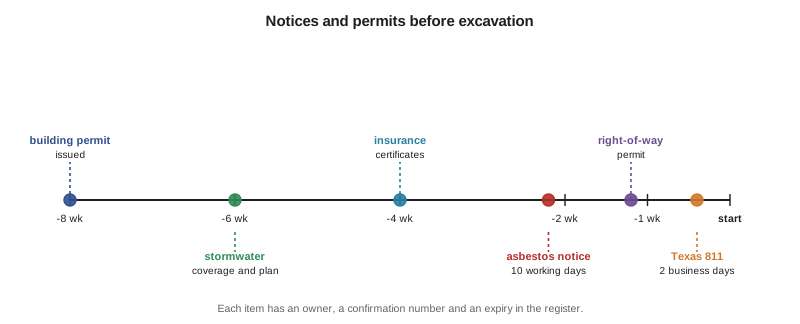
Working out the deadlines
Some lead times are counted in calendar days, some in working or business days, and some in hours. Adaeze uses a short script to turn the planned start date into the latest date each notice can go in, skipping weekends where the rule counts business days.
from datetime import date, timedelta

def back(start, n, business):
    d = start
    while n > 0:
        d -= timedelta(days=1)
        if not business or d.weekday() < 5:
            n -= 1
    return d

start = date(2027, 4, 12)   # planned start of excavation (a Monday)
items = [("locate request", 2, True), ("asbestos notice", 10, True),
         ("permit application buffer", 30, False)]
for name, n, business in items:
    kind = "business" if business else "calendar"
print(f"{name:26s} {n:2d} {kind:8s} days -> file by {back(start, n, business)}")locate request 2 business days -> file by 2027-04-08 asbestos notice 10 business days -> file by 2027-03-29 permit application buffer 30 calendar days -> file by 2027-03-13
The script does not know about statutory holidays, so Adaeze checks the calendar by hand for any holiday in the window. And because many notices also have a maximum lead time or an expiry, such as locates that expire after a set period, she schedules each one close to its window rather than months early.
Worked problem
The expired locate
Show solution
- Silva Earthworks requested locates in mid-March for the east lane excavation, planning to dig in early April.
- A late snowfall and a delayed shoring design pushed the start back by three weeks.
- On the morning digging was to start, Marco Silva checked the locate ticket and found it had expired, and two paint marks had been washed away.
- He stopped the work and requested new locates. The relocate found that a fiber optic line had been marked in the wrong place on the original ticket.
- Digging started two days later, with the fiber line exposed by hydrovac before the excavator came near it.
Answer: Notices and locates are only valid for the conditions and dates they cover; when the job changes, check them again.
Posting and displaying information on site
Some information must be posted where workers can see it. At Cottonwood Place, the site board at the main gate held the OSHA poster, the emergency contacts and muster point, the building permit card, the stormwater site notice required by the permit, the names of the site safety committee members, and, from February 1 to April 30, the OSHA 300A summary for Tallgrass's employees. Any OSHA citation had to be posted near the place where the violation occurred for three working days or until it was corrected, whichever was longer. Owen checked the board weekly.
A register of everything
The 'Before we dig' sheet grew into a register that ran for the whole project. Each row was a notice, permit, registration or certificate, with the responsible company, the date filed, the confirmation number, the expiry date and the date it was last checked. Adaeze sorted it by expiry date every Monday and highlighted anything expiring in the next two weeks. That register caught an expired crane inspection certificate before the annual inspection lapsed, a subcontractor whose workers' compensation coverage had ended without anyone noticing, and a street use permit that needed renewing when the schedule slipped.
The register also helped at the end of the job. When Cottonwood Place was handed over to Cottonwood Place Developments, the closeout package included the final inspections, the occupancy permit, the environmental disposal records for the contaminated soil and the asbestos clearance records for the old garage. Because each had been tracked from the start, assembling the package took days rather than weeks.
When the paperwork and the site disagree
A notice describes what the contractor intends to do. If the work changes, the notice may no longer be accurate. When the east lane excavation was deepened by a meter (3 ft) to reach better bearing soil, the shoring design had to be revised by the engineer, the excavation notice updated and the locates checked again for the deeper cut. Marco Silva's rule for his crews is that if the work does not match the paperwork, the paperwork is wrong until it is fixed, and the work waits.
The same applies in the other direction. A permit or notice can be correct on paper while the site has moved on: a street use permit for a lane closure that the traffic crew has quietly extended by another lane, or a crane permit for working hours that the schedule now exceeds. Owen's weekly walk includes holding the register up against what he can see, because a permit's conditions only protect people if the site is actually following them.
Common mistakes
MistakeAssuming the subcontractor has filed its own notices.
InsteadThe general contractor should confirm each notice was filed before the work starts, and keep the confirmation.
MistakeDigging on an expired or damaged locate.
InsteadCheck the locate ticket's dates and the marks every day; relocate when in doubt.
MistakeLetting a subcontractor start before its workers' compensation coverage is confirmed.
InsteadNo proof of coverage, no start.
MistakeFiling notices months early to get them out of the way.
InsteadMany notices have windows or expiries; file them close to the work and re-file when dates change.
MistakeTreating permits as paperwork that does not affect safety.
InsteadStreet use, demolition and crane permits set conditions that protect workers and the public.
Summary and key terms
- Notices tell regulators, utilities and municipalities where high-risk work is about to happen so the right checks take place.
- OSHA has no notice-of-project requirement; contractors must report serious incidents, post the OSHA poster and citations, and keep injury records.
- Building, demolition, street use and crane permits each set conditions that protect workers and the public.
- Locates are required before digging and must be checked and renewed when work is delayed.
- Texas allows most private employers to opt out of workers' compensation, so general contractors set their own coverage requirements in subcontracts.
- Locate
- The marking of buried utility lines by their operators after a request through the one-call center.
- Tolerance zone
- The area on each side of a locate mark where digging must be done by hand or vacuum excavation.
- Building permit
- Municipal approval to construct, with conditions and required inspections.
- Nonsubscriber
- A Texas employer that has chosen not to carry workers' compensation insurance.
- Stormwater pollution prevention plan
- The plan that sets out erosion and sediment controls for a construction site under a stormwater permit.
- OSHA 300A
- The annual summary of recordable injuries and illnesses, posted from February 1 to April 30.
Practice problems
Work each problem on paper first, then reveal the answer to check.
Does OSHA require a notice before a construction project starts?
Show answer
No. OSHA has no general notice-of-project requirement; reports come after serious incidents.
Why did Marco Silva stop work on the morning excavation was to start?
Show answer
The locate ticket had expired and marks had been washed away; the relocate found a mismarked fiber line.
What is a Texas nonsubscriber?
Show answer
An employer that has chosen not to carry workers' compensation insurance and must report that status and tell its employees.
Give two permits other than the building permit that protect people during construction.
Show answer
Any two of: street use or right-of-way permit, demolition permit, crane swing permit, dewatering approval.
Why should notices not be filed months ahead of the work?
Show answer
Many have windows or expiries and must reflect the actual dates and conditions of the work.
Lesson quiz · 5 questions
Score 60% or more to complete this lesson.
Create a free account to save your progress, take quizzes and earn a certificate.