
HSE-375 · Lesson 2 of 12 · 20 min
Due diligence and the duty to supervise
In June, a Tallgrass laborer named Kyle took off his harness to reach a dropped tool on the level 7 slab edge, stepped over the guardrail to retrieve it from a ledge, and was spotted by the an OSHA compliance safety and health officer who happened to be on site for an unrelated complaint. Nobody was hurt. The officer asked Carla Mendes, the superintendent, a simple question: 'What has Tallgrass done to make sure this does not happen?'
How Carla answers that question decides whether Tallgrass is held responsible for Kyle's choice. It is the question at the heart of this lesson: what the law expects an employer and its supervisors to do before something goes wrong, and how they prove they did it.
Employer knowledge and the employee misconduct defense
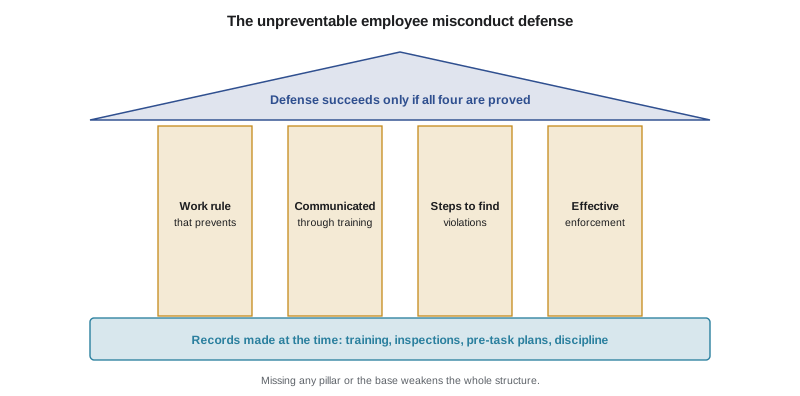
To cite an employer for violating a standard, OSHA must show four things: that the standard applies, that its terms were not met, that employees were exposed to the hazard, and that the employer knew or, with the exercise of reasonable diligence, could have known of the violation. That last element is employer knowledge. A supervisor's knowledge is usually treated as the employer's, so if a foreman saw Kyle step over the rail and did nothing, Tallgrass knew. Where a worker breaks a rule that the employer had made and enforced, the employer can raise the affirmative defense of unpreventable employee misconduct. To succeed, the employer must prove that it had a work rule designed to prevent the violation, that it communicated the rule to employees, that it took steps to discover violations, and that it effectively enforced the rule when violations were discovered.
The defense is not easy to win. OSHA and the Occupational Safety and Health Review Commission look hard at whether enforcement was real. Frequent violations by the same crew suggest that supervision was lax, and a defense built on rules that existed only on paper usually fails. The same evidence that supports the defense, a written rule, training records, inspection records and a history of discipline, is also what keeps violations from happening in the first place.
The five building blocks
Whatever the legal name, the same five building blocks show that an employer took reasonable care. Tallgrass's safety program is built around them.
- Hazard identification. The employer knew, or should have known, about the hazard because it looked for hazards systematically: hazard assessments, pre-task plans, inspections and incident investigations.
- Rules and procedures. There was a clear written rule or safe work procedure that addressed the hazard, specific enough that a worker would know what to do.
- Training and competence. Workers were trained in the rule and the skills it required, in a language they understand, and the employer checked that they understood.
- Supervision. Competent supervisors were present, watched the work and corrected unsafe acts as they happened.
- Enforcement. When rules were broken, the employer acted consistently, from coaching through written warnings to removal from site, and the same rules applied to supervisors and high performers.
Underneath all five sits a sixth element: records. A training session that is not recorded is hard to prove. An inspection that found and fixed a hazard but left no record looks, a year later, like no inspection at all.
What Carla could show
Carla answered the officer by pulling up the records for the level 7 slab edge. The site-specific safety plan named slab edge work as a hazard and required guardrails and, wherever work happened outside them, a harness tied to an approved anchor. Kyle had signed his orientation on his first day, which included the 100 percent tie-off rule outside guardrails, and had attended a toolbox talk on dropped objects two weeks earlier. His foreman's pre-task plan for that morning listed the slab edge and the tie-off rule. The daily inspection log showed the guardrail checked at 7:10 a.m. And the discipline log showed that Tallgrass had issued two written warnings and one removal from site for tie-off violations in the previous four months, including one to a foreman.
Kyle received a written warning and a one-day suspension under the site's progressive discipline policy, and he and his crew had a short retraining session on retrieving dropped tools: stop, call the foreman, and use a tool retrieval method or an aerial lift, never step over the rail.
The compliance officer recorded the observation. Because Tallgrass could document a specific rule, training, inspection and a record of enforcement, including against a foreman, the employee misconduct defense was likely to succeed, and the area director decided not to issue a citation for that observation.
The duty to supervise
OSHA's construction standards rely heavily on supervision. Many require a competent person, defined in 1926.32(f), to inspect excavations, scaffolds, fall protection systems and other work, and to have the authority to take prompt corrective measures. Under 1926.20(b)(2), competent persons must make frequent and regular inspections of job sites. In practice, foremen on most sites are the competent persons for their crews. A foreman who does not know the standard cannot supervise compliance with it.
Supervising means more than being on site. A good supervisor plans the work so that the safe way is the easy way, briefs the crew at the start of each task, watches the work and corrects problems on the spot, and steps in when conditions change. Tallgrass's supervisor standards, which every Tallgrass foreman and every subcontractor foreman agrees to at orientation, set out what that means in practice.
| Supervisor duty | What it looks like at Cottonwood Place | Record kept |
|---|---|---|
| Know the hazards and rules | Foremen complete the Tallgrass supervisor orientation and the training their trade requires | Training matrix |
| Plan the work | Pre-task plan written with the crew before each task or change | Signed pre-task plan |
| Brief the crew | Start-of-shift huddle covering the day's hazards and controls | Huddle sign-in |
| Watch and correct | At least two walks of the work area each shift; on-the-spot coaching | Notes in foreman's daily report |
| Act on changes | Stop and re-plan when weather, sequence or crew changes | Updated pre-task plan |
| Enforce rules fairly | Progressive discipline applied the same to everyone, including foremen | Discipline log |
Criminal liability
Under section 17(e) of the OSH Act, an employer that willfully violates a standard, and that violation causes the death of an employee, can be prosecuted for a criminal misdemeanor, with a maximum sentence of six months in jail for a first conviction and higher fines under federal sentencing law. These cases are rare and are referred by OSHA to the Department of Justice. State prosecutors have also brought charges such as manslaughter or reckless endangerment against companies and individual supervisors after construction deaths, under state criminal law. The best protection against any of these is the same as the best defense against a citation: a real, enforced system that prevents violations.
Measuring the strength of a due diligence file
Owen keeps a simple scorecard for each major hazard on the site, showing which building blocks have evidence behind them. He reviews it monthly with Carla and the project manager, Adaeze Okoro.
# Evidence scorecard for the slab edge hazard on level 7.
elements = {
    "hazard identified in site plan": True,
    "written rule (guardrail or 100% tie-off)": True,
    "worker trained (orientation, toolbox talk)": True,
    "pre-task plan that day": True,
    "inspection record that morning": True,
    "discipline history for this rule": True,
    "tool tethering rule": False,
}
have = sum(elements.values())
print(f"evidence for {have} of {len(elements)} elements")
for name, ok in elements.items():
    print(("  ok    " if ok else "  GAP   ") + name)
gaps = [k for k, v in elements.items() if not v]
print("action:", "close gaps: " + ", ".join(gaps) if gaps else "none")evidence for 6 of 7 elements ok hazard identified in site plan ok written rule (guardrail or 100% tie-off) ok worker trained (orientation, toolbox talk) ok pre-task plan that day ok inspection record that morning ok discipline history for this rule GAP tool tethering rule action: close gaps: tool tethering rule
The gap in tool tethering was exactly where the officer's attention landed. Within a week, Tallgrass required tethers for hand tools used within 6 ft (2 m) of any unprotected edge and issued tool lanyards to every crew working at the slab edge.
Worked problem
Two employers, the same incident, different outcomes
Show solution
- On a different site the same month, a roofer with a small contractor fell through a skylight while unharnessed. He survived with serious injuries.
- The roofing company had a fall protection policy, but its foreman had not briefed the crew, no one had inspected the skylights, and workers said they often worked untied when the foreman was away.
- The company had never disciplined anyone for a fall protection violation.
- On the Tallgrass site, Kyle's violation was found by the officer, but Tallgrass could show a specific rule, training, a pre-task plan, an inspection and consistent enforcement.
- The roofing company faced penalties and prosecution; Tallgrass received an order to improve tool tethering.
Answer: The difference was not the policy on paper but evidence that the policy was trained, supervised and enforced before anything happened.
Due diligence for subcontractors' workers
Tallgrass's reasonable care as the controlling employer is not limited to its own employees. It must show that it had a system to detect and correct hazards across the whole site. That means its file must also show what it did about hazards created or faced by subcontractors: that it reviewed their programs, that its site walks covered their work areas, that it raised deficiencies with their foremen, and that it followed up until each one was closed. A deficiency log that shows a hazard was raised on Tuesday and still open on Friday, with no escalation, is evidence against Tallgrass, not for it.
Owen's rule of thumb is that a serious hazard raised with a subcontractor foreman should be fixed before the end of the shift, or the work stopped until it is. Lesser deficiencies get a date. If the date passes, the issue goes to the subcontractor's project manager in writing, and if it still is not fixed, to Tallgrass's project manager, who can withhold payment or remove the subcontractor's crew under the subcontract. Each step is recorded.
The supervisor's own protection
Supervisors sometimes see due diligence as paperwork that protects the company at their expense. It works the other way. A foreman who can show that he briefed the crew, inspected the work, corrected the hazard he saw and reported the one he could not fix has done his legal duty and protected himself. A foreman who signs pre-task plans he did not discuss, or who ignores a crew working untied because the job is behind, has put himself personally in the line of fire if someone is hurt.
Tallgrass's supervisor training makes this point with a simple exercise. Foremen are given a short scenario, such as a worker on a ladder above an open stairwell, and asked to write down, in order, what they would do and what they would record. Most quickly list the actions: stop the work, move the ladder or protect the stairwell, brief the worker. Far fewer remember the record: a note in the daily report, an entry in the deficiency log if another trade created the hazard, and a line in the next pre-task plan. The exercise ends with the reminder that both halves matter, because a hazard fixed without a record can look, months later, like a hazard ignored.
Common mistakes
MistakeWriting a policy and assuming that is due diligence.
InsteadA policy only counts if workers were trained in it, supervisors enforced it and records show both.
MistakeDisciplining workers but never foremen.
InsteadEnforcement must be consistent; excusing supervisors undermines the whole system and the legal defense.
MistakePreparing records after an incident.
InsteadRecords must be made at the time; backdated or reconstructed records destroy credibility.
MistakeTreating supervision as being somewhere on site.
InsteadSupervising means planning, briefing, watching and correcting the work.
MistakeAssuming criminal liability only applies to company owners.
InsteadState criminal charges and federal willful cases can involve individual supervisors and managers.
Summary and key terms
- OSHA must prove employer knowledge, and a supervisor's knowledge counts as the employer's.
- The unpreventable employee misconduct defense requires a work rule, communication of it, steps to discover violations and effective enforcement.
- Supervising means planning, briefing, watching, correcting and enforcing, done by a competent person.
- Willful violations that cause death can be prosecuted criminally, and state prosecutors can bring charges under state law.
- The evidence that defends an employer is the same evidence that prevents incidents in the first place.
- Employer knowledge
- The element OSHA must prove: that the employer knew or with reasonable diligence could have known of the violation.
- Unpreventable employee misconduct
- An affirmative defense showing a rule, communication, steps to discover violations and effective enforcement.
- Willful violation
- A violation committed with intentional disregard of, or plain indifference to, the law.
- Competent person
- Someone who can identify existing and predictable hazards and is authorized to take prompt corrective measures.
- Progressive discipline
- A graduated series of responses to rule violations, from coaching to removal from site.
- Affirmative defense
- A defense the employer must prove, rather than one OSHA must disprove.
Practice problems
Work each problem on paper first, then reveal the answer to check.
What four elements make up the unpreventable employee misconduct defense?
Show answer
A work rule, communication of the rule, steps to discover violations and effective enforcement.
List the five building blocks of a defensible safety system.
Show answer
Hazard identification, rules and procedures, training and competence, supervision, enforcement, all backed by records.
Why did Tallgrass include its discipline history in the answer to the officer?
Show answer
Because consistent enforcement, including against a foreman, shows the rule was real and not just on paper.
What gap did the scorecard reveal, and how was it closed?
Show answer
There was no tool tethering rule; Tallgrass required tethers within 6 ft (2 m) of unprotected edges and issued tool lanyards.
When can a willful OSHA violation lead to criminal prosecution?
Show answer
When a willful violation of a standard causes the death of an employee.
Lesson quiz · 5 questions
Score 60% or more to complete this lesson.
Create a free account to save your progress, take quizzes and earn a certificate.