
HSE-375 · Lesson 12 of 12 · 20 min
Leading the site safety meeting: capstone
Eighteen months into Cottonwood Place, Tallgrass promoted Ben Nakamura to safety coordinator for its next project, a five-story seniors' residence called Harvest Lane, due to start in the spring. Before Ben left, Owen asked him to run the site-wide safety meeting at Cottonwood Place for a month, and then to write the outline of the Harvest Lane safety program using everything the two of them had learned. This last lesson follows both tasks: running a meeting that people actually listen to, and pulling the whole course together into a program.
Meetings that matter
A construction site has many safety conversations: the start-of-shift huddle, the pre-task plan, the toolbox talk, the Tuesday coordination meeting for foremen, and the committee meeting. Each has a different purpose and audience.
| Meeting | Who | How often | Purpose |
|---|---|---|---|
| Start-of-shift huddle | Foreman and crew | Every shift | Today's tasks, hazards and controls |
| Toolbox talk | Foreman and crew, or all crews on site | Weekly | One topic in depth, with discussion |
| Foremen's coordination meeting | Every trade's foreman, superintendent, safety coordinator | Weekly | Look-ahead, shared hazards, deficiencies, deliveries |
| Site safety committee | Worker and management members from the main trades | Monthly | Concerns, inspections, incidents, recommendations |
| Site-wide safety meeting | Everyone on site | Monthly, and after serious incidents | Lessons, changes to the plan, recognition |
The site safety committee
Federal OSHA does not require safety committees, and neither does Texas, although several state plans do. Tallgrass sets one up on every large project anyway, because worker participation is one of the core elements of every recognized safety management system, including OSHA's own recommended practices, VPP and ISO 45001. On Cottonwood Place, the site safety committee had worker members from the larger trades, chosen by their crews, and management members from Tallgrass and two subcontractors. It met monthly, reviewed concerns, inspections and incidents, joined the monthly inspection walk, and made written recommendations, to which Tallgrass committed to respond in writing within two weeks. Lena Petrov was the worker co-chair.
Running the site-wide meeting
Ben's first site-wide meeting was a lesson in itself. He read from a list of reminders for twenty minutes in the lunchroom, at the end of a Friday shift, with a generator running outside. By the end, half the crowd was looking at phones. Owen's feedback afterwards was short: fewer topics, more stories, more questions, and finish on time.
By the third meeting, Ben had a format that worked.
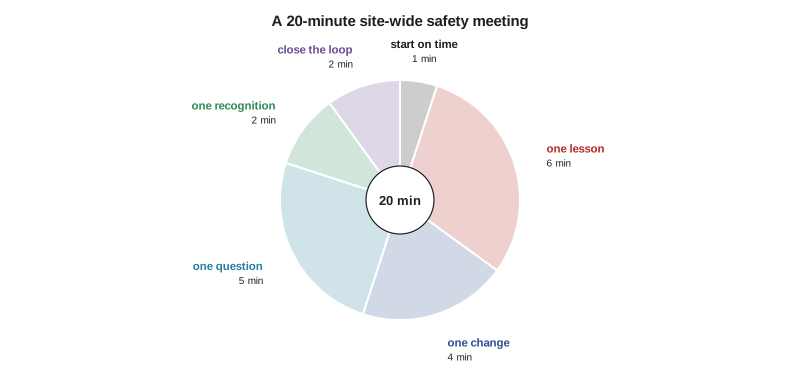
- Start on time and keep it to 20 minutes. Start-of-shift on a Wednesday, in the yard, not the end of a Friday.
- One lesson from the site. A recent incident or near miss, told as a story without naming or blaming anyone: what happened, why, and what has changed.
- One change to the plan. A new rule, a new route or a new phase, and the reason for it.
- One question for the crews. A real question, such as 'Where on site do you feel least safe this week?', with time for answers. Ben wrote every answer down and reported back at the next meeting on what had been done.
- One recognition. A crew or worker who did something well: a good catch, a stop-work call, a tidy floor.
- Close the loop. What happened to last meeting's questions and concerns.
The question segment produced the most useful information. In the second month, a laborer said the north gate was dangerous at 7 a.m. because concrete trucks and workers on foot arrived at the same time. Ben timed it the next morning, counted 14 trucks and 60 workers through the same gate in 25 minutes, and the next week Tallgrass opened a separate pedestrian entrance on the lane side. He announced the change at the following meeting and thanked the laborer by name, with his permission.
Making talk lead to action
Meetings that produce no action teach workers that speaking up is pointless. Ben kept a simple log of every concern raised at any meeting, with an owner and a due date, and reviewed it weekly with Owen.
# Concerns raised at safety meetings over four weeks.
concerns = [
    ("north gate trucks and walkers at 7 a.m.", "Tallgrass", True),
    ("poor lighting in stair tower B", "Brooks Electric", True),
    ("no water station on level 7", "Tallgrass", True),
    ("hoist wait times push workers to use stairs with loads", "Tallgrass", False),
    ("dust from cutting on level 3 drifts to level 4", "Pinecrest Interiors", True),
    ("noisy compressor next to lunchroom", "Lone Star Mechanical", False),
]
done = [c for c in concerns if c[2]]
print(f"closed {len(done)} of {len(concerns)} ({100 * len(done) / len(concerns):.0f}%)")
for text, owner, closed in concerns:
    if not closed:
print(f"open: {text} -> {owner}")closed 4 of 6 (67%) open: hoist wait times push workers to use stairs with loads -> Tallgrass open: noisy compressor next to lunchroom -> Lone Star Mechanical
Two items were still open after four weeks. The hoist wait time needed a second hoist car, which the project manager approved after Ben showed the counts. The compressor was moved. Both were reported back at the next meeting.
Capstone: the Harvest Lane safety program
For his second task, Ben wrote an outline of the safety program for Harvest Lane, a five-story wood-frame building on a concrete podium, beside an operating seniors' care home, with about 90 workers from 14 employers at peak. Owen asked him to organize it by the duties in this course, and for each one to say what Tallgrass would do and how it would show it had done it.
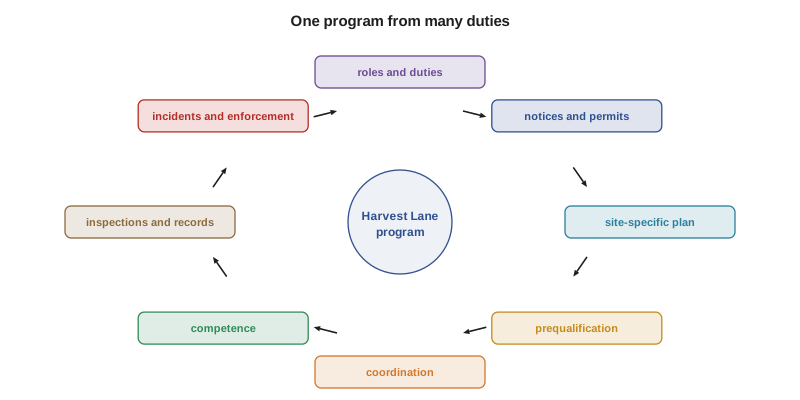
- Roles and duties (lesson 1). Confirm in the contract that Tallgrass controls the site and has authority to correct hazards. Get the owner's written disclosure of known site hazards, including the care home's operations, oxygen storage and emergency routes. Name the superintendent, safety coordinator and each subcontractor's competent persons.
- Reasonable care and supervision (lesson 2). Supervisor standards for every foreman, with the evidence scorecard for each top hazard.
- Notices and permits (lesson 3). A register from day one, with locate requests, any asbestos notifications for existing structures, building and right-of-way permits, stormwater coverage, insurance certificates and OSHA posting.
- Site-specific plan (lesson 4). A hazard register by phase, with special attention to fire during wood-frame construction, work beside an occupied care home, and crane lifts near residents.
- Certification and measurement (lesson 5). Leading and lagging indicators on the monthly report; EMR and TRIR tracked.
- Competence (lesson 6). A training matrix for every worker and verification of high-risk credentials, including crane operator certification, qualified riggers and signal persons.
- Coordination (lesson 7). Shared hazard owners, the opening register, the guardrail removal permit, the look-ahead and handover walks from the first week.
- Subcontractor selection (lesson 8). Prequalification for every trade, pre-award meetings with foremen, conditions for any firm in the conditional band.
- Inspections and records (lesson 9). The six layers of inspection, the deficiency log with risk classes, monthly pattern review and OSHA recordkeeping.
- OSHA visits (lesson 10). The visit procedure practiced with the site team; a register of citation contest windows and abatement dates.
- Incidents (lesson 11). The first-hour procedure, the 8-hour and 24-hour reporting responsibilities named, the five-step investigation method, near-miss reporting from day one.
- Meetings and the committee (lesson 12). A site safety committee from the first month, the 20-minute site meeting and the concern log.
Owen read the outline and added one line at the top: 'Everything here is a promise. Write down how we will know if we have kept it.' Ben went back and added a measure to each item, such as 'percentage of planned inspections completed' or 'days to close class B deficiencies', so that the Harvest Lane program could be checked against itself every month.
What holds it together
The duties in this course can look like a long list of separate obligations. They are really one idea, expressed in the law in different ways: the people who control the work must find its hazards, control them, check that the controls work and learn when they fail. The controlling contractor does this for the whole site, each employer for its own work, each supervisor for their crew and each worker for themselves and those around them. A program that keeps those four levels connected, with records that show it, is both the best protection for workers and the best answer to any compliance officer, court or owner who asks what was done.
Worked problem
The first week at Harvest Lane
Show solution
- On the first day of mobilization at Harvest Lane, Ben held the orientation for the excavation and shoring crews himself and walked the site with the care home's facility manager to agree on emergency routes and resident areas.
- By the end of the first week, the notice register showed every required item filed or held, the training matrix had every worker on site entered, and the first coordination meeting had assigned owners for the shared hazards, including the fence line beside the care home's garden.
- On day four, an excavator operator reported a near miss: a resident had wandered through a gap in the fence while the machine was swinging.
- Ben stopped the excavator, the fence was repaired within the hour with a locked gate, and the care home agreed to escort residents in the garden while excavation was underway.
- The near miss was the first story told at the first site-wide meeting the following week, and the first concern closed on the log.
Answer: A program built from the start on clear duties, records and fast follow-up turns the first near miss into the first improvement.
Toolbox talks that work
The weekly toolbox talk is the meeting most workers attend most often, and the one most often wasted. A foreman reading a printed sheet aloud while the crew stands in the cold teaches little. Tallgrass's guidance for foremen is to choose a topic that matters to this week's work, to start with a real example from the site or the trade, to show the actual equipment where possible, to ask the crew questions rather than just tell them, and to finish with one thing the crew will do differently. Ben ran a short session for foremen on these points during his month leading the site meeting, using a talk on dropped objects as the example: the foreman held up a tethered and an untethered tape measure, asked the crew where on site they had seen tools left at an edge, and finished by issuing tool lanyards to anyone who did not have one. Attendance sheets show who was there; questions and answers show whether anyone learned anything, so the guidance asks foremen to record one question raised at each talk.
Common mistakes
MistakeRunning long meetings full of reminders at the end of a shift.
InsteadKeep it short, start on time, tell one real story and ask one real question.
MistakeCollecting concerns and never reporting back.
InsteadLog each concern with an owner and date, and report what was done at the next meeting.
MistakeChoosing committee worker members on behalf of the workers.
InsteadLet crews choose their own members, so the committee carries real worker trust.
MistakeTreating each duty in this course as a separate checklist.
InsteadConnect them into one program with measures that show whether promises are kept.
MistakeStarting the program after the site is busy.
InsteadSet up the register, plan, coordination, inspections and committee from the first week.
Summary and key terms
- Different safety meetings serve different purposes: huddles, toolbox talks, coordination meetings, committee meetings and site-wide meetings.
- OSHA and Texas do not require safety committees, but worker participation is a core element of every recognized safety management system, so Tallgrass sets one up on every large project.
- Effective site meetings are short, built around real stories and questions, and close the loop on concerns raised.
- A complete program connects roles, notices, the site plan, measurement, competence, coordination, selection, inspections, enforcement, incidents and meetings, each with a measure.
- The common thread is that those who control the work must find hazards, control them, check the controls and learn from failures, and keep records that show it.
- Site safety committee
- A joint worker and management committee for a construction project, set up by Tallgrass on large projects.
- Worker participation
- Involving workers in finding hazards and deciding controls; a core element of safety management systems.
- Co-chairs
- The two chairs of a committee, one chosen by worker members and one by management members.
- Toolbox talk
- A short, focused safety discussion with a crew on one topic.
- Concern log
- A record of concerns raised, with owners, due dates and outcomes.
- Close the loop
- Report back to the people who raised a concern on what was done about it.
Practice problems
Work each problem on paper first, then reveal the answer to check.
What was wrong with Ben's first site-wide meeting?
Show answer
It was a twenty-minute list of reminders at the end of a Friday shift, beside a running generator, with no stories or questions.
List the six parts of Ben's 20-minute format.
Show answer
Start on time, one lesson from the site, one change to the plan, one question for the crews, one recognition, close the loop.
Why does Tallgrass set up a safety committee in Texas, where none is required?
Show answer
Because worker participation is a core element of every recognized safety management system and brings information management would otherwise miss.
What came of the laborer's concern about the north gate?
Show answer
Ben counted 14 trucks and 60 workers in 25 minutes, and Tallgrass opened a separate pedestrian entrance.
What did Owen add to the top of Ben's Harvest Lane outline, and why?
Show answer
That everything is a promise and each needs a measure, so the program can be checked against itself every month.
Lesson quiz · 5 questions
Score 60% or more to complete this lesson.
Create a free account to save your progress, take quizzes and earn a certificate.