
HSE-375 · Lesson 10 of 12 · 20 min
OSHA inspections, citations and contests
At 9:40 on a Wednesday morning in the first summer, an OSHA compliance safety and health officer signed in at the Cottonwood Place gate, showed his credentials and asked for the superintendent. He had driven past the site the day before and seen workers on the level 6 slab edge without visible fall protection, and OSHA's emphasis program on falls allows an inspection based on an observed hazard. By noon he had walked the site, interviewed six workers and two foremen, photographed four conditions and held a closing conference. Seven weeks later, OSHA issued citations to Tallgrass and one subcontractor. How the site team handled the visit, and the weeks after it, made the difference between a manageable outcome and a much worse one.
This lesson explains how regulators enforce safety law on construction sites, what to do during an inspection, and what happens afterwards.
How OSHA decides where to inspect
OSHA sets priorities for inspections: imminent danger situations first, then fatalities and catastrophes, then complaints and referrals, then targeted inspections of high-hazard industries and emphasis programs. National emphasis programs have focused on falls, trenching and excavation, silica and heat, and OSHA's regions run local emphasis programs for construction. Under the falls emphasis program, a compliance officer who sees workers exposed to a fall hazard can open an inspection on the spot. With limited inspectors for millions of workplaces, OSHA relies heavily on these targeting tools.
The inspection process
An OSHA inspection follows a standard pattern. The compliance officer presents credentials, which the employer should check. In the opening conference, the officer explains why the site was selected and the scope of the inspection. During the walkaround, the officer observes conditions, takes photographs and measurements, interviews workers in private and reviews records such as the OSHA 300 log, training records and written programs. An employee representative has the right to accompany the officer. At the closing conference, the officer discusses apparent violations and possible abatement, but does not issue citations on the spot. The employer has a constitutional right to require a warrant before a nonconsensual inspection, established by the Supreme Court in Marshall v. Barlow's in 1978, but most construction employers consent, because a warrant is usually easy to obtain and refusing rarely helps.
During the visit at Cottonwood Place
Tallgrass's procedure for a regulator's visit is short and Carla had practiced it. It says, in order:
- Greet the officer politely and check credentials.
- Call the superintendent, the safety coordinator and the foreman of any subcontractor whose work is involved. Tallgrass's corporate safety director is notified by phone.
- Ask the purpose and scope of the inspection in the opening conference.
- Accompany the officer at all times, and take the same photographs, measurements and notes.
- Answer questions honestly and factually; do not guess, argue or speculate. Managers' statements can be treated as the company's admissions, so stick to facts.
- Provide documents that are asked for, and keep a copy of everything provided.
- Fix any hazard the officer points out right away, and note that it was corrected during the inspection.
- Never interfere with employee interviews, and never retaliate against a worker for talking to OSHA.
- At the closing conference, take notes on every apparent violation discussed.
The officer's findings on level 6 were four conditions. A 30 ft section of perimeter guardrail had been removed for a formwork lift and not replaced, and two carpenters employed by the formwork subcontractor were working near the edge without fall arrest. A stair tower was partly blocked with stored rebar. A temporary power panel was missing its cover. And a portable grinder had no guard. The guardrail was reinstated before he left, the rebar moved, and the panel cover and grinder guard fixed the same day, and each correction was photographed.
Citations and penalties
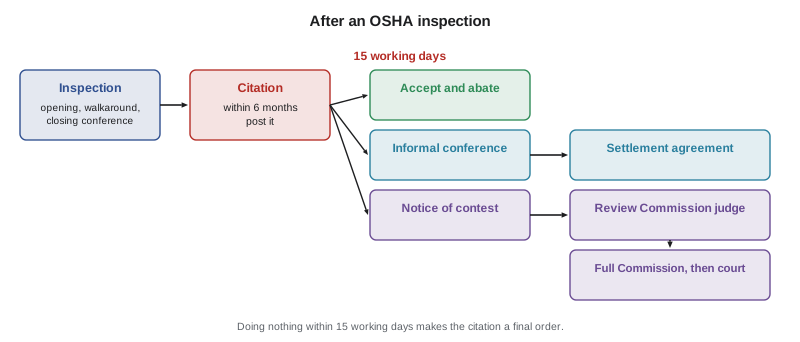
OSHA must issue any citation within six months of the violation. Each citation describes the standard violated, the classification, the proposed penalty and the date by which the hazard must be abated. The classifications are serious (a substantial probability that death or serious physical harm could result and the employer knew or should have known), other-than-serious, willful (intentional disregard of or plain indifference to the law), repeat (the same or a substantially similar violation within five years of a final order) and failure to abate. Maximum penalties are set by statute and adjusted for inflation each year; because the October 2025 price data were not published, OSHA made no adjustment for 2026, so the 2025 maximums remain: $16,550 per serious or other-than-serious violation, $165,514 per willful or repeat violation, and $16,550 per day for failure to abate. OSHA reduces proposed penalties for small employers, for good faith and for a clean history, but not for willful violations.
What Tallgrass received and what it did
Seven weeks after the visit, OSHA issued a serious citation to the formwork subcontractor as the exposing and creating employer for the unguarded edge, with a proposed penalty reduced for its size, and a serious citation to Tallgrass as the controlling employer, because the rail had been down for most of a shift without anyone from Tallgrass noticing. The stair tower, power panel and grinder were cited as other-than-serious items against Tallgrass and the trades involved. Each citation had to be posted near the place of the violation for three working days or until abated, whichever was longer.
The 15-day window
From the day it receives a citation, an employer has 15 working days to respond. It can accept the citation, pay the penalty and certify abatement. It can request an informal conference with the area director, where many cases are settled, often with reduced penalties or reclassified items in exchange for agreed abatement measures. Or it can file a written notice of contest, which sends the case to the independent Occupational Safety and Health Review Commission, where an administrative law judge hears it; appeals then go to the full Commission and the federal courts. If an employer does nothing within 15 working days, the citation becomes a final order that cannot be reviewed. Tallgrass requested an informal conference. It accepted the controlling-employer citation for the guardrail, showed the guardrail removal permit and daily floor walks it had introduced, and the area director reduced the penalty by a further 25 percent in a settlement that required those measures to stay in place for the rest of the project.
Tracking the deadlines
Missing a deadline after an inspection can turn a manageable situation into a serious one, so Owen enters every date into the register on the day the paperwork arrives.
from datetime import date, timedelta
def add_working(d, n):
    while n > 0:
        d += timedelta(days=1)
        if d.weekday() < 5:
            n -= 1
    return d
served = date(2027, 6, 23)            # day the paperwork was received
deadlines = {
    "appeal or contest window (calendar, 14 d)": served + timedelta(days=14),
    "appeal or contest window (working, 15 d)": add_working(served, 15),
    "abatement or compliance date on the paperwork": date(2027, 7, 2),
}
for k, v in deadlines.items():
    print(f"{k:46s} {v}  ({(v - served).days} days)")
print("Check which rule applies in your jurisdiction; holidays are not handled here.")appeal or contest window (calendar, 14 d) 2027-07-07 (14 days) appeal or contest window (working, 15 d) 2027-07-14 (21 days) abatement or compliance date on the paperwork 2027-07-02 (9 days) Check which rule applies in your jurisdiction; holidays are not handled here.
Under the OSH Act, the 15-working-day contest window is the one that applies; the 14-calendar-day line shows how a different counting rule changes the date, which matters when Tallgrass works across borders.
Reprisal protection
Section 11(c) of the OSH Act prohibits retaliation against a worker for reporting a hazard or injury, filing a complaint, talking to OSHA or taking part in an inspection. A worker must file a retaliation complaint within 30 days. On Cottonwood Place, Carla reminded every foreman after the visit that workers who spoke to the officer had done nothing wrong.
Worked problem
A citation the controlling contractor did not deserve
Show solution
- Later in the project, a compliance officer inspecting the facade found a scaffold bay erected by Highline Scaffold LLC with planks not secured.
- OSHA cited Highline Scaffold LLC and proposed a citation to Tallgrass as the controlling employer.
- At the informal conference, Tallgrass showed that its weekly inspection had checked the scaffold the previous Thursday, its foremen walked the facade daily, and the bay had been altered on Monday morning by a worker from another trade, only two hours before the inspection.
- The area director agreed that Tallgrass had exercised reasonable care, since it had a functioning inspection system and the hazard had existed only briefly, and withdrew the controlling-employer item.
- Tallgrass still added a site rule that only Highline Scaffold LLC may alter scaffolds, because the incident had exposed a gap.
Answer: Records of a working inspection system are what allow a controlling contractor to show reasonable care.
Preparing before anyone arrives
The best time to prepare for a regulator's visit is before one happens. Tallgrass's site teams rehearse the visit procedure once a year, with someone playing the officer, so that the first time a foreman meets a real inspector is not the first time they have thought about it. The documents an officer is most likely to ask for are kept together and up to date: the site safety plan, the training matrix, recent inspection records and the deficiency log, competent person designations, the notice and permit register, injury records, and the committee minutes. When the officer asked for the fall protection plan for the level 6 perimeter and the training records for the two carpenters, Owen had both on his tablet within five minutes. That speed did not change the findings, but it showed the officer a system that worked, which shaped how she viewed everything else.
Compliance officers and area directors have discretion in how they classify violations and how they treat a controlling employer. One who finds a working system with an isolated lapse is more likely to see reasonable care, and penalty reductions for good faith depend on the quality of the employer's program. The way to earn that is the same as the way to prevent the lapse: a real program, with records.
After the officer leaves
The most important work happens after the inspection. Within a day of the level 6 visit, Carla held a short meeting with every foreman on site to explain what the officer had found, what had been fixed and what was changing. She did not blame the formwork crew, whose foreman had removed the guardrail for a good reason and then been called away. Instead she asked what would have made it easy to put the rail back, and the answer, a permit that named who was responsible and a check at shift end, became the guardrail removal permit. Owen added each finding to the deficiency log, linked to the paperwork, so that the follow-up was tracked like any other finding.
Tallgrass also shares every regulator visit, and its outcome, with its other projects. A finding on one site is a warning for all of them. In the month after the level 6 visit, two other Tallgrass superintendents walked their own slab edges with the same question in mind and found rails removed for formwork lifts and not yet replaced. Both were fixed before anyone else noticed them.
Common mistakes
MistakeArguing with the officer or refusing to answer.
InsteadBe polite, factual and cooperative; accompany the officer and record what they record.
MistakeMissing the response deadline.
InsteadDiarize the 15-working-day contest window the day the citation arrives; after it, the citation is final.
MistakeFixing the condition without addressing why it happened.
InsteadReport what was fixed and what was changed in the system to stop it recurring.
MistakeTaking down posted orders or citations early.
InsteadKeep citations posted for three working days or until abated, whichever is longer.
MistakeTreating workers who spoke to the officer differently.
InsteadReprisal is illegal; tell foremen explicitly that talking to an officer is a right.
Summary and key terms
- OSHA inspections follow a set process of credentials, opening conference, walkaround and closing conference; employers may require a warrant but most consent.
- Citations are classified as serious, other-than-serious, willful, repeat or failure to abate; 2026 maximums are unchanged from 2025 at $16,550 and $165,514 per violation.
- Employers have 15 working days to accept, settle at an informal conference or file a notice of contest with the Review Commission.
- Good responses fix the condition and the system behind it, and report both.
- Workers who speak to regulators are protected from reprisal.
- Compliance safety and health officer
- An OSHA inspector who conducts inspections and recommends citations.
- Citation
- A written notice of an alleged violation, with classification, proposed penalty and abatement date.
- Notice of contest
- The employer's written challenge to a citation, filed within 15 working days.
- Informal conference
- A meeting with the OSHA area director to discuss and often settle citations.
- Review Commission
- The independent Occupational Safety and Health Review Commission, which hears contested cases.
- Abatement
- Correcting the hazard cited, certified to OSHA by the abatement date.
Practice problems
Work each problem on paper first, then reveal the answer to check.
What are the four stages of an OSHA inspection?
Show answer
Presenting credentials, the opening conference, the walkaround and the closing conference.
What are the 2026 maximum penalties for serious and willful violations?
Show answer
$16,550 per serious violation and $165,514 per willful or repeat violation, unchanged from 2025.
What happens if an employer does nothing within 15 working days of a citation?
Show answer
The citation becomes a final order that cannot be reviewed.
What system changes did Tallgrass make after the level 6 visit?
Show answer
The guardrail removal permit, a no-storage rule for stair towers and weekly checks of temporary power panels.
Why did Carla remind foremen about workers who spoke to the officer?
Show answer
Because reprisal against workers who exercise their rights, including talking to an inspector, is illegal.
Lesson quiz · 5 questions
Score 60% or more to complete this lesson.
Create a free account to save your progress, take quizzes and earn a certificate.