
HSE-374 · Lesson 9 of 12 · 21 min
Fall protection for ironworkers
In the trailer at the Prairie Gate Community Center, Owen Hartley kept a photograph on the wall from a job twenty years earlier: three ironworkers sitting on a beam high above a city street, eating lunch, with nothing attached to them. Visitors usually smiled at it. Owen used it to start every fall protection talk. 'That picture is famous because they got away with it,' he would say. 'Nobody takes pictures of the ones who didn't.' Falls are the leading cause of death in steel erection, and almost every one of them happens to a worker who was not tied off, was tied off to something that failed, or fell further than the system allowed.
This lesson covers the rules for fall protection in erection work, the order in which protection is chosen, anchorages and lifelines, fall clearance, equipment for connectors and deckers, custody of fall protection left for other trades, and rescue.
The rules
In Texas, OSHA's Subpart R has its own fall protection rules for steel erection in 1926.760. Each employee on a walking or working surface with an unprotected side or edge more than 15 feet above a lower level must be protected by guardrails, safety nets, personal fall arrest, positioning or restraint systems. Connectors must be protected from falls of more than two stories or 30 feet, whichever is less; between 15 and 30 feet, OSHA allows connectors to work between 15 and 30 feet (or two stories) with fall arrest, positioning or restraint equipment worn and ready, and requires full protection above that. OSHA allows a controlled decking zone (CDZ) for leading-edge decking between 15 and 30 feet, no larger than 90 by 90 feet, with trained workers only and no more than 3,000 square feet of unsecured decking. Equipment must meet the criteria in Subpart M. Tallgrass's site rule at the Prairie Gate Community Center was stricter than the minimum: anyone above 15 feet on the frame is protected at all times, including connectors, and Tallgrass did not use a CDZ.
| Worker | OSHA Subpart R minimum | Tallgrass rule at the Prairie Gate job |
|---|---|---|
| Most workers on steel | Protected above 15 ft (4.6 m) | Protected above 15 ft at all times |
| Connectors | Equipment worn and ready between 15 and 30 ft or two stories; fully protected above that | Fully protected above 15 ft |
| Leading-edge deckers | May work in a CDZ between 15 and 30 ft under strict limits | No CDZ; SRLs on an engineered overhead lifeline |
| Other trades after the erector | Subpart M rules for their work (6 ft), with custody rules for erector-installed protection | Use only protection Tallgrass has accepted in writing |
Choosing the protection
Fall protection is chosen in an order of preference, from methods that remove the hazard to methods that only reduce the harm.
- Eliminate the hazard. Do the work on the ground or from a permanent floor. Pre-assembling sections of steel, bracing and lifelines on the ground and lifting them as units, attaching perimeter cable stanchions and ladders to columns before they go up, and connecting from a lift all remove time at height.
- Guardrails, perimeter cables and covers. Passive protection that works without the worker doing anything.
- Safety nets. Nets below the work catch falling workers and, with debris nets, falling objects. They need clear space below them and must be installed and tested by competent people.
- Travel restraint. A harness and lanyard short enough that the worker cannot reach the edge.
- Fall arrest. A harness, connector and anchorage that stop a fall after it starts. Fall arrest works only if it is attached, if the anchorage holds, and if there is enough clear space below.
On a steel frame, the work happens at edges, so fall arrest is often unavoidable. But the more work moved to the ground, to lifts and behind guardrails, the less depends on a worker clipping on correctly every time.
Anchorages and lifelines
An anchorage must be strong enough to stop a fall. For a single worker using fall arrest, the anchorage must hold a load set by the regulation or standard, typically several times the maximum arrest force, or be designed by an engineer with a safety factor. On a steel frame, common anchorages include the following.
- The steel itself. A beam with a beam strap or a sliding beam anchor, or a column with a choker strap. The member must be connected well enough to take the load; a beam held by only two wrench-tight bolts may not be a suitable anchorage, so the erection plan says when a member may be used.
- Horizontal lifelines. Wire rope lines strung between columns, letting workers move along a beam while staying attached. Horizontal lifelines sag under load and put very high forces on their end anchorages, so they must be designed by a qualified person or engineer and installed to the design, with the right tension and energy absorber.
- Vertical lifelines and self-retracting lifelines (SRLs). For climbing columns and working at the leading edge.
- Joists and purlins. Only with written approval from a qualified person, because light members can twist or fail under a fall arrest load.
Subpart R requires fall arrest anchorages on joists to have written approval from a qualified person, and purlins and girts may not be used as anchorages without similar approval. At the Prairie Gate Community Center, Sanjay Mehta designed the horizontal lifelines on each floor, and the cable stanchions were bolted to the columns on the ground before the columns were lifted. Connectors used twin-leg SRLs so that one leg was always attached as they moved between anchorages.
Fall clearance
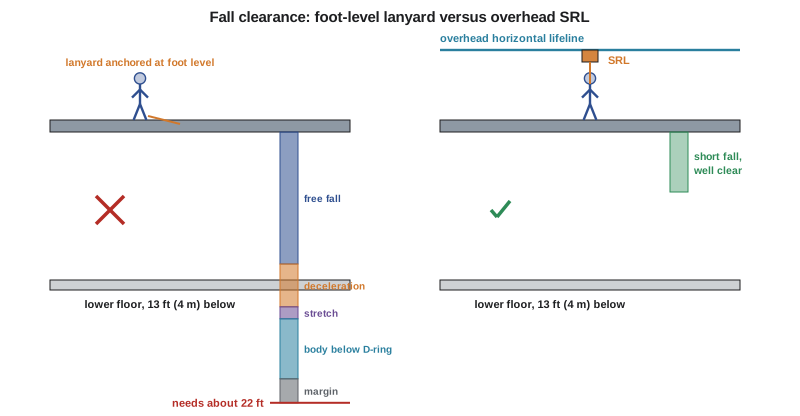
Fall arrest only works if the worker stops before hitting the next level or a structural member. The clearance needed below the working surface is the sum of the free fall distance, the deceleration distance of the energy absorber or SRL, harness stretch and D-ring shift, the height of the worker's body below the D-ring, and a safety margin. For a worker tied off at foot level on a beam with a 6 ft (1.8 m) shock-absorbing lanyard, the clearance needed can be more than 18 ft (5.5 m), which is more than one story.
# Fall clearance for a 1.8 m shock-absorbing lanyard anchored at foot level (illustrative SI values).
lanyard = 1.8            # m
anchor_above_feet = 0.0  # anchored at the beam the worker stands on
d_ring_height = 1.5      # m above the feet
free_fall = lanyard + d_ring_height - anchor_above_feet
decel = 1.07             # maximum deceleration distance for a typical energy absorber, m
stretch = 0.3            # harness stretch and D-ring shift, m
body_below_ring = 1.5    # feet are this far below the D-ring at the end of the fall
margin = 0.6
total = free_fall + decel + stretch + body_below_ring + margin
print(f"free fall: {free_fall:.2f} m")
print(f"clearance needed below the working surface: {total:.2f} m ({total * 3.281:.1f} ft)")
for floor_to_floor in (3.6, 4.0, 4.5):
print(f"floor-to-floor height {floor_to_floor} m: {'enough' if floor_to_floor >= total else 'NOT enough'}")free fall: 3.30 m clearance needed below the working surface: 6.77 m (22.2 ft) floor-to-floor height 3.6 m: NOT enough floor-to-floor height 4.0 m: NOT enough floor-to-floor height 4.5 m: NOT enough
The result is clear: tying off at foot level with a standard lanyard on a single-story drop does not work. The worker hits the floor below before the lanyard stops them. The answer is to anchor overhead, to a horizontal lifeline or column strap above the D-ring, which cuts the free fall, and to use SRLs rated for the application, which lock within a short distance. SRLs used at a leading edge, where the line can bend over the edge of the deck or steel during a fall, must be rated for leading-edge use.
Equipment for connectors and deckers
Ironworkers need equipment that lets them move and work without disconnecting. At the Prairie Gate Community Center, each connector wore a full-body harness with a back D-ring and side positioning rings, a twin-leg SRL with leading-edge rating, and a positioning lanyard for hands-free work at a column. Deckers used SRLs connected to the overhead horizontal lifeline. Every harness, lanyard and SRL was inspected by the user before each shift and by a competent person at the intervals the manufacturer requires, and any equipment involved in a fall was removed from service.
Positioning systems hold a worker in place at a column or beam so they can use both hands, but they are not fall arrest. A worker in positioning must also be connected to fall arrest, or the positioning system must limit any fall to a short distance as the regulation allows.
Leaving fall protection for other trades
OSHA 1926.760(e) controls custody of fall protection. The steel erector may leave fall protection in place for other trades only if the controlling contractor or its representative directs it to, and has inspected and accepted control and responsibility for the protection before anyone other than the erector's employees works in the area. At the Prairie Gate Community Center, Owen inspected the cables and covers with Bill floor by floor, and Tallgrass signed for each floor before other trades were allowed on it.
Rescue
A worker hanging in a harness after a fall must be reached quickly. Suspension in a harness can cause suspension trauma, where blood pools in the legs and the worker can lose consciousness. The rescue plan at the Prairie Gate Community Center used a boom lift kept fueled and parked near the work, with the key in it and a trained operator on every shift, and a pre-rigged rescue kit for places the lift could not reach. The crew practiced a rescue in the first week and again when the gymnasium roof work started. Calling emergency services was part of the plan, not the plan itself.
Worked problem
The lanyard at foot level
Show solution
- During a site walk, Owen saw a bolter from a subcontractor sitting on a second-floor beam, tied off with a 6 ft (1.8 m) lanyard wrapped around the beam he was sitting on.
- The story below was 13 ft (4.0 m). With the lanyard anchored at foot level, the clearance needed was more than 18 ft (5.5 m).
- Owen asked the bolter to stop and showed him the calculation. If he fell, he would hit the first floor before the lanyard arrested him.
- The bolter moved to the horizontal lifeline above the beam with an SRL from the gang box.
- Tallgrass added a rule to the site orientation: lanyards are not anchored at or below foot level anywhere on the frame, and all workers at height on steel use overhead anchorages or SRLs.
Answer: Being tied off is not the same as being protected. The system must stop the fall before the worker hits the level below.
Inspecting fall protection equipment
Fall protection equipment fails when it is damaged, worn or used outside its rating. Before each shift, every worker at the Prairie Gate Community Center checked their harness webbing for cuts, burns, fraying, chemical damage and broken stitching; buckles and D-rings for cracks, distortion and sharp edges; labels for legibility and the date of manufacture; lanyards and energy absorbers for signs that they had been deployed; and SRLs for proper retraction, locking and line condition. A competent person inspected the equipment at least as often as the manufacturer required and recorded the results. Any equipment that had arrested a fall, or failed an inspection, was tagged out and removed from service.
Workers were also trained in how to fit a harness: chest strap across the middle of the chest, leg straps snug enough to fit a flat hand, and the back D-ring between the shoulder blades. A loose harness can let a worker slip out or cause injury in a fall.
Common mistakes
MistakeAssuming connectors are exempt from fall protection.
InsteadConnectors must be protected above 30 ft or two stories and have equipment worn and ready between 15 and 30 ft; Tallgrass protects them above 15 ft.
MistakeAnchoring a lanyard at foot level on a one-story drop.
InsteadCalculate clearance and anchor overhead or use an SRL rated for the job.
MistakeUsing a joist as an anchorage because it is close.
InsteadJoists and purlins are used as anchorages only with written approval from a qualified person.
MistakeRigging a horizontal lifeline by hand without a design.
InsteadHorizontal lifelines must be designed by a qualified person or engineer and installed to the design.
MistakeRelying on emergency services for rescue at height.
InsteadHave equipment and trained people on site to reach a suspended worker within minutes.
Summary and key terms
- OSHA 1926.760 requires protection above 15 feet, with special rules for connectors up to 30 feet or two stories and for controlled decking zones.
- Fall protection is chosen in order: eliminate, guardrails and covers, nets, restraint, then fall arrest.
- Anchorages must be strong enough; horizontal lifelines must be engineered; joists and purlins need qualified approval.
- Fall clearance includes free fall, deceleration, stretch, body height and margin; anchoring overhead with SRLs keeps falls short.
- Fall protection left for other trades is handed over in writing, and a practiced rescue plan reaches a suspended worker within minutes.
- Fall arrest system
- A full-body harness, connector and anchorage that stops a fall after it begins.
- Travel restraint
- A system that stops a worker from reaching an edge where a fall could occur.
- Self-retracting lifeline (SRL)
- A device with a line that pays out and retracts with the worker and locks quickly if a fall begins.
- Horizontal lifeline
- A cable or rope strung between anchorages so a worker can move along it while attached.
- Fall clearance
- The distance needed below a working surface for a fall arrest system to stop a fall safely.
- Positioning system
- Equipment that holds a worker in place so both hands are free, not a substitute for fall arrest.
Practice problems
Work each problem on paper first, then reveal the answer to check.
Above what height does OSHA Subpart R require fall protection for most workers on steel?
Show answer
More than 15 feet.
List the order of preference for fall protection.
Show answer
Eliminate the hazard, guardrails and covers, safety nets, travel restraint, fall arrest.
What makes up fall clearance?
Show answer
Free fall, deceleration distance, harness stretch and D-ring shift, body height below the D-ring, and a safety margin.
Why are horizontal lifelines engineered?
Show answer
They sag under load and put very high forces on their end anchorages, so the line, tension and anchors must be designed.
What is required before other trades use fall protection installed by the erector?
Show answer
The general contractor inspects it and accepts control and responsibility for it in writing.
Lesson quiz · 5 questions
Score 60% or more to complete this lesson.
Create a free account to save your progress, take quizzes and earn a certificate.