
HSE-374 · Lesson 8 of 12 · 20 min
Decking, floor openings and controlled decking zones
Metal deck is the corrugated steel sheet that spans between beams or joists to form floors and roofs. On the second and third floors of the classroom wing at the Prairie Gate Community Center, the deck would later be filled with concrete to make composite floors. On the gymnasium roof, it would carry insulation and roofing. For the decking crew led by Kyle Bear, it was also the surface they stood on while they built it. Each sheet was 3 ft (about 0.9 m) wide and up to 30 ft (9 m) long, light enough to carry but large enough to act like a sail in wind, and slippery when wet or frosty. Until each sheet was fastened down, it could slide, lift or tip under a worker's feet.
This lesson covers landing deck bundles on the frame, spreading and fastening deck, openings and covers, gaps at columns, perimeter safety cables, shear connectors, and the leading edge, where decking crews work at the edge of the deck they have just laid.
Landing deck bundles
Deck arrives in bundles of 20 to 40 sheets, banded together and weighing 1 to 3 tons (1 to 2.5 t). The bundles are hoisted onto the frame and landed on the beams or joists near where they will be spread. Landing bundles is one of the most dangerous moments in decking, for three reasons. A heavy bundle can overload the members it lands on, especially open-web joists. A bundle landed on too few supports can tip or slide when the bands are cut. And loose items on top of the bundle can fall during the lift.
OSHA 1926.754(e)(1) sets the rules for hoisting and landing deck bundles. Packaging and strapping may not be used for hoisting unless designed for it. Loose items placed on top of a bundle, such as dunnage or flashing, must be secured to the bundle. Bundles on joists must be landed as 1926.757(e)(4) requires, which includes having all bridging installed and anchored and the joist bearing ends attached. Bundles must be landed on framing so that there is enough support to unband them without dislodging them. And at the end of the shift, or when conditions require, deck must be secured against displacement.
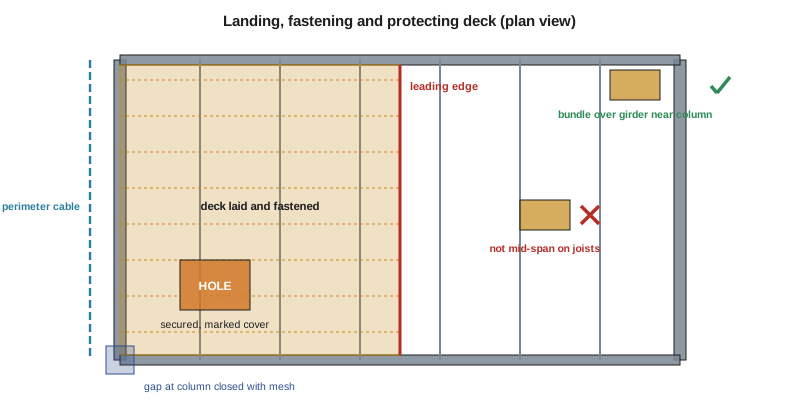
At the Prairie Gate Community Center, the deck bundles for each floor were landed on the girders close to the columns, where the framing was strongest, on timber blocking that kept them off the beam flanges and let the slings come out. Bundles were never landed on the middle of a span of joists. Kyle's crew did not cut the bands until the bundle had been landed, released from the hook and checked to make sure it was stable.
Spreading and fastening deck
OSHA 1926.754(e)(5) requires metal decking to be laid tightly and immediately secured upon placement to prevent accidental movement or displacement. Kyle's crew spread sheets from the bundle, aligned them, and made the initial attachments at each support before moving on, then returned to complete the final fastening pattern shown on the deck drawings.
Deck is fastened with welds, powder-actuated pins, self-drilling screws or button punches at side laps. Powder-actuated tools must be used only by trained operators, following the tool manufacturer's instructions and the rules in HSE-104 and TRD-104. Welding deck puts welders at the leading edge with their attention on the arc, so their fall protection must not depend on them remembering it.
Openings in the deck
Every floor has openings: stairs, elevator shafts, mechanical shafts, roof drains and skylights. Openings can be framed so that the deck runs continuously over them and is cut out later, or left open with the deck stopped at the edges. A deck that runs continuously over an opening and is cut later is safer, because there is no hole until the trade that needs it is ready, and the hole can be protected when it is cut.
Under 1926.754(e)(3), covers for roof and floor openings must support twice the weight of the employees, equipment and materials that may be on them at one time, be secured against accidental displacement, and be painted high-visibility orange or marked with the word HOLE or COVER. Smoke domes and skylights do not count as covers unless they meet the strength requirement. Framed openings should have members turned down so deck can be laid continuously, except where the design does not allow it.
Covers are a common cause of falls when they are removed and not replaced. At the Prairie Gate Community Center, removing a cover required the foreman's permission and a guardrail or a worker stationed at the opening until the cover went back.
Gaps at columns
Deck sheets do not fit tightly around columns, leaving gaps that can be large enough for a foot or a person to go through. At the Prairie Gate Community Center, every gap around a column was closed with wire mesh, plywood or a steel plate fastened in place as soon as the deck around the column was laid, so that no gap was left that a worker could fall through.
Perimeter safety cables
OSHA 1926.760(a)(2) requires perimeter safety cables to be installed at the final interior and exterior perimeters of multi-story structures as soon as the metal decking has been installed. The cables must meet the guardrail criteria of Subpart M (a top rail about 42 inches high, plus or minus 3 inches, with a mid rail, able to withstand 200 pounds). OSHA 1926.756(e) requires perimeter columns to extend at least 48 inches above the finished floor, or have attachment points, so the cables can be installed.
Shear connectors and the walking surface
OSHA 1926.754(c) prohibits shear connectors, such as studs, from being installed so that they project vertically or horizontally across the top flange of a member until after the metal decking or other walking surface has been installed. On composite floors, they must be installed from the deck after it is laid, and not from within a controlled decking zone. That is why the studs at the Prairie Gate Community Center were field-welded through the deck after it was fastened.
The leading edge
The leading edge is the unprotected edge of deck that moves forward as sheets are laid. The decking crew works right at it. Behind them is a growing area of deck; in front of them is open framing and a fall to the floor below.
OSHA allows a controlled decking zone (CDZ) for leading-edge decking between 15 and 30 feet, no larger than 90 by 90 feet, with trained workers only and no more than 3,000 square feet of unsecured decking. The CDZ must be marked with control lines or equivalent, access is limited to trained workers doing leading-edge work, safety deck attachments are made from the leading edge back to the control line with at least two attachments per sheet, and final deck attachments and shear connectors may not be installed in the CDZ. Above 30 feet or two stories, conventional fall protection is required. At the Prairie Gate Community Center, Tallgrass chose not to use a CDZ at all: the decking crew wore harnesses connected to self-retracting lifelines on a horizontal lifeline above the work, designed by Sanjay Mehta. Lesson 9 covers the fall protection systems in more detail.
# End-of-shift deck check: unsecured area on the second floor (invented data).
sheets = [
    # sheet id, length (m), width (m), initial attachments made, full pattern done
    ("2-01", 9.0, 0.91, True, True),
    ("2-02", 9.0, 0.91, True, True),
    ("2-03", 9.0, 0.91, True, False),
    ("2-04", 9.0, 0.91, False, False),
    ("2-05", 6.0, 0.91, False, False),
]
loose = [(s, l * w) for s, l, w, initial, full in sheets if not initial]
partial = [s for s, l, w, initial, full in sheets if initial and not full]
area_m2 = sum(a for s, a in loose)
print("sheets with no attachments:", [s for s, a in loose])
print(f"unsecured area: {area_m2:.1f} m2 ({area_m2 * 10.764:.0f} ft2)")
print("sheets awaiting full fastening:", partial)
print("secure or remove loose sheets before leaving" if loose else "deck secured for the night")sheets with no attachments: ['2-04', '2-05'] unsecured area: 13.6 m2 (147 ft2) sheets awaiting full fastening: ['2-03'] secure or remove loose sheets before leaving
Weather and decking
Wind lifts deck sheets easily. At the Prairie Gate Community Center, decking stopped at a lower wind speed than other erection work, set in the erection plan, and bundles were not opened when strong gusts were forecast. Frost, ice, snow and rain make deck slippery; the crew swept frost and snow off before walking on it and stopped work when the surface could not be made safe. In the hot weeks of summer, steel deck in direct sun gets hot enough to burn skin, so gloves and sleeves were required.
Worked problem
The bundle that slid
Show solution
- On the third floor, a new deckhand cut the bands on a bundle while it was still hanging slightly from the crane hook, to save time.
- The bundle had been landed with one end on a girder and the other end on a single joist. As the bands parted, the top sheets slid toward the unsupported side, and two sheets dropped through the framing to the floor below.
- The area below had been barricaded as the plan required, and nobody was hurt.
- The investigation found that the landing location had been changed on the day because another bundle was in the way, without checking it against Sanjay Mehta's landing plan.
- Kyle Bear's crew retrained on landing and unbanding: bundles only on approved locations, on blocking, fully released from the hook and checked before any band is cut.
Answer: Deck bundles are landed only where the plan shows enough support, released from the hook and checked, then unbanded. Changing the landing spot on the fly removes the safety margin.
Deck as a working platform for other trades
Once a floor's deck is fastened, it becomes the working surface for other trades: concrete crews placing the slab, plumbers and electricians setting sleeves and boxes, and inspectors checking studs and fasteners. Deck that has not had its concrete placed is thin steel and cannot carry heavy concentrated loads. At the Prairie Gate Community Center, the deck drawings listed the construction loads the bare deck could carry, and Rosa Delgado's coordination meetings made sure no trade landed heavy pallets, gang boxes or rebar bundles on the bare deck outside the areas marked for them. Concrete pump hoses and buckets were planned so they did not overload the deck before the slab was placed.
Deck edges and openings changed as trades worked. Electricians cut openings for floor boxes, plumbers cut holes for drains. Every new opening had to be cut only after a cover or guardrail was ready, and Tallgrass's hole permit made the trade that cut the hole responsible for covering it the same moment.
Common mistakes
MistakeHoisting a deck bundle by its packaging bands.
InsteadUse rigging designed for the bundle, and secure loose items on top before lifting.
MistakeLanding a bundle in the middle of a joist span.
InsteadLand bundles only on framing confirmed to carry them, near supports, with bridging installed and joist ends attached.
MistakeLeaving deck loose at the end of the shift.
InsteadFasten deck as it is laid and secure any loose sheets before leaving.
MistakeLifting a hole cover without guarding the opening.
InsteadGet the foreman's permission and guard the opening until the cover is replaced.
MistakeWelding shear studs to beams before the deck is laid.
InsteadInstall studs through the deck after it is fastened, using the deck as the walking surface.
Summary and key terms
- Deck bundles are hoisted with proper rigging, landed only on framing that can carry them with enough support to unband safely, and unbanded only after release from the hook.
- Deck is laid tightly and attached as soon as it is placed, and loose deck is secured at the end of every shift.
- Openings are covered with secured, marked covers that carry twice the expected load, or guarded; gaps at columns are closed.
- Perimeter safety cables go in as soon as deck is laid, and shear studs are installed only after the deck is in place.
- OSHA allows a CDZ between 15 and 30 feet with strict limits; Tallgrass chose continuous fall arrest instead.
- Metal deck
- Corrugated steel sheets spanning between beams or joists to form a floor or roof.
- Leading edge
- The unprotected edge of a floor or roof that moves as new deck is laid.
- Controlled decking zone (CDZ)
- Under OSHA, a marked area where trained workers may lay initial deck at the leading edge between 15 and 30 feet without conventional fall protection.
- Perimeter safety cable
- Wire rope guardrails installed around the edges of floors and openings during erection.
- Shear connector
- A stud or similar device welded to a beam so that it acts together with the concrete slab above.
- Hole cover
- A secured, marked cover strong enough to carry twice the expected load, placed over a floor or roof opening.
Practice problems
Work each problem on paper first, then reveal the answer to check.
Why are deck bundles landed near columns on girders rather than mid-span on joists?
Show answer
The framing near columns is strongest and gives enough support for the bundle to be unbanded without sliding or overloading joists.
What three things must a hole cover do?
Show answer
Carry twice the expected load, be secured against displacement, and be marked HOLE or COVER or painted a high-visibility color.
When must perimeter safety cables be installed?
Show answer
As soon as the metal deck has been installed on the floor.
Why are shear studs installed only after the deck is laid?
Show answer
Studs projecting from beam flanges are a tripping hazard for workers walking the beams; installing them through the deck uses the deck as a walking surface.
What protected the decking crew at the leading edge at the Prairie Gate Community Center?
Show answer
Full-body harnesses on self-retracting lifelines connected to an engineered horizontal lifeline above the work.
Lesson quiz · 5 questions
Score 60% or more to complete this lesson.
Create a free account to save your progress, take quizzes and earn a certificate.