
HSE-374 · Lesson 3 of 12 · 21 min
Site layout, laydown and crane access
The steel for the Prairie Gate Community Center arrived on flatbed trailers, about 25 loads in all, from Alamo Steel Fabricators. Each trailer carried 17 to 22 tons (15 to 20 t) of columns, beams, braces, joists or deck bundles, loaded in the order the fabricator had been told the erector wanted them. If the site had not been ready, those trucks would have been parked on the street, unloaded wherever there was room, and their contents dug out of muddy piles in the wrong order. Instead, Rosa Delgado and Bill Okafor had laid out the site weeks earlier so that every truck had a place to go, every stack had firm ground under it, and the crane could reach every piece from a level, compacted pad.
Site layout is not glamorous, but many erection incidents begin with it: a crane that tips because an outrigger sinks into a backfilled trench, a beam that rolls off a stack onto a worker's legs, a delivery truck that backs into a tag line handler, a boom that swings into an overhead power line. This lesson covers access roads, crane set-up, laydown and shakeout areas, stacking, power lines, and keeping people out of the crane's reach.
Access roads and the crane pad
Cranes and loaded trailers are heavy. A 100 ton (90 t) all-terrain crane with its counterweight weighs well over 55 tons (50 t) before it lifts anything, and a loaded steel trailer can weigh 39 tons (35 t). Access roads must carry those loads without rutting, and they must be wide and straight enough for the trailers to turn and back without people walking behind them.
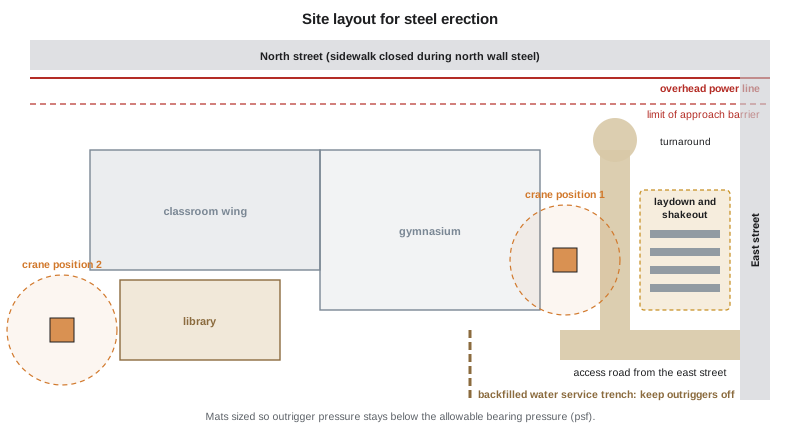
At the Prairie Gate Community Center, Tallgrass built a gravel access road from the east street into the site, with a turnaround at the north end so trucks could drive in forwards and out forwards. The crane pads were compacted granular fill over undisturbed clay, tested by the geotechnical engineer. Subpart R requires the controlling contractor to provide adequate access roads and a firm, properly graded, drained and readily accessible area for cranes, and OSHA's crane standard (1926.1402) requires ground conditions firm, drained and graded enough, with supporting materials if needed, to meet the crane manufacturer's specifications.
The biggest hidden danger under a crane pad is something that was dug and filled. Backfilled trenches for services, old foundations, buried tanks and utility vaults can all collapse under an outrigger. Before each crane set-up, Rosa checked the site services drawing and marked every buried service and backfilled area within the outrigger footprint. On the second crane location, one outrigger would have landed on the backfilled trench for the new water service. The crane was moved 10 ft (3 m) north.
Outrigger loads and mats
When a crane lifts, much of its weight and the load's weight can end up on one or two outriggers. The pressure on the ground under each outrigger pad is the outrigger load divided by the area of the pad or mat. If that pressure is higher than the ground can carry, the outrigger sinks, the crane tilts, the radius increases and the crane can tip. Mats or cribbing spread the load over a bigger area.
# Ground bearing check for one outrigger (invented loads; US units).
outrigger_load_lb = 94_000     # worst-case outrigger load from the crane supplier
allowable_psf = 3_100          # allowable bearing pressure from the geotechnical engineer
float_area = 2.0 * 2.0         # crane's own float, square feet
print(f"pressure on the float alone: {outrigger_load_lb / float_area:,.0f} psf")
for side in (4, 5, 6, 7):
    p = outrigger_load_lb / (side * side)
    ok = "OK" if p <= allowable_psf else "too high"
print(f"mat {side} ft square: {p:7,.0f} psf {ok}")pressure on the float alone: 23,500 psf mat 4 ft square: 5,875 psf too high mat 5 ft square: 3,760 psf too high mat 6 ft square: 2,611 psf OK mat 7 ft square: 1,918 psf OK
The crane's own float pad would have put several times the allowable pressure on the clay. A square mat 6 ft (about 1.8 m) on a side brought the pressure within the allowable value. Ray Lindqvist set the crane on timber crane mats on every set-up and checked the level after each move, as the crane manufacturer requires.
Laydown, shakeout and stacking
Steel arrives in truckloads, but it goes up piece by piece. The laydown area is where loads are unloaded and stored; shakeout is the work of spreading the pieces out so each one can be identified by its piece mark and picked in sequence. Good laydown keeps the pieces off the ground, stable, readable and within the crane's reach, with clear walkways between stacks.
- Firm, level, drained ground. Stacks on soft or sloping ground can shift or settle unevenly.
- Dunnage. Timber blocking under each stack keeps steel out of mud and water and leaves room for slings. Blocking should be sound, square and placed under the points the fabricator shows.
- Stable stacks. Beams are stored upright on their flanges, not on their sides where they can roll. Stacks are kept low enough to be stable, with blocking between layers lined up vertically. Columns and long members are chocked so they cannot roll.
- Readable piece marks. Piece marks face out, so nobody has to climb on the stack to read them.
- Walkways. Clear paths between stacks wide enough for a rigger to walk without stepping over steel.
- Away from edges. No stacks near excavations, slopes or the edge of the crane pad.
- Sequence. The pieces needed first are stored closest to the crane and on top.
Deck bundles and joist bundles need extra care. They are banded at the factory, and the bands are only meant to hold the bundle together in transport. Cutting bands on the ground before the bundle is lifted can let sheets slide off, and landing a bundle on the frame and then cutting its bands before it is secured is a classic cause of falling deck. Lesson 8 covers landing deck bundles on the frame.
Overhead power lines
A three-phase distribution line ran along the north street at the Prairie Gate Community Center. Contact between a crane boom, load line or load and an energized line kills the people touching the load or the crane. OSHA's crane standard (1926.1408) requires the employer to identify the work zone and decide whether any part of the crane, load line or load could come within 20 feet of a line rated up to 350 kV. If so, the employer must either de-energize and ground the line, keep at least 20 feet away, or have the utility tell it the voltage and keep the minimum distance for that voltage from Table A. Encroachment prevention measures include a planning meeting, tag lines that are non-conductive, an elevated warning line or barricade, and a dedicated spotter. On the north side of the building, Tallgrass and Northern Iron Erectors LLC arranged with CPS Energy for insulating line covers, set up a barricade marking the limit, and assigned a dedicated spotter.
Insulating covers on a line do not make it safe to touch. They reduce the chance of an arc if something comes close by accident, but the limits of approach still apply. On the morning of each lift near the street, Bill held a short planning meeting with Ray, the signal person and the spotter to review the route of each load.
The crane's swing radius
The rear of a crane's superstructure swings with the boom, and the counterweight can crush anyone standing between it and an obstruction. At the Prairie Gate Community Center, the swing radius of the counterweight was barricaded with orange fencing and a sign at the opening. Only the crane crew could enter, and only when the operator knew they were there.
The load itself also swings. OSHA 1926.753(d) requires routes for suspended loads to be pre-planned so that no employee is directly below a load, except employees engaged in the initial connection of the steel or employees needed to hook or unhook the load. The crane standard also requires the swing radius to be barricaded where there is a pinch or crush hazard (1926.1424). Lesson 4 covers loads in detail.
Protecting the public
The Prairie Gate Community Center faced two public streets. Loads were never swung over the sidewalks or the streets while they were open. When the steel on the north wall was set, the north sidewalk was closed for three days with a protected pedestrian route on the far side, under a permit from the City of San Antonio. Deliveries were scheduled before the morning rush or after it, and a flagger controlled trucks entering and leaving the site, as described in HSE-373. A covered walkway protected the east sidewalk from falling objects for the whole erection period.
Delivery planning
Bill sent Alamo Steel Fabricators a delivery schedule that matched the erection sequence, with no more than two trucks a day arriving, each at a fixed time. Each load was checked against the shipping list when it arrived, and missing or damaged pieces were reported the same day. Trucks were unloaded by the crane or by a telehandler with forks rated for the load, never by tipping or rolling members off the deck. Drivers stayed in a marked safe area away from the unloading, and nobody climbed onto a load while it was being lifted.
Worked problem
The soft corner
Show solution
- For the gymnasium roof joists, the plan placed the crane at the north-west corner of the site, where it could reach the far end of the 105 ft (32 m) joists.
- After three days of rain, Rosa noticed standing water on the pad and a rut where a loaded trailer had turned.
- The geotechnical engineer tested the pad and found that the top layer had softened. The allowable bearing pressure was reduced until the pad was dried and re-compacted.
- Ray and Bill rechecked the outrigger loads for the heaviest joist picks with larger mats, confirmed the pressure was within the reduced allowable value, and added a drainage ditch on the uphill side of the pad.
- Lifting resumed a day later, after the crane level was checked again with the first light pick.
Answer: Ground conditions change with weather and traffic. Pads must be checked before each critical set-up, not just once at the start of the job.
Housekeeping on the ground
The ground around a steel frame collects a surprising amount of debris: offcuts, bolt boxes, banding straps, blocking, welding rod stubs and packaging. Banding straps are a particular nuisance. They coil up, catch feet and can slice a hand when they spring back after being cut. At the Prairie Gate Community Center, the crew cut bands with proper cutters while standing to one side of the strap, collected the straps immediately in a dedicated bin, and stacked used blocking where it would not be tripped over or blown away. The laydown area was walked and cleaned at the end of every shift.
Housekeeping matters for falling objects too. Material left near the edge of a floor can be kicked or blown off, and debris on the ground hides holes and trip hazards from riggers who spend the day walking backwards with their eyes on a load. Tallgrass treated a clean laydown area as part of the erection plan, not an afterthought.
Winter and summer conditions
The Prairie Gate Community Center started in a San Antonio March and finished in August. In spring, heavy rain can soften crane pads quickly, and in summer, steel in the sun gets hot enough to burn skin and heat stress builds on a frame with no shade. The erection plan set out heat measures, including water, shade, rest breaks, acclimatization for new workers and earlier start times in the hottest weeks.
Common mistakes
MistakeSetting a crane outrigger on ground that looks firm without checking what is buried there.
InsteadCheck the services and excavation records and keep outriggers off backfilled trenches, tanks and vaults.
MistakeUsing the crane's own float pads on soft ground.
InsteadUse mats sized so the pressure stays within the allowable bearing pressure set by the geotechnical engineer.
MistakeStoring beams on their sides to save space.
InsteadStore beams upright on dunnage, chocked and in stable stacks so they cannot roll.
MistakeAssuming insulating covers make a power line safe to approach.
InsteadThe limits of approach still apply; covers only reduce the risk of accidental contact.
MistakeLeaving the counterweight swing area open.
InsteadBarricade the swing radius so nobody can be caught between the counterweight and an obstruction.
Summary and key terms
- Access roads and crane pads must carry cranes and loaded trailers, be drained and graded, and avoid backfilled trenches and buried services.
- Outrigger mats spread the load so the ground pressure stays below the allowable bearing pressure set by the geotechnical engineer.
- Laydown and shakeout areas need firm, level ground, sound dunnage, stable upright stacks, readable piece marks, walkways and storage in erection order.
- OSHA 1926.1408 requires a 20-foot clearance from lines up to 350 kV unless the voltage is known and the Table A distance is kept, or the line is de-energized, with encroachment prevention measures such as a dedicated spotter.
- The counterweight swing radius is barricaded, loads are never swung over workers or the public, and deliveries are scheduled to match the erection sequence.
- Laydown area
- An area of the site where delivered material is unloaded and stored before installation.
- Shakeout
- Spreading out delivered pieces so each can be identified by its piece mark and picked in sequence.
- Dunnage
- Timber blocking used to keep stored material off the ground and leave room for slings.
- Outrigger mat
- A large timber, steel or composite pad placed under a crane outrigger to spread its load over the ground.
- Allowable bearing pressure
- The pressure the ground can safely carry, set by a geotechnical engineer.
- Swing radius
- The area swept by the rotating upper part of a crane, including the counterweight.
Practice problems
Work each problem on paper first, then reveal the answer to check.
Why must a crane outrigger never land on a backfilled trench?
Show answer
The fill can collapse under the outrigger load, letting the crane tilt and tip.
How do you find the ground pressure under an outrigger?
Show answer
Divide the outrigger load by the area of the pad or mat under it.
How should beams be stored in the laydown area?
Show answer
Upright on their flanges on sound dunnage, chocked, in stable stacks with piece marks facing out and walkways between stacks.
Name three ways to control the hazard of an overhead power line near crane work.
Show answer
Any three of de-energizing the line, keeping the limit of approach, insulating covers arranged with the utility, a barrier marking the limit, a planning meeting and a dedicated spotter.
What did the team do when the crane pad softened after rain?
Show answer
Had it tested, rechecked outrigger loads with larger mats against the reduced allowable pressure, added drainage and rechecked level before lifting resumed.
Lesson quiz · 5 questions
Score 60% or more to complete this lesson.
Create a free account to save your progress, take quizzes and earn a certificate.