
HSE-374 · Lesson 12 of 12 · 21 min
Falling objects, other trades and an incident investigation
By late June the steel at the Prairie Gate Community Center was topped out, the tilt-up walls were connected to the gymnasium roof, and the library's CLT roof was on. The building was full of other trades: electricians pulling wire, plumbers hanging pipe, sheet metal workers running ductwork, curtain wall installers on the outside of the classroom wing and concrete crews placing the composite floor slabs. Every one of them worked under or beside the ironworkers who were still finishing connections, welding studs and installing the last braces. This final lesson covers protection from falling objects, working alongside other trades, and how Tallgrass investigated the one serious incident on the job, using everything the earlier lessons covered.
Why falling objects are so dangerous
A small object dropped from height carries a surprising amount of energy. A 5 lb (2.3 kg) spud wrench dropped 30 ft (9 m) hits the ground at 44 ft/s (about 13 m/s) with roughly 200 joules of energy, enough to cause a serious head injury even through a hard hat, and far more if it lands point first. Bolts, nuts, drift pins, offcuts and welding rod stubs are smaller but fall in large numbers. A dropped piece of deck or a beam that slides off a stack can kill instantly.
# Impact energy of dropped objects (energy = m * g * h; air resistance ignored).
import math
g = 9.81
items = [("hex nut", 0.05), ("structural bolt and nut", 0.4), ("drift pin", 1.0),
         ("spud wrench", 2.3), ("impact wrench", 9.0)]
for h in (4.0, 9.0):
    v = math.sqrt(2 * g * h)
    print(f"dropped {h:.0f} m: impact speed {v:.1f} m/s")
    for name, kg in items:
print(f" {name:24} {kg * g * h:7.0f} J")dropped 4 m: impact speed 8.9 m/s hex nut 2 J structural bolt and nut 16 J drift pin 39 J spud wrench 90 J impact wrench 353 J dropped 9 m: impact speed 13.3 m/s hex nut 4 J structural bolt and nut 35 J drift pin 88 J spud wrench 203 J impact wrench 795 J
Controls for falling objects
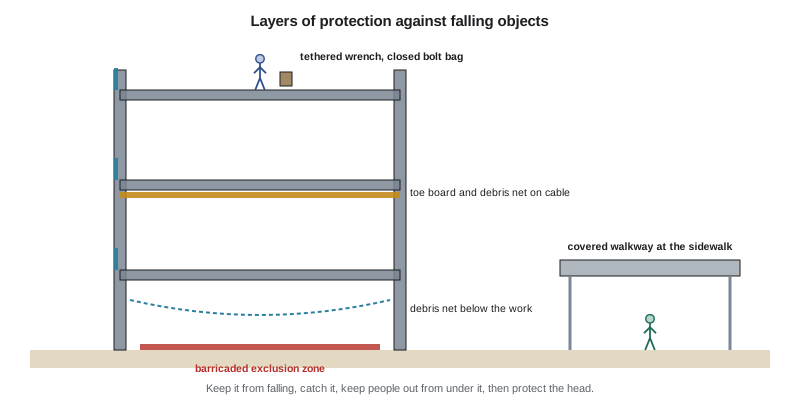
OSHA 1926.759 deals with falling objects in steel erection. All materials, equipment and tools that are not in use while aloft must be secured against accidental displacement. And the controlling contractor must bar other construction processes below steel erection unless overhead protection for the employees below is provided. Tallgrass's erection plan at the Prairie Gate Community Center set out the layers it used.
- Keep it from falling. Tools tethered to the worker or the structure, using tethers and attachment points rated for the tool's weight; bolt bags and buckets with closures; loose material secured at the end of each task; bundles secured on the frame; no throwing of tools or material.
- Catch it if it falls. Toe boards and debris netting on perimeter cables and platforms; debris nets under work areas; covers over openings and gaps.
- Keep people out from under it. Barricaded exclusion zones below active steel work and hoisting routes; scheduling other trades so they do not work directly below the ironworkers; covered walkways where people must pass under the work.
- Protect the head. Hard hats, with chin straps when working at height or looking up, as the last layer.
Tool tethering has its own standard, ANSI/ISEA 121, which sets requirements for tethers, attachment points and containers used to prevent dropped objects. At the Prairie Gate Community Center, every tool used above the first floor had to be tethered with equipment rated for its weight, and the tethers were inspected like other personal equipment.
Working with other trades
As the building filled with trades, coordination became as important as any piece of equipment. Each morning at the Prairie Gate Community Center, Rosa Delgado held a 15-minute coordination meeting with the foremen of every trade on site. They reviewed where the ironworkers would be working and hoisting that day, which floors and areas were closed below them, which perimeter cables or covers would be removed or changed, and who needed the crane. A large board in the trailer showed each floor and the trade working in each area.
- No work below active steel erection or hoisting unless overhead protection was provided, as the plan required.
- Fall protection handover. Trades used perimeter cables and covers only on floors Tallgrass had accepted from the erector, as lesson 9 described.
- Nobody touches temporary bracing except the erector, as lesson 7 described.
- Permits. Hot work, removal of covers or cables, and crane use by other trades all needed permits from Tallgrass.
- Shared equipment. Lifts and scaffolds used by more than one trade were inspected by each user before use.
Other trades often have less experience at height than ironworkers. A sheet metal worker installing duct hangers from a ladder near the slab edge, or an electrician walking a beam to reach a junction box, may not know the hazards of an incomplete frame. Tallgrass's orientation for every new worker included a section on the frame: where the edges were, which areas were closed, and what not to touch.
The incident
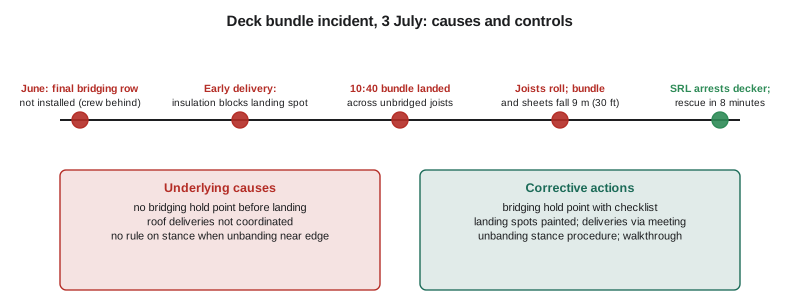
On 3 July, at about 10:40 in the morning, a deck bundle tipped on the gymnasium roof. Kyle Bear's decking crew was landing the last roof deck bundles. One bundle, 2 tons (about 1.8 t), was landed across three joists near the east wall. As the crew prepared to unband it, the bundle rolled toward the open side of the roof, two joists twisted sideways, and the bundle and about a dozen sheets fell to the floor of the gymnasium 30 ft (9 m) below. A decker, Ellie Ross, was knocked off her feet by the moving sheets and fell over the leading edge. Her SRL, attached to the overhead horizontal lifeline, arrested her after 3 ft (about 1 m). She was rescued with the boom lift within eight minutes and taken to hospital with a broken wrist and bruising. The floor below had been barricaded, and nobody was under the bundle.
The investigation
Tallgrass investigated with a team that included Owen Hartley, Bill Okafor, Kyle Bear, a worker member of the site safety committee, Sanjay Mehta and the joist supplier's engineer. They used a causal factor approach: they built a timeline, identified each event or condition that, if removed, would have prevented the incident or reduced its severity, and for each one asked why it happened until they reached causes the organization could fix.
| Causal factor | Why it happened | Underlying cause |
|---|---|---|
| Bundle landed on joists that had not been fully bridged | The final row of bridging near the east wall had not been installed because the bridging crew was behind | No hold point stopping bundle landing until bridging was confirmed complete |
| Joists twisted under the bundle | Without bridging, the joists had little resistance to rolling | The landing plan assumed complete bridging |
| Bundle landed away from the support line | The planned spot near the girder was blocked by a stack of insulation delivered early by the roofer | Roofing deliveries were not coordinated with the decking sequence |
| Decker knocked over the edge | She was standing on the side of the bundle toward the open edge while preparing to cut bands | No rule on where the crew stands when unbanding near an edge |
| Injury limited | Overhead SRL arrested the fall quickly; rescue in eight minutes; area below barricaded | Controls from lessons 8, 9 and 12 worked as designed |
Because the injury did not involve an in-patient hospitalization, amputation or loss of an eye, Tallgrass was not required to report it to OSHA within 24 hours, but it was recorded on the OSHA 300 log, and the scene was preserved until the investigation team had seen it. Tallgrass also notified the owner and its insurer.
Corrective actions
The team chose corrective actions starting at the top of the hierarchy of controls, not with retraining alone.
- Engineering. A hold point was added to the erection plan: no bundle may be landed on joists until Bill or Kyle confirms in writing, on a bay-by-bay checklist, that all bridging is installed and anchored and joist bearing ends are attached. Landing locations were marked on the steel with paint before each bundle went up.
- Coordination. All roofing and other material deliveries to the roof had to be scheduled through Rosa's coordination meeting and could not be landed on an area until decking there was complete.
- Procedure. When unbanding near an edge, the crew stands on the side of the bundle away from the edge, and the bundle is checked for stability by two people before the bands are cut.
- Training. The decking crew and the bridging crew walked through the new hold point and procedure on site.
- Sharing. Tallgrass shared a summary with the other employers on site and with Northern Iron Erectors LLC's other projects.
# Simple tracker for corrective actions (invented status at two weeks).
actions = [
    ("Bridging hold point added to erection plan", "engineering", True),
    ("Landing spots painted on steel before lifts", "engineering", True),
    ("Roof deliveries via coordination meeting", "coordination", True),
    ("Unbanding stance procedure", "procedure", True),
    ("Crew walkthrough of new procedure", "training", True),
    ("Summary shared with other employers", "sharing", False),
]
done = sum(1 for _, _, ok in actions if ok)
print(f"{done} of {len(actions)} actions complete")
for name, kind, ok in actions:
print(("done " if ok else "OPEN ") + f"{kind:12} {name}")5 of 6 actions complete done engineering Bridging hold point added to erection plan done engineering Landing spots painted on steel before lifts done coordination Roof deliveries via coordination meeting done procedure Unbanding stance procedure done training Crew walkthrough of new procedure OPEN sharing Summary shared with other employers
What the incident shows
The incident pulled together almost every topic in this course. Site layout and delivery planning (lesson 3) put insulation where the bundle should have gone. The erection plan (lesson 2) had assumed complete bridging without a hold point to confirm it. Structural stability (lesson 7) failed locally because joists without bridging could roll. Landing bundles (lesson 8) went wrong because the landing spot changed on the fly. And the protection that worked, the overhead SRL and engineered lifeline (lesson 9), the rescue plan and the barricaded area below (lesson 12), turned what could have been a fatality into a broken wrist.
Course review: questions before any erection work
Before any crew starts erection work on a Tallgrass site, the foreman should be able to answer these questions:
- Is there a current, reviewed site-specific erection plan, and has the crew been walked through it?
- Have the foundations, anchor rods and any repairs been confirmed in writing?
- Can the crane make every pick from a pad checked for buried services and bearing capacity?
- Is the rigging inspected and right for each load, and is everyone clear of the load path?
- Does every member get the required bolts before release, and is the frame braced at the end of each shift?
- Is everyone at height protected, with enough clearance, and is there a rescue plan with equipment on site?
- Are tools tethered, areas below barricaded and other trades kept clear?
- Is hot work under permit with a fire watch?
Worked problem
Closing out the job
Show solution
- In August, Northern Iron Erectors LLC finished its work at the Prairie Gate Community Center. Before Bill's crew demobilized, Owen and Bill walked every floor together.
- They confirmed that all temporary bracing had been removed with Sanjay Mehta's written approval and that the permanent bracing and diaphragms were complete.
- They listed every perimeter cable, cover and lifeline that would stay for other trades, and Tallgrass accepted each one in writing.
- Bill handed over the training records, rigging inspection logs, hot work permits and the incident file.
- At the final toolbox talk, Bill thanked the crew and Nora Whitehorse said what she had learned most: that every rule on the frame had someone's injury behind it.
Answer: Erection safety ends with a deliberate handover: bracing removed only with approval, fall protection accepted by the general contractor, and records kept so the next job starts with this job's lessons.
Common mistakes
MistakeRelying on hard hats as the main protection from falling objects.
InsteadKeep objects from falling, catch them, and keep people out from under the work; hard hats are the last layer.
MistakeLetting other trades work below active steel erection.
InsteadBar work below active erection and hoisting unless overhead protection is provided.
MistakeEnding an investigation at 'worker error'.
InsteadAsk why until you reach causes the organization can fix, such as missing hold points or poor coordination.
MistakeChoosing retraining as the only corrective action.
InsteadStart at the top of the hierarchy: engineering and coordination changes before procedures and training.
MistakeDemobilizing without handing over fall protection and records.
InsteadWalk the job, confirm bracing removal approvals, have the general contractor accept fall protection and hand over records.
Summary and key terms
- Dropped objects carry large energy; even small tools can cause serious injury from a few stories.
- OSHA 1926.759 requires loose items aloft to be secured and bars other work below steel erection unless overhead protection is provided.
- Daily coordination meetings, permits and orientation keep other trades safe around an incomplete frame.
- The deck bundle incident traced back to missing bridging, an unplanned landing spot, uncoordinated deliveries and the crew's position near the edge.
- Corrective actions started with engineering and coordination changes, and the controls that worked turned a possible fatality into a minor injury.
- Dropped object
- Any tool, part or material that falls from a height, whether from equipment, the structure or a person.
- Tool tether
- A lanyard rated for a tool's weight that connects the tool to the worker or the structure.
- Exclusion zone
- A barricaded area below or around work where nobody may enter while the hazard exists.
- Hold point
- A step in a procedure beyond which work may not continue until a named person confirms a condition.
- Causal factor
- An event or condition that, if removed, would have prevented an incident or reduced its severity.
- Bridging
- Members installed between open-web joists to keep them from rolling or buckling sideways.
Practice problems
Work each problem on paper first, then reveal the answer to check.
Name the four layers of falling object protection.
Show answer
Keep it from falling, catch it if it falls, keep people out from under the work, and protect the head.
What did the daily coordination meeting cover?
Show answer
Where ironworkers would work and hoist, which areas were closed below, changes to cables or covers, and crane use by other trades.
What were the underlying causes of the deck bundle incident?
Show answer
No hold point for bridging, uncoordinated roof deliveries blocking the planned landing spot, and no rule on where the crew stands when unbanding near an edge.
Which controls limited Ellie Ross's injury?
Show answer
The overhead SRL on the engineered horizontal lifeline, the quick rescue with the boom lift, and the barricaded area below.
What should happen before the erector demobilizes?
Show answer
A joint walk-through, confirmation that bracing was removed with approval, written acceptance of fall protection left in place, and handover of records.
Lesson quiz · 5 questions
Score 60% or more to complete this lesson.
Create a free account to save your progress, take quizzes and earn a certificate.