
HSE-374 · Lesson 10 of 12 · 20 min
Bolting, welding and hot work at height
Once the connectors had set a bay at the Prairie Gate Community Center, the bolting-up crew moved in behind them. They filled every hole the connectors had left empty, ran the bolts up snug, and then pretensioned the bolts in the braced bays and moment connections to the level Helen Kowal had specified. Behind them came Marie Tremblay, a certified welder, who made the field welds at the braced-bay gussets and the roof girder seats, welded the shear studs through the deck and installed embedded plates for the curtain wall. Bolting and welding look like routine trade work, but on a steel frame they are done at height, at edges, with power tools, heat, sparks and fume. This lesson covers those hazards.
Bolts and how they are tightened
Most structural bolts at the Prairie Gate Community Center were high-strength bolts to ASTM F3125, the standard that replaced the separate A325 and A490 specifications, with nuts and hardened washers. The Research Council on Structural Connections (RCSC) specification, referenced by AISC 360, says which joints are snug-tight and which are pretensioned or slip-critical, and the engineer's drawings show which applies. Snug-tight means the plies are in firm contact, achieved by a few impacts of an impact wrench or the full effort of an ironworker on a spud wrench. Pretensioned bolts are tightened further, to a minimum tension, by one of the approved methods.
- Turn-of-nut. The bolt is snugged, the nut and bolt end are match-marked, and the nut is turned a set fraction of a turn depending on the bolt length.
- Calibrated wrench. The wrench is set, by testing bolts from the job in a tension calibrator, to stop at the right tension.
- Twist-off-type tension-control (TC) bolts. A spline on the end of the bolt shears off when the correct tension is reached.
- Direct tension indicators (DTIs). Special washers with bumps that flatten to a measured gap at the right tension.
The special inspector checked a sample of bolts in each connection type. For the crew, the safety points were about the tools and the positions.
Impact wrenches and hand tools
Impact wrenches for structural bolts are heavy, loud and powerful. They can twist out of a worker's hands if the socket slips, injure wrists and shoulders, and expose the user to hand-arm vibration and noise. Sockets can shatter if they are not impact-rated. Air-powered wrenches add the hazards of whipping hoses and couplings.
- Use impact-rated sockets, check them for cracks, and secure them with pins and rings.
- Hold the wrench with both hands, braced against the reaction, and keep fingers out of the gap between the socket and the steel.
- On air tools, use whip checks at every coupling and shut off the air before disconnecting.
- Tether the wrench, the socket and the spud wrench when working at height.
- Rotate tasks to limit vibration exposure, and use hearing protection; structural impact wrenches are far above the levels that require it.
# Daily hand-arm vibration exposure from an impact wrench (illustrative values).
# A(8) = a * sqrt(T / 8), where a is the vibration magnitude (m/s^2) and T is hours of trigger time.
import math
a = 9.0                       # vibration magnitude for a large impact wrench, illustrative
action, limit = 2.5, 5.0      # common action and limit values used as guidance, m/s^2
for hours in (0.25, 0.5, 1.0, 2.0):
    a8 = a * math.sqrt(hours / 8)
    flag = "over limit" if a8 > limit else "over action value" if a8 > action else "below action value"
print(f"{hours:4.2f} h trigger time: A(8) = {a8:4.1f} m/s^2 {flag}")0.25 h trigger time: A(8) = 1.6 m/s^2 below action value 0.50 h trigger time: A(8) = 2.2 m/s^2 below action value 1.00 h trigger time: A(8) = 3.2 m/s^2 over action value 2.00 h trigger time: A(8) = 4.5 m/s^2 over action value
Trigger time, the time the tool is actually running, is much shorter than the time a worker holds it, but a full shift of bolting up can still add up to more than an hour. The crew at the Prairie Gate Community Center rotated between bolting, sorting bolts and inspection checks to keep each person's exposure down, and the foreman tracked it.
Where bolters and welders stand
Bolting and welding happen at connections, which are at the ends of beams, at columns and at the edges of the frame. The fall protection rules in lesson 9 apply in full. At the Prairie Gate Community Center, the bolting-up crew worked from boom lifts wherever the floor below would carry them, and from bolting floats, small platforms hung from the beams, where it would not. Floats were hung from engineered hangers, with the worker also tied off to the structure, not to the float. Nobody sat on a beam and tied off at foot level.
Welding processes and qualification
Field welding on structural steel is mostly done with shielded metal arc welding (stick) or flux-cored arc welding (FCAW), because they work outdoors in wind. Shear studs are welded with a stud gun that uses a high current for a fraction of a second. Each process produces fume, ultraviolet and visible light, heat, sparks and spatter, and an electrical shock hazard.
Structural welds must be made by qualified welders. In the US, AWS D1.1, under which welders are qualified by test for each process and position, and the special inspector checks qualifications before work starts. Marie Tremblay carried her current qualification records for the processes and positions she would use, and Northern Iron Erectors LLC's welding procedure specifications were approved before the first weld.
Welding fume and gases
Welding fume is a mixture of fine metal oxide particles and gases. For carbon steel, the main concerns are manganese, which can damage the nervous system, and iron oxide; for stainless steel, hexavalent chromium and nickel, which can cause cancer; for galvanized steel, zinc oxide, which causes metal fume fever. The International Agency for Research on Cancer classifies welding fume as carcinogenic to humans. Ultraviolet light from the arc also makes ozone, and some fluxes and coatings give off other gases.
Working outdoors does not remove the fume hazard, because the welder's face is often directly above the plume. At the Prairie Gate Community Center, Marie positioned herself upwind of the work where she could, used a small portable fan to move the plume away from her breathing zone, and wore a half-mask respirator with particulate filters for long welds and for all welding inside the elevator shaft. Coatings were ground off the weld area before welding where the drawings allowed. Galvanized connections were welded only with local exhaust and respirators.
Arc light, burns and shock
The welding arc gives off ultraviolet light that burns the eyes (arc eye) and skin within seconds. Welders wear helmets with the correct shade of filter lens and flame-resistant clothing, gloves and leather sleeves. Other workers nearby are protected with welding screens or by keeping their distance, because the arc can burn the eyes of passers-by too. Spatter and hot slag burn through ordinary clothing and can drop onto workers below.
Electric shock is a particular risk when welding on steel in wet conditions, because the whole frame can become part of the circuit. Welding machines must be grounded and in good condition, cables undamaged, the work lead clamped close to the weld, and welders must not stand in water or work with wet gloves. The work lead must not be clamped to a member in a way that sends current through bolted connections, bearings or crane rigging.
Hot work and fire
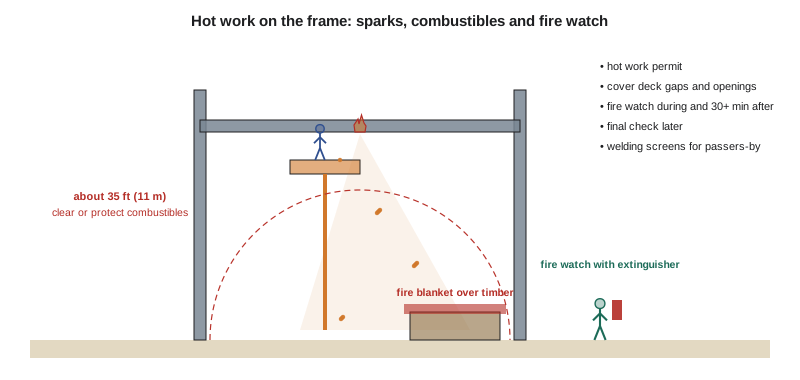
Welding, cutting, grinding and stud welding are hot work. Sparks and slag from a steel frame can fall several floors and travel sideways on the wind, landing in stored material, insulation, timber blocking, or the CLT panels of the library. OSHA's welding and cutting rules in Subpart J (1926.350 to 1926.354), the International Fire Code and NFPA 51B, and the Tallgrass hot work program applied at the Prairie Gate Community Center. Every hot work task needed a hot work permit issued by the foreman after checking the area: combustibles removed or protected within 35 ft (about 11 m), floor openings and gaps covered so sparks could not fall through, a charged fire extinguisher at the work, and a fire watch during the work and for at least 30 minutes after it finished, with a final check later.
The library pavilion needed special attention. Mass timber is hard to ignite, but sawdust, packaging and protective wrap are not, and a fire in a partly built timber structure before sprinklers are working can grow fast. All hot work on the steel connections in the library was done before the CLT panels arrived where possible, and after that only with fire-resistant blankets over the timber and an extended fire watch.
Oxy-fuel cutting
Cutting torches use oxygen and a fuel gas, usually acetylene or propane. Cylinders are stored and used upright, secured so they cannot fall, with valve caps on when not in use, and kept away from heat and electrical circuits. Hoses have flashback arrestors at the torch and regulator, are checked for leaks and damage, and are kept away from falling slag. Cylinders are hoisted onto the frame only in a cradle or rack designed for it, never by slings around the cylinders or by the valve cap. Oxygen must never be used to blow dust off clothing or to ventilate a space, because oxygen-enriched clothing burns fiercely.
Fall protection equipment and heat
Synthetic lanyards, SRL lines and harness webbing can be damaged by heat, sparks and slag. Welders at the Prairie Gate Community Center used SRLs with steel cable lines and harnesses with heat-resistant webbing and covers where spatter could reach them, and every welder's harness was inspected for burn marks before each shift. A harness with burned or glazed webbing was removed from service.
Worked problem
Smoke in the gymnasium
Show solution
- In June, the bolting-up crew in the gymnasium smelled smoke near the end of the shift. Marie had finished welding a roof girder seat about 45 minutes earlier.
- A piece of slag had fallen through a gap in the roof deck onto a pile of timber blocking and cardboard packaging left on the floor by another trade.
- The fire watch had stayed for 30 minutes, as the permit required, and seen nothing. The packaging had smoldered slowly and then started to burn.
- A laborer put the fire out with an extinguisher. Nobody was hurt and damage was limited to the packaging.
- Tallgrass changed its hot work permit to require a final check of the area below one hour after hot work ends, covering of all deck gaps below hot work before the permit is issued, and daily removal of packaging from the floor below active steel work.
Answer: Sparks and slag can smolder for a long time before flames appear. Clear combustibles, cover gaps, keep the fire watch and check again later.
Grinding and cutting discs
Grinders are used to dress welds, remove coatings and cut steel. Discs and wheels must be rated for the grinder's speed, mounted with the right flanges, and covered by the guard. Cutting discs must never be used for side grinding, and a disc that has been dropped is discarded. At the Prairie Gate Community Center, grinding was treated as hot work, face shields were worn over safety glasses, and the grinder was tethered when used at height.
Common mistakes
MistakeUsing standard sockets on a structural impact wrench.
InsteadUse impact-rated sockets, secured and inspected, and tether tools at height.
MistakeAssuming outdoor welding has no fume hazard.
InsteadPosition upwind, move the plume with ventilation, and use respirators for long welds, confined areas and coated steel.
MistakeClamping the welding work lead wherever is convenient.
InsteadClamp the work lead close to the weld so current does not pass through bolts, bearings or rigging.
MistakeEnding the fire watch when the welding stops.
InsteadKeep the fire watch for at least 30 minutes after hot work and check the area again later.
MistakeUsing a synthetic lanyard while welding overhead.
InsteadUse heat-resistant fall protection equipment and inspect it for burn damage.
Summary and key terms
- High-strength bolts are snug-tightened or pretensioned by turn-of-nut, calibrated wrench, TC bolts or DTIs, as the engineer specifies.
- Impact wrenches need impact-rated sockets, two-handed control, whip checks, tethering, hearing protection and limits on vibration exposure.
- Structural welders must be qualified under AWS D1.1 and their procedures approved.
- Welding fume, arc light, burns and shock are controlled with positioning, ventilation, respirators, screens, protective clothing and sound equipment.
- Hot work needs a permit, combustibles cleared or protected within 35 ft (about 11 m), openings covered, an extinguisher and a fire watch during and at least 30 minutes after, with a later check.
- Snug-tight
- A bolt condition in which the connected plies are in firm contact, achieved by a few impacts or full effort on a spud wrench.
- Pretensioned bolt
- A high-strength bolt tightened to a specified minimum tension by an approved method.
- Turn-of-nut method
- A pretensioning method in which the nut is turned a set amount past snug-tight.
- Bolting float
- A small work platform hung from steel members so that bolters and welders can reach connections.
- Hot work
- Work that produces flames, sparks or heat that could start a fire, such as welding, cutting and grinding.
- Fire watch
- A trained person who watches for and puts out fires during and after hot work.
Practice problems
Work each problem on paper first, then reveal the answer to check.
Name the four common methods of pretensioning high-strength bolts.
Show answer
Turn-of-nut, calibrated wrench, twist-off-type tension-control bolts and direct tension indicators.
Give three controls for impact wrench hazards.
Show answer
Any three of impact-rated sockets, two-handed grip braced against reaction, whip checks on air hoses, tethering at height, hearing protection and limiting vibration time.
Which metals in welding fume are of special concern for stainless steel?
Show answer
Hexavalent chromium and nickel.
What must be in place before hot work starts on the frame?
Show answer
A hot work permit, combustibles cleared or protected within 35 ft (about 11 m), floor openings and gaps covered, an extinguisher and a fire watch.
Why did the gymnasium fire start after the fire watch had left?
Show answer
Slag fell through a deck gap onto packaging, which smoldered for a long time before flames appeared.
Lesson quiz · 5 questions
Score 60% or more to complete this lesson.
Create a free account to save your progress, take quizzes and earn a certificate.