
ELV-410 · Lesson 9 of 12 · 21 min
Accessibility requirements for elevators
For many people, an elevator is the only way into most of a building. A wheelchair user, a person using a walker, someone with a stroller, a person who is blind or has low vision, and a person who is deaf or hard of hearing all depend on the elevator working in a way they can use: buttons they can reach and read, signals they can see and hear, doors that wait for them, a car big enough to enter and turn, and a way to call for help that does not depend on hearing a voice. The Tillicum package replaced every fixture on car 1, the hall buttons, lanterns, car operating panel, position indicator and emergency phone, so Priya made accessibility a section of its own. This lesson covers where the accessibility requirements for elevators come from, what they require, how they apply when an existing elevator is altered, and how the Tillicum fixtures were checked.
Where the requirements come from
In the United States, accessibility requirements for elevators come from civil rights law and from building codes. The 2010 ADA Standards for Accessible Design, issued under the Americans with Disabilities Act, contain section 407 on elevators, with requirements for hall calls, signals, door timing, car size, controls, position indicators and emergency communication; section 408 covers limited-use and limited-application elevators and section 409 private residence elevators. The building codes refer to the ICC A117.1 standard on accessible and usable buildings, which has very similar elevator requirements. The elevator code itself sets the safety requirements and refers to these standards, and ASME A18.1 covers platform lifts and stairway chairlifts; Washington's rules adopt ASME A18.1-2020. For a mechanic, the practical rule is that the ADA Standards apply to public accommodations and commercial facilities in any case, and the local building code decides which edition of A117.1 applies as well.
The two countries' requirements are similar in substance, because they answer the same needs, and the numbers are close. Tamsin's checklist for the package followed the order a user meets the elevator: the hall call, the hall signals, the doors and their timing, the car size and the clear space inside, the car controls, the position indicators and audible signals, and emergency communication.
Hall calls and hall signals
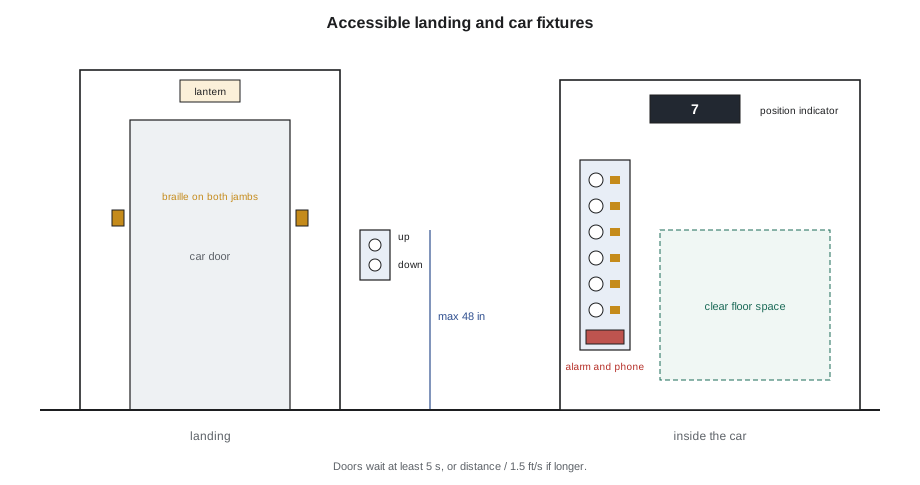
Hall call buttons must be within the reach range of a person in a wheelchair, with the highest operable part no higher than 48 in above the floor, mounted with the up button above the down button, and with a clear floor space in front of them. Buttons must be raised or flush within limits, large enough to press easily, and must light to show that a call is registered. Each hoistway entrance needs a visible and audible signal that tells a waiting person which car is answering and in which direction it is going: a hall lantern or a car-mounted lantern that can be seen from the call station, with an audible signal sounding once for up and twice for down, or a spoken announcement. Floor designations in raised characters and braille must be fixed on both jambs of each hoistway entrance at a set height, so that a person who is blind can tell which floor they are on when they step out.
Destination dispatch systems, like Quayside's, change the hall call from an up or down button to a keypad or touchscreen, and the standards have specific provisions for them: the keypad must be within reach, give audible and visible feedback, show which car to take, and include an accessible way to request extra time or a car for a person who needs it. ELV-310 described the Quayside keypads; their accessibility settings were part of that installation's acceptance.
Doors and timing
Doors must stay open long enough for a person who moves slowly to reach the car. The standards set a minimum time from the moment the hall signal tells a person which car is answering until the car doors start to close, based on the distance from the hall call station to the farthest point of that car's door: the time is the distance divided by a slow walking speed, 1.5 ft/s, but never less than five seconds. Once in the car, the doors must stay fully open for at least three seconds when a car stops in response to a car call. The doors must have a reopening device that senses a person or object in the opening without contact, across a range of heights, and that keeps the doors open for a minimum time after it is activated, so that a person can pass through. The car doors and hoistway doors must provide a minimum clear opening width.
# Hall call notification time and fixture heights for Tillicum car 1
import math
walk = 1.5                      # ft/s, the slow walking speed the standards use
distances = {"lobby call station to car 1 door": 10.2, "upper floor station to car 1 door": 6.2}   # ft
for place, d in distances.items():
    t = max(5.0, d / walk)
    print(f"{place}: {d} ft, doors must wait at least {t:.1f} s after the signal")
heights = {"hall call, highest button": 42.5, "car panel, highest floor button": 46.9, "alarm and phone buttons": 35.4}
limit = 48                   # in, highest operable part allowed
for item, h in heights.items():
print(f"{item}: {h} in: {'ok' if h <= limit else 'too high'}")lobby call station to car 1 door: 10.2 ft, doors must wait at least 6.8 s after the signal upper floor station to car 1 door: 6.2 ft, doors must wait at least 5.0 s after the signal hall call, highest button: 42.5 in: ok car panel, highest floor button: 46.9 in: ok alarm and phone buttons: 35.4 in: ok
The lobby call station at Tillicum sits between the two cars, a few steps from car 1, so its notification time comes out longer than the five-second minimum; the upper floors are shorter and the minimum governs. The new controller holds these times as adjustable parameters, and the acceptance test includes timing them with a stopwatch from the lantern chime to the start of door closing.
The car: size, clear space and controls
An accessible car must be large enough for a wheelchair user to enter, reach the controls and leave. The standards give minimum inside dimensions that depend on the door width and position: a car with a centered door needs to be wider than one with a side door, and a car that can be entered from one end and left from the other can be narrower but deeper. Inside, there must be a clear floor space in front of the car operating panel. Handrails, where provided, must not reduce the required space. The car floor must be firm and slip resistant, and the gap between the car sill and the landing sill limited so that wheels and canes do not catch.
Car controls must be within reach, with the highest floor button no higher than the same limit as the hall buttons, arranged in ascending order, with raised characters and braille beside each button, and with the emergency controls, the alarm and the emergency stop or call button where one is allowed, grouped at the bottom of the panel. The car must have a position indicator, visible and audible: a display of the floor number above the panel or the door, and an audible signal or spoken announcement as the car passes or stops at each floor. Emergency communication must work for people who cannot hear or cannot speak: the two-way system must let the person in the car signal for help without voice, and must show visibly that help has been told and is coming, which is the requirement behind the text and video features ELV-320 described.
| Fixture or feature | Requirement in summary | Tillicum package |
|---|---|---|
| Hall call buttons | within reach, up above down, lit when registered | new stations at 42 1/2 in to the top button |
| Hall signals | visible lantern and audible signal, once up and twice down | new lanterns with chimes and voice |
| Jamb markings | raised characters and braille on both jambs | new plates at every landing |
| Door timing | notification time from distance, at least 5 s; 3 s on car calls | set in the new controller and timed at acceptance |
| Reopening device | non-contact, across a range of heights | new full-height light curtain |
| Car controls | within reach, braille, emergency controls at the bottom | new operating panel |
| Position indicator | visible display and audible announcement | new display and voice annunciator |
| Emergency communication | two-way, usable without voice, visible acknowledgment | new phone with text display and help-on-the-way light |
| Car size | minimum inside dimensions for the door type | existing platform kept; see the alteration discussion |
# Car inside size against the accessible car minimums (summary of the published table)
car = {"width": 76, "depth": 53, "door": 36, "door position": "side"}   # in
minimums = [  # (door position, min door, min width, min depth)
    ("centered", 42, 80, 51),
    ("side", 36, 68, 51),
    ("any", 36, 54, 80),
    ("any", 36, 60, 60),
]
for pos, door, w, d in minimums:
    if pos in (car["door position"], "any"):
        ok = car["door"] >= door and car["width"] >= w and car["depth"] >= d
print(f"{pos:8} door {door}: needs {w} x {d}; car {car['width']} x {car['depth']} with {car['door']} door: {'meets' if ok else 'does not meet'}")side door 36: needs 68 x 51; car 76 x 53 with 36 door: meets any door 36: needs 54 x 80; car 76 x 53 with 36 door: does not meet any door 36: needs 60 x 60; car 76 x 53 with 36 door: does not meet
The minimums in the script are those of the table in section 407 of the ADA Standards. Tillicum car 1, with its side door, meets the side-door minimums once the new cab is installed.
Accessibility when an existing elevator is altered
New elevators must meet the accessibility requirements in full. When an existing elevator is altered, the general rule in both countries is that the elements altered must meet the current requirements, to the extent technically feasible, while unaltered elements may stay as they are unless another rule requires an upgrade. Replacing all the fixtures, as at Tillicum, therefore brings every fixture up to date, and the door timing and reopening device are part of the controller and door work. The platform size is not being altered, so it is not required to change, although the new cab happens to meet the minimums. Where several elevators answer the same hall call, some rules require an altered element to be altered on every car in the group, so that a person waiting does not face one accessible car and one inaccessible one; Tillicum car 2 had received new fixtures when its machine was replaced, so the package noted that both cars would now match.
Moira added a point from her years as an inspector. Accessibility findings are the ones owners argue about least and tenants notice most. A hall lantern that does not chime, braille plates fixed upside down, a phone that only works by voice or doors that close too fast for someone with a cane are failures that people meet every day, and they are easy to get right at installation and hard to fix later.
Worked problem
Setting the door timing at the lobby
The lobby call station at Tillicum is 10.2 ft from the far side of car 1's door. What notification time must the controller allow, and what else must be set?
Show solution
- The notification time is the distance divided by 1.5 ft/s: 10.2 / 1.5 = 6.8 s, which is more than the 5 s minimum.
- The doors must not start to close until at least 6.8 s after the hall lantern and chime announce car 1.
- For stops in response to car calls, the doors must stay fully open for at least 3 s.
- The reopening device must keep the doors open for the required time after activation, and the setting is verified at acceptance.
Answer: Allow at least 6.8 s at the lobby, 5 s minimum elsewhere, 3 s on car calls, and verify the reopening device time.
Common mistakes
MistakeMounting hall buttons wherever the old ones were.
InsteadCheck the reach range and clear floor space for the new fixtures.
MistakeFixing braille plates on one jamb only.
InsteadRaised characters and braille go on both jambs of every entrance.
MistakeSetting door times short to improve traffic flow.
InsteadDoor and signal timing must meet the accessibility minimums.
MistakeProviding an emergency phone that only works by voice.
InsteadTwo-way communication must be usable without voice and show visibly that help is coming.
MistakeAltering fixtures on one car of a group only.
InsteadCheck whether the same element must be altered on every car answering the same call.
Summary and key terms
- In the United States, section 407 of the 2010 ADA Standards and ICC A117.1 set elevator accessibility requirements, with ASME A18.1 for platform lifts.
- Hall buttons must be within reach with visible and audible signals; floor designations in raised characters and braille go on both jambs.
- Doors must wait a notification time based on distance at a slow walking speed, at least 5 s, and stay open at least 3 s on car calls, with a non-contact reopening device.
- Cars must meet minimum inside sizes for their door type, with controls within reach, a visible and audible position indicator and emergency communication usable without voice.
- In alterations, altered elements must meet current requirements; group rules may extend an alteration to every car answering the same call.
- Reach range
- The range of heights a person in a wheelchair can reach, which sets the highest operable part of controls.
- Hall lantern
- A visible signal at a landing showing which car is answering and its direction.
- Notification time
- The minimum time between the hall signal and the start of door closing, based on distance.
- Reopening device
- A non-contact sensor that reopens or holds the doors when a person is in the opening.
- Jamb marking
- The raised character and braille floor designation on a hoistway entrance jamb.
- Position indicator
- The visible display and audible signal that tell passengers where the car is.
Practice problems
Work each problem on paper first, then reveal the answer to check.
What is the minimum hall call notification time?
Show answer
Five seconds, or longer where the distance divided by the slow walking speed gives a longer time.
How do audible hall signals show direction?
Show answer
One sound for up and two for down, or a spoken announcement.
Where must braille floor designations be fixed?
Show answer
On both jambs of every hoistway entrance.
What must emergency communication provide for a person who cannot hear?
Show answer
A way to signal without voice and a visible indication that help has been notified.
Must an unaltered car platform be enlarged when the fixtures are replaced?
Show answer
Generally no; the altered elements must comply, not the unaltered platform, unless another rule requires it.
Lesson quiz · 5 questions
Score 60% or more to complete this lesson.
Create a free account to save your progress, take quizzes and earn a certificate.