
ELV-410 · Lesson 2 of 12 · 21 min
How the code is organized
On the second evening Moira handed out a blank sheet and asked the class to draw the code from memory: its parts, their order, and where they would look for the rules on a hydraulic elevator's pit, an escalator's brake and a rope replacement. Nobody got it all right, and that was the point. “The code is more than five hundred pages,” she said. “You will never memorize it, and you do not need to. You need a map in your head that gets you to the right section in a minute, and the habit of reading the section once you get there.” This lesson is that map: the parts of the code, how the sections and clauses are numbered, what the appendices and tables are for, how editions and interpretations work, and how one part of the code borrows from another.
The parts of the code
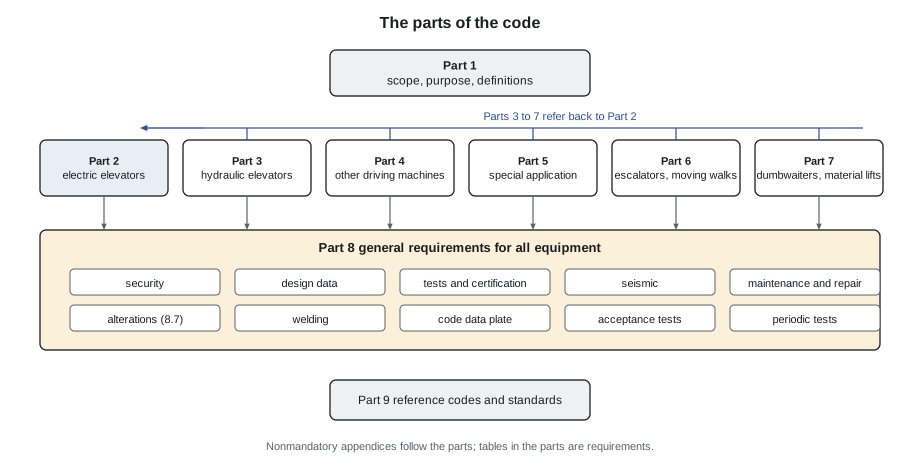
The code is divided into parts by type of equipment, followed by general parts that apply to everything. Part 1 holds the scope, the purpose and the definitions. Part 2 covers electric elevators, meaning traction and drum machines, and it is the largest and most detailed part: most of the basic requirements for hoistways, machine rooms, doors, cars, safeties, governors, ropes, buffers, machines and controls are written here. Part 3 covers hydraulic elevators, Part 4 elevators with other kinds of driving machines such as rack-and-pinion and screw-column machines, and Part 5 special-application elevators, including inclined elevators, limited-use and limited-application elevators, private residence elevators and elevators used during construction. Part 6 covers escalators and moving walks, and Part 7 dumbwaiters and material lifts.
Part 8 applies to all of these. It contains the general requirements that do not belong to one kind of equipment: security of machine rooms and hoistways, design data and formulas, engineering and type tests and the certification of components, seismic requirements, maintenance, repair and replacement, alterations, welding, the code data plate, and the acceptance and periodic inspections and tests. Part 9 lists the other standards the code refers to, with the editions it relies on. When you are on site, it is very often Part 8 you need, because Part 8 tells you what must happen when existing equipment is maintained, repaired, replaced or altered.
Part 2 section by section
Because Part 2 sets the pattern, Tamsin learned its section order first. It runs roughly in the order an elevator is built: the hoistway and its enclosure, the pit, the location and guarding of counterweights, vertical clearances, runbys and refuge spaces, horizontal clearances, the machinery spaces and machine rooms, the equipment allowed in hoistways, machinery supports and guarding, the hoistway door openings and their locking devices, power-operated doors, the car enclosure and car doors, car frames and platforms, capacity and loading, safeties, governors, ascending car overspeed and unintended movement protection, suspension means, counterweights, buffers, guide rails, driving machines and sheaves, terminal stopping devices, operating devices and control equipment, emergency operation and signaling devices, layout data, and finally the identification of equipment.
| Section | Subject (paraphrased) | Where you met it |
|---|---|---|
| 2.1 to 2.3 | hoistway construction, pits, counterweight location | ELV-120 rails and pits |
| 2.4, 2.5 | vertical and horizontal clearances, runby, refuge spaces | ELV-120, ELV-230 runby |
| 2.7 to 2.10 | machinery spaces, equipment in hoistways, supports, guarding | ELV-130 machine setting |
| 2.11 to 2.14 | hoistway doors, interlocks, power doors, car enclosures | ELV-320 doors |
| 2.15, 2.16 | car frames, platforms, capacity and loading | this course, lesson 6 |
| 2.17 to 2.19 | safeties, governors, ascending car and unintended movement | ELV-320 |
| 2.20 to 2.24 | suspension, counterweights, buffers, rails, machines | ELV-230, ELV-120 |
| 2.25 to 2.27 | terminal stopping, control, emergency operation | ELV-310 |
| 2.28, 2.29 | layout data and identification | every permit drawing |
How clauses are numbered
Every requirement has an address. The first number is the part, the second the section within the part, and further numbers narrow down to a requirement, a clause and a subclause, with letters and roman numerals for the lowest levels. In a reference such as 2.27.3.1, the 2 is Part 2, electric elevators; 2.27 is the section on emergency operation and signaling devices; 2.27.3 is the requirement for firefighters' emergency operation; and 2.27.3.1 is the clause on Phase I recall. Tables and figures are numbered after the clause that uses them, such as Table 2.16.1.1 for the capacity table. Once you know this pattern, a clause number tells you where you are in the book before you have read a word of it.
# Decode a code reference into its part, section and requirement
parts = {"1": "general", "2": "electric elevators", "3": "hydraulic elevators",
         "4": "elevators with other types of driving machines", "5": "special application elevators",
         "6": "escalators and moving walks", "7": "dumbwaiters and material lifts",
         "8": "general requirements", "9": "reference codes and standards"}
sections = {"2.2": "pits", "2.4": "vertical clearances and runbys", "2.7": "machinery spaces and machine rooms",
            "2.16": "capacity and loading", "2.18": "speed governors", "2.27": "emergency operation and signals",
            "3.18": "hydraulic jacks", "8.6": "maintenance, repair, replacement and testing", "8.7": "alterations",
            "8.10": "acceptance inspections and tests"}
def decode(ref):
    main = ref.split("(")[0]
    bits = main.split(".")
    part = bits[0]
    sec = ".".join(bits[:2])
    depth = {2: "section", 3: "requirement", 4: "clause"}.get(len(bits), "subclause")
    print(f"{ref}: Part {part} ({parts[part]}), section {sec} ({sections.get(sec, 'see the contents')}), a {depth}")
for r in ["2.27.3.1", "8.7.2.17", "3.18.3", "2.4.12.1(a)", "8.10.2"]:
decode(r)2.27.3.1: Part 2 (electric elevators), section 2.27 (emergency operation and signals), a clause 8.7.2.17: Part 8 (general requirements), section 8.7 (alterations), a clause 3.18.3: Part 3 (hydraulic elevators), section 3.18 (hydraulic jacks), a requirement 2.4.12.1(a): Part 2 (electric elevators), section 2.4 (vertical clearances and runbys), a clause 8.10.2: Part 8 (general requirements), section 8.10 (acceptance inspections and tests), a requirement
The section titles in Tamsin's decoder are her own short versions; the code's titles are longer. The decoder is crude, but it makes the point Moira wanted: a reference to 8.7 is always about alterations, and a reference that starts with 3 is always hydraulic, before you open the book.
Cross-references and borrowing
The later parts of the code do not repeat everything in Part 2. A hydraulic elevator needs a hoistway, a pit, hoistway doors and interlocks just as an electric elevator does, so Part 3 says, in effect, that the hoistway shall conform to the Part 2 requirements, with listed exceptions and additions. The same happens in Parts 4, 5 and 7. This saves hundreds of pages, but it means that a hydraulic or special-application requirement often lives in two places: the Part 2 clause that sets the rule and the later clause that modifies it. When Tamsin looked up the pit requirements for the Marlowe hydraulic, she found the Part 3 clause first, followed its reference back to Part 2, and then came back to Part 3 to read the exceptions. Reading only one of the two would have given the wrong answer.
Cross-references also run outward to other standards. The code relies on the electrical code for wiring, on building codes for fire separations and structure, on welding standards for welded parts, on accessibility standards for controls and signals, and on many material and test standards listed in Part 9. When a clause says that something shall conform to another standard, that standard becomes part of the requirement, but usually only for the subject the clause names, and usually in the edition Part 9 lists unless the regulation says otherwise.
Appendices, tables and the Canadian clauses
After the parts come nonmandatory appendices. They contain explanations, sample forms, diagrams and recommended practices, such as guidance on control system evaluation, sample maintenance records, or drawings that show how clearances are measured. They are useful, but as lesson 1 said, they are not requirements unless a jurisdiction makes them so. Some jurisdictions do exactly that for selected appendices; some jurisdictions make an appendix mandatory, and Washington's rules include local amendments of this kind. Tables in the body of the code are requirements, and many of the numbers a mechanic uses, such as rope factors of safety, governor tripping speeds and capacity, come from them.
A few clauses apply only in Canada or only outside Canada. In the harmonized text they are introduced by phrases such as “in jurisdictions enforcing the NBCC” or “in jurisdictions not enforcing the NBCC,” where NBCC is the National Building Code of Canada. They usually deal with things the two countries' building codes treat differently, such as fire service signals, standby power and some construction details. In Washington the clauses for jurisdictions not enforcing the NBCC apply; the Canadian versions can be skipped.
Editions, interpretations and the handbook
The code is reissued on a regular cycle, recently every three years, with editions such as 2016, 2019, 2022 and 2025. Each edition lists its changes, and older editions were sometimes updated with addenda between full editions. Because jurisdictions adopt editions at different times, and because equipment is usually held to the edition in force when it was installed or altered, a mechanic in one city may work to three or four editions in a single week. Always check which edition you are reading and which edition applies.
When the meaning of a requirement is unclear, anyone can ask the code committee for an interpretation. Published interpretations answer a specific question about a specific edition, and they are often the clearest statement of what a clause means. The committee also issues cases, which allow an alternative to a requirement under stated conditions until the code itself is revised. Commentary books written to explain the rationale behind each requirement are helpful for study, but they are not part of the code. On site, the authority having jurisdiction makes the final decision about how the adopted code applies.
| Source | Status | Use |
|---|---|---|
| Code clause and table | requirement once adopted | what must be done |
| Nonmandatory appendix | guidance unless adopted | how to apply, examples, forms |
| Committee interpretation | official reading of one edition | settling what a clause means |
| Code case | approved alternative, with conditions | allowing a new method before the code changes |
| Commentary book | explanation, not part of the code | study and background |
| Decision of the authority | binding on that site | how the adopted code applies here |
Worked problem
Finding the rule for a hydraulic pit ladder
Tamsin needs to know whether the Marlowe hydraulic, a 1978 installation, needs a fixed pit ladder, and where the rule is.
Show solution
- Start in Part 3, because the equipment is hydraulic, and find the clause for hydraulic pits.
- Part 3 refers back to the Part 2 pit section, 2.2, and adds hydraulic exceptions, so read 2.2 for the ladder rule and then return to Part 3 for any exception.
- Check which edition applies: a 1978 elevator was installed under a much older code, so the current ladder rule applies only if the jurisdiction requires an upgrade or the pit is altered.
- Record the clauses read and the edition, and ask the authority if the answer is not clear.
Answer: The rule lives in 2.2 as modified by Part 3, but whether it applies to the Marlowe depends on the edition and any upgrade requirement.
Using the code on site
Moira finished the evening with the way experienced mechanics actually use the code on a job. Few carry the whole book into a hoistway. Instead they work from three things: the inspection guide's checklists, which follow the code's order and point to its clauses; the maker's manuals, which say how each device is adjusted and tested; and a short list of the clauses that matter most for the work in hand, written out before the job starts. When a question comes up that the list does not answer, they go back to the full text, in the right edition, and read the whole clause with its exceptions and definitions. Moira's advice was to keep a marked-up personal copy of the edition used most in the area, with tabs at the sections that come up again and again: definitions, Part 2's clearance, door, safety and control sections, and Part 8's maintenance, alteration and test sections.
Tamsin made a one-page map of the book for her notebook, with the parts down the side and, against each, the courses in which she had already used it. It showed something she had not noticed: almost everything she had done in three years came from Part 2 and Part 8, with Parts 3 and 6 for the hydraulic and escalator terms. Most mechanics, Moira said, spend their working lives in the same few hundred pages.
| Task | Where to look first |
|---|---|
| Adjusting a door closing force | Part 2 power door section, then the maker's procedure |
| Testing a governor | Part 2 governor section, Part 8 periodic tests, inspection guide |
| Replacing ropes | Part 2 suspension section, Part 8 replacement rules, A17.6 |
| Planning a modernization | Part 8 alteration section, then every section it lists |
| Working on a hydraulic | Part 3, following its references back to Part 2 |
Common mistakes
MistakeReading only the Part 3 clause for a hydraulic requirement.
InsteadFollow its reference back to Part 2 and return for the exceptions.
MistakeTreating a commentary book as part of the code.
InsteadCommentary explains; only the adopted code and its tables are requirements.
MistakeIgnoring the Canadian and non-Canadian clauses.
InsteadCheck which version applies in your jurisdiction.
MistakeQuoting a clause number without the edition.
InsteadNumbers change between editions; always give the edition.
MistakeAssuming a table is guidance.
InsteadTables in the body of the code are requirements.
Summary and key terms
- Part 1 holds scope and definitions; Parts 2 to 7 cover equipment types; Part 8 general requirements; Part 9 reference standards.
- Part 2, electric elevators, sets the pattern and is borrowed by later parts through cross-references.
- Clause numbers run part, section, requirement and clause, and tables are numbered after their clauses.
- Nonmandatory appendices are guidance unless adopted; some clauses apply only in jurisdictions enforcing the NBCC.
- Editions appear on a regular cycle; interpretations, cases and the authority's decisions settle questions of meaning.
- Part 8
- The general requirements part covering maintenance, repair, replacement, alteration, tests and other matters for all equipment.
- Cross-reference
- A clause that applies another clause or standard to its subject.
- Interpretation
- An official answer from the code committee about the meaning of a clause in one edition.
- Code case
- An approved alternative to a requirement, with conditions, pending code revision.
- NBCC clause
- A requirement flagged for jurisdictions that enforce the National Building Code of Canada.
- Edition
- A published version of the code identified by its year.
Practice problems
Work each problem on paper first, then reveal the answer to check.
Which part covers hydraulic elevators?
Show answer
Part 3.
What does 8.7 cover?
Show answer
Alterations.
A clause starts “in jurisdictions enforcing the NBCC.” Where does it apply?
Show answer
In Canadian jurisdictions that enforce the National Building Code of Canada.
Is a committee interpretation tied to an edition?
Show answer
Yes; it answers a question about a specific edition.
Why must you follow a Part 3 cross-reference back to Part 2?
Show answer
Because the rule is set in Part 2 and Part 3 only adds exceptions or changes.
Lesson quiz · 5 questions
Score 60% or more to complete this lesson.
Create a free account to save your progress, take quizzes and earn a certificate.