
ELV-410 · Lesson 1 of 12 · 22 min
Why elevators have a code
Tamsin's fourth year at Northcrest began with a heavy book on the lunchroom table. Lena had put her on two assignments for the term. The first was the evening code block at the training center, taught by Moira Kessler, who had spent twenty-two years as an elevator inspector in Seattle before retiring into teaching. The second was more practical: Priya Sandhu was preparing the permit package for the modernization of Tillicum car 1, the 1962 geared car with the motor-generator set and the relay controller that Tamsin had worked on in almost every term so far, and Lena wanted Tamsin to help check the package against the code before it went to the city. “You have been following the code for three years without reading it,” Lena said. “Every test you did, every clearance you measured, every device you checked came from a clause somewhere in that book. This term you find the clauses.” This lesson explains what an elevator code is, why it exists, who uses it, and how its requirements are written.
What the code is
The Safety Code for Elevators and Escalators, ASME A17.1, is a consensus standard. It is written by a committee of people who design, build, install, maintain and inspect elevators, together with owners, insurers, regulators and other interested parties, and it is revised on a regular cycle as technology changes and as experience shows where the old rules fell short. It sets minimum requirements for the design, construction, installation, operation, testing, inspection, maintenance, alteration and repair of elevators, dumbwaiters, escalators, moving walks and material lifts, and for the hoistways, machine rooms and other spaces that go with them. The same document is published in Canada as CSA B44 and is the American code here: the two committees have worked together for many years and now issue one harmonized text, in which a small number of requirements that apply only in Canada are flagged by references to the National Building Code of Canada.
A standard on its own is not law. It becomes enforceable when a government adopts it, usually through a regulation that names an edition and adds local amendments, and it is applied by an authority having jurisdiction, the body that issues permits, inspects and decides questions of interpretation. Lesson 3 covers that chain in detail. For now the important point is that the code book on the lunchroom table, the regulation that adopts it and the inspector who enforces it are three different things, and a mechanic needs to know all three.
Why the code exists
Elevators move people through a vertical shaft at speed, and the hazards are severe and well known. People can fall into an open hoistway. They can be sheared or crushed between a moving car and a landing sill or a hoistway wall. A car can move with its doors open, overspeed downward or upward, or strike the bottom or top of its travel. Mechanics can be crushed in a pit or on a car top, struck by a counterweight, or electrocuted at a controller. Passengers can be trapped for hours, exposed to smoke in a fire, or hurt by doors that close too hard. Nearly every requirement in the code is a response to one of these hazards, and many can be traced to particular accidents that showed a gap in an earlier edition.
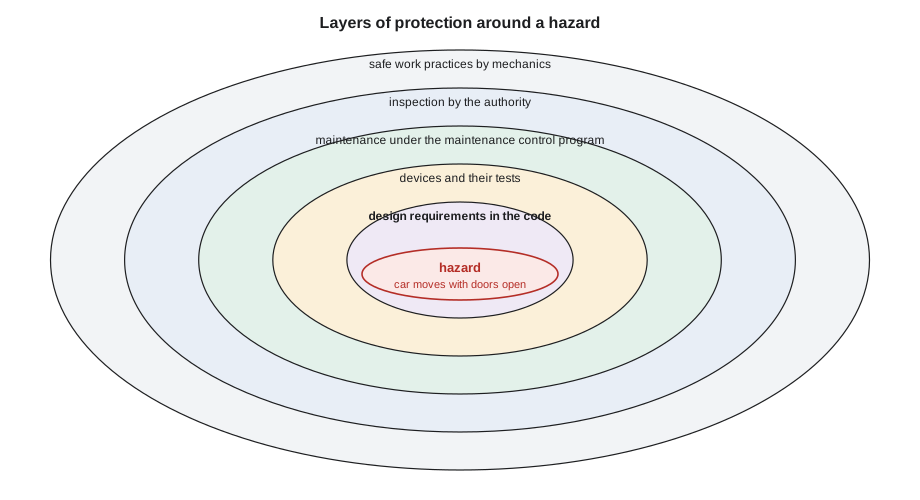
Moira's first evening was a tour of the hazards and the defenses built against them. Door interlocks keep a car from running unless the hoistway door at its landing is closed and locked, and keep a hoistway door from opening unless the car is there. Safeties and governors stop a car that overspeeds downward; ascending car overspeed and unintended movement protection stop a car that runs away upward or creeps away from a landing with its doors open. Buffers and terminal stopping devices protect the ends of the hoistway. Refuge spaces in the pit and on the car top give a mechanic somewhere to survive if the car moves unexpectedly. Firefighters' emergency operation keeps passengers out of a fire and gives firefighters control. Each of these is a family of clauses in the code, and each has appeared in earlier courses.
Who uses the code
Many people use the same book for different purposes. Architects and engineers use it to lay out hoistways, pits, overheads and machine rooms before a building is built, because the space an elevator needs is fixed early and is expensive to change later. Elevator makers use it to design machines, controllers, safeties and doors that will be accepted everywhere the code is adopted. Installers use it when they set rails, buffers and machines and when they run acceptance tests. Maintenance mechanics use it every day, because the code tells them what each device must do and how it must be tested. Inspectors use it, together with the inspection guide, to decide whether equipment may be put in service. Owners rely on it, often without reading it, through the permits, certificates and maintenance contracts that the code makes necessary.
For a mechanic, the code is not only a list of rules for new installations. It also governs the work you do on existing equipment: Part 8 covers maintenance, repair, replacement, alteration, acceptance and periodic tests and inspections, and those clauses apply to every visit you make to a site. When Tamsin replaced ropes at Tillicum, set the governor tripping speed at Larchmont, or adjusted door closing force at Quayside, she was working to requirements in the code whether or not she had the clause open in front of her.
How the code is written
Code requirements are written as mandatory statements, using the word “shall”: the car shall be provided with a car door; the pit shall be provided with a stop switch. Anything the code does not require is outside its scope, and anything it says only “should” or places in a nonmandatory appendix is guidance, not a requirement, unless a regulation makes it mandatory. Definitions matter: Section 1.3 defines several hundred terms, and many arguments about what the code requires come down to a definition, such as the difference between a repair, a replacement and an alteration, which lesson 11 covers. Requirements often have exceptions written into the clause itself, and reading a clause without its exceptions, or without the definitions of its terms, is the most common way to misread the code.
The code is mostly prescriptive: it tells you what to build, such as a minimum dimension, a minimum factor of safety or a required device. Some requirements are performance based: they say what a device must achieve, such as stopping a car within a range of decelerations, and leave the method to the designer. A separate standard, ASME A17.7/CSA B44.7, allows new designs that do not fit the prescriptive rules to be accepted through a risk-based process and certification, which is how some new machine and suspension technologies first reached the market. Most of what a mechanic meets is the prescriptive text.
| Word or feature | What it means in the code |
|---|---|
| shall | a mandatory requirement |
| should, or a nonmandatory appendix | guidance; not required unless a regulation adopts it |
| exception | a stated case where the requirement does not apply, written into the clause |
| definition (Section 1.3) | the meaning of a term wherever it appears in the code |
| reference to another standard | that standard applies to the extent the clause says |
| note | explanation; not a requirement |
The family of standards
The elevator code has relatives, and a mechanic should know what each covers. A companion inspection guide, ASME A17.2, describes how inspectors and testers carry out the inspections and tests the code requires; it is the book that tells you how a full-load safety test is run and what is checked on a car top. ASME A17.3 is a safety code for existing elevators and escalators, setting minimum upgrades for old equipment where a jurisdiction adopts it. A suspension standard, A17.6, covers steel wire ropes, coated belts and other suspension means. An electrical equipment standard, ASME A17.5/CSA B44.1, covers the certification of controllers and other electrical parts. Platform lifts and stairway chairlifts fall under ASME A18.1 rather than the elevator code. Building codes, fire codes and the National Electrical Code govern the building and wiring around the elevator, and accessibility standards set what the car and the controls must provide for people with disabilities. Which of these apply on a given job depends on what the jurisdiction has adopted.
# A small index from hazards to the code sections that address them (section titles paraphrased)
index = {
    "falling into an open hoistway": ["2.11 protection of hoistway openings", "2.12 locking devices"],
    "car moving with doors open": ["2.12 interlocks", "2.19 unintended movement protection", "2.26 control and operating circuits"],
    "car overspeed downward": ["2.17 car and counterweight safeties", "2.18 speed governors"],
    "car overspeed upward": ["2.19 ascending car overspeed protection"],
    "striking the end of travel": ["2.22 buffers", "2.25 terminal stopping devices"],
    "mechanic crushed in pit or on car top": ["2.2 pits", "2.4 clearances, runbys and refuge spaces", "2.26 inspection operation"],
    "smoke and fire": ["2.27 emergency operation and signaling devices", "2.8 equipment in hoistways"],
    "passenger trapped": ["2.27 emergency communication", "8.6 maintenance and repair"],
}
for hazard in ("car moving with doors open", "mechanic crushed in pit or on car top", "car overspeed upward"):
    print(f"{hazard}:")
    for sec in index[hazard]:
print(f" see {sec}")car moving with doors open:
see 2.12 interlocks
see 2.19 unintended movement protection
see 2.26 control and operating circuits
mechanic crushed in pit or on car top:
see 2.2 pits
see 2.4 clearances, runbys and refuge spaces
see 2.26 inspection operation
car overspeed upward:
see 2.19 ascending car overspeed protectionThe section numbers in Tamsin's index are the ones the electric elevator part of the code uses; the hydraulic part and the escalator part have their own numbering for the same ideas, and many hydraulic and special-application clauses refer back to Part 2 rather than repeating it. Building such an index is a good way to learn the book: the same few sections come up again and again.
The code and the maker's instructions
The code sets minimums, but it does not tell you everything. For most modern equipment it requires the maker to provide maintenance, examination and test procedures, and the owner's maintenance control program, covered in ELV-420, must follow them. Where the maker's instructions are stricter than the code, follow the instructions. Where the code is stricter, the code governs. Where they conflict, stop and ask: in Moira's experience, an apparent conflict is usually a misreading of one or the other. The code also does not replace safe work practices, the employer's procedures or the occupational health and safety rules covered in ELV-110; it is written mainly about the equipment, not about how a mechanic works on it.
The code is not a design textbook either. It does not tell a designer how big the hoistway should be for good service, how many cars a building needs, or how to make a ride comfortable; it sets the minimum for safety and leaves the rest to engineering. That is why two fully code-compliant elevators can perform very differently.
Tamsin's study plan
Moira gave the class a study method that Tamsin copied into the front of her notebook. Read the scope and purpose sections first, and the definitions of any term you are not sure of. Use the index and the table of contents to find the section, then read the whole clause, including its exceptions, and follow every cross-reference it makes. Note which edition you are reading and which edition applies to the equipment, because they are often different. Write down the clause number with every finding, so that anyone can check your reading. And when you are not sure, ask the authority having jurisdiction for an interpretation rather than guessing; interpretations are part of the record, and an interpretation on file is worth far more than an argument on site.
Worked problem
Finding the hazard behind a requirement
A new apprentice asks Tamsin why the code requires a pit stop switch that can be reached from the pit access door before anyone climbs down the ladder.
Show solution
- The hazard is a mechanic in the pit when the car moves down, the crushing hazard covered by the pit and refuge space requirements.
- A stop switch inside the pit is useless if the mechanic must climb into the pit to reach it, because the car could move while they are on the ladder.
- Placing the switch within reach of the access opening lets the mechanic stop the car before entering the pit.
- The requirement is one layer; locking out the controller and placing the car on inspection operation are others, from safe work practice.
Answer: The switch location protects the mechanic during the most exposed moment, entering the pit; it works together with lockout and inspection operation.
Common mistakes
MistakeTreating the code book as the law.
InsteadThe code becomes law only when adopted; the regulation and the authority having jurisdiction decide what applies.
MistakeReading a clause without its exceptions or definitions.
InsteadRead the whole clause, its exceptions and the definitions of its terms.
MistakeAssuming the newest edition applies to every elevator.
InsteadEquipment is usually held to the edition in force when it was installed or altered; check which applies.
MistakeTreating a nonmandatory appendix as a requirement.
InsteadAppendix guidance is not required unless a regulation adopts it.
MistakeIgnoring the maker's instructions because the code is satisfied.
InsteadThe code sets minimums; maintenance must follow the maker's procedures as well.
Summary and key terms
- The elevator code is a harmonized consensus standard published as CSA B44 and ASME A17.1, setting minimum requirements for elevators, escalators and related equipment.
- It becomes enforceable when a jurisdiction adopts it, and an authority having jurisdiction applies and interprets it.
- Its requirements answer known hazards: falls, shearing and crushing, uncontrolled car movement, fire and entrapment.
- Requirements use shall; appendices and notes are guidance; definitions and exceptions are part of every clause.
- Related standards cover inspection, existing equipment, suspension means, electrical equipment, platform lifts and performance-based acceptance.
- Mechanics use the code for every visit, through Part 8's maintenance, repair, alteration and test requirements.
- Consensus standard
- A standard written by a balanced committee of interested parties and revised on a regular cycle.
- Harmonized code
- One code text published jointly as CSA B44 and ASME A17.1, with a few clauses flagged for Canadian jurisdictions.
- Adoption
- The legal act by which a government makes an edition of a standard enforceable.
- Authority having jurisdiction
- The body that enforces the adopted code, issues permits and inspects.
- Nonmandatory appendix
- Guidance in the code that is not required unless adopted.
- Performance-based requirement
- A requirement that states what must be achieved rather than how.
Practice problems
Work each problem on paper first, then reveal the answer to check.
Name three hazards the elevator code protects against.
Show answer
Falling into an open hoistway, a car moving with its doors open, and a mechanic being crushed in a pit; others include overspeed, fire and entrapment.
Is a nonmandatory appendix enforceable?
Show answer
Not unless a regulation adopts it.
Which part of the code covers maintenance, repair and alteration?
Show answer
Part 8.
What standard covers platform lifts?
Show answer
ASME A18.1; they are not covered by the elevator code.
Why should every finding carry a clause number?
Show answer
So anyone can check the reading against the code and the edition that applies.
Lesson quiz · 5 questions
Score 60% or more to complete this lesson.
Create a free account to save your progress, take quizzes and earn a certificate.