
CMP-420 · Lesson 2 of 12 · 36 min
Classical cryptography and the foundations of modern cryptography
Cryptography is the study of techniques for secure communication in the presence of adversaries. For most of its history it meant encryption: turning a readable plaintext into an unreadable ciphertext so that only someone holding a key can recover the plaintext. Today it also covers integrity, authentication, digital signatures, key agreement and much more, and it underpins nearly every other control in this course. This lesson looks at classical ciphers, not because anyone should use them, but because the ways they were broken teach the ideas that shape modern design: key space, statistical structure, the need for randomness, perfect secrecy and Kerckhoffs' principle. Lessons 3 to 6 then build the modern toolbox.
A word on scope. CMPUT-272 introduced modular arithmetic and a toy RSA example, and CISSP-112 surveys cryptography for security managers, including algorithm choices and key management policy. Here we focus on how the mechanisms work and why particular designs fail, and we write small programs that break classical ciphers so that the weaknesses are concrete rather than asserted.
The vocabulary of cryptography
An encryption scheme has three algorithms: key generation, which produces a key; encryption \( E_k(m) = c \), which maps a plaintext \( m \) to a ciphertext \( c \) under key \( k \); and decryption \( D_k(c) = m \), which inverts it. In symmetric cryptography the same key encrypts and decrypts, so both parties must share it in advance. In asymmetric or public-key cryptography, Lesson 5, a public key encrypts or verifies and a separate private key decrypts or signs. Cryptanalysis is the study of breaking schemes. Attacks are classified by what the attacker has: ciphertext only, known plaintext (some plaintext–ciphertext pairs), chosen plaintext (the attacker can obtain encryptions of messages of their choice) and chosen ciphertext (the attacker can also obtain decryptions of chosen ciphertexts, except the target). Modern schemes are expected to resist the strongest of these, because real systems routinely give attackers such abilities: a web server encrypts whatever a client sends, and an error message can leak whether a ciphertext decrypted correctly.
Shift and substitution ciphers
The Caesar cipher replaces each letter with the one three places later in the alphabet. Generalized to any shift, it has only 26 keys, so an attacker simply tries them all. This is brute force, or exhaustive key search, and it reminds us of the first requirement of any cipher: the key space must be too large to search.
import string
A = string.ascii_lowercase
def shift(text, k):
    return ''.join(A[(A.index(c) + k) % 26] if c in A else c for c in text)

secret = shift("meet at the library at noon", 3)
print("ciphertext:", secret)
# Brute force: only 26 keys, so try them all and let a human (or a dictionary) spot English
for k in range(26):
    guess = shift(secret, -k)
    if all(w in {"meet", "at", "the", "library", "noon"} for w in guess.split()):
print(f"key {k:2d} gives: {guess}")ciphertext: phhw dw wkh oleudub dw qrrq key 3 gives: meet at the library at noon
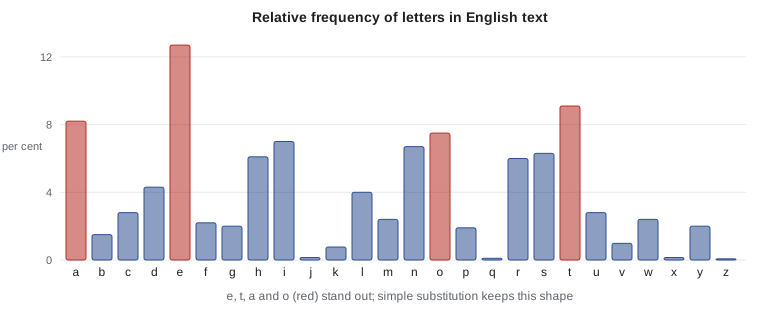
A simple substitution cipher maps each letter to an arbitrary other letter, giving \( 26! \approx 4 \times 10^{26} \) keys, about 88 bits. Brute force is hopeless, yet these ciphers are solved by hand in newspaper puzzle columns. The reason is that substitution preserves the statistics of the language. In English, e is the most common letter (about 12.7 percent of letters), followed by t, a and o; th and he are the most common pairs; and words like the, and and of recur constantly. The Arab scholar al-Kindi described frequency analysis in the ninth century. Count the ciphertext letters, match the most frequent ones to e, t and a, and use common words and pairs to fill in the rest. A large key space is necessary but not sufficient: the cipher must also hide the structure of the plaintext.
Polyalphabetic ciphers and how Vigenère fell
The Vigenère cipher, described by Giovan Battista Bellaso in 1553 and later misattributed to Blaise de Vigenère, uses a keyword to choose a different shift for each position: with key lemon, the first letter is shifted by l (11), the second by e (4), and so on, repeating every five letters. A given plaintext letter encrypts to several different ciphertext letters, which flattens the frequency counts, and the cipher was called le chiffre indéchiffrable for three centuries. Charles Babbage and, independently, Friedrich Kasiski broke it in the nineteenth century. The weakness is the repeating key. If the key length is \( L \), then letters \( L \) positions apart were shifted by the same amount, so splitting the ciphertext into \( L \) columns gives \( L \) separate Caesar ciphers, each solvable by frequency analysis.
To find \( L \), we use William Friedman's index of coincidence: the probability that two letters drawn at random from a text are equal, \( IC = \sum_i n_i(n_i - 1) / (N(N-1)) \). For English it is about 0.066; for uniformly random letters it is \( 1/26 \approx 0.038 \). When we guess the right key length, every column is English shifted by a constant, so its index of coincidence is close to 0.066; wrong guesses mix shifts and look random. Then for each column we choose the shift whose decryption best matches English letter frequencies, measured with the chi-squared statistic \( \chi^2 = \sum (O - E)^2 / E \). The program below does exactly this on a paragraph encrypted with the key lemon, with no knowledge of the key.
import string
EN = {'a':8.2,'b':1.5,'c':2.8,'d':4.3,'e':12.7,'f':2.2,'g':2.0,'h':6.1,'i':7.0,'j':0.15,'k':0.77,'l':4.0,'m':2.4,
      'n':6.7,'o':7.5,'p':1.9,'q':0.095,'r':6.0,'s':6.3,'t':9.1,'u':2.8,'v':0.98,'w':2.4,'x':0.15,'y':2.0,'z':0.074}
A = string.ascii_lowercase
def clean(t): return ''.join(c for c in t.lower() if c in A)
def vig(text, key, sign=1):
    return ''.join(A[(A.index(c) + sign * A.index(key[i % len(key)])) % 26] for i, c in enumerate(text))
def ioc(s):
    n = len(s); return sum(s.count(c) * (s.count(c) - 1) for c in A) / (n * (n - 1))
def chi(s):
    n = len(s); return sum((s.count(c) - n * EN[c] / 100) ** 2 / (n * EN[c] / 100) for c in A)
plain = clean("""Every winter the students in the computing club run a puzzle hunt across the campus. Teams follow
clues hidden in the library, the engineering building and the student union, and each clue is protected by a
cipher that the organizers believe is unbreakable. This year the organizers chose an old method that was called
the indecipherable cipher for three hundred years, because it hides the frequency of each letter by shifting it
by a different amount depending on its position. The teams quickly learned that the method is anything but
indecipherable once you have enough text, because the shifts repeat with the length of the keyword and each
column of letters behaves like a simple shift cipher that can be solved by counting letters.""")
ct = vig(plain, "lemon")
print("ciphertext starts:", ct[:40])
for L in range(1, 9):
    cols = [ct[i::L] for i in range(L)]
    print(f"key length {L}: mean index of coincidence {sum(map(ioc, cols)) / L:.4f}")
L = max(range(1, 9), key=lambda L: sum(map(ioc, [ct[i::L] for i in range(L)])) / L - 0.002 * L)
key = ''.join(min(A, key=lambda k: chi(vig(ct[i::L], k, -1))) for i in range(L))
print("best key length:", L, " recovered key:", key)
print("plaintext starts:", vig(ct, key, -1)[:40])ciphertext starts: pzqflhmzhrcxtsfeypsaewubgsioczayfwargxio key length 1: mean index of coincidence 0.0433 key length 2: mean index of coincidence 0.0446 key length 3: mean index of coincidence 0.0441 key length 4: mean index of coincidence 0.0433 key length 5: mean index of coincidence 0.0676 key length 6: mean index of coincidence 0.0444 key length 7: mean index of coincidence 0.0444 key length 8: mean index of coincidence 0.0434 best key length: 5 recovered key: lemon plaintext starts: everywinterthestudentsinthecomputingclub
The key length of 5 stands out clearly, with a mean index of coincidence near the English value, and frequency analysis on each column recovers the key. The lesson generalizes: any cipher that leaves a detectable statistical relationship between plaintext and ciphertext can eventually be broken given enough ciphertext. Mechanical cipher machines of the twentieth century, such as the German Enigma, were vastly more complex polyalphabetic ciphers, and they too fell to statistical attacks combined with operator mistakes and known plaintext (cribs), a story in which Polish mathematicians, then British codebreakers at Bletchley Park, played the leading roles.
Kerckhoffs' principle
In 1883 Auguste Kerckhoffs set out requirements for military ciphers. The most famous is that the system must not require secrecy and should be able to fall into enemy hands without inconvenience. In modern terms: assume the adversary knows every detail of your algorithm, and let security depend only on the secrecy of the key. Claude Shannon put it as the enemy knows the system. There are three reasons. Algorithms leak, through reverse engineering, defectors, stolen documents and published patents. Keys are small and easy to change, whereas a compromised algorithm must be replaced everywhere. And public algorithms receive scrutiny from cryptanalysts worldwide, which is the only reliable way to gain confidence in them. The history of proprietary ciphers broken shortly after their designs were revealed, from the DVD Content Scramble System to early mobile phone and car-key ciphers, is long. The modern standards in this course, AES, SHA-2, SHA-3, RSA and the elliptic-curve and post-quantum schemes, were all chosen in open processes.
Perfect secrecy and the one-time pad
In 1949 Shannon gave a mathematical definition of perfect secrecy: a cipher is perfectly secret if seeing the ciphertext gives the attacker no information at all about the plaintext, that is, \( \Pr[M = m \mid C = c] = \Pr[M = m] \) for every message and ciphertext. He proved that the one-time pad achieves it: XOR the message with a truly random key of the same length, \( c = m \oplus k \), and never reuse the key. Because every possible plaintext of that length corresponds to exactly one key, every plaintext is equally consistent with the ciphertext. He also proved the price: perfect secrecy requires a key at least as long as the message, with as much entropy as the messages themselves.
import secrets
def xor(a, b): return bytes(x ^ y for x, y in zip(a, b))

m1 = b"TRANSFER 100 TO ALEX"
key = secrets.token_bytes(len(m1))            # truly random, as long as the message, used ONCE
c1 = xor(m1, key)
print("decrypts correctly:", xor(c1, key) == m1)

# Perfect secrecy: for ANY other message of the same length there is a key that maps c1 to it
m_fake = b"TRANSFER 900 TO EVE "
k_fake = xor(c1, m_fake)
print("a different key turns c1 into:", xor(c1, k_fake))

# Reusing the pad ("two-time pad") destroys the guarantee
m2 = b"MEET AT GATE 5 TODAY"
c2 = xor(m2, key)
leak = xor(c1, c2)                             # the key cancels out: c1 XOR c2 = m1 XOR m2
print("c1 XOR c2 equals m1 XOR m2:", leak == xor(m1, m2))
# An attacker who guesses part of one message ("TRANSFER") learns the same part of the other
print("crib 'TRANSFER' reveals:", xor(leak[:8], b"TRANSFER"))decrypts correctly: True a different key turns c1 into: b'TRANSFER 900 TO EVE ' c1 XOR c2 equals m1 XOR m2: True crib 'TRANSFER' reveals: b'MEET AT '
The two-time pad failure is not hypothetical. In the 1940s Soviet cipher clerks under wartime pressure reused pages of one-time pad material, and the United States Venona project exploited the reuse to read thousands of messages. The same mistake recurs in modern form whenever a stream cipher or counter-mode encryption reuses a key and nonce pair, which Lesson 3 demonstrates. The one-time pad's key-distribution burden makes it impractical for almost everything, so modern cryptography settles for computational security: schemes that no attacker with realistic computing power can break with more than negligible probability.
Computational security and key length
A modern cipher with a \( k \)-bit key should offer about \( k \) bits of security, meaning the best known attack costs about \( 2^k \) operations, no better than brute force. We measure security in bits because each extra bit doubles the work. The Data Encryption Standard (DES), adopted in 1977 with a 56-bit key, was broken by brute force in 1998 when the Electronic Frontier Foundation built a dedicated machine that searched the key space in days. Today, 128 bits is the baseline for symmetric keys and 256 bits is used where long-term or post-quantum margins are wanted, because Grover's quantum search algorithm could in principle reduce brute-force cost to about \( 2^{k/2} \).
import math
# Time to search a key space at one trillion (10^12) guesses per second
rate = 1e12
year = 365.25 * 24 * 3600
for name, size in [("Caesar shift", 26),
                   ("Simple substitution (26!)", math.factorial(26)),
                   ("8-character password, 95 printable chars", 95 ** 8),
                   ("56-bit DES key", 2 ** 56),
                   ("128-bit AES key", 2 ** 128)]:
    secs = size / 2 / rate                       # on average the key is found halfway through
    bits = math.log2(size)
    if secs < 1:
        t = f"{secs:.1e} s"
    elif secs < year:
        t = f"{secs / 3600:,.1f} hours"
    else:
        t = f"{secs / year:.2e} years"
print(f"{name:<42} {bits:6.1f} bits average search {t}")Caesar shift 4.7 bits average search 1.3e-11 s Simple substitution (26!) 88.4 bits average search 6.39e+06 years 8-character password, 95 printable chars 52.6 bits average search 0.9 hours 56-bit DES key 56.0 bits average search 10.0 hours 128-bit AES key 128.0 bits average search 5.39e+18 years
A trillion guesses per second is a rough figure for a well-resourced attacker against a fast cipher; dedicated hardware can go faster, but the point stands: 128-bit keys are beyond brute force by a margin of many orders of magnitude, while human passwords are not, which is why Lesson 4 stores passwords with deliberately slow hash functions. Security bits also depend on the algorithm: the best attacks on 2048-bit RSA cost about \( 2^{112} \) operations, so RSA needs much longer keys than AES for comparable strength, a theme of Lesson 5.
Randomness
Every key, nonce and salt in this course must be unpredictable to an attacker. Computers are deterministic, so they gather entropy from unpredictable physical events, such as interrupt timing and dedicated hardware noise sources, and feed it to a cryptographically secure pseudorandom number generator (CSPRNG) in the operating system. In Python, the secrets module and os.urandom draw from it; the random module does not, because it uses the Mersenne Twister, whose entire internal state can be reconstructed from 624 consecutive 32-bit outputs, after which every future value is predictable. Weak randomness has broken real systems: a 2008 Debian change reduced OpenSSL's key generation to about 32,768 possible keys per architecture, and studies of internet devices have found many RSA keys sharing prime factors because they were generated at boot before enough entropy was available.
Worked problem
Estimating a substitution-cipher solving effort
An attacker has 300 letters of ciphertext from a simple substitution cipher. Why is the 88-bit key space irrelevant, and roughly how would they proceed?
Show solution
- Brute force over 26! keys is impossible, but the attacker does not need it: the cipher maps each plaintext letter to one fixed ciphertext letter, so letter frequencies carry over.
- Count the 300 letters. The most frequent ciphertext letter is very probably e (about 38 occurrences expected), the next ones t, a, o; a three-letter word that recurs is probably the.
- Fix the confident letters, read partial words, and refine; each confirmed word fixes more letters. With 300 letters this typically takes minutes by hand and milliseconds by program (hill-climbing over keys scored by English pair frequencies).
Answer: The key space is large but the statistics leak: frequency analysis solves the cipher without searching keys. Key space size is necessary for security, not sufficient.
Worked problem
Is a 10-letter keyword Vigenère safe for a 20-letter message?
A student argues that Vigenère with a random 10-letter key cannot be broken when the message is only 20 letters long. Evaluate the claim.
Show solution
- With 20 letters and key length 10, each column has only 2 letters, far too few for frequency analysis.
- But the key is reused twice: the two halves are encrypted with the same key, so subtracting them cancels the key and gives the difference of the two plaintext halves, the same leak as a two-time pad.
- Guessing likely words (cribs) in one half then reveals the matching letters of the other. If the key were truly random and as long as the message (20 letters) and never reused, it would be a one-time pad and perfectly secret.
Answer: The claim is too strong. Short messages resist statistical attacks, but key reuse still leaks plaintext relationships; only a never-reused random key as long as the message gives perfect secrecy.
Worked problem
Choosing a random source
A web developer generates password reset tokens with random.randint(0, 10**6). Identify two problems and fix the code.
Show solution
- The space is only one million values, about 20 bits, which an attacker can enumerate online if guesses are not limited, or offline if tokens are stored unhashed.
- The random module is not cryptographically secure; an attacker who sees enough tokens can predict future ones.
- Use token = secrets.token_urlsafe(32), which gives 256 bits from the operating system CSPRNG; store only a hash of the token, give it a short expiry and allow one use.
Answer: Replace random.randint with secrets.token_urlsafe(32), hash it at rest, expire it quickly and limit attempts.
Common mistakes
MistakeA huge key space means the cipher is secure.
InsteadA large key space is necessary but the cipher must also hide statistical structure; substitution ciphers have 88-bit key spaces and fall to frequency analysis.
MistakeKeeping the algorithm secret adds a strong layer of security.
InsteadFollow Kerckhoffs' principle: assume the algorithm is known and rely on key secrecy and public scrutiny.
MistakeThe one-time pad is safe as long as the key is random.
InsteadThe key must also be as long as the message and never reused; reuse leaks the XOR of messages.
MistakePython's random module is fine for keys if seeded with the time.
InsteadUse the secrets module or os.urandom; Mersenne Twister output is predictable and time seeds are guessable.
MistakeMore rounds of an old cipher make it modern.
InsteadUse standard, analyzed algorithms such as AES; ad hoc strengthening rarely fixes structural weaknesses.
Summary and key terms
- Encryption schemes consist of key generation, encryption and decryption; attacks range from ciphertext-only to chosen-ciphertext.
- Shift ciphers fall to brute force; substitution ciphers fall to frequency analysis despite huge key spaces.
- Vigenère is broken by finding the key length with the index of coincidence and solving each column as a shift cipher.
- Kerckhoffs' principle: security must rest on the key, not on secrecy of the algorithm.
- The one-time pad is perfectly secret but needs a random key as long as the message, used once; key reuse is catastrophic.
- Modern cryptography aims for computational security, measured in bits; 128-bit symmetric keys are beyond brute force.
- Keys, nonces and salts must come from a cryptographically secure random number generator.
- Plaintext
- The readable message before encryption.
- Ciphertext
- The encrypted form of a message.
- Brute force
- Trying every possible key until the right one is found.
- Frequency analysis
- Breaking a cipher by matching symbol frequencies to those of the language.
- Index of coincidence
- The probability that two randomly chosen letters of a text are the same.
- Kerckhoffs' principle
- A cryptosystem should be secure even if everything except the key is public.
- Perfect secrecy
- The ciphertext reveals no information about the plaintext.
- One-time pad
- XOR with a truly random, single-use key as long as the message.
- Computational security
- Security against attackers with realistic, bounded computing power.
- CSPRNG
- A cryptographically secure pseudorandom number generator whose output cannot be predicted.
Practice problems
Work each problem on paper first, then reveal the answer to check.
Decrypt the Caesar ciphertext "dwwdfn" with shift 3.
Show answer
attack.
Why does a simple substitution cipher preserve the index of coincidence of the plaintext?
Show answer
It permutes letter labels without changing their counts, so the sum of n(n-1) is unchanged.
A ciphertext has an index of coincidence of 0.039. What does that suggest?
Show answer
The text looks random: a polyalphabetic cipher with a long key, a modern cipher, or random data, not a simple substitution.
What are the four attack models, from weakest to strongest attacker?
Show answer
Ciphertext only, known plaintext, chosen plaintext, chosen ciphertext.
How many bits of security does a 40-bit key give, and why was 40 bits used in the 1990s?
Show answer
About 40 bits; US export rules limited exported cryptography to 40-bit keys, which were brute-forced quickly.
Two messages are encrypted with the same one-time pad. What does an attacker learn without the key?
Show answer
The XOR of the two plaintexts, from which partial guesses reveal parts of both.
State Shannon's requirement on key length for perfect secrecy.
Show answer
The key space must be at least as large as the message space, so keys at least as long as messages.
Why is 2^128 considered secure while 2^56 is not?
Show answer
Each bit doubles the work; 2^56 is searchable in hours with modern hardware, while 2^128 would take far longer than the age of the universe.
Name one source of entropy an operating system uses.
Show answer
Interrupt and device timing jitter, or a hardware random number generator.
What does Grover's algorithm imply for symmetric key lengths?
Show answer
It could reduce brute force to about 2^(k/2), so 256-bit keys give a comfortable post-quantum margin.
Lesson quiz · 5 questions
Score 60% or more to complete this lesson.
Create a free account to save your progress, take quizzes and earn a certificate.