
CMP-250 · Lesson 11 of 12 · 29 min
Counting and number theory for computing
Two branches of discrete mathematics are used constantly in computing. Combinatorics counts things: how many passwords of a given form exist, how many ways a test suite can be ordered, how many subsets an algorithm might examine. Number theory studies the integers, and its modular arithmetic underlies hashing, checksums, random number generators and public-key cryptography. This lesson introduces both, ending with a toy version of RSA. MATH-260 (Discrete Mathematics) and MATH-351 (Number Theory) go much further.
The sum and product rules
Two rules underlie nearly all counting. The sum rule: if a task can be done in one of \(m\) ways or in one of \(n\) other ways, with no overlap, there are \(m + n\) ways. The product rule: if a task consists of a first step with \(m\) choices followed by a second step with \(n\) choices, regardless of the first choice, there are \(mn\) ways. The product rule is the counting form of \(|A \times B| = |A||B|\) from lesson 7, and the sum rule is \(|A \cup B| = |A| + |B|\) for disjoint sets.
Worked problem
Counting passwords
A system requires passwords of length 8 using lowercase letters (26), uppercase letters (26) and digits (10). How many passwords are possible, and how many contain at least one digit?
Show solution
- Each position has 26 + 26 + 10 = 62 choices (sum rule).
- Eight positions give 62⁸ ≈ 2.18 × 10¹⁴ passwords (product rule).
- Passwords with no digit: 52⁸ ≈ 5.35 × 10¹³.
- At least one digit = total − none = 62⁸ − 52⁸ ≈ 1.65 × 10¹⁴.
Answer: About 2.18 × 10¹⁴ in total and 1.65 × 10¹⁴ with a digit. Counting the complement is often easier than counting directly.
total = 62 ** 8
no_digit = 52 ** 8
print(f"total:            {total:,}")
print(f"at least 1 digit: {total - no_digit:,}")
rate = 10 ** 10                 # guesses per second, an illustrative offline attack rate
print(f"exhaustive search at 10^10 guesses/s: {total / rate / 3600:.1f} hours")
print(f"length 12 instead: {62 ** 12 / rate / (3600 * 24 * 365):,.0f} years")total: 218,340,105,584,896 at least 1 digit: 164,880,377,053,440 exhaustive search at 10^10 guesses/s: 6.1 hours length 12 instead: 10,230 years
Permutations
A permutation is an ordered arrangement. The number of ways to arrange \(n\) distinct objects in a row is \(n! = n(n-1)(n-2)\cdots 1\), by the product rule: \(n\) choices for the first position, \(n - 1\) for the second, and so on. The number of ways to choose and arrange \(r\) of \(n\) objects is
Factorials grow astonishingly fast. There are \(10! = 3,628,800\) orders for 10 tasks, and \(20! \approx 2.4 \times 10^{18}\) orders for 20. An algorithm that tries every ordering, such as a brute-force solution to the traveling salesperson problem, becomes useless beyond a few dozen items.
Combinations
A combination is an unordered selection. The number of ways to choose \(r\) objects from \(n\), read n choose r, is
The formula comes from dividing permutations by the \(r!\) orders in which each selection could be arranged. Choosing a 5-card hand from 52 cards gives \(\binom{52}{5} = 2,598,960\) hands. A useful identity is \(\binom{n}{r} = \binom{n}{n-r}\): choosing which \(r\) to take is the same as choosing which \(n - r\) to leave.
from math import comb, perm, factorial
from itertools import combinations, permutations
print("P(5,3) =", perm(5, 3), " = len(permutations):", len(list(permutations("abcde", 3))))
print("C(5,3) =", comb(5, 3), " = len(combinations):", len(list(combinations("abcde", 3))))
print("C(52,5) =", f"{comb(52, 5):,}")
print("20! =", f"{factorial(20):,}")
print("C(10,3) == C(10,7):", comb(10, 3) == comb(10, 7))P(5,3) = 60 = len(permutations): 60 C(5,3) = 10 = len(combinations): 10 C(52,5) = 2,598,960 20! = 2,432,902,008,176,640,000 C(10,3) == C(10,7): True
| Situation | Order matters? | Repetition? | Count |
|---|---|---|---|
| Arrange all n objects | Yes | No | n! |
| Choose and arrange r of n | Yes | No | n!/(n − r)! |
| Choose r of n | No | No | C(n, r) |
| Strings of length r from n symbols | Yes | Yes | nʳ |
| Choose r of n kinds, repeats allowed | No | Yes | C(n + r − 1, r) |
Worked problem
Choosing the formula
A project team of 4 is chosen from 10 developers, and then one of the 4 is named lead. How many outcomes are there? Count it two ways.
Show solution
- Method 1: choose the team, C(10, 4) = 210, then the lead, 4 ways: 210 × 4 = 840.
- Method 2: choose the lead first, 10 ways, then the other 3 from the remaining 9, C(9, 3) = 84: 10 × 84 = 840.
- The two counts agree.
Answer: 840. Counting the same set in two ways is a classic proof technique: it proves the identity 4 · C(10, 4) = 10 · C(9, 3).
The binomial theorem and Pascal's triangle
The numbers \(\binom{n}{r}\) are called binomial coefficients because they appear when \((x + y)^n\) is expanded. Each term of the expansion picks \(x\) or \(y\) from each of the \(n\) factors, and the number of ways to pick \(y\) exactly \(r\) times is \(\binom{n}{r}\).
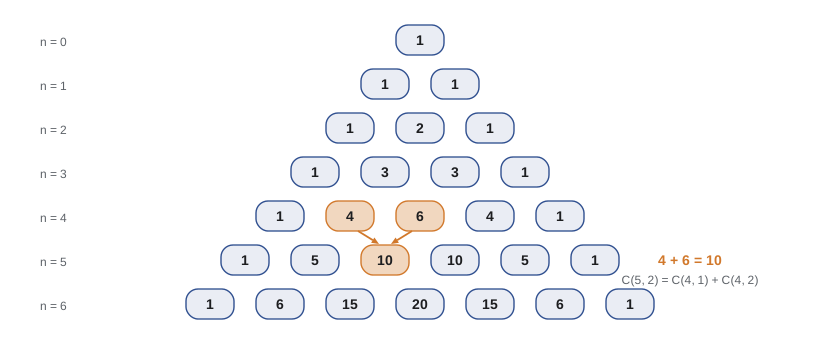
Setting \(x = y = 1\) gives \(\sum_r \binom{n}{r} = 2^n\), which is the power set count of lesson 7 in another form: subsets of an \(n\)-element set, grouped by size. Pascal's identity, \(\binom{n}{r} = \binom{n-1}{r-1} + \binom{n-1}{r}\), says that a subset of size \(r\) either contains a particular element (choose the other \(r - 1\) from the rest) or does not (choose all \(r\) from the rest). It generates Pascal's triangle, where each entry is the sum of the two above it.
row = [1]
for n in range(8):
    print(f"n={n}: " + " ".join(f"{x:3d}" for x in row).center(40), " sum =", sum(row))
row = [1] + [row[i] + row[i + 1] for i in range(len(row) - 1)] + [1]n=0: 1 sum = 1 n=1: 1 1 sum = 2 n=2: 1 2 1 sum = 4 n=3: 1 3 3 1 sum = 8 n=4: 1 4 6 4 1 sum = 16 n=5: 1 5 10 10 5 1 sum = 32 n=6: 1 6 15 20 15 6 1 sum = 64 n=7: 1 7 21 35 35 21 7 1 sum = 128
Divisibility, primes and the greatest common divisor
Number theory begins with the division algorithm: for integers \(a\) and \(d > 0\), there are unique integers \(q\) (the quotient) and \(r\) (the remainder) with \(a = dq + r\) and \(0 \le r < d\). In Python, q = a // d and r = a % d, and Python's % always returns a non-negative remainder for positive \(d\), even when \(a\) is negative: -7 % 3 is 2, because \(-7 = 3 \cdot (-3) + 2\). Some languages, including C, behave differently for negative numbers, a frequent source of bugs.
The greatest common divisor \(\gcd(a, b)\) is the largest integer dividing both \(a\) and \(b\). Euclid's algorithm computes it efficiently using the fact that \(\gcd(a, b) = \gcd(b, a \bmod b)\): any common divisor of \(a\) and \(b\) also divides \(a - qb = r\), and conversely. The algorithm repeats until the remainder is 0. It is one of the oldest algorithms still in daily use, and it runs in a number of steps proportional to the number of digits.
def gcd_trace(a, b):
    while b:
        print(f"gcd({a}, {b}): {a} = {b} * {a // b} + {a % b}")
        a, b = b, a % b
    return a

print("result:", gcd_trace(252, 198))
print("-7 % 3 =", -7 % 3, " -7 // 3 =", -7 // 3)gcd(252, 198): 252 = 198 * 1 + 54 gcd(198, 54): 198 = 54 * 3 + 36 gcd(54, 36): 54 = 36 * 1 + 18 gcd(36, 18): 36 = 18 * 2 + 0 result: 18 -7 % 3 = 2 -7 // 3 = -3
The extended Euclidean algorithm also finds integers \(s\) and \(t\) with \(sa + tb = \gcd(a, b)\), a fact known as Bézout's identity. Those coefficients are exactly what is needed to compute modular inverses, below.
Modular arithmetic
We write \(a \equiv b \pmod{n}\), read a is congruent to b modulo n, when \(n\) divides \(a - b\), that is, when \(a\) and \(b\) have the same remainder on division by \(n\). Lesson 9 showed that congruence modulo \(n\) is an equivalence relation with \(n\) classes. Its key property is that it respects addition and multiplication: if \(a \equiv b\) and \(c \equiv d \pmod{n}\), then \(a + c \equiv b + d\) and \(ac \equiv bd \pmod{n}\). So you can reduce modulo \(n\) at every step of a calculation and still get the right remainder at the end, which keeps numbers small.
This property justified the finite check in lesson 6: the remainder of \(n^2\) mod 8 depends only on the remainder of \(n\) mod 8. Clocks, days of the week, hash tables (key mod table size), checksums and the wraparound of fixed-width integers (arithmetic mod \(2^{32}\) or \(2^{64}\)) are all modular arithmetic.
Worked problem
Reducing as you go
What is the last digit of 7²⁰²⁶?
Show solution
- The last digit is the remainder mod 10. Compute powers of 7 mod 10: 7, 9 (49), 3 (343), 1 (2401), then the cycle repeats with period 4.
- 2026 = 4 × 506 + 2, so 7²⁰²⁶ = (7⁴)⁵⁰⁶ · 7² ≡ 1⁵⁰⁶ · 49 ≡ 9 (mod 10).
- Python confirms: pow(7, 2026, 10) returns 9.
Answer: The last digit is 9. Python's three-argument pow uses fast exponentiation (lesson 10) and reduces mod n at every step.
A number \(b\) is a modular inverse of \(a\) modulo \(n\) if \(ab \equiv 1 \pmod{n}\). An inverse exists exactly when \(\gcd(a, n) = 1\). For example, 3 has inverse 7 modulo 10 because \(3 \cdot 7 = 21 \equiv 1\), but 4 has no inverse modulo 10. Python 3.8 and later compute inverses with pow(a, -1, n).
def egcd(a, b):
    """Return (g, s, t) with s*a + t*b == g == gcd(a, b)."""
    if b == 0:
        return a, 1, 0
    g, s, t = egcd(b, a % b)
    return g, t, s - (a // b) * t

g, s, t = egcd(240, 46)
print(f"gcd = {g}, {s}*240 + {t}*46 = {s * 240 + t * 46}")
print("inverse of 3 mod 10:", pow(3, -1, 10), "  check:", 3 * pow(3, -1, 10) % 10)
try:
    pow(4, -1, 10)
except ValueError as e:
print("4 mod 10:", e)gcd = 2, -9*240 + 47*46 = 2 inverse of 3 mod 10: 7 check: 1 4 mod 10: base is not invertible for the given modulus
A toy RSA example
RSA, published in 1977 by Rivest, Shamir and Adleman, was the first widely used public-key cryptosystem. It lets anyone encrypt a message with a public key that only the holder of a private key can decrypt. Its mathematics uses everything in this lesson. The tiny numbers below make the arithmetic visible; real RSA uses primes hundreds of digits long, careful padding schemes and vetted libraries, and must never be implemented by hand for real use. CISSP-112 covers cryptography from a security perspective and CMPUT-331 from a computing one.
| Step | Toy value | Purpose |
|---|---|---|
| Choose primes p, q | p = 61, q = 53 | Kept secret |
| n = pq | n = 3233 | Public modulus |
| φ = (p − 1)(q − 1) | φ = 3120 | Secret; counts the residues coprime to n |
| Choose e with gcd(e, φ) = 1 | e = 17 | Public exponent |
| d = e⁻¹ mod φ | d = 2753 | Private exponent |
| Encrypt m | c = mᵉ mod n | Anyone can do this with (n, e) |
| Decrypt c | m = cᵈ mod n | Requires d |
p, q = 61, 53
n, phi = p * q, (p - 1) * (q - 1)
e = 17
d = pow(e, -1, phi)
print(f"n = {n}, phi = {phi}, e = {e}, d = {d}, e*d mod phi = {e * d % phi}")
for m in [65, 1234, 3000]:
    c = pow(m, e, n)
print(f"m = {m:4d} -> c = {c:4d} -> decrypted {pow(c, d, n)}")n = 3233, phi = 3120, e = 17, d = 2753, e*d mod phi = 1 m = 65 -> c = 2790 -> decrypted 65 m = 1234 -> c = 2183 -> decrypted 1234 m = 3000 -> c = 1780 -> decrypted 3000
Why does decryption recover \(m\)? Because \(ed \equiv 1 \pmod{\varphi}\), so \(ed = 1 + k\varphi\) for some \(k\), and Euler's theorem from number theory says \(m^{\varphi} \equiv 1 \pmod{n}\) when \(\gcd(m, n) = 1\). Then \(c^d = m^{ed} = m \cdot (m^{\varphi})^k \equiv m \pmod{n}\). Security rests on the belief that factoring \(n\) into \(p\) and \(q\) is infeasible for large \(n\); anyone who could factor \(n\) could compute \(\varphi\) and then \(d\). Large quantum computers running Shor's algorithm could factor efficiently, which is why standards bodies are moving to post-quantum algorithms.
Common mistakes
MistakeUsing permutations when order does not matter.
InsteadAsk whether rearranging a selection gives a different outcome; if not, use combinations.
MistakeAdding counts that overlap with the sum rule.
InsteadThe sum rule needs disjoint cases; otherwise use inclusion–exclusion.
MistakeAssuming -7 % 3 is negative in Python.
InsteadPython's % returns a remainder with the sign of the divisor: -7 % 3 is 2.
MistakeComputing huge powers before reducing mod n.
InsteadReduce at every step, or use pow(a, k, n).
MistakeExpecting every number to have an inverse mod n.
Insteada has an inverse mod n only when gcd(a, n) = 1.
MistakeImplementing RSA by hand for real security.
InsteadUse vetted libraries with proper padding and key sizes; toy RSA is for learning only.
Summary and key terms
- The sum rule adds counts of disjoint cases; the product rule multiplies counts of successive choices.
- n! orders n objects; P(n, r) = n!/(n − r)! arranges r of them; C(n, r) = n!/(r!(n − r)!) selects r of them.
- Binomial coefficients appear in (x + y)ⁿ, sum to 2ⁿ, and satisfy Pascal's identity.
- The division algorithm gives a unique quotient and remainder; Euclid's algorithm computes gcds quickly.
- Congruence mod n respects + and ×, so you can reduce at every step.
- a has an inverse mod n exactly when gcd(a, n) = 1; the extended Euclidean algorithm finds it.
- RSA combines primes, modular inverses and fast exponentiation; its security relies on the difficulty of factoring.
- Product rule
- If one choice has m options and the next has n, there are mn combined outcomes.
- Sum rule
- If a task can be done in m ways or in n disjoint other ways, there are m + n ways.
- Permutation
- An ordered arrangement of distinct objects.
- Combination
- An unordered selection of objects.
- Binomial coefficient
- C(n, r), the number of r-element subsets of an n-element set.
- Pascal's identity
- C(n, r) = C(n − 1, r − 1) + C(n − 1, r).
- Greatest common divisor
- The largest integer dividing two given integers.
- Congruence
- a ≡ b (mod n) when n divides a − b.
- Modular inverse
- A number b with ab ≡ 1 (mod n).
- RSA
- A public-key cryptosystem based on modular exponentiation and the difficulty of factoring.
Practice problems
Work each problem on paper first, then reveal the answer to check.
How many 4-digit PINs are there? How many with no repeated digit?
Show answer
10⁴ = 10,000; 10 × 9 × 8 × 7 = 5,040.
How many ways can 3 prizes (gold, silver, bronze) go to 12 runners?
Show answer
P(12, 3) = 1,320.
How many 3-person committees can be formed from 12 people?
Show answer
C(12, 3) = 220.
How many 8-bit strings have exactly three 1s?
Show answer
C(8, 3) = 56.
Expand (x + y)⁴.
Show answer
x⁴ + 4x³y + 6x²y² + 4xy³ + y⁴.
Compute gcd(462, 1071) with Euclid's algorithm.
Show answer
1071 = 2 × 462 + 147; 462 = 3 × 147 + 21; 147 = 7 × 21; gcd = 21.
What is 2¹⁰⁰ mod 7?
Show answer
2³ ≡ 1 mod 7 and 100 = 3 × 33 + 1, so 2¹⁰⁰ ≡ 2.
Find the inverse of 7 mod 26.
Show answer
15, since 7 × 15 = 105 = 4 × 26 + 1.
In toy RSA with p = 5, q = 11, e = 3, find n, φ and d.
Show answer
n = 55, φ = 40, d = 27 since 3 × 27 = 81 ≡ 1 mod 40.
Why must gcd(e, φ) = 1 in RSA?
Show answer
So that e has an inverse d modulo φ.
Lesson quiz · 5 questions
Score 60% or more to complete this lesson.
Create a free account to save your progress, take quizzes and earn a certificate.