
CMP-229 · Lesson 12 of 12 · 35 min
Virtual memory, input/output and parallelism
This final lesson completes the picture of the machine in three directions. Virtual memory gives every program the illusion of its own large, private address space, with hardware translating each address on every access; it is how operating systems isolate programs from one another. Input and output connect the processor to the world, through device registers, interrupts and direct memory access. Parallel hardware, from vector instructions to multicore chips, is where performance growth has come from since clock rates stalled, as lesson 1 explained. The lesson ends with a capstone that traces one C program through every layer of the course: compilation, execution, pipelining and caching.
The treatment here is from the hardware side. How an operating system chooses which pages to keep in memory, schedules processes and drives devices is the subject of CMPUT-379; how to write parallel programs well is the subject of CMPUT-450 and other courses. What this lesson provides is the mechanism those courses build on.
Why virtual memory
Every program in this course has assumed it owns memory starting at fixed addresses: text at 0x00400000, data at 0x10010000. On a real system dozens of programs run at once, each linked to use the same addresses. Virtual memory makes that possible. Each process uses virtual addresses, and hardware translates each one to a physical address in main memory, using a table the operating system maintains for that process. Two processes can both use virtual address 0x10010000 and reach entirely different physical memory. A process cannot even name another process's memory, which gives protection. Memory can be allocated in scattered pieces while looking contiguous to the program, which simplifies loading. And pages that are not currently needed can live on storage instead of in DRAM, so the total memory used by all programs can exceed physical memory.
Memory is divided into fixed-size pages, 4 KiB in RISC-V and most other systems, with larger pages available for special uses. A virtual address is split into a virtual page number and a page offset; translation replaces the virtual page number with a physical page number and keeps the offset unchanged. The mapping is recorded in a page table: an array of page table entries, each holding a physical page number and permission bits. If a program touches a page whose entry is marked invalid, the hardware raises a page fault, an exception that transfers control to the operating system, which can load the page from storage, allocate a fresh zeroed page, or terminate the program for an illegal access, and then let the program retry the instruction.
Page tables in RISC-V
A single flat page table would be enormous: a 32-bit address space with 4 KiB pages has 2²⁰ pages, needing a 4 MiB table per process even though most programs use a tiny fraction of the space. RISC-V's Sv32 scheme for 32-bit systems uses a two-level tree instead. The 20-bit virtual page number is split into two 10-bit indexes. The first indexes a root table of 1,024 entries, whose base address is held in the satp register; that entry points to a second-level table of 1,024 entries, which holds the final physical page number. Each table is exactly one 4 KiB page. Regions of the address space that are unused need no second-level table at all, so a small program needs only a few pages of tables. 64-bit RISC-V systems use three, four or five levels (Sv39, Sv48 and Sv57).
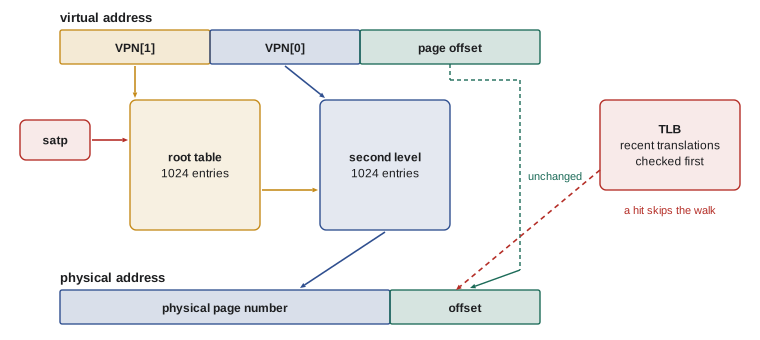
Each page table entry holds the physical page number and flag bits: V (valid), R, W and X (readable, writable, executable), U (accessible in user mode), G (global), A (accessed) and D (dirty). The permission bits enforce the segment protections of lesson 8, so an attempt to write to the text segment or execute the stack causes a page fault. The A and D bits are set by hardware when a page is used and written, which tells the operating system which pages are in active use and which must be written back to storage before being reused.
PAGE = 4096
def split(va):
    return va >> 22, (va >> 12) & 0x3FF, va & 0xFFF

# A toy two-level page table: root[vpn1] -> second-level table {vpn0: (ppn, flags)}
root = {
    0x001: {0x000: (0x8A2F1, 'R-X'), 0x001: (0x8A2F2, 'R-X')},     # text near 0x00400000
    0x040: {0x010: (0x91C07, 'RW-')},                              # data near 0x10010000
    0x1FF: {0x3FE: (0x7F3A0, 'RW-')},                              # stack near 0x7FFFE000
}

def translate(va, write=False, execute=False):
    vpn1, vpn0, off = split(va)
    second = root.get(vpn1)
    if second is None or vpn0 not in second:
        return f'page fault (no mapping for VPN {vpn1:#05x}:{vpn0:#05x})'
    ppn, flags = second[vpn0]
    need = 'X' if execute else 'W' if write else 'R'
    if need not in flags:
        return f'page fault (access needs {need}, page is {flags})'
    return f'PA {ppn * PAGE + off:#010x}'

for va, w, x in [(0x00400010, False, True), (0x10010A44, True, False), (0x7FFFEFF8, True, False),
                 (0x00400020, True, False), (0x20000000, False, False)]:
    vpn1, vpn0, off = split(va)
    kind = 'execute' if x else 'write' if w else 'read'
print(f'VA {va:#010x} ({kind:<7}) VPN1={vpn1:#05x} VPN0={vpn0:#05x} off={off:#05x} -> {translate(va, w, x)}')VA 0x00400010 (execute) VPN1=0x001 VPN0=0x000 off=0x010 -> PA 0x8a2f1010 VA 0x10010a44 (write ) VPN1=0x040 VPN0=0x010 off=0xa44 -> PA 0x91c07a44 VA 0x7fffeff8 (write ) VPN1=0x1ff VPN0=0x3fe off=0xff8 -> PA 0x7f3a0ff8 VA 0x00400020 (write ) VPN1=0x001 VPN0=0x000 off=0x020 -> page fault (access needs W, page is R-X) VA 0x20000000 (read ) VPN1=0x080 VPN0=0x000 off=0x000 -> page fault (no mapping for VPN 0x080:0x000)
The fourth access tries to write to a text page, which is mapped readable and executable but not writable, so it faults; the fifth touches an address with no mapping at all. On a real system the operating system would respond to the first by terminating the program with a segmentation fault, and to the second either the same way or, if the address belonged to a region the program had legitimately reserved, by allocating a page.
The TLB
Translation as described would make every memory access cost three: two page table reads and then the access itself. The translation lookaside buffer, or TLB, avoids that. It is a small cache of recent translations, typically 32 to a few thousand entries, often fully associative or highly associative, consulted in parallel with the L1 cache on every access. Because programs have locality and a single 4 KiB page covers 1,024 words, TLB hit rates are very high. On a TLB miss, RISC-V hardware walks the page table itself, as x86-64 and Arm hardware do; some older designs, including MIPS, trapped to the operating system to refill the TLB in software. When the operating system changes a mapping, it must invalidate stale TLB entries, with the RISC-V instruction sfence.vma.
import random
random.seed(229)

def tlb_hit_rate(addresses, entries=16):
    tlb, hits = [], 0                       # fully associative, LRU
    for va in addresses:
        vpn = va >> 12
        if vpn in tlb:
            hits += 1; tlb.remove(vpn)
        elif len(tlb) == entries:
            tlb.pop(0)
        tlb.append(vpn)
    return hits / len(addresses)

seq = [0x10010000 + 4 * i for i in range(20000)]                    # walk an 80 KB array
strided = [0x10010000 + 4096 * (i % 64) for i in range(20000)]      # one word per page, 64 pages
rand = [0x10010000 + 4 * random.randrange(1 << 20) for _ in range(20000)]   # 4 MB at random
for name, trace in [('sequential', seq), ('page stride', strided), ('random', rand)]:
print(f'{name:>11}: TLB hit rate {100 * tlb_hit_rate(trace):5.1f}%') sequential: TLB hit rate 99.9%
page stride: TLB hit rate 0.0%
random: TLB hit rate 1.6%Sequential access misses only once per 1,024 accesses, when it crosses into a new page. Touching one word in each of 64 pages in rotation overwhelms a 16-entry TLB completely, and random access over 4 MB is almost as bad. Large pages, 4 MiB megapages in Sv32 and 2 MiB or 1 GiB pages on 64-bit systems, let one TLB entry cover far more memory, which is why databases and scientific programs often request them.
Exceptions, interrupts and privilege
Page faults are one kind of exception: an event that diverts the processor from the normal flow of instructions. Exceptions caused by the instruction being executed, such as an illegal instruction, a misaligned access, a page fault or an ecall, are synchronous. Interrupts, caused by events outside the program such as a timer or a network card receiving data, are asynchronous. RISC-V handles both the same way. The processor saves the address of the interrupted instruction in the exception program counter, mepc or sepc, records the cause in mcause or scause, switches to a more privileged mode and jumps to the handler whose address is in mtvec or stvec. The handler, part of the operating system, does its work and executes mret or sret to return.
RISC-V defines privilege modes: machine mode (M), the most privileged, used by firmware; supervisor mode (S), used by an operating system kernel; and user mode (U), used by applications. Instructions that change page tables, disable interrupts or access devices directly are allowed only in privileged modes, and page table entries without the U bit are inaccessible from user mode, so an application cannot interfere with the kernel or with other applications. The ecall instruction used throughout this course is exactly the doorway between modes: in a real system it traps from user mode into the kernel, which reads a7 to decide which service to perform. RARS and this course's simulator implement the services directly instead of running a kernel, but the calling convention is the same idea.
| Event | Type | Typical handling |
|---|---|---|
| ecall | Synchronous exception | Kernel performs a system call and returns to the next instruction |
| Page fault | Synchronous exception | Kernel maps or loads the page and retries the instruction, or ends the program |
| Illegal instruction | Synchronous exception | Kernel may emulate the instruction or end the program |
| Timer interrupt | Asynchronous interrupt | Kernel may switch to another process |
| Device interrupt | Asynchronous interrupt | Kernel runs the device driver's handler |
Input and output
Devices are connected to the processor through controllers that expose a small set of registers: a status register indicating whether the device is ready, a control register for commands and a data register for the bytes themselves. RISC-V, like most modern ISAs, uses memory-mapped I/O: device registers appear at physical addresses, and ordinary loads and stores read and write them. Those addresses are marked in the page tables and memory system as uncached, since a device register's value can change at any time and caching it would return stale data. On the widely used QEMU virtual RISC-V machine, for example, a serial port appears at physical address 0x10000000, and writing a byte to it prints a character.
The processor can learn that a device needs attention in two ways. With polling, the program repeatedly reads the status register until the device is ready, which is simple but wastes processor time when devices are slow. With interrupts, the device signals the processor when it is ready, and the processor runs a handler only then, which is efficient for slow or unpredictable devices but has a fixed overhead per event. For large transfers, such as reading a block from a solid-state drive or receiving network packets, direct memory access (DMA) lets the device controller copy data between the device and memory itself, interrupting the processor only when the whole transfer is done. Devices connect through buses and links such as PCI Express, whose current generations deliver tens of gigabytes per second per device.
Worked problem
Polling versus interrupts
A keyboard produces at most 15 characters per second. Polling it costs 400 cycles per check and must happen 100 times per second to feel responsive; an interrupt costs 2,000 cycles per character. On a 2 GHz processor, what fraction of time does each approach use?
Show solution
- Polling: 100 × 400 = 40,000 cycles per second, 40,000 / 2 × 10⁹ = 0.002 percent.
- Interrupts: at most 15 × 2,000 = 30,000 cycles per second, 0.0015 percent, and nothing when no keys are pressed.
- For a device delivering 500 MB/s in 16-byte units, polling or interrupting per unit would need 31 million events per second, far beyond the processor's capacity at these costs.
Answer: For a keyboard both are negligible, with interrupts slightly cheaper; for fast devices neither works per unit, which is why they use DMA and interrupt once per large transfer.
Parallel hardware
Since the power wall of lesson 1, processors have gained speed mainly through parallelism at several levels. Pipelining and superscalar execution, from lesson 10, exploit instruction-level parallelism within one program automatically. Data-level parallelism applies one operation to many data items: single instruction, multiple data (SIMD) or vector instructions operate on whole registers of values at once. The RISC-V V extension provides vector registers whose length is chosen by the implementation, from 128 bits in small cores to thousands of bits, and code written for it runs unchanged on any vector length. x86-64 has fixed-width SIMD extensions such as SSE, AVX2 and AVX-512, and Arm has NEON and SVE. Compilers can vectorize simple loops automatically, as clang does here for an element-wise addition.
void vadd(int *restrict c, const int *restrict a,
          const int *restrict b, int n) {
    for (int i = 0; i < n; i++)
        c[i] = a[i] + b[i];
}$ clang --target=riscv32 -march=rv32imv -O2 -S vadd.c -o -
vadd:
blez a3, .LBB0_8
csrr a6, vlenb
srli a5, a6, 1
bgeu a3, a5, .LBB0_3
li a4, 0
j .LBB0_6
.LBB0_3:
neg a4, a5
and a4, a4, a3
slli a6, a6, 1
vsetvli a7, zero, e32, m2, ta, ma
mv a7, a4
mv t0, a0
mv t1, a2
mv t2, a1
.LBB0_4:
vl2re32.v v8, (t2)
vl2re32.v v10, (t1)
vadd.vv v8, v10, v8
vs2r.v v8, (t0)
add t2, t2, a6
add t1, t1, a6
sub a7, a7, a5
add t0, t0, a6
bnez a7, .LBB0_4
beq a4, a3, .LBB0_8
.LBB0_6:
sub a3, a3, a4
slli a4, a4, 2
add a0, a0, a4
add a2, a2, a4
add a1, a1, a4
.LBB0_7:
lw a4, 0(a1)
lw a5, 0(a2)
add a4, a5, a4
sw a4, 0(a0)
addi a3, a3, -1
addi a0, a0, 4
addi a2, a2, 4
addi a1, a1, 4
bnez a3, .LBB0_7
.LBB0_8:
retFind the vector loop in the middle: vl2re32.v loads a group of vector registers from a, a second load fetches b, vadd.vv adds them element by element, and vs2r.v stores the result to c. The csrr reading vlenb at the top asks the hardware how long its vector registers are, so the same machine code processes 8 integers per iteration on a core with 128-bit registers and 32 on one with 512-bit registers. A scalar loop after the vector loop handles any leftover elements. The restrict keywords promise the compiler that the arrays do not overlap, which it needs to know before vectorizing safely.
Thread-level parallelism runs separate instruction streams on separate cores, or on hardware threads that share one core. Cores on one chip share main memory, which raises a new problem: each core has its own L1 and L2 caches, so two cores may hold different copies of the same block. Cache coherence protocols keep the copies consistent. In the common MESI protocol, each cached block is Modified, Exclusive, Shared or Invalid, and a core that wants to write a block first invalidates every other copy, by snooping on a shared bus or by consulting a directory. Coherence makes shared memory behave sensibly, but it has a cost that programmers can see: if two cores repeatedly write different variables that happen to share a cache block, the block bounces between their caches, an effect called false sharing that can make a parallel program slower than a serial one.
Graphics processing units (GPUs) push data-level and thread-level parallelism to the extreme, with thousands of simple cores running the same program on different data, hiding memory latency by switching among many threads rather than with large caches. They were designed for graphics, but their throughput on regular, parallel arithmetic made them the main engine of machine learning. Whatever the hardware, Amdahl's law from lesson 1 still applies: the serial fraction of a program limits the benefit of every one of these forms of parallelism.
Capstone: one program through the whole machine
To close the course, follow one program from source code to cache behavior. The C program below fills an array of 512 integers from a simple pseudo-random generator, sorts it with insertion sort, and prints a summary and a checksum. It was compiled by clang for RV32IM, linked with the course's runtime, and executed on the simulator, which counted instructions by class, measured the deepest stack use, counted load-use pairs and taken branches to estimate a five-stage pipeline's cycles as in lesson 10, and recorded every data access for the cache models of lesson 11.
void print_int(int);
void print_str(const char *);

#define N 512
static int data[N];

static unsigned seed = 2026;
static int next_random(void) {           /* a linear congruential generator */
    seed = seed * 1103515245u + 12345u;
    return (int)((seed >> 16) % 1000);
}

static void insertion_sort(int *a, int n) {
    for (int i = 1; i < n; i++) {
        int key = a[i], j = i - 1;
        while (j >= 0 && a[j] > key) {
            a[j + 1] = a[j];
            j--;
        }
        a[j + 1] = key;
    }
}

int cmain(void) {
    for (int i = 0; i < N; i++)
        data[i] = next_random();
    insertion_sort(data, N);
    int checksum = 0;
    for (int i = 0; i < N; i++)
        checksum = checksum * 31 + data[i];
    print_str("min "); print_int(data[0]);
    print_str(", median "); print_int(data[N / 2]);
    print_str(", max "); print_int(data[N - 1]);
    print_str(", checksum "); print_int(checksum); print_str("\n");
    return 0;
}min 2, median 528, max 998, checksum 1575081745 instructions executed: 470633 ALU 205304, loads 66703, stores 66201, branches 132382 (66684 taken), jumps 33, system 10 instructions: 470633, load-use stalls: 65673, taken branches and jumps: 66717 5-stage pipeline estimate: 470633 + 4 + 65673 + 2 x 66717 = 669744 cycles, CPI = 1.42 deepest stack use: 16 bytes
void print_int(int);
void print_str(const char *);

#define N 512
static int data[N];

static unsigned seed = 2026;
static int next_random(void) {           /* a linear congruential generator */
    seed = seed * 1103515245u + 12345u;
    return (int)((seed >> 16) % 1000);
}

static void insertion_sort(int *a, int n) {
    for (int i = 1; i < n; i++) {
        int key = a[i], j = i - 1;
        while (j >= 0 && a[j] > key) {
            a[j + 1] = a[j];
            j--;
        }
        a[j + 1] = key;
    }
}

int cmain(void) {
    for (int i = 0; i < N; i++)
        data[i] = next_random();
    insertion_sort(data, N);
    int checksum = 0;
    for (int i = 0; i < N; i++)
        checksum = checksum * 31 + data[i];
    print_str("min "); print_int(data[0]);
    print_str(", median "); print_int(data[N / 2]);
    print_str(", max "); print_int(data[N - 1]);
    print_str(", checksum "); print_int(checksum); print_str("\n");
    return 0;
}min 2, median 528, max 998, checksum 1575081745 instructions executed: 470633, data accesses: 132904 512 B, 32-byte blocks, direct-mapped: miss rate 4.3% (5681 misses) 1 KiB, 32-byte blocks, 2-way: miss rate 2.1% (2727 misses) 4 KiB, 64-byte blocks, 4-way: miss rate 0.0% (34 misses)
Read the results layer by layer. Lesson 2 explains the checksum, which deliberately wraps around 32 bits because signed overflow in this checksum is harmless on the machine, even though C does not promise it; a careful program would use unsigned. Lesson 6 explains the instruction mix: insertion sort's inner loop of loads, compares, stores and branches dominates, so loads and stores together make up more than a quarter of all instructions, and branches another quarter. Lesson 7 explains the small stack figure: the compiler inlined the helper functions and kept almost everything in registers, so cmain's single frame is the deepest the stack goes. Lesson 10's estimate shows the pipeline's CPI rising to about 1.4, in roughly equal parts from load-use stalls and taken branches: the inner loop compares each element immediately after loading it, and its backward branch is taken on almost every iteration, exactly the patterns that scheduling and branch prediction exist to attack. And lesson 11 explains the cache results: the 2 KiB array fits comfortably in the 4 KiB cache, so after the first touch almost everything hits, while a 512-byte cache, too small for the array, misses much more.
# Combine the measured counts with lesson 11's cost model (cycle costs are illustrative).
instructions = 470_633          # from the run above
pipe_cycles  = 669_744          # five-stage estimate from the run above
accesses     = 132_904          # data accesses from the cache run
for name, misses in [('512 B direct-mapped', 5_681), ('4 KiB 4-way', 34)]:
    for penalty in (20, 100):
        total = pipe_cycles + misses * penalty
print(f'{name:<20} miss penalty {penalty:3d}: {total:>9,} cycles, CPI {total / instructions:.2f}')512 B direct-mapped miss penalty 20: 783,364 cycles, CPI 1.66 512 B direct-mapped miss penalty 100: 1,237,844 cycles, CPI 2.63 4 KiB 4-way miss penalty 20: 670,424 cycles, CPI 1.42 4 KiB 4-way miss penalty 100: 673,144 cycles, CPI 1.43
With the larger cache, misses add almost nothing; with the tiny cache and a slow next level, they add noticeably to the run time even for this cache-friendly program. Every number in this capstone traces back to a mechanism covered in this course: the representation of the data, the instructions the compiler chose, the calling convention, the pipeline's hazards and the cache's organization. That is the payoff of opening the black box. When a program is slow, or wrong in a way the source code cannot explain, you now know which layer to look at and what tools to use.
Common mistakes
MistakeThinking virtual addresses are just physical addresses with an offset.
InsteadEach page is mapped independently through page tables; contiguous virtual pages can be scattered in physical memory or absent.
MistakeAssuming every memory access walks the page table.
InsteadThe TLB caches translations; walks happen only on TLB misses, and hit rates are usually very high.
MistakeTreating a page fault as always fatal.
InsteadMany page faults are normal: the operating system loads or allocates the page and the instruction is retried.
MistakePolling fast devices byte by byte.
InsteadHigh-bandwidth devices use DMA and interrupt once per large transfer.
MistakePlacing variables written by different threads in the same cache block.
InsteadFalse sharing makes coherence traffic bounce the block between cores; pad or separate such data.
Summary and key terms
- Virtual memory translates each process's virtual addresses to physical addresses page by page, providing isolation, flexible allocation and more memory than physically present.
- RISC-V Sv32 uses a two-level page table rooted at satp; entries hold physical page numbers and V, R, W, X, U, A and D bits.
- The TLB caches translations; RISC-V hardware walks the page table on a TLB miss, and sfence.vma invalidates stale entries.
- Exceptions and interrupts save the PC in mepc or sepc, record the cause and jump to a handler in a more privileged mode; ecall enters the kernel.
- Devices are controlled through memory-mapped registers; polling, interrupts and DMA trade simplicity against efficiency.
- SIMD and vector instructions exploit data-level parallelism; multicore chips exploit thread-level parallelism and need cache coherence.
- The capstone shows every layer at once: representation, instructions, calling convention, pipeline hazards and caches together determine performance.
- Virtual memory
- Translating program-visible virtual addresses to physical addresses through page tables.
- Page
- The fixed-size unit of virtual memory, 4 KiB in RISC-V.
- Page table
- The data structure mapping virtual page numbers to physical page numbers and permissions.
- Page fault
- An exception raised when a page is not mapped or the access is not permitted.
- TLB
- Translation lookaside buffer: a cache of recent address translations.
- Exception
- An event that diverts execution to a handler, caused by an instruction (synchronous) or an external signal (interrupt).
- Privilege mode
- A level of authority, machine, supervisor or user in RISC-V, that controls which instructions and pages are accessible.
- Memory-mapped I/O
- Accessing device registers with ordinary loads and stores to reserved addresses.
- DMA
- Direct memory access: a device controller copying data to or from memory without the processor.
- Cache coherence
- Keeping multiple cached copies of the same memory block consistent across cores.
Practice problems
Work each problem on paper first, then reveal the answer to check.
How many 4 KiB pages are there in a 32-bit virtual address space?
Show answer
2³² / 2¹² = 2²⁰, about one million.
Split the Sv32 virtual address 0x10010A44 into VPN[1], VPN[0] and offset.
Show answer
VPN[1] = 0x040, VPN[0] = 0x010, offset = 0xA44.
Why does a two-level page table save memory compared with a flat one?
Show answer
Second-level tables are needed only for regions in use; unused 4 MiB regions need no table.
What does the D bit in a page table entry record, and why does the OS care?
Show answer
That the page has been written; a dirty page must be saved to storage before its frame is reused.
A TLB has a 99.5 percent hit rate and a miss costs 30 cycles. How many cycles does translation add per access on average?
Show answer
0.005 × 30 = 0.15 cycles.
What happens when a user program executes ecall on a real RISC-V system?
Show answer
The processor traps to supervisor mode, saving the PC in sepc and the cause in scause, and the kernel performs the requested service.
Why are device registers mapped as uncached?
Show answer
Their values can change independently of the processor, so a cached copy could be stale.
When is DMA preferable to interrupts per byte?
Show answer
For high-bandwidth transfers, where per-byte events would overwhelm the processor.
What does the restrict keyword let the compiler do in the vector example?
Show answer
Assume the arrays do not overlap, so it can load and store many elements at once safely.
What is false sharing?
Show answer
Two cores writing different variables in the same cache block, causing the block to bounce between their caches.
Lesson quiz · 5 questions
Score 60% or more to complete this lesson.
Create a free account to save your progress, take quizzes and earn a certificate.