
CMP-210 · Lesson 5 of 12 · 28 min
Karnaugh maps and minimization
Lesson 3 simplified expressions with the laws of Boolean algebra. That works, but it depends on spotting the right step, and it is easy to stop before reaching the simplest form. In 1953 Maurice Karnaugh, an engineer at Bell Labs, published a graphical method that makes simplification almost mechanical for functions of up to four variables, and manageable for five or six. A Karnaugh map, or K-map, rearranges the truth table so that minterms which differ in only one variable sit next to each other, and the adjacencies that algebra would find step by step can be seen at a glance. This lesson covers two-, three- and four-variable maps, prime and essential implicants, don't-care conditions, product-of-sums minimization, and the Quine-McCluskey method that software uses for larger functions.
The idea: adjacency
The key simplification in two-level logic is XY + XȲ = X: two product terms that differ in exactly one variable merge into one term without that variable. In a truth table, rows that differ in one variable can be far apart: rows 0011 and 1011 are eight rows apart. A K-map places each minterm in a cell of a grid and orders the rows and columns in Gray code, so that any two cells next to each other differ in exactly one variable. The edges also wrap around: the leftmost column is adjacent to the rightmost, and the top row to the bottom row, as if the map were drawn on a doughnut.
Simplifying then means circling groups of 1s. A group must be a rectangle whose size is a power of two (1, 2, 4, 8 or 16 cells). A group of two cells eliminates one variable, a group of four eliminates two, and a group of eight eliminates three. The product term for a group contains only the variables that keep the same value across every cell in it.
Two- and three-variable maps
A two-variable map has four cells, one for each minterm of A and B. A three-variable map has eight cells, usually arranged as two rows (A = 0 and A = 1) and four columns for BC in the Gray order 00, 01, 11, 10. The order of the columns is the essential trick: 01 and 11 differ only in B, 11 and 10 differ only in C, and 10 wraps around to 00, which differs only in B.
Worked problem
A three-variable map
Simplify F(A,B,C) = Σm(1, 3, 4, 5, 6) with a K-map.
Show solution
- Place 1s in cells 001, 011, 100, 101 and 110.
- Cell 111 is 0, so no group of four exists. Cells 001 and 011 (A = 0, C = 1) pair to give ĀC, and cells 001 and 101 (B = 0, C = 1) pair to give B̄C.
- Cells 100 and 101 pair (A = 1, B = 0), giving AB̄; cells 100 and 110 pair across the wrap (A = 1, C = 0), giving AC̄.
- Choose the fewest groups that cover every 1: ĀC covers 1 and 3, AC̄ covers 4 and 6, and cell 5 is covered by either AB̄ or B̄C.
- \[F = \overline{A}C + A\overline{C} + A\overline{B} \quad \text{or} \quad F = \overline{A}C + A\overline{C} + \overline{B}C\]
Answer: F has two equally good minimal forms, each with three 2-literal terms.
The example shows that a function can have more than one minimal expression. Both answers use the same number of terms and literals, so either is acceptable; a designer might choose the one that shares a term with another output.
Four-variable maps
A four-variable map is a 4 × 4 grid with AB labeling the rows and CD labeling the columns, both in Gray order. Each cell is adjacent to four others, counting the wrap-around at the edges. The four corner cells are all adjacent to each other, which surprises everyone the first time. The map makes groups of four and eight easy to see: a whole row, a whole column, a 2 × 2 square, the four corners, or two edge columns together.
Worked problem
Groups that wrap around
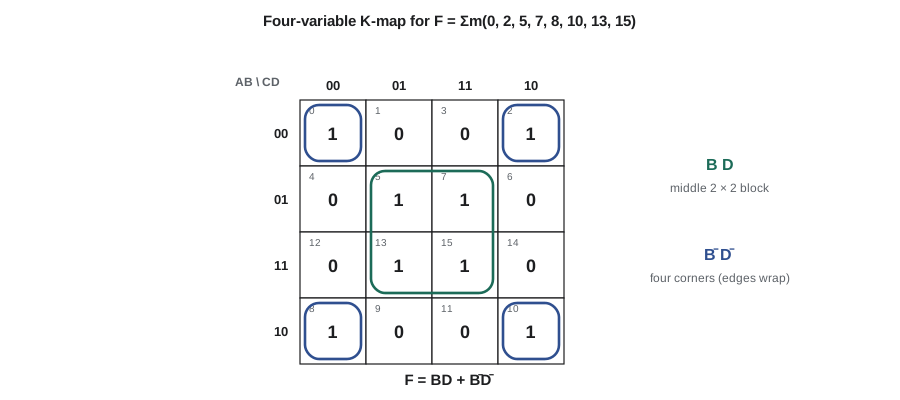
Simplify F(A,B,C,D) = Σm(0, 2, 5, 7, 8, 10, 13, 15).
Show solution
- The 1s at 0, 2, 8 and 10 are the four corners of the map. They all have B = 0 and D = 0, so they form one group: B̄D̄.
- The 1s at 5, 7, 13 and 15 form the 2 × 2 square in the middle rows (B = 1) and middle columns (D = 1): BD.
- \[F = BD + \overline{B}\,\overline{D} = \overline{B \oplus D}\]
Answer: F = BD + B̄D̄, which is simply B XNOR D: A and C do not matter at all.
Implicants, prime implicants and essential prime implicants
A few words make the method precise. An implicant is any product term that is 1 only where the function is 1; on the map, it is any valid group of 1s. A prime implicant is an implicant that cannot be made larger: its group cannot be doubled without including a 0. An essential prime implicant is a prime implicant that covers at least one 1 that no other prime implicant covers. Every minimal sum of products uses only prime implicants, and it must include all the essential ones.
This gives a reliable procedure. First, find all the prime implicants by making every group as large as possible. Second, mark the essential prime implicants and include them. Third, if any 1s are still uncovered, choose the smallest set of the remaining prime implicants that covers them. On a four-variable map the third step is usually easy to do by eye. The common beginner's error is to start with the biggest group and then add groups greedily, which can produce a cover with a redundant term.
Don't-care conditions
In many designs some input combinations can never occur, or the output does not matter when they do. These are don't-care conditions, marked with an X or a dash on the map. A don't-care can be treated as 1 if that makes a group larger, or as 0 if it does not help. Don't-cares often give large savings. The classic example is a circuit that takes a BCD digit as input: the patterns 1010 to 1111 never occur, so they are all don't-cares.
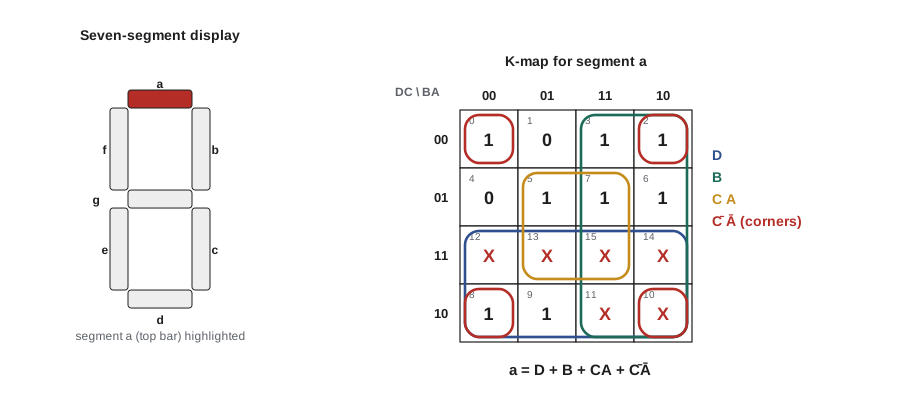
Amara's tachometer shows each digit on a seven-segment display, and each segment needs its own logic function of the four BCD bits D, C, B and A (with D the most significant). Segment a, the top bar, is lit for the digits 0, 2, 3, 5, 6, 7, 8 and 9, and off for 1 and 4.
Worked problem
Segment a with don't-cares
Find a minimal sum of products for segment a: a = Σm(0, 2, 3, 5, 6, 7, 8, 9) + d(10, 11, 12, 13, 14, 15).
Show solution
- Using the don't-cares, the whole bottom half of the map (D = 1: cells 8 to 15) is a group of eight: D.
- The two right-hand columns (B = 1: cells 2, 3, 6, 7, 10, 11, 14, 15) form a group of eight: B.
- Cells 5, 7, 13 and 15 (C = 1, A = 1) form a group of four: CA.
- Cells 0, 2, 8 and 10, the four corners (C = 0, A = 0), form a group of four: C̄Ā.
- \[a = D + B + CA + \overline{C}\,\overline{A}\]
Answer: a = D + B + CA + C̄Ā: four terms, compared with eight 4-literal minterms without the don't-cares.
The design is only correct if the don't-care inputs truly never occur. If a fault could put 1100 on the inputs, the display would show a strange symbol. For a safety function, such as deciding when the walk signal may turn on, Daniel insists that unused input or state codes are assigned a safe output deliberately rather than left as don't-cares.
Product-of-sums minimization
A K-map can also give a minimal product of sums. Group the 0s instead of the 1s, using the same rules. Each group of 0s gives a sum term in which a variable appears uncomplemented if it is 0 throughout the group and complemented if it is 1. The AND of these sum terms is the minimal POS. Equivalently, find the minimal SOP of the complement F̄ from the 0s and apply De Morgan's theorem. Sometimes the POS is cheaper than the SOP; a designer can work out both and pick the smaller.
Worked problem
Segment a as a product of sums
Find the minimal POS for segment a, using the same don't-cares.
Show solution
- The 0s are at cells 1 (0001) and 4 (0100).
- Cell 1 (0001) has neighbors 0, 3, 5 and 9, which are all 1s, so it cannot grow. It stays a single cell: sum term (D + C + B + Ā).
- Cell 4 (0100) can join cell 12, a don't-care: C = 1, B = 0, A = 0 with D varying, giving the sum term (C̄ + B + A).
- \[a = (D + C + B + \overline{A})(\overline{C} + B + A)\]
Answer: a = (D + C + B + Ā)(C̄ + B + A): two sum terms with seven literals in all, about the same cost as the four-term SOP.
Multiple outputs and sharing
Real circuits rarely compute just one function. The seven-segment decoder has seven outputs, all functions of the same four inputs. Minimizing each output separately gives a correct design, but a smaller one may share product terms between outputs, even if a shared term is not prime for every output on its own. Lesson 6 shows the complete decoder; the multiple-output optimization is usually left to software.
Five and six variables
A five-variable map can be drawn as two four-variable maps side by side, one for E = 0 and one for E = 1, with cells in the same position on the two maps counting as adjacent. A six-variable map uses four such maps. Beyond that, maps become impractical and designers rely on algorithms. Even at five variables it is easy to miss an adjacency, so the map is best used as a check on a software result or as a teaching tool.
The Quine-McCluskey method
The tabular method developed by Willard Quine and Edward McCluskey in the 1950s does what a K-map does, but in a form a computer can follow for any number of variables. Write the minterms and don't-cares in binary. Repeatedly combine pairs that differ in exactly one bit, replacing that bit with a dash, until no more combinations are possible; the terms that never combine are the prime implicants. Then build a prime implicant chart, select the essential prime implicants, and cover the remaining minterms with as few others as possible. The method finds all prime implicants exactly, but the covering step can grow exponentially, so large practical tools such as the Espresso program use heuristics that give near-minimal results quickly.
# Quine-McCluskey: prime implicants, then a smallest cover (brute force is fine for small problems)
from itertools import combinations

def combine(a, b):
    diff = [i for i in range(len(a)) if a[i] != b[i]]
    if len(diff) == 1 and "-" not in (a[diff[0]], b[diff[0]]):
        i = diff[0]
        return a[:i] + "-" + a[i + 1:]
    return None

def primes(minterms, dontcares, n):
    terms = {format(m, f"0{n}b") for m in minterms + dontcares}
    found = set()
    while terms:
        used, nxt = set(), set()
        for a, b in combinations(sorted(terms), 2):
            c = combine(a, b)
            if c:
                nxt.add(c); used.update((a, b))
        found |= terms - used
        terms = nxt
    return found

def covers(term, m, n):
    return all(t in "-" + b for t, b in zip(term, format(m, f"0{n}b")))

def minimal_cover(minterms, dontcares, n):
    pis = sorted(primes(minterms, dontcares, n))
    for k in range(1, len(pis) + 1):
        for choice in combinations(pis, k):
            if all(any(covers(t, m, n) for t in choice) for m in minterms):
                return pis, choice

def to_expr(term, names):
    out = ""
    for t, v in zip(term, names):
        if t == "1": out += v
        elif t == "0": out += v + "'"
    return out or "1"

names = "DCBA"
pis, best = minimal_cover([0, 2, 3, 5, 6, 7, 8, 9], [10, 11, 12, 13, 14, 15], 4)
print("prime implicants:", ", ".join(to_expr(t, names) for t in pis))
print("segment a =", " + ".join(to_expr(t, names) for t in best))prime implicants: B, C'A', CA, D segment a = B + C'A' + CA + D
The program finds every prime implicant and then searches for the smallest set that covers all the required minterms. For segment a there are only four prime implicants and every one is essential, so the cover uses all of them, exactly as the map showed. For other functions the list of primes is longer than the cover. Amara keeps this script for checking hand minimizations of five- and six-variable functions, where a missed wrap-around adjacency is easy.
Is minimal always best?
Two-level minimization counts terms and literals, which is a good proxy for cost in a programmable logic array or a small gate-level circuit. In a modern chip, synthesis tools optimize for area, delay and power together and use multi-level logic with shared intermediate signals, which can be far smaller than any two-level form. In a programmable chip built from lookup tables (lesson 12), any function of up to four or six inputs costs the same single table, so minimization of small functions hardly matters there. K-maps remain valuable because they build intuition about adjacency and hazards, and because small hand designs and exam questions still use them.
Common mistakes
MistakeLabeling the map rows or columns in binary order 00, 01, 10, 11.
InsteadUse Gray order 00, 01, 11, 10 so that neighboring cells differ in one variable.
MistakeMaking groups of three or six cells.
InsteadGroups must be rectangles of 1, 2, 4, 8 or 16 cells.
MistakeForgetting that the edges and corners wrap around.
InsteadThe left and right edges are adjacent, the top and bottom are adjacent, and all four corners form a group.
MistakeIncluding a group whose cells are all covered by other groups.
InsteadTake essential prime implicants first, then the fewest others needed.
MistakeUsing don't-cares for inputs that could actually occur in a safety function.
InsteadAssign a deliberate safe output to any code that might appear through a fault.
Summary and key terms
- A K-map orders cells in Gray code so that adjacent cells differ in one variable; edges wrap around.
- Groups are rectangles of 2ᵏ cells; a group of 2ᵏ cells eliminates k variables.
- A minimal SOP uses only prime implicants and includes every essential prime implicant.
- Don't-cares may be treated as 1 or 0, whichever gives larger groups.
- Grouping 0s gives a minimal product of sums.
- Quine-McCluskey finds all prime implicants algorithmically; tools like Espresso use heuristics for large problems.
- Karnaugh map
- A grid form of the truth table in which adjacent cells differ in one variable.
- Implicant
- A product term that is 1 only where the function is 1.
- Prime implicant
- An implicant that cannot be enlarged without covering a 0.
- Essential prime implicant
- A prime implicant that covers a 1 no other prime implicant covers.
- Don't-care
- An input combination for which the output may be 0 or 1, because it never occurs or does not matter.
- Quine-McCluskey method
- A tabular algorithm that finds prime implicants by repeatedly combining terms differing in one bit.
Practice problems
Work each problem on paper first, then reveal the answer to check.
Simplify F(A,B,C) = Σm(0, 2, 4, 6).
Show answer
All four have C = 0: F = C̄.
Simplify F(A,B,C,D) = Σm(0, 1, 2, 3, 8, 9, 10, 11).
Show answer
These are all cells with B = 0: F = B̄.
Simplify F(A,B,C,D) = Σm(1, 3, 5, 7, 9, 11, 13, 15).
Show answer
All cells with D = 1: F = D.
Simplify F(A,B,C,D) = Σm(4, 5, 6, 7, 12, 13).
Show answer
Group 4–7 (ĀB) and group 4, 5, 12, 13 (BC̄): F = ĀB + BC̄.
Segment g (middle bar) is lit for digits 2, 3, 4, 5, 6, 8, 9. With don't-cares 10–15, find a minimal SOP.
Show answer
g = D + CB̄ + C̄B + BĀ (one minimal form); check by covering cells 2, 3, 4, 5, 6, 8, 9.
How many cells does a group eliminating three variables contain?
Show answer
2³ = 8 cells.
Lesson quiz · 5 questions
Score 60% or more to complete this lesson.
Create a free account to save your progress, take quizzes and earn a certificate.