
CIV-340 · Lesson 7 of 12 · 24 min
Permeability and one-dimensional seepage
Water moves through soil whenever there is a difference in head: into an excavation, under a dam, toward a well, out of a consolidating clay. How fast it moves depends on the permeability of the soil, which varies more than any other soil property, over ten orders of magnitude from gravel to clay. This lesson introduces head and Darcy's law, measures the permeability of the site soils, deals with layered deposits and looks at the most dangerous effect of seepage, the loss of effective stress under upward flow. Lesson 8 extends the ideas to two-dimensional flow around the pump station excavation.
Head
Bernoulli's equation describes the energy of flowing water as a sum of three heads, each with units of length:
The elevation head \(z\) is the height of the point above a chosen datum, the pressure head \(u/\gamma_w\) is the height to which water would rise in a standpipe, and the velocity head \(v^2/2g\) reflects the speed of the water. Seepage velocities in soil are tiny, a few millimeters a day in clay and a few meters a day in clean sand, so the velocity head is negligible and the total head is simply
It is the level to which water would rise in a piezometer at the point, measured from the datum. Water flows from high total head to low total head, not necessarily from high pressure to low pressure: water at the bottom of a still lake has a high pressure but the same total head as the surface, so it does not flow. The hydraulic gradient \(i = \Delta h/L\) is the head lost per unit length along a flow path.
Darcy's law
In 1856, Henry Darcy, studying sand filters for the fountains of Dijon, found that the rate of flow through a column of sand was proportional to the head loss and the cross-sectional area and inversely proportional to the length:
Here \(q\) is the flow rate, \(A\) the total cross-sectional area, \(v = q/A\) the discharge velocity and \(k\) the coefficient of permeability, also called hydraulic conductivity, with units of velocity. The water actually travels only through the pores, so its average speed through the pores, the seepage velocity, is \(v_s = v/n\), larger than \(v\). Darcy's law holds for the slow, laminar flow found in almost all soils; it breaks down only in very coarse gravels and rock fill at high gradients, where flow becomes turbulent.
Permeability depends on the size of the pores, which depends mostly on the size of the finest grains, and on the viscosity of the fluid. It is conventionally quoted for water at 20 °C. Hydrogeologists sometimes use the intrinsic permeability, a property of the soil alone, but geotechnical engineers work with \(k\) for water.
| Soil | k (cm/s) | Drainage |
|---|---|---|
| Clean gravel | > 1 | Very free |
| Clean sand, sand and gravel | 10⁻³ to 1 | Free |
| Fine sand, silty sand | 10⁻⁵ to 10⁻³ | Fair |
| Silt, glacial till | 10⁻⁷ to 10⁻⁴ | Poor |
| Intact clay | < 10⁻⁷ | Practically impervious |
Laboratory tests
Permeability is measured in the laboratory by two tests, chosen according to the soil.
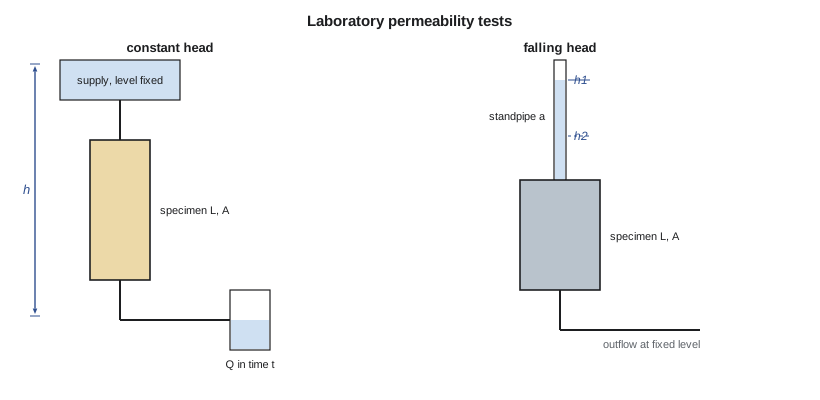
The constant head test suits sands and gravels. Water flows through a specimen of length \(L\) and area \(A\) under a fixed head difference \(h\), and the volume \(Q\) collected in time \(t\) is measured. Darcy's law gives
In silts and clays the flow is too small to collect accurately, so the falling head test is used. Water flows into the specimen from a narrow standpipe of area \(a\), and the time \(t\) for the level to fall from \(h_1\) to \(h_2\) is recorded. Equating the flow into the specimen with the drop in the standpipe and integrating gives
For clays, permeability is more often found from consolidation tests, as lesson 11 shows, or in a flexible-wall permeameter, a triaxial cell in which the specimen is enclosed in a rubber membrane so that water cannot leak along the sides.
Empirical estimates
For clean, uniform sands, Allen Hazen's 1892 rule relates permeability to the effective size:
The constant \(C\) ranges from about 40 to 150, so the estimate is good only to within a factor of two or three, but that is often enough for planning. The Kozeny-Carman equation adds the effect of void ratio and grain shape and is somewhat more reliable for a wider range of sands. No simple formula works for clays, whose permeability depends on the clay mineral, the chemistry of the pore water and the structure.
Testing the site soils
The laboratory ran a constant head test on the brown sand, recompacted to its in situ density, and a falling head test on a tube sample of the silt lens from B-2. The clay's vertical permeability, about \(3 \times 10^{-8}\) cm/s, came from the consolidation tests of lesson 11.
Worked problem
Constant head test on the sand
A specimen 101.6 mm (4.0 in.) in diameter and 150 mm (6 in.) long passes 420 cm³ of water in 120 s under a constant head of 60 cm. Find \(k\) and compare it with Hazen's estimate.
Show solution
- \[A = \frac{\pi(10.16)^2}{4} = 81.1\ \text{cm}^2\]
- \[k = \frac{420(15)}{81.1(60)(120)} = 0.0108\ \text{cm/s} \approx 31\ \text{ft/day}\]
- Hazen, with \(D_{10} = 0.097\) mm = 0.0097 cm:
- \[k \approx 100(0.0097)^2 = 0.0094\ \text{cm/s}\]
Answer: The two agree within 15 %, unusually close. The sand is a free-draining, moderately permeable soil.
# Permeability of the site soils and one-dimensional seepage
from math import log
CMS_TO_FTD = 86400 / 30.48            # cm/s to ft/day

# Constant head test on the brown sand (specimen 4.0 in. diameter, 6.0 in. long, run in cm units)
A = 3.14159 * 10.16 ** 2 / 4          # cm2
L, h, Q, t = 15.0, 60.0, 420.0, 120.0  # cm, cm, cm3, s
k_sand = Q * L / (A * h * t)           # cm/s
print(f"Constant head test: k = {k_sand:.2e} cm/s = {k_sand*CMS_TO_FTD:.1f} ft/day")
D10 = 0.0097                           # cm
print(f"Hazen estimate k = 100 D10^2 = {100*D10**2:.2e} cm/s")

# Falling head test on the silt lens from B-2 (standpipe area 0.50 cm2)
a, L2, h1, h2, t2 = 0.50, 12.0, 100.0, 60.0, 1850.0
k_silt = a * L2 / (A * t2) * log(h1 / h2)
print(f"Falling head test: k = {k_silt:.2e} cm/s = {k_silt*CMS_TO_FTD:.3f} ft/day")

# Equivalent permeability of the clay layer with thin silt lenses
layers = [(22.0, 3.0e-8), (1.0, k_silt)]           # (thickness ft, k cm/s): clay and total of silt lenses
H = sum(t for t, _ in layers)
kh = sum(t * k for t, k in layers) / H
kv = H / sum(t / k for t, k in layers)
print(f"\nClay with lenses: kh = {kh:.2e} cm/s, kv = {kv:.2e} cm/s, kh/kv = {kh/kv:.0f}")

# Upward seepage through the clay from the artesian till
i = 3.0 / 23.0
q = kv * i * CMS_TO_FTD                            # ft3/day per ft2
print(f"Upward flux through the clay: q = {q:.2e} ft/day = {q*365*7.48:.2f} gal per ft2 per year")

# Quick condition in the sand
gsat, gw = 126.0, 62.4
icr = (gsat - gw) / gw
print(f"\nCritical gradient of the sand: i_cr = {icr:.2f}")
for i_up in (0.3, 0.6, 1.0):
    sp = (gsat - gw - i_up * gw)
print(f" upward gradient {i_up:.1f}: effective stress increases {sp:5.1f} psf per foot; FS = {icr/i_up:.2f}")Constant head test: k = 1.08e-02 cm/s = 30.6 ft/day Hazen estimate k = 100 D10^2 = 9.41e-03 cm/s Falling head test: k = 2.04e-05 cm/s = 0.058 ft/day Clay with lenses: kh = 9.17e-07 cm/s, kv = 3.14e-08 cm/s, kh/kv = 29 Upward flux through the clay: q = 1.16e-05 ft/day = 0.03 gal per ft2 per year Critical gradient of the sand: i_cr = 1.02 upward gradient 0.3: effective stress increases 44.9 psf per foot; FS = 3.40 upward gradient 0.6: effective stress increases 26.2 psf per foot; FS = 1.70 upward gradient 1.0: effective stress increases 1.2 psf per foot; FS = 1.02
Layered soils
Natural soils are layered, and the varved clay at the site is layered on a scale of millimeters, with thicker silt lenses at intervals. The permeability of a layered deposit depends on the direction of flow.
For flow parallel to the layers, each layer carries flow under the same gradient, and the flows add. The equivalent horizontal permeability is the thickness-weighted average:
For flow across the layers, the same flow passes through every layer, and the head losses add. The equivalent vertical permeability is the thickness-weighted harmonic mean:
The horizontal value is dominated by the most permeable layers and the vertical value by the least permeable. Even a few thin sand or silt seams make a clay much more permeable horizontally than vertically. Here, 0.3 m (1 ft) of silt lenses in 7 m (23 ft) of clay raises the horizontal permeability about thirtyfold while barely changing the vertical value. Ratios of 2 to 10 are common in varved clays, and higher where silt partings are thick or continuous, and this matters for the rate of consolidation when vertical drains are installed, because the water then flows horizontally to the drains.
The upward flow from the till
Lesson 6 found an upward gradient of 0.130 through the clay. With \(k_v = 3.1 \times 10^{-8}\) cm/s, the flux is about 0.03 gal per square foot per year, which evaporates or drains away through the sand without anyone noticing. The flow is tiny, but its effect on the effective stress in the clay is not, as lesson 6 showed, and it becomes important when the pump station excavation removes the sand above.
Seepage forces
Water flowing through soil loses head by friction against the grains, and that friction is a force on the grains in the direction of flow. Per unit volume of soil, the seepage force is
For downward flow, it adds to the buoyant weight of the soil and increases the effective stress. For upward flow, it subtracts. In a layer with upward flow at gradient \(i\), the effective stress at depth \(z\) below the surface of the layer is
The quick condition
If the upward gradient is large enough, the effective stress falls to zero throughout the layer: the seepage force exactly balances the buoyant weight of the grains. Setting \(\sigma'_v = 0\) gives the critical hydraulic gradient,
which is close to 1.0 for most soils. At the critical gradient, a cohesionless soil has no strength. It boils: sand grains are carried upward and the surface heaves and bubbles. Quicksand is simply sand in this state; it is not a special kind of soil, and a person caught in it floats, because the mixture is denser than water. Boiling at the base of an excavation in sand, or at the toe of a levee during a flood, is extremely dangerous, because once grains start moving, the flow path shortens, the gradient rises and the failure accelerates. This is the start of piping, the progressive erosion of a channel back toward the water source.
Worked problem
Factor of safety against boiling
Find the critical gradient of the site sand, \(\gamma_{sat} = 126\) pcf, and the factor of safety against boiling if the upward gradient at the base of a dewatered trench reaches 0.6.
Show solution
- \[i_{cr} = \frac{126 - 62.4}{62.4} = 1.02\]
- \[FS = \frac{i_{cr}}{i} = \frac{1.02}{0.6} = 1.70\]
- The effective stress then increases by only \(63.6 - 0.6(62.4) = 26.2\) psf per foot of depth, less than half the no-flow value.
Answer: Factors of safety of 1.5 to 3 are usually required against boiling, larger where the consequences are severe or the soil is fine and uniform, which erodes easily. A gradient of 0.6 would be marginal for a deep excavation; the contractor would lower the water table further with wells outside the excavation or deepen the cut-off.
Filters
Where water must leave a fine soil, at a drain, a toe of a dam or behind a retaining wall, a filter keeps the soil grains in place while letting the water pass. A granular filter must be fine enough that the soil cannot wash through it and coarse enough to drain freely. Terzaghi's criteria compare the grain sizes of the filter (F) and the protected soil (S):
The first condition prevents piping of the soil into the filter; the second makes the filter much more permeable than the soil. Modern design rules, such as those of the US Natural Resources Conservation Service, refine these limits by soil type. Geotextile filters, nonwoven fabrics of synthetic fibers, do the same job in a thin layer and are selected by their apparent opening size and permeability.
Field permeability
Laboratory tests on small specimens can miss the features that control flow in the ground: lenses, fissures, root holes and gravel seams. For important projects, such as the pump station dewatering, field tests are run. A rising or falling head test in a borehole or piezometer, a slug test, gives the permeability of the soil around the screen. A pumping test, in which a well is pumped at a steady rate while water levels are recorded in observation wells at several distances, gives the permeability of a large volume of the aquifer; the Thiem equation for a confined aquifer was introduced in CIV-241. Dr. Kowalczyk schedules a short pumping test in the sand at the pump station before the dewatering contractor is engaged.
Practical points
- Treat any permeability value as an order of magnitude. Factors of two or three are normal uncertainty.
- Measure clay permeability in flexible-wall cells or from consolidation tests, not in rigid molds.
- For layered soils, use \(k_h\) for horizontal flow and \(k_v\) for vertical flow.
- Check upward gradients at the base of every excavation below the water table.
Common mistakes
MistakeSaying water flows from high pressure to low pressure.
InsteadWater flows from high total head to low total head.
MistakeUsing the arithmetic average of layer permeabilities for vertical flow.
InsteadUse the harmonic mean for flow across layers.
MistakeUsing the discharge velocity as the speed of water through the pores.
InsteadThe seepage velocity is v/n, faster than the discharge velocity.
MistakeTreating quicksand as a special soil type.
InsteadAny cohesionless soil becomes quick when the upward gradient reaches the critical value.
Summary and key terms
- Total head \(h = z + u/\gamma_w\); water flows from high to low total head under gradient \(i = \Delta h/L\).
- Darcy's law: \(q = kiA\); \(k\) ranges from over \(10^{-2}\) m/s in gravel to below \(10^{-9}\) m/s in clay.
- Constant head: \(k = QL/(Aht)\); falling head: \(k = (aL/At)\ln(h_1/h_2)\); Hazen: \(k \approx 100D_{10}^2\) cm/s.
- Layered soils: \(k_h\) is the weighted mean, \(k_v\) the weighted harmonic mean.
- Upward seepage reduces effective stress; the critical gradient \(i_{cr} = \gamma'/\gamma_w \approx 1\) causes boiling.
- Filters protect soils against piping while allowing drainage.
- Total head
- The sum of elevation head and pressure head; the level water would rise to in a piezometer.
- Darcy's law
- The flow through soil is proportional to the hydraulic gradient and the area.
- Coefficient of permeability
- The constant k in Darcy's law, also called hydraulic conductivity.
- Seepage velocity
- The average speed of water through the pores, v/n.
- Seepage force
- The drag of flowing water on the soil grains, iγw per unit volume.
- Critical hydraulic gradient
- The upward gradient at which the effective stress becomes zero.
- Piping
- Progressive internal erosion of soil by seepage, forming a channel.
- Filter
- A layer of graded granular material or geotextile that lets water pass but retains soil grains.
Practice problems
Work each problem on paper first, then reveal the answer to check.
A falling head test on a 10 cm long clay specimen of area 30 cm² with a standpipe of 0.2 cm² takes 24 hours for the head to fall from 80 to 70 cm. Find k.
Show answer
\(k = (0.2 \times 10)/(30 \times 86{,}400)\ln(80/70) = 1.0 \times 10^{-7}\) cm/s.
Three horizontal layers 3 ft thick have k = 10⁻², 10⁻⁴ and 10⁻⁶ cm/s. Find kh and kv.
Show answer
\(k_h = 3.37 \times 10^{-3}\) cm/s; \(k_v = 3/(10^2 + 10^4 + 10^6) = 2.97 \times 10^{-6}\) cm/s.
A sand has Gs = 2.66 and e = 0.70. Find the critical gradient.
Show answer
\(i_{cr} = 1.66/1.70 = 0.98\).
Why does the presence of silt lenses speed up drainage when vertical wick drains are installed in the clay?
Show answer
Flow to wick drains is horizontal, and the lenses raise kh well above kv.
Lesson quiz · 5 questions
Score 60% or more to complete this lesson.
Create a free account to save your progress, take quizzes and earn a certificate.