
CIV-340 · Lesson 2 of 12 · 20 min
Phase relationships
A sample of soil from the ground is a mixture of solid grains, water and air. Before anything else can be calculated, whether the stress at a depth, the amount a layer will settle or the volume of fill a truck fleet must haul, the engineer needs to know how much of each phase is present. Phase relationships are the bookkeeping of soil mechanics. They are simple, but they are used in every lesson that follows, and most errors in soil calculations start with a muddled phase diagram.
The phase diagram
The trick is to imagine the three phases separated and stacked: solids at the bottom, water above, air on top. Volumes are written on one side of the stack and masses or weights on the other. The air has volume but, for practical purposes, no mass. The volume of voids is the volume of water plus the volume of air.
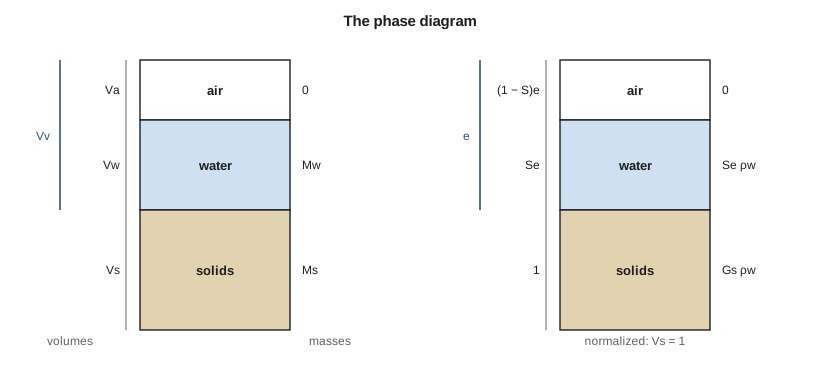
Two families of ratios describe the diagram. Volume ratios describe how open the soil skeleton is and how full the pores are. Mass ratios describe how much water there is compared with solids.
Volume relationships
The void ratio \(e\) compares the volume of voids with the volume of solids, and the porosity \(n\) compares it with the total volume:
Geotechnical engineers prefer the void ratio, because the volume of solids does not change as the soil compresses: when a clay layer consolidates, only the voids shrink, so changes in \(e\) map directly onto changes in thickness. Void ratios range from about 0.3 for dense well-graded gravel to more than 1.5 for soft clays and over 5 for peat.
The degree of saturation \(S\) is the fraction of the voids filled with water, from 0 for a dry soil to 1 (100 %) for a saturated one:
Below the water table, most soils are saturated or very nearly so. Above it, sands drain and are partly saturated, while fine soils may stay saturated well above the water table by capillary suction, as lesson 6 shows.
Mass relationships
The water content \(w\), sometimes called moisture content, is the mass of water divided by the mass of solids, not the total mass. It is found by weighing a sample, drying it in an oven at 110 °C until its mass is constant, and weighing it again:
Because it is referred to the dry mass, the water content can exceed 100 %; organic clays and peats often do. The specific gravity of solids \(G_s\) is the density of the solid particles divided by the density of water. Most inorganic soils have \(G_s\) between 2.6 and 2.8: quartz sand is close to 2.65, and clays with iron-bearing minerals approach 2.8. Organic soils are lighter.
Density and unit weight
In US practice, stresses are calculated from unit weights, the weight per unit volume, in pounds per cubic foot (pcf). Water has \(\gamma_w = 62.4\) pcf. The dry unit weight \(\gamma_d\), the weight of solids per unit total volume, is what compaction specifications control. Typical unit weights are 105 to 135 pcf for most natural soils. Laboratories still weigh specimens in grams and measure volumes in cubic centimeters, and one g/cm³ corresponds to 62.4 pcf.
Several unit weights are in common use:
The buoyant or submerged unit weight \(\gamma' = \gamma_{sat} - \gamma_w\) is the effective weight of soil below the water table, where the water pressure supports part of the weight of the grains. It is roughly half the saturated unit weight and appears whenever effective stresses are calculated.
The key identity
Setting the volume of solids to 1 makes every relationship easy to derive. The voids then have volume \(e\), the water has volume \(Se\), the mass of solids is \(G_s\rho_w\) and the mass of water is \(Se\rho_w\). Dividing the masses gives the most useful identity in the subject:
For a saturated soil, \(e = wG_s\): the void ratio follows directly from the water content. This is how the void ratio of a clay layer is usually found, because water contents are measured on every sample, and it gives a check on the laboratory work, since an independently measured \(S\) should satisfy the identity.
A clay specimen from B-3
In the laboratory, a technician trims a specimen of the varved clay from a Shelby tube taken at 20 ft in B-3 into a stainless steel ring of 100.0 cm³, weighs it, dries it and weighs it again. A pycnometer test on another portion gives \(G_s = 2.75\).
Worked problem
Phase properties of the clay
The specimen has a wet mass of 182.6 g and an oven-dry mass of 131.8 g in a volume of 100.0 cm³. Find \(w\), \(\gamma\), \(\gamma_d\), \(e\), \(n\) and \(S\).
Show solution
- Water content:
- \[w = \frac{182.6 - 131.8}{131.8} = 0.385\]
- Unit weights, with 1 g/cm³ equal to 62.4 pcf:
- \[\gamma = 1.826(62.4) = 113.9\ \text{pcf} \qquad \gamma_d = 1.318(62.4) = 82.2\ \text{pcf}\]
- Volumes, taking the density of water as 1 g/cm³:
- \[V_s = \frac{131.8}{2.75} = 47.9\ \text{cm}^3 \qquad V_v = 100.0 - 47.9 = 52.1\ \text{cm}^3 \qquad V_w = 50.8\ \text{cm}^3\]
- \[e = \frac{52.1}{47.9} = 1.086 \qquad n = \frac{52.1}{100.0} = 0.521 \qquad S = \frac{50.8}{52.1} = 0.976\]
Answer: The check \(Se = 1.060 = wG_s\) confirms the arithmetic. The clay below the water table should be fully saturated; a measured \(S\) of 0.976 is typical of tube samples, in which a little gas comes out of solution as the stress is released, or of small errors in trimming the specimen.
Dr. Kowalczyk tells Owen to use \(e_0 = wG_s = 0.385(2.75) = 1.06\) for the clay in the settlement calculations of lesson 10, because the water content is measured on many samples and does not depend on the trimmed volume. The saturated unit weight from the same values is
which agrees with the 113 to 115 pcf measured on other tube samples.
Relative density of sands
The void ratio alone says little about whether a sand is loose or dense, because the loosest and densest states depend on grain size, shape and grading. Relative density compares the in-place void ratio with the loosest and densest states found in standard laboratory tests:
A relative density near 0 % is very loose, 15 to 35 % loose, 35 to 65 % medium dense, 65 to 85 % dense and above 85 % very dense. Loose saturated sands are prone to large settlement under vibration and to liquefaction in earthquakes; dense sands are strong and stiff. The minimum and maximum densities are found by pouring dry sand gently into a mold and by vibrating it under a surcharge.
In a test pit beside B-3, a nuclear density gauge measured a dry unit weight of 102.1 pcf in the sand at 5 ft. Laboratory tests gave \(e_{max} = 0.88\), \(e_{min} = 0.50\) and \(G_s = 2.65\).
The result agrees with the SPT estimate of about 70 % from lesson 1. Agreement this close is partly luck, since both correlations scatter by 10 to 20 percentage points, but it gives confidence that the sand is in a dense to medium dense state, adequate for footings.
Earthworks quantities
Phase relationships also answer a practical question every contractor asks: how much material must be dug from a borrow pit to build a given volume of compacted fill? The solids are conserved. Their volume in the fill equals their volume in the borrow, so
The salt storage shed sits on a pad of compacted sand fill, 5,500 yd³ in place, compacted to a void ratio of 0.43 from borrow sand at 0.75. Sofia's script computes the borrow volume and the water the contractor must add to bring the sand from its natural 6 % to the 10 % needed for compaction (lesson 5).
# Phase relationships for a Shelby tube specimen of the B-3 clay and the site sand
gw = 62.4                          # unit weight of water (pcf)
Gs = 2.75                          # specific gravity of solids (pycnometer test)
M, Md, V = 182.6, 131.8, 100.0     # wet mass (g), oven-dry mass (g), ring volume (cm3)

w = (M - Md) / Md                  # water content
gamma = M / V * gw                 # 1 g/cm3 corresponds to 62.4 pcf
gamma_d = Md / V * gw
Vs = Md / Gs                       # volume of solids (cm3), water density 1 g/cm3
Vv = V - Vs
Vw = M - Md
e, n, S = Vv / Vs, Vv / V, Vw / Vv
print(f"Clay: w = {w:.3f}, gamma = {gamma:.1f} pcf, gamma_d = {gamma_d:.1f} pcf")
print(f"      e = {e:.3f}, n = {n:.3f}, S = {S:.3f}")
print(f"Check: S e = {S*e:.3f} and w Gs = {w*Gs:.3f}")
gsat = (Gs + e) / (1 + e) * gw
print(f"      gamma_sat from (Gs + e)/(1 + e) gamma_w = {gsat:.1f} pcf")

# Sand: relative density from laboratory limits and the field density
emax, emin, Gs_s = 0.88, 0.50, 2.65
gd_field = 102.1                   # pcf, from a nuclear gauge test in a test pit
e_field = Gs_s * gw / gd_field - 1
Dr = (emax - e_field) / (emax - emin)
print(f"\nSand: e = {e_field:.3f}, Dr = {100*Dr:.0f} %")
w_sat = e_field / Gs_s
print(f"      water content if saturated = {w_sat:.3f}, gamma_sat = {(Gs_s+e_field)/(1+e_field)*gw:.1f} pcf")

# Earthworks: borrow sand (e = 0.75) placed and compacted to e = 0.43 for the salt shed pad
V_fill = 5500.0                    # yd3 of compacted fill
e_borrow, e_fill = 0.75, 0.43
Vs_fill = V_fill / (1 + e_fill)
V_borrow = Vs_fill * (1 + e_borrow)
print(f"\nSolids in fill = {Vs_fill:.0f} yd3; borrow volume = {V_borrow:.0f} yd3 "
      f"({V_borrow/V_fill:.2f} yd3 per yd3 of fill)")
Ws = Vs_fill * 27 * Gs_s * gw / 2000      # tons of solids
w_borrow, w_target = 0.06, 0.10
water_tons = Ws * (w_target - w_borrow)
print(f"Water to add from {w_borrow:.0%} to {w_target:.0%}: {water_tons:.0f} tons, about {water_tons*2000/8.34:,.0f} gal")Clay: w = 0.385, gamma = 113.9 pcf, gamma_d = 82.2 pcf
e = 1.086, n = 0.521, S = 0.976
Check: S e = 1.060 and w Gs = 1.060
gamma_sat from (Gs + e)/(1 + e) gamma_w = 114.7 pcf
Sand: e = 0.620, Dr = 69 %
water content if saturated = 0.234, gamma_sat = 126.0 pcf
Solids in fill = 3846 yd3; borrow volume = 6731 yd3 (1.22 yd3 per yd3 of fill)
Water to add from 6% to 10%: 343 tons, about 82,360 galThe contractor needs about 6,730 yd³ of borrow in the ground, 22 % more than the compacted volume, before allowing for the swell of loose material in the trucks, which is larger still. Bringing the water content up by four percentage points takes about 82,000 gal of water, delivered by water trucks and spread with a disk harrow or by spraying each lift.
Bank, loose and compacted volumes
Earthwork estimators speak of three volumes. Bank volume is the material in its natural state, the borrow volume above. Loose volume is the same material dug and heaped in a truck, typically 10 to 30 % larger for sands and more for clays and rock, which is called swell. Compacted volume is the material placed and compacted in the fill. Haul costs depend on the loose volume, excavation on the bank volume and payment for fill usually on the compacted volume. Clear specifications state which volume is measured.
Working without a phase diagram
With practice, most problems can be solved from the identities, but when a problem is unfamiliar, draw the diagram, set either the total volume or the volume of solids to 1, fill in what is known and compute the rest. Always check \(Se = wG_s\) at the end. Remember that water content is measured on the dry mass and that unit weights depend on saturation: using \(\gamma\) above the water table and \(\gamma_{sat}\) below is the most common requirement in the stress calculations of lesson 6.
| Soil | γ (pcf) | e | w (%) |
|---|---|---|---|
| Loose uniform sand | 100–115 | 0.7–0.9 | 5–20 |
| Dense well-graded sand and gravel | 125–140 | 0.3–0.5 | 5–12 |
| Glacial till | 130–145 | 0.25–0.4 | 8–15 |
| Stiff glaciolacustrine clay | 115–125 | 0.6–1.0 | 22–35 |
| Soft clay | 95–110 | 1.2–2.5 | 45–90 |
| Peat | 60–75 | 5–12 | 300–800 |
Practical points
- Water contents are the cheapest and most informative test in a soils laboratory. Measure them on every sample.
- Do not assume \(G_s = 2.65\) for clays; measure it or use about 2.7 to 2.8 for inorganic clays.
- Keep track of saturated and moist unit weights above and below the water table.
- For earthworks, state whether volumes are bank, loose or compacted.
Common mistakes
MistakeDividing the mass of water by the total mass to get the water content.
InsteadDivide by the dry mass of solids.
MistakeUsing the porosity in place of the void ratio in settlement calculations.
InsteadUse the void ratio, whose denominator, the volume of solids, does not change.
MistakeUsing the saturated unit weight above the water table in a sand.
InsteadUse the moist unit weight above the water table and the saturated unit weight below.
MistakeAssuming a compacted fill needs the same volume of borrow.
InsteadCompute the ratio (1 + e borrow)/(1 + e fill) and add swell for haul.
Summary and key terms
- Soil is a mixture of solids, water and air, represented by a phase diagram.
- Void ratio \(e = V_v/V_s\), porosity \(n = V_v/V\), saturation \(S = V_w/V_v\) and water content \(w = M_w/M_s\).
- The identity \(Se = wG_s\) links the ratios; for saturated soil \(e = wG_s\).
- Unit weights: \(\gamma = (G_s + Se)\gamma_w/(1 + e)\), \(\gamma_d = G_s\gamma_w/(1 + e)\), and \(\gamma' = \gamma_{sat} - \gamma_w\) below the water table.
- Relative density \(D_r = (e_{max} - e)/(e_{max} - e_{min})\) describes the state of sands.
- Borrow volume equals fill volume times \((1 + e_{borrow})/(1 + e_{fill})\).
- Void ratio
- The volume of voids divided by the volume of solids.
- Porosity
- The volume of voids divided by the total volume.
- Degree of saturation
- The fraction of the void volume occupied by water.
- Water content
- The mass of water divided by the mass of dry solids.
- Specific gravity of solids
- The density of the soil particles divided by the density of water.
- Dry unit weight
- The weight of solids per unit total volume of soil.
- Buoyant unit weight
- The saturated unit weight minus the unit weight of water.
- Relative density
- The position of a sand's void ratio between its loosest and densest laboratory states.
Practice problems
Work each problem on paper first, then reveal the answer to check.
A saturated clay has a water content of 52 % and Gs = 2.72. Find e and the saturated unit weight.
Show answer
\(e = 0.52(2.72) = 1.414\); \(\gamma_{sat} = (2.72 + 1.414)(62.4)/2.414 = 107\) pcf.
A sand has γ = 118 pcf and w = 10 % with Gs = 2.66. Find γd, e and S.
Show answer
\(\gamma_d = 118/1.10 = 107.3\) pcf; \(e = 2.66(62.4)/107.3 - 1 = 0.547\); \(S = 0.10(2.66)/0.547 = 0.49\).
Show that n = e/(1 + e).
Show answer
With Vs = 1, Vv = e and V = 1 + e, so n = Vv/V = e/(1 + e).
A road embankment needs 10,000 yd³ of fill at e = 0.45 from borrow at e = 0.70. How much bank volume is needed?
Show answer
\(10{,}000(1.70/1.45) = 11{,}700\) yd³.
Lesson quiz · 5 questions
Score 60% or more to complete this lesson.
Create a free account to save your progress, take quizzes and earn a certificate.