
CIV-340 · Lesson 12 of 12 · 24 min
Shear strength and the soils report
Soils fail in shear. A footing that is overloaded pushes a wedge of soil sideways, a slope slides along a curved surface, and the soil behind a wall shears as the wall moves. In each case the grains slide and roll past each other along a surface, and the resistance to that sliding is the shear strength. This final lesson explains the Mohr-Coulomb failure criterion, the laboratory tests that measure strength, and the crucial difference between drained and undrained behavior. It then assembles the soils report for the operations center from the results of every lesson.
Friction and effective stress
Shear strength in soil is mostly friction. Two grains pressed together resist sliding in proportion to the force pressing them, and in dense soils the grains must also ride up over their neighbors, which adds to the resistance. Because the force pressing grains together is the effective stress, the strength depends on effective stress, not total stress. That single fact explains why a saturated slope can fail after heavy rain without any change in its geometry or load: the rain raises the pore pressure, the effective stress falls and with it the strength.
The Mohr-Coulomb criterion
Coulomb, in 1773, described the strength of soil on a failure plane as a cohesion plus a friction term. Written in effective stresses, as Terzaghi's principle requires, the criterion is
where \(\tau_f\) is the shear stress on the failure plane at failure, \(\sigma'_n\) is the effective normal stress on that plane, \(\phi'\) is the effective angle of shearing resistance or friction angle, and \(c'\) is the effective cohesion intercept. For sands and normally consolidated clays, \(c'\) is essentially zero. Overconsolidated clays and cemented soils show a small \(c'\), but it is often an artifact of fitting a straight line to a curved envelope and is used cautiously in design.
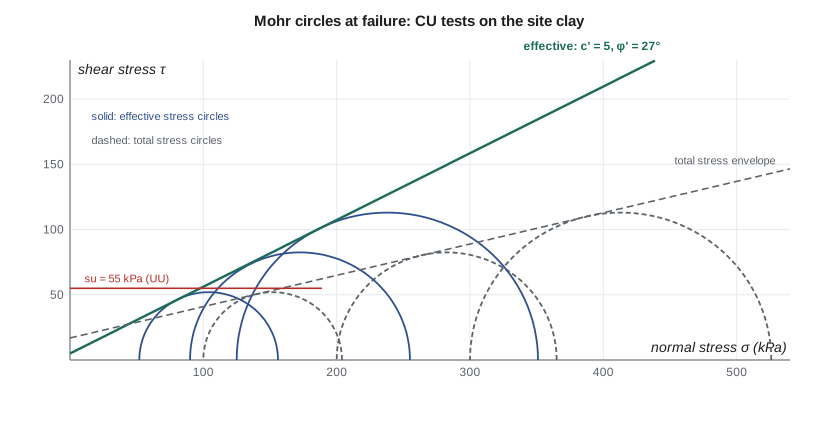
The state of stress at a point is represented by Mohr's circle, with normal stress on the horizontal axis and shear stress on the vertical axis. A circle drawn from the major and minor principal stresses \(\sigma_1\) and \(\sigma_3\) gives the normal and shear stresses on every plane through the point. Failure occurs when the circle touches the Mohr-Coulomb line, the failure envelope. From the geometry of the tangent point, the principal stresses at failure are related by
and the failure plane is inclined at \(45^\circ + \phi'/2\) to the plane on which \(\sigma_1\) acts. The same relationship gives the active and passive earth pressures on retaining walls, covered in CIV-440.
The direct shear test
The direct shear test is the simplest strength test. A specimen in a split box, square or circular, is loaded vertically by a normal force and then sheared by moving the lower half of the box horizontally relative to the upper half at a constant rate. The shear force and the horizontal and vertical displacements are recorded. Repeating the test at three or more normal stresses and plotting the peak shear stress against normal stress gives the failure envelope directly. The test forces failure on a horizontal plane and gives no control of drainage, so it is used mainly for sands, which drain freely, and, run very slowly, for drained tests on clays. Run repeatedly back and forth, it measures residual strength, the low strength that develops on a polished slip surface in clay.
Dense sands show a peak strength followed by a drop to a lower, steady value as the specimen dilates, expanding as the grains ride over each other. Loose sands contract and rise steadily to the same ultimate value, the critical state, without a peak. The difference between peak and critical-state friction angles can be 5 to 10 degrees in dense sand.
The triaxial test
The triaxial test is the workhorse of soil strength testing. A cylindrical specimen, typically 38 to 100 mm (1.5 to 4 in.) in diameter and twice as tall, is sealed in a rubber membrane and placed in a cell filled with water. The cell pressure applies the minor principal stress \(\sigma_3\) all round, and a piston adds a vertical deviator stress \(\sigma_1 - \sigma_3\) until failure. Drainage lines from the top and bottom of the specimen can be opened or closed, and a transducer measures the pore pressure. Three types of test are standard:
- Unconsolidated-undrained (UU): the specimen is sheared quickly with no drainage at any stage. It gives the undrained shear strength \(s_u\) of the sample at its field water content. The unconfined compression test is a UU test with no cell pressure.
- Consolidated-undrained (CU): the specimen is first consolidated under the cell pressure, then sheared with the drainage closed and the pore pressure measured. It gives both total and effective stress parameters and is the most informative test for clays.
- Consolidated-drained (CD): the specimen is consolidated and then sheared slowly enough that no excess pore pressure develops. It gives \(c'\) and \(\phi'\) directly but takes days for clays.
Drained and undrained behavior
When a saturated soil is sheared, its skeleton tends to change volume: loose soils and normally consolidated clays tend to contract, dense soils and heavily overconsolidated clays tend to dilate. If water can drain freely, as in a sand or in a clay loaded very slowly, the volume changes and the pore pressure stays at its static value. This is drained behavior, analyzed with effective stresses and \(c'\), \(\phi'\).
If water cannot drain during loading, as in a clay loaded over days or weeks, the volume stays constant, and the tendency to contract or dilate appears instead as a positive or negative excess pore pressure. This is undrained behavior. The strength then depends on the effective stress after those pore pressures develop, which the engineer usually cannot predict reliably. Instead, the soil is treated as having a constant undrained strength \(s_u\), measured directly, independent of the total stress: the \(\phi_u = 0\) analysis. Saturated clay under a footing or an embankment built quickly is analyzed this way for the end of construction, because its strength cannot rise until the excess pore pressure dissipates. In the long term, as the clay consolidates, the drained analysis governs.
Skempton's pore pressure parameter \(A\) describes the response: \(\Delta u = B[\Delta\sigma_3 + A(\Delta\sigma_1 - \Delta\sigma_3)]\), with \(B\) close to 1 for saturated soil. At failure, \(A_f\) is about 0.7 to 1.3 for normally consolidated clays, smaller for lightly overconsolidated ones and negative for heavily overconsolidated clays, which dilate.
Tests on the site soils
The laboratory ran three direct shear tests on the medium dense sand, recompacted to its field density, and a suite of tests on the tube samples of the clay: three CU tests with pore pressure measurement consolidated to cell pressures of 2,000, 4,000 and 6,000 psf, and three UU tests at the field stress. Sofia's script fits the envelopes. For the CU tests it uses the stress path plot of \(q = (\sigma_1 - \sigma_3)/2\) against \(p' = (\sigma'_1 + \sigma'_3)/2\), on which the failure points lie on a line of slope \(\tan\alpha = \sin\phi'\) and intercept \(a = c'\cos\phi'\).
# Shear strength parameters of the site soils from laboratory tests
from math import atan, degrees, radians, sin, cos, tan, asin, sqrt

def line_fit(xs, ys):
    n = len(xs); xm, ym = sum(xs) / n, sum(ys) / n
    b = sum((x - xm) * (y - ym) for x, y in zip(xs, ys)) / sum((x - xm) ** 2 for x in xs)
    return ym - b * xm, b                       # intercept, slope

# Direct shear tests on the compact sand (peak values)
sn = [1000.0, 2000.0, 4000.0]; tf = [690.0, 1335.0, 2710.0]
tan_phi = sum(s * t for s, t in zip(sn, tf)) / sum(s * s for s in sn)       # fit through the origin, c' = 0
print(f"Sand, direct shear: phi' = {degrees(atan(tan_phi)):.1f} deg (c' = 0)")

# Consolidated-undrained triaxial tests with pore pressure on the clay (psf)
cell = [2000.0, 4000.0, 6000.0]; dev = [2010.0, 3140.0, 4250.0]; uf = [1000.0, 2300.0, 3650.0]
p_eff = [(c - u) + d / 2 for c, d, u in zip(cell, dev, uf)]                # p' = (s1' + s3')/2
q = [d / 2 for d in dev]                                                    # q = (s1 - s3)/2
a, tan_alpha = line_fit(p_eff, q)
phi = asin(tan_alpha); c = a / cos(phi)
print(f"Clay, CU effective: phi' = {degrees(phi):.1f} deg, c' = {c:.0f} psf")
p_tot = [c3 + d / 2 for c3, d in zip(cell, dev)]
a2, t2 = line_fit(p_tot, q)
print(f"Clay, CU total stress: phi_cu = {degrees(asin(t2)):.1f} deg, c_cu = {a2 / cos(asin(t2)):.0f} psf")
for c3, d, u in zip(cell, dev, uf):
    s3, s1 = c3 - u, c3 - u + d
    A = u / d
    print(f"  cell {c3:5.0f}: s3' = {s3:5.0f}, s1' = {s1:5.0f}, Af = {A:.2f}")

# Unconsolidated-undrained tests on tube samples, and the field vane
uu = [1100.0, 1190.0, 1150.0]
print(f"Clay, UU: su = {sum(uu)/3:.0f} psf (field vane 1,090 to 1,250 psf, design 1,150 psf)")

# Drained and undrained strength at mid-depth of the clay under the garage (lesson 6)
s0 = 1749.0
print(f"\nAt 24.5 ft: drained strength on a horizontal plane = {c + s0 * tan(phi):.0f} psf; undrained su = 1,150 psf")

# Design summary for the soils report
rows = [("Sand, SP-SM, 0 to 13 ft", "115 / 126", "phi' 34 deg, c' 0", "N60 12-24, Dr about 70 %"),
        ("Clay, CL, 13 to 36 ft", "115", f"phi' {degrees(phi):.0f} deg, c' {c:.0f}; su 1150", "Cc 0.32, Cr 0.047, POP 800, cv 27 ft2/yr"),
        ("Till, SM, 36 to 51 ft", "137", "phi' 38 deg (assumed)", "artesian head 5 ft below grade"),]
print("\nStratum                     gamma (pcf)     strength                   other")
for r in rows:
print(f"{r[0]:27s} {r[1]:14s} {r[2]:26s} {r[3]}")Sand, direct shear: phi' = 34.1 deg (c' = 0) Clay, CU effective: phi' = 27.0 deg, c' = 105 psf Clay, CU total stress: phi_cu = 12.6 deg, c_cu = 358 psf cell 2000: s3' = 1000, s1' = 3010, Af = 0.50 cell 4000: s3' = 1700, s1' = 4840, Af = 0.73 cell 6000: s3' = 2350, s1' = 6600, Af = 0.86 Clay, UU: su = 1147 psf (field vane 1,090 to 1,250 psf, design 1,150 psf) At 24.5 ft: drained strength on a horizontal plane = 994 psf; undrained su = 1,150 psf Stratum gamma (pcf) strength other Sand, SP-SM, 0 to 13 ft 115 / 126 phi' 34 deg, c' 0 N60 12-24, Dr about 70 % Clay, CL, 13 to 36 ft 115 phi' 27 deg, c' 105; su 1150 Cc 0.32, Cr 0.047, POP 800, cv 27 ft2/yr Till, SM, 36 to 51 ft 137 phi' 38 deg (assumed) artesian head 5 ft below grade
Worked problem
Effective strength from one CU test
In the CU test at a cell pressure of 4,000 psf, the deviator stress at failure was 3,140 psf and the pore pressure 2,300 psf. With the envelope \(c' = 105\) psf, \(\phi' = 27.0^\circ\), check that this specimen lies on it.
Show solution
- \[\sigma'_3 = 4000 - 2300 = 1700\ \text{psf} \qquad \sigma'_1 = 1700 + 3140 = 4840\ \text{psf}\]
- Predicted \(\sigma'_1\) at failure from the envelope:
- \[\sigma'_1 = 1700\tan^2 58.5^\circ + 2(105)\tan 58.5^\circ = 1700(2.66) + 343 = 4870\ \text{psf}\]
Answer: The measured and predicted values agree within 1 %. The pore pressure parameter at failure, \(A_f = 110/165 = 0.67\), is typical of a lightly overconsolidated clay that contracts as it shears.
The sand has \(\phi' = 34^\circ\) with no cohesion, consistent with its medium dense state and the SPT correlations of lesson 1. The clay has \(\phi' = 27^\circ\) and \(c' = 105\) psf in effective stress; in total stress the CU envelope is much flatter, \(\phi_{cu} = 12.6^\circ\), because positive pore pressures develop as the clay contracts. The UU tests give \(s_u = 1{,}150\) psf, agreeing with the field vane.
Which strength to use
The choice between drained and undrained strength depends on how fast the soil is loaded compared with how fast it drains. For sands and gravels, which drain in seconds, drained parameters apply to almost everything except earthquake shaking. For clays, both cases must be checked. The end of construction, before consolidation, is usually critical for loading, such as a footing or an embankment, because the clay gains strength as it consolidates; the undrained analysis applies. For unloading, such as an excavation or a cut slope, the reverse is true: the pore pressures drop on unloading and rise slowly back, the clay softens with time and the long-term drained case is critical. Many slope failures in clay cuts have happened years or decades after excavation for this reason.
For the garage footings, the end-of-construction check uses \(s_u = 1{,}150\) psf in the clay, and CIV-341 develops the bearing capacity equations that use it. For the pump station excavation, the long-term check of the clay beneath and around it uses \(c' = 105\) psf and \(\phi' = 27^\circ\), with the pore pressures from the seepage analysis of lesson 8.
Sensitivity
Some clays lose much of their strength when remolded. Sensitivity is the ratio of undisturbed to remolded undrained strength. Most clays have a sensitivity of 2 to 4; quick clays, such as the Leda clay of eastern Canada and many Scandinavian marine clays, have sensitivities above 16 and can liquefy when disturbed, causing large retrogressive landslides. The site clay, with a field vane sensitivity of about 3, is of low to medium sensitivity, but it will soften if trafficked when wet, so the specification requires construction traffic to stay on a granular working platform.
The soils report
Dr. Kowalczyk's interpretive report brings the course together. It follows the structure that most geotechnical reports share: the project and its scope, the site and its geology, the investigation, the subsurface conditions and groundwater, the design parameters, the engineering analyses and recommendations, and the construction considerations, with the factual logs and test results in appendices.
| Item | Lesson | Finding at the operations center |
|---|---|---|
| Stratigraphy | 1 | Sand to 13 ft (23 ft at the pump station), clay to 36 ft, till, basalt at 51 ft |
| Groundwater | 1, 6 | 8 ft in the sand; till artesian, 5 ft below grade |
| Index properties | 2, 3 | Clay w 38.5 %, e0 1.06, LL 45, PI 23 |
| Classification | 4 | Sand SP-SM, clay CL, till SM, silt lenses ML |
| Compaction | 5 | Borrow sand modified maximum 124.5 pcf at 9.1 %; 95 % specified |
| Permeability | 7 | Sand 0.011 cm/s; clay kv 3 × 10⁻⁸ cm/s, kh/kv about 30 |
| Pump station | 8 | Inflow about 30 gpm; exit gradient FS 3.7; uplift FS 1.34 |
| Footing stresses | 9 | q net 4,388 psf; 1,971 psf at the top of the clay |
| Settlement | 10, 11 | Interior footing about 2.2 in. primary, almost half in three months, plus about 0.8 in. secondary over 50 years |
| Strength | 12 | Sand φ' 34°; clay φ' 27°, c' 105 psf, su 1,150 psf |
Recommendations
From those findings, the report makes its recommendations. Each one traces back to a calculation in this course:
- Spread footings on the medium dense sand at 5 ft depth, as designed in CIV-330, are acceptable. Predicted consolidation settlement of interior footings is about 2.2 in. and differential settlement about 0.4 in. between adjacent footings, an angular distortion of about 1/750. The structure and finishes should be detailed for these movements.
- The slab-on-grade must be isolated from columns and walls and placed on a granular base with a capillary break.
- The yard fill should be placed as early as possible, with settlement plates and piezometers, so that most of its consolidation occurs before paving and before the garage is complete.
- Structural fill for the salt shed pad: site sand placed in thin lifts, compacted to the specified density within 2 points of optimum, with field density tests on every lift.
- The till and silty soils must not be used as backfill against foundations or under slabs, because they are frost-susceptible.
- The pump station cofferdam: sheet piles to the specified tip, pumping capacity at least twice the computed inflow, a piezometer in the till inside the cofferdam with trigger levels, relief wells on standby and no over-excavation.
- Dewatering must be monitored at the garage. If the drawdown extends beneath it, settlement points on the garage will be read weekly, and recharge wells will be installed if needed.
- Construction traffic on the clay should be kept to a granular working platform to avoid remolding, and the clay at footing level, if exposed, must be protected from freezing and water.
Owen reads the draft and notices how much of it depends on things that were not in the original footing design: the artesian till, the silt lenses, the dewatering, the time for consolidation. Dr. Kowalczyk tells him that is the usual experience. The footing calculation is the easy part. The value of soil mechanics lies in understanding the ground well enough to see what could go wrong, and in writing that down clearly for the people who will build and use the structure.
Practical points
- Always state whether parameters are drained (effective stress) or undrained (total stress) and when each applies.
- Check loading cases at the end of construction with su and unloading cases in the long term with c' and φ'.
- Use \(c'\) cautiously; a small intercept multiplied by a large failure surface can give a large, unreliable resistance.
- Write recommendations that a contractor can act on, and tie each to the finding that supports it.
Common mistakes
MistakeUsing total stress parameters from a CU test for long-term stability.
InsteadUse the effective stress parameters with the long-term pore pressures.
MistakeTreating su as a fixed property of a clay at all times.
Insteadsu changes as the clay consolidates or swells; use the value for the stage being analyzed.
MistakeAssuming an excavation in clay is safest in the long term because it stood at the end of construction.
InsteadUnloading lets the clay soften with time; the drained long-term case often governs.
MistakeReporting test results without interpreting what they mean for the design.
InsteadAn interpretive report must turn data into parameters and recommendations.
Summary and key terms
- Shear strength follows Mohr-Coulomb in effective stress: \(\tau_f = c' + \sigma'_n\tan\phi'\).
- At failure \(\sigma'_1 = \sigma'_3\tan^2(45^\circ + \phi'/2) + 2c'\tan(45^\circ + \phi'/2)\), on a plane at \(45^\circ + \phi'/2\).
- Direct shear suits sands; triaxial UU, CU and CD tests suit clays and give total and effective parameters.
- Undrained loading of saturated clay is analyzed with \(s_u\) (\(\phi_u = 0\)); drained behavior with \(c'\) and \(\phi'\).
- The site sand has φ' = 34°; the clay φ' = 27°, c' = 105 psf and su = 1,150 psf.
- The soils report turns the investigation into design parameters, analyses and actionable recommendations.
- Shear strength
- The maximum shear stress a soil can sustain on a plane.
- Mohr-Coulomb criterion
- The failure condition τf = c' + σ'n tan φ'.
- Angle of shearing resistance
- φ', the friction angle in effective stress.
- Undrained shear strength
- su, the strength of saturated clay loaded without drainage.
- Dilation
- The increase in volume of a dense soil as it shears.
- Critical state
- The state in which a soil shears at constant volume and constant stress.
- Triaxial test
- A strength test on a cylindrical specimen under controlled cell pressure and drainage.
- Sensitivity
- The ratio of the undisturbed to the remolded undrained strength of a clay.
Practice problems
Work each problem on paper first, then reveal the answer to check.
A sand with φ' = 34° is at σ'3 = 1,600 psf in a drained triaxial test. Find σ'1 at failure.
Show answer
\(\tan^2 62^\circ = 3.54\); \(\sigma'_1 = 5{,}660\) psf.
At what angle to the horizontal does the failure plane form in that test?
Show answer
At 45° + 34°/2 = 62° to the plane on which σ1 acts, which is horizontal.
A UU test on the clay at a cell pressure of 3,000 psf fails at a deviator stress of 2,300 psf. Find su.
Show answer
\(s_u = 2{,}300/2 = 1{,}150\) psf; the cell pressure does not affect it.
Why is a clay cut slope often less stable years after excavation than on the day it was dug?
Show answer
Unloading lowers the pore pressures; as they recover, the effective stress and strength fall.
Lesson quiz · 5 questions
Score 60% or more to complete this lesson.
Create a free account to save your progress, take quizzes and earn a certificate.