
CHE-380 · Lesson 2 of 12 · 23 min
Toxicology and industrial hygiene
The first hazard most people meet at a chemical plant is not an explosion but a vapor they breathe. Ethyl acetate has a sweet, fruity smell that operators at Kingfisher Bioenergy notice when they sample a tank or fill a drum. Ethanol vapor is everywhere around the loading racks. Neither is highly toxic, but both can cause headaches, dizziness and irritation at high concentrations, and both are handled in large quantities. Theo's second week is spent with the site industrial hygienist, Priya Venkat, who measures what workers actually breathe and decides whether it is acceptable. This lesson covers how toxic effects are described, how exposure limits are set and used, how exposure is measured, and how ventilation and other controls keep it low.
How toxicants enter and act on the body
Chemicals enter the body by four routes: inhalation, absorption through the skin, ingestion and injection. In industry, inhalation is the most important, because the lungs have a large surface area and deliver absorbed material quickly to the blood. Skin absorption matters for some liquids, such as phenol and many solvents, and safety data sheets flag these with a skin notation. Ingestion usually happens through contaminated hands and food, which is why eating is banned in process areas. Injection occurs through cuts and high-pressure leaks.
Once absorbed, a chemical is distributed, metabolized and eliminated. Its effects may be local, at the point of contact, or systemic, affecting organs such as the liver, kidneys or nervous system. Toxicologists distinguish acute effects, which follow a single short exposure, from chronic effects, which follow repeated exposure over months or years. Solvent vapors like ethyl acetate cause acute narcotic effects at high concentrations and irritation of eyes and airways. Other chemicals at the site, such as the sulfuric acid used for pH control and the ammonia stored for the same purpose at some plants, are corrosive and act mostly at the point of contact.
Dose and response
The central idea of toxicology is that the dose makes the poison. For a population exposed to increasing doses, the fraction showing a given response rises in an S-shaped curve when plotted against the logarithm of the dose. Individuals differ in sensitivity, so the curve spreads out. Key points on such curves include the dose at which half the population responds, written \(ED_{50}\) for an effect and \(LD_{50}\) for lethality in animal studies, and the threshold below which no effect is observed. For inhalation, concentration and time combine into a dose, and many effects depend on something like \(C^n t\), where \(n\) is often between 1 and 3.
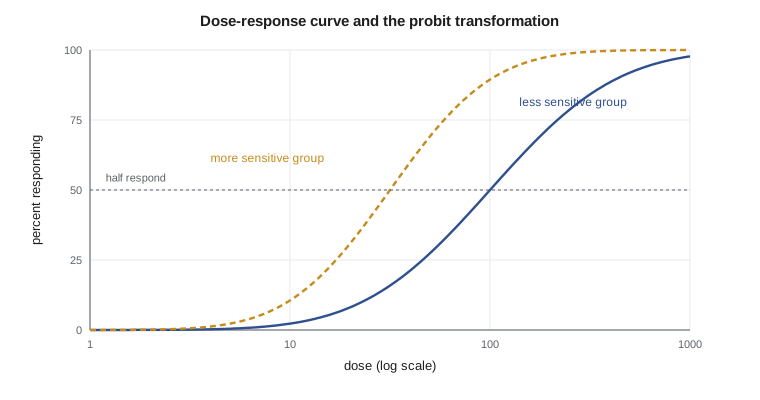
For mathematical work the S-shaped curve is often converted to a straight line with a probit transformation. The probit variable \(Y\) is related to the dose \(V\) by \(Y = k_1 + k_2 \ln V\), and the fraction responding is the cumulative normal distribution evaluated at \(Y - 5\). Probit equations are used in risk assessment to estimate the effects of thermal radiation and blast as well as toxic exposure. In this course we use them for fire and explosion effects in the risk lessons. The constants come from published studies and carry large uncertainty.
Exposure limits
Occupational exposure limits state concentrations of airborne chemicals to which nearly all workers can be exposed day after day without adverse health effects. They are expressed in several forms. The time-weighted average, TWA, is the average concentration over an 8-hour shift. The short-term exposure limit, STEL, is a 15-minute average that should not be exceeded. A ceiling value must not be exceeded even briefly. In Iowa the legal limits are OSHA's permissible exposure limits in 29 CFR 1910.1000, many of which date from 1971, read alongside the more recent NIOSH recommended limits and ACGIH threshold limit values. Exposure limits are not sharp lines between safe and dangerous; they are judgments built on animal studies, human experience and policy, and many have been lowered over time as evidence accumulated.
| Substance | Typical 8-hour limit | Notes |
|---|---|---|
| Ethyl acetate | 400 ppm | Eye and airway irritation; narcotic at high levels |
| Ethanol | 1,000 ppm | Some lists give only a short-term value |
| Acetaldehyde | Ceiling of about 25 ppm in several lists | Irritant; suspected carcinogen |
| Carbon dioxide | 5,000 ppm | Fermentation by-product; asphyxiant in confined spaces |
Several of these substances matter for reasons beyond their limits. Carbon dioxide from fermentation is heavier than air and collects in pits, tanks and enclosed spaces, where it can displace oxygen; several deaths in the fermentation industries have occurred this way. Confined space entry programs, covered in the safety program courses, treat oxygen deficiency as a primary hazard. Acetaldehyde, found in small amounts in the vent streams scrubbed in CHE-314, has a low limit and is controlled at the source.
Measuring exposure
Priya measures exposure with personal sampling: a small pump draws air through a sorbent tube or onto a badge clipped near the worker's breathing zone for the duration of a task or shift. The sample is analyzed in a laboratory, and the result is combined with the time of each task to give a time-weighted average. Direct-reading instruments, such as photoionization detectors, give real-time readings that help find sources but are less accurate for compliance. Sampling strategies aim to identify similar exposure groups, workers who do the same tasks, and sample enough of them to be confident the limit is met with a margin.
# Time-weighted average exposure for a tank-farm operator against 8-hour limits, and dilution ventilation
samples = (("drum filling, ethyl acetate", 1.5, 260.0), ("sampling at tank T-402", 0.5, 120.0),
           ("control room", 5.0, 5.0), ("walk-around", 1.0, 30.0))   # (task, hours, ppm), illustrative
twa = sum(h * c for _, h, c in samples) / 8.0
oel = 400.0   # ethyl acetate 8-hour limit used in both countries, ppm
print(f"8-hour TWA = {twa:.0f} ppm = {100 * twa / oel:.0f} % of the {oel:.0f} ppm limit")
# Mixture of two solvents: additive effect, sum of C/OEL must be below 1
mix = ((twa, 400.0), (40.0, 1000.0))     # ethyl acetate and ethanol (ethanol limit taken as 1000 ppm, a short-term value in ACGIH)
print(f"mixture index = {sum(c / l for c, l in mix):.2f}  (below 1 is acceptable)")
# Dilution ventilation for a drum-filling room: Q = G k / C, G the vapor generation rate
M, rho = 88.1, 900.0        # ethyl acetate molar mass g/mol, liquid density kg/m3
evap_L_h = 0.20             # liquid evaporated per hour, liters
G = evap_L_h / 1000 * rho * 1000 / M / 3600   # mol/s
Vm = 0.02445                 # m3/mol at 25 C and 1 atm
for k in (3, 5):             # mixing factor
    for target in (100.0, 40.0):
        Q = G * Vm * k / (target * 1e-6)
print(f"k = {k}, target {target:.0f} ppm: ventilation {Q:.2f} m3/s ({Q * 2119:.0f} cfm)")8-hour TWA = 63 ppm = 16 % of the 400 ppm limit mixture index = 0.20 (below 1 is acceptable) k = 3, target 100 ppm: ventilation 0.42 m3/s (882 cfm) k = 3, target 40 ppm: ventilation 1.04 m3/s (2205 cfm) k = 5, target 100 ppm: ventilation 0.69 m3/s (1470 cfm) k = 5, target 40 ppm: ventilation 1.73 m3/s (3675 cfm)
For the tank farm operator, four tasks give an 8-hour TWA of 63 ppm of ethyl acetate, 16 % of the 400 ppm limit. Most of the dose comes from drum filling, 1.5 hours at 260 ppm, even though the operator spends five hours in the clean control room. That is typical: a small number of tasks dominate exposure, so controls should target them. Where several substances with similar effects are present, their fractions of their limits are added. Here ethyl acetate and ethanol together give a mixture index of 0.20, well below 1. If the index exceeded 1 the exposure would be over the combined limit even though each substance was individually below its own.
Worked problem
Time-weighted average
A worker spends 2 h at 150 ppm, 3 h at 60 ppm and 3 h at 10 ppm. The limit is 100 ppm. Is the exposure acceptable?
Show solution
- \(TWA = (2 \times 150 + 3 \times 60 + 3 \times 10)/8 = 510/8 = 63.8\) ppm.
- That is 64 % of the limit. Many hygienists aim to keep exposures below half the limit, so further controls on the 150 ppm task would be considered.
Answer: Below the limit, but above the common action level of half the limit.
Controlling exposure
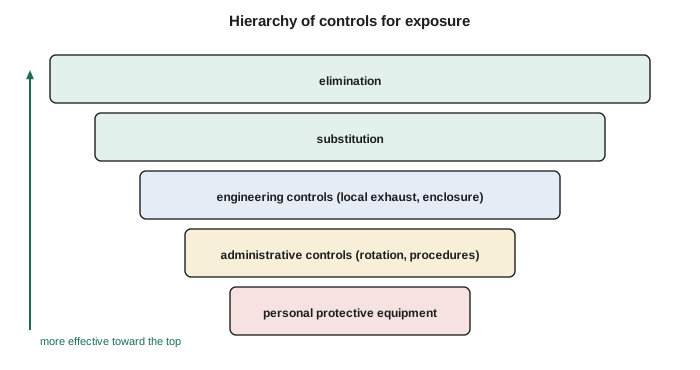
Controls follow the hierarchy shown below. Elimination and substitution remove or replace the hazard: for example, a less volatile solvent for cleaning. Engineering controls change the workplace: enclosing a process, adding local exhaust ventilation at the drum filling lance, or installing closed-loop sampling so that sample bottles are filled without venting to the operator's face. Administrative controls change how work is done: rotating tasks, shorter durations, written procedures. Personal protective equipment, such as respirators and gloves, is the last line, because it depends on correct selection, fit and use every time.
Dilution ventilation supplies enough fresh air to keep the average concentration in a room below a target. If vapor is generated at a molar rate \(G\), the steady concentration in a well-mixed room is \(C = G V_m/Q\), where \(Q\) is the ventilation rate and \(V_m\) the molar volume. Real rooms are not well mixed, so a mixing factor \(k\), between about 3 and 10, multiplies the required airflow: \(Q = kGV_m/C\). For the drum-filling room, an evaporation of 0.2 L/h of ethyl acetate needs about 0.4 to 0.7 m³/s to hold 100 ppm and over 1 m³/s to hold 40 ppm. The same calculation shows why local exhaust at the source is usually better: capturing vapor at the drum opening takes far less air than diluting it throughout the room.
Worked problem
Dilution ventilation
A room generates 0.01 mol/s of a solvent vapor. With \(V_m = 0.0245\) m³/mol and a mixing factor of 4, what airflow holds the concentration at 50 ppm?
Show solution
- \(Q = kGV_m/C = 4 \times 0.01 \times 0.0245/(50 \times 10^{-6})\).
- \(Q = 19.6\) m³/s.
Answer: About 20 m³/s, a very large flow: local exhaust at the source would be the better choice.
Respirators, gloves and skin
When engineering controls cannot reduce exposure enough, for example during an occasional tank cleaning or a line break, respirators are used. Air-purifying respirators with organic vapor cartridges remove solvent vapors but provide no oxygen, so they must never be used in oxygen-deficient atmospheres or at concentrations above their rated protection factor. Supplied-air respirators and self-contained breathing apparatus deliver clean air from a separate source and are required for confined spaces where oxygen may be low and for emergency response. Every respirator program needs medical clearance, fit testing, training and cartridge change schedules, because a respirator that leaks around the face gives a false sense of protection. Priya keeps the program records, and the operators who fill drums are fit tested every year.
Skin contact is easy to overlook because vapor sampling does not measure it. Ethyl acetate defats the skin and causes dermatitis with repeated contact; some other solvents pass through the skin into the blood. Glove selection depends on the chemical: a glove that resists one solvent may let another through within minutes. Manufacturers publish breakthrough times for their glove materials, and the plant's glove chart lists the right type for each product. Washing facilities, barrier creams and the rule that gloves are discarded rather than reused when contaminated complete the controls. Priya also reviews the safety data sheets for any new chemical before it reaches the site, so that the hazard information and the controls are in place on the first day it is used.
From hygiene to process safety
Industrial hygiene deals mainly with chronic, low-level exposures in normal operation. Process safety deals with acute exposures from accidental releases. The two meet in emergency planning, where the question becomes what concentration a person could tolerate for an hour while escaping. For that purpose, emergency response planning guidelines and acute exposure guideline levels are published for many chemicals; lesson 4 uses such endpoints to decide how far a release could matter. At Kingfisher Bioenergy the ethanol, ethyl acetate and the small amounts of acetaldehyde are flammable hazards more than toxic ones, so the dispersion studies in this course concentrate on flammable clouds. Toxic release modeling for emergency planning follows the same physics with different endpoints.
Common mistakes
MistakeAssuming time in a clean area offsets a high-exposure task without checking the average.
InsteadCalculate the TWA; short high-exposure tasks often dominate.
MistakeComparing each substance alone with its limit when several have the same effect.
InsteadAdd the fractions of each limit to get the mixture index.
MistakeTreating an exposure limit as a sharp safe or unsafe line.
InsteadLimits are judgments; keep exposures well below them.
MistakeChoosing respirators before engineering controls.
InsteadFollow the hierarchy of controls.
Summary and key terms
- Inhalation is the main route of industrial exposure.
- Dose-response curves are S-shaped on a log-dose axis; probits linearize them.
- Exposure limits are given as TWA, STEL and ceiling values.
- The tank farm operator's TWA was 63 ppm, 16 % of the ethyl acetate limit, mostly from drum filling.
- Dilution ventilation needs \(Q = kGV_m/C\); local exhaust is usually more effective.
- TWA
- An 8-hour time-weighted average exposure.
- STEL
- A short-term exposure limit, usually a 15-minute average.
- Ceiling
- A concentration that must not be exceeded at any time.
- Probit
- A transformed variable that makes a dose-response curve a straight line.
- Mixture index
- The sum of each substance's concentration divided by its limit.
- Local exhaust ventilation
- Ventilation that captures contaminants at their source.
Practice problems
Work each problem on paper first, then reveal the answer to check.
Name the four routes of entry.
Show answer
Inhalation, skin absorption, ingestion and injection.
Two hours at 300 ppm and six hours at 20 ppm: what is the TWA?
Show answer
\((600 + 120)/8 = 90\) ppm.
Substance A at 100 ppm with limit 200 and B at 300 ppm with limit 500. Is the mixture acceptable?
Show answer
\(0.5 + 0.6 = 1.1\): no.
Why is carbon dioxide a hazard in fermentation pits?
Show answer
It is denser than air, collects in low spaces and displaces oxygen.
Doubling the mixing factor does what to the required dilution airflow?
Show answer
Doubles it.
Which control is the last line of defense?
Show answer
Personal protective equipment.
Lesson quiz · 5 questions
Score 60% or more to complete this lesson.
Create a free account to save your progress, take quizzes and earn a certificate.