
CHE-350 · Lesson 6 of 12 · 21 min
Azeotropic, extractive and pressure-swing distillation
Two of the plant's separations run into azeotropes. Hydrous ethanol from the rectifiers can approach, but never pass, about 95.6 wt % ethanol at atmospheric pressure, while fuel ethanol must be nearly dry. And the ethyl acetate line's reactive distillation column sends overhead a ternary mixture of ester, ethanol and water that boils at about 70.3 °C as an azeotrope. Neither mixture can be separated by ordinary distillation into pure components. This lesson covers the four main ways around an azeotrope: change the pressure, add a solvent that changes the volatilities, exploit a liquid-liquid split, or leave distillation altogether.
Why distillation stops at an azeotrope
At an azeotrope the gas and liquid in equilibrium have the same composition, so \(y = x\) and the relative volatility is 1. On a McCabe-Thiele diagram, the equilibrium curve crosses the diagonal there, and a staircase approaching it from either side takes smaller and smaller steps and never arrives. A minimum-boiling azeotrope, such as ethanol-water, ends up at the top of a column fed from either side; a maximum-boiling azeotrope, such as nitric acid-water, ends up at the bottom. A column fed with 10 mol % ethanol can make nearly pure water at the bottom and something close to the azeotrope at the top, but nothing beyond it.
The azeotrope's composition depends on pressure, because the vapor pressures of the two components change at different rates with temperature. That dependence is the basis of the first technique.
# Azeotropes and ways around them
import math
# Ethanol (1) - water (2) at 1 atm: Antoine (mmHg, deg C) and van Laar constants fitted in CHE-320
ANT = {'ethanol': (8.20417, 1642.89, 230.300), 'water': (8.07131, 1730.63, 233.426)}
A12, A21 = 1.672, 0.930
def psat(c, T):  # kPa
    a, b, cc = ANT[c]
    return 10 ** (a - b / (T + cc)) * 0.133322
def gammas(x1):
    x2 = 1 - x1
    d = A12 * x1 + A21 * x2
    return math.exp(A12 * (A21 * x2 / d) ** 2), math.exp(A21 * (A12 * x1 / d) ** 2)
def bubble(x1, P=101.325):
    g1, g2 = gammas(x1)
    lo, hi = -20.0, 250.0
    for _ in range(60):
        T = (lo + hi) / 2
        s = x1 * g1 * psat('ethanol', T) + (1 - x1) * g2 * psat('water', T)
        lo, hi = (T, hi) if s < P else (lo, T)
    y1 = x1 * g1 * psat('ethanol', T) / P
    return T, y1
def azeotrope(P):
    # azeotrope where y = x: solve x*g1*P1sat = x*... i.e. g1*P1sat = g2*P2sat at the bubble temperature
    lo, hi = 0.5, 0.999
    for _ in range(60):
        m = (lo + hi) / 2
        T, y = bubble(m, P)
        lo, hi = (m, hi) if y > m else (lo, m)
    x = (lo + hi) / 2
    return x, bubble(x, P)[0]
def wt(x): return 100 * x * 46.07 / (x * 46.07 + (1 - x) * 18.015)
print("P (kPa)   azeotrope x   wt % ethanol   T (C)")
for P in (20, 50, 101.325, 300, 1000):
    x, T = azeotrope(P)
    print(f"{P:7.1f}     {x:7.3f}       {wt(x):6.1f}       {T:6.1f}")
# residue curve for an ideal ternary with constant relative volatilities (illustrative):
# dx/dxi = x - y, integrated from a starting still composition
alpha = (4.0, 2.0, 1.0)            # light, middle, heavy
x = [0.30, 0.40, 0.30]
print("\nresidue curve (simple distillation still), ideal ternary:")
h = 0.05
for k in range(121):
    s = sum(a * xi for a, xi in zip(alpha, x))
    y = [a * xi / s for a, xi in zip(alpha, x)]
    if k % 20 == 0:
        print(f"  step {k:3d}: still x = ({x[0]:.3f}, {x[1]:.3f}, {x[2]:.3f})")
    x = [xi + h * (xi - yi) for xi, yi in zip(x, y)]
    t = sum(x); x = [xi / t for xi in x]
# extractive distillation: a heavy solvent that holds water back by lowering its activity coefficient
# illustrative: the solvent divides gamma_water by a factor at the same solvent-free liquid composition
T, y = bubble(0.85)
g1, g2 = gammas(0.85)
a0 = (g1 * psat('ethanol', T)) / (g2 * psat('water', T))
print(f"\nrelative volatility ethanol/water at x = 0.85, no solvent: {a0:.3f}")
for factor in (1.5, 2.0, 3.0):
print(f" solvent lowering water's activity coefficient {factor:.1f} times: alpha about {a0 * factor:.2f}")P (kPa) azeotrope x wt % ethanol T (C) 20.0 0.954 98.2 42.2 50.0 0.930 97.1 61.4 101.3 0.910 96.3 78.2 300.0 0.880 94.9 108.1 1000.0 0.846 93.4 148.7 residue curve (simple distillation still), ideal ternary: step 0: still x = (0.300, 0.400, 0.300) step 20: still x = (0.108, 0.400, 0.492) step 40: still x = (0.020, 0.291, 0.690) step 60: still x = (0.002, 0.158, 0.841) step 80: still x = (0.000, 0.070, 0.930) step 100: still x = (0.000, 0.028, 0.972) step 120: still x = (0.000, 0.010, 0.990) relative volatility ethanol/water at x = 0.85, no solvent: 1.076 solvent lowering water's activity coefficient 1.5 times: alpha about 1.61 solvent lowering water's activity coefficient 2.0 times: alpha about 2.15 solvent lowering water's activity coefficient 3.0 times: alpha about 3.23
Pressure-swing distillation
The van Laar model, fitted at 1 atm in CHE-320, predicts that the ethanol-water azeotrope moves from about 98.2 wt % at 20 kPa to 96.3 wt % at 1 atm, 94.9 wt % at 300 kPa and 93.4 wt % at 1,000 kPa. The model overstates the ethanol content at 1 atm by about 0.7 percentage points, since the measured value is 95.6 wt %, and an extrapolation to other pressures with temperature-independent parameters is only indicative, but the trend is real. Below roughly 10 kPa the ethanol-water azeotrope disappears altogether, as reported in CHE-320, though a vacuum column that operates there needs enormous diameters and very cold condensing.
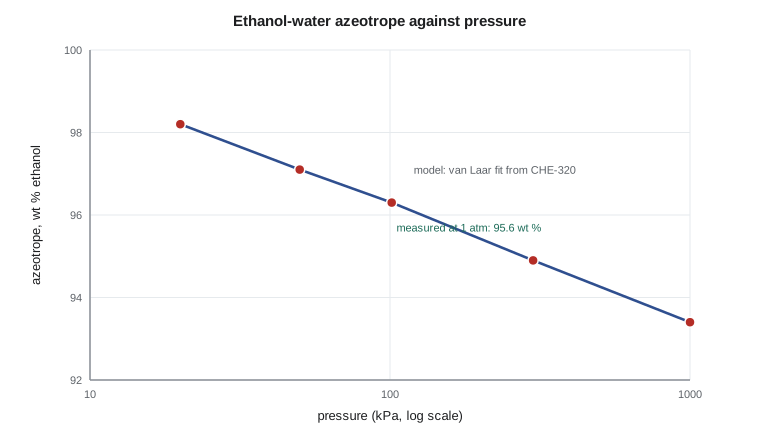
Pressure-swing distillation uses two columns at different pressures. Feed the high-pressure column with a mixture richer in ethanol than its azeotrope and it can make pure ethanol at the bottom, sending its near-azeotrope overhead to the low-pressure column, where the same mixture lies on the other side of that column's azeotrope and gives pure water at the bottom. The two overheads are recycled between the columns. It works only when the azeotrope moves enough with pressure; for ethanol-water the shift of a few percentage points means very large recycle flows, so the method is rarely used for ethanol. It is used for mixtures such as tetrahydrofuran-water and acetonitrile-water, whose azeotropes move much more. Heat integration between the two columns, with the high-pressure condenser driving the low-pressure reboiler, recovers much of the energy.
Extractive distillation
In extractive distillation a heavy solvent, fed near the top of the column, changes the liquid-phase activity coefficients enough to break the azeotrope. For ethanol and water, ethylene glycol is the classic solvent: it interacts strongly with water and holds it in the liquid, so ethanol becomes relatively more volatile. Nearly pure ethanol leaves the top, and water and glycol leave the bottom for a second column that recovers the glycol and recycles it.
The program shows the effect in its simplest form. At \(x = 0.85\), near the azeotrope, the relative volatility of ethanol to water without solvent is only 1.08. If the solvent lowers water's activity coefficient by a factor of 1.5, 2 or 3 at the same solvent-free composition, the relative volatility rises to about 1.6, 2.2 or 3.2. A real solvent's effect depends on its concentration on each tray, which is why it is fed high in the column and kept at a high liquid fraction, often 50 to 80 mol %, throughout the section above the feed. Extractive distillation was common for fuel ethanol before molecular sieves; it is still used for other systems, including separating close-boiling hydrocarbons with solvents such as N-methylpyrrolidone.
Heterogeneous azeotropic distillation
Some azeotropes are heterogeneous: when condensed, the azeotrope splits into two liquid phases. The ternary azeotrope of ethyl acetate, ethanol and water is one. Its overall composition is roughly 83 wt % ester, 8 % ethanol and 9 % water, and it condenses into an ester-rich layer and a water-rich layer. A decanter does what distillation cannot: it separates the two liquid layers, whose compositions lie on opposite sides of the distillation boundary, and sends each to a column that can work on it.
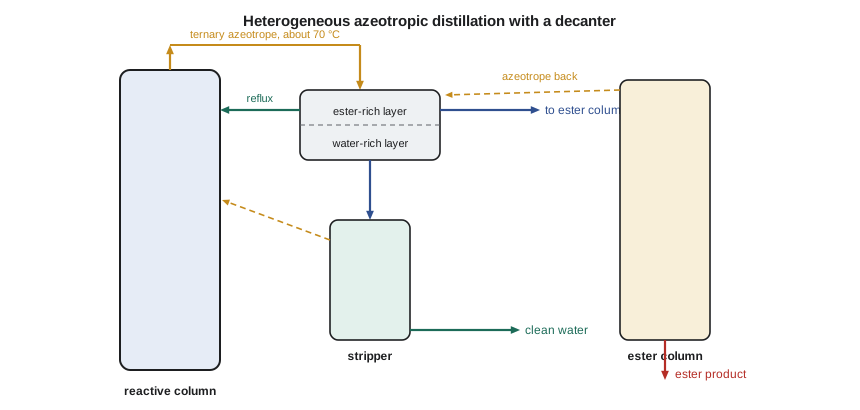
This is the scheme of the ethyl acetate line, and the capstone (lesson 12) designs it in detail. The same principle was long used to dry ethanol: an entrainer such as benzene, now replaced for safety by cyclohexane, was added to form a heterogeneous ternary azeotrope with ethanol and water, the overhead decanted, and the water-rich layer stripped. Modern fuel ethanol plants dry with molecular sieves instead (lesson 10), but the decanter principle is the same one the ester line depends on.
Residue curve maps
For ternary mixtures, engineers judge which products are feasible with a residue curve map. A residue curve traces the composition of the liquid left in a still as it is boiled away by simple distillation, with no reflux. Its equation is
where \(\xi\) is a dimensionless time. The program integrates one residue curve for an ideal ternary with relative volatilities 4, 2 and 1: the still loses the light component first, then the middle one, and ends at the pure heavy component. Every residue curve of an ideal mixture runs from the lightest component to the heaviest. With azeotropes, the map gains extra end points and distillation boundaries, curves that residue curves cannot cross. For the ester-ethanol-water system, a boundary runs from the ternary azeotrope and separates the region from which pure ester can be made from the region that ends at water or ethanol.
For simple column sequences, the products of a column must lie on a straight line through the feed in composition space (a material balance), and both products must lie in the same distillation region as the feed. A designer sketches the residue curve map, draws the balance line, and sees at once whether a proposed split is possible. Where a liquid-liquid region overlaps the boundary, a decanter can move a stream from one region to another, which is exactly how the ester line works. CHE-320 lesson 12 described the thermodynamic model choice for that map; the model must predict both the vapor-liquid and the liquid-liquid equilibria to draw it correctly.
Worked problem
Choosing between columns
An overhead stream of 95 wt % ethanol must become 99.5 wt %. Which technique fits a 200-million-liter fuel ethanol plant, and why?
Show solution
- Pressure swing: the azeotrope moves only a few points between 1 and 10 bar, so recycles would be very large.
- Extractive distillation with glycol: works, but needs a solvent recovery column and solvent make-up.
- Heterogeneous azeotropic distillation: works, but needs an entrainer that must not reach the fuel.
- Molecular sieves: adsorb the water directly from the vapor with no added chemical, regenerated by pressure swing.
Answer: Molecular sieves, which is why nearly every modern fuel ethanol plant uses them (lesson 10).
Leaving distillation
The fourth way around an azeotrope is not to distil across it at all. Adsorption on molecular sieves (lesson 10) and pervaporation through hydrophilic membranes (lesson 11) remove water selectively, independent of the vapor-liquid equilibrium. Liquid-liquid extraction (lesson 9) moves a component into a second solvent. Often the best design combines methods: distillation does the bulk of the separation where it is efficient, and another method finishes the job near the azeotrope. Theo's rule for the design basis is to record, for each azeotrope, which technique was chosen and why the others were rejected, so that a future review can see the reasoning.
Energy is the usual tie-breaker. Every azeotrope-breaking scheme recycles material around its columns, and recycles cost boil-up. Pressure swing recycles the near-azeotropic overheads; extractive distillation boils and condenses a solvent loop; heterogeneous schemes recycle the decanter layers. Before choosing, Theo estimates each recycle from the material balance and multiplies by a latent heat, which gives a first comparison of steam use within an hour. The options that survive that screen are then simulated properly, with the thermodynamic model checked against data for every pair of components involved.
Common mistakes
MistakeDesigning an ordinary column to pass an azeotrope.
InsteadNo number of stages crosses it; change pressure, add a solvent, decant or leave distillation.
MistakeAssuming the azeotrope composition is fixed.
InsteadIt changes with pressure; check it at the operating pressure.
MistakeChoosing an entrainer that contaminates the product.
InsteadConsider the entrainer's fate and safety; benzene was abandoned for that reason.
MistakeDrawing balance lines across a distillation boundary.
InsteadProducts must lie in the feed's distillation region unless a decanter or another method crosses the boundary.
Summary and key terms
- At an azeotrope, \(\alpha = 1\) and distillation cannot proceed.
- The ethanol-water azeotrope moves from about 98 wt % at 20 kPa to 93 wt % at 1,000 kPa in the model.
- Extractive distillation uses a heavy solvent, such as glycol, to change the activity coefficients.
- A heterogeneous azeotrope can be split by a decanter, which crosses the distillation boundary.
- Residue curve maps show which products are feasible for ternary mixtures.
- Pressure-swing distillation
- Two columns at different pressures exploiting the shift of an azeotrope with pressure.
- Extractive distillation
- Distillation with a heavy solvent added to change the relative volatility.
- Entrainer
- A component added to form a new azeotrope that makes a separation possible.
- Heterogeneous azeotrope
- An azeotrope that splits into two liquid phases when condensed.
- Residue curve
- The path of a still’s liquid composition during simple distillation.
- Distillation boundary
- A curve that residue curves, and simple columns, cannot cross.
Practice problems
Work each problem on paper first, then reveal the answer to check.
In the model, how much does the ethanol-water azeotrope shift between 1 atm and 300 kPa?
Show answer
From 96.3 to 94.9 wt %, about 1.4 percentage points.
Why is glycol fed near the top of an extractive column?
Show answer
So that it is present on every tray above the feed, where it must change the volatility.
Why can a decanter cross a distillation boundary?
Show answer
Its two liquid layers lie on opposite sides of the boundary.
Where does every residue curve of an ideal ternary end?
Show answer
At the pure heaviest component.
Name two methods that remove water from ethanol without distillation.
Show answer
Molecular sieve adsorption and pervaporation.
Why was benzene replaced as an entrainer?
Show answer
It is a carcinogen and must not reach the product or workers.
Lesson quiz · 5 questions
Score 60% or more to complete this lesson.
Create a free account to save your progress, take quizzes and earn a certificate.