
CHE-350 · Lesson 2 of 12 · 21 min
Binary distillation: the McCabe-Thiele method
The recovery column is Theo's first design. The plant collects several dilute ethanol-water streams: rinse water from the fermenters, the bottoms of the vent scrubber from CHE-314 when it runs off its normal routing, and drains from the distillation area. Today they go back to the fermentation tanks, where the ethanol is recovered slowly and the water dilutes the next batch. A small column would recover the ethanol directly and return clean water. Ingrid sets the design basis: 100 kmol/h of feed at 10 mol % ethanol, arriving as saturated liquid at 1 atm, an overhead product of 80 mol % ethanol to join the main rectifier's feed, and bottoms with no more than 0.05 mol % ethanol, clean enough to reuse as process water.
The method Theo uses first was published by Warren McCabe and Ernest Thiele in 1925. It is graphical, it assumes that the molar flows of liquid and gas are constant within each section of the column, and it handles any shape of equilibrium curve. Simulators have replaced it for final design, but no other method shows as clearly why a column needs the stages and the reflux it does.
The column and its balances
A distillation column has a feed somewhere in its height, a condenser at the top and a reboiler at the bottom. The section above the feed is the rectifying section, which enriches the rising gas in the light component; the section below is the stripping section, which strips the light component out of the falling liquid. The overall balances fix the product flows before any stage is counted:
With \(F = 100\), \(z_F = 0.10\), \(x_D = 0.80\) and \(x_B = 0.0005\), the distillate is \(D = 12.45\) kmol/h and the bottoms \(B = 87.55\) kmol/h.
Constant molar overflow and the operating lines
If each mole of gas that condenses on a tray releases enough heat to boil one mole of liquid, the molar flows do not change from tray to tray within a section. This is constant molar overflow. It holds well when the components have similar molar latent heats, as ethanol (about 39 kJ/mol) and water (about 41 kJ/mol) roughly do, and when heat losses and heats of mixing are small. With it, a balance around the top of the column down to any tray gives a straight line relating the gas rising to a tray to the liquid falling from the tray above, the rectifying operating line:
where \(R = L/D\) is the reflux ratio. Below the feed, the stripping operating line has slope \(\bar L/\bar V\) and passes through \((x_B, x_B)\):
The feed condition sets how the two sections' flows differ. The parameter \(q\) is the fraction of the feed that joins the liquid flowing down: \(q = 1\) for saturated liquid, \(q = 0\) for saturated vapor, more than 1 for a subcooled liquid and less than 0 for a superheated vapor. The q-line, \(y = \frac{q}{q-1}x - \frac{z_F}{q-1}\), passes through \((z_F, z_F)\) and is the locus where the two operating lines meet. For the recovery column's saturated liquid feed it is vertical at \(x = 0.10\), and \(\bar L = L + F\), \(\bar V = V\).
Stepping off stages
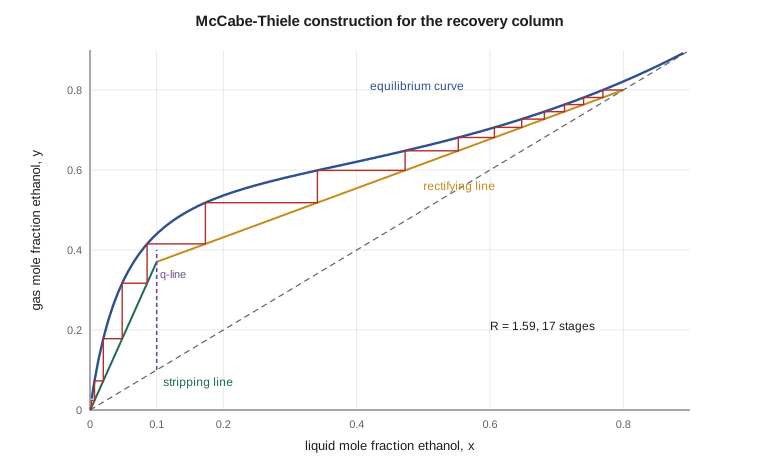
An equilibrium stage connects a point on the equilibrium curve (the streams leaving the stage) with points on the operating line (streams passing between stages). Starting at the top at \((x_D, x_D)\), for a total condenser, a horizontal step to the equilibrium curve gives the liquid leaving the top stage; a vertical step to the operating line gives the gas rising from the stage below. Repeating the staircase down the column, switching from the rectifying line to the stripping line once the steps pass the intersection, counts the equilibrium stages. The partial reboiler acts as the last equilibrium stage, because the gas it returns is in equilibrium with the bottoms it releases.
The optimum feed stage is the one at which the staircase crosses the intersection of the two lines. Switching earlier or later wastes stages, because one section then works in a region where its operating line lies closer to the equilibrium curve than the other section's would.
Minimum reflux and minimum stages
The reflux ratio sets the rectifying line's slope. As \(R\) falls, the line rotates toward the equilibrium curve, the steps get smaller, and more stages are needed. At the minimum reflux ratio the operating line touches the curve, a pinch forms, and an infinite number of stages would be needed. For an ordinary curve the pinch is at the feed, where the q-line meets the equilibrium curve. Ethanol-water is not ordinary: its curve has an inflection, and as the distillate approaches the azeotrope the operating line can touch the curve tangentially above the feed before it reaches the feed point. The program checks both possibilities.
At the other limit, total reflux, no product is withdrawn, both operating lines become the diagonal, and the staircase between the diagonal and the curve gives the minimum number of stages.
# McCabe-Thiele design of the ethanol rectifying column at 1 atm (constant molar overflow)
import math
# Ethanol (1) - water (2) at 1 atm: Antoine (mmHg, deg C) and van Laar constants fitted in CHE-320
ANT = {'ethanol': (8.20417, 1642.89, 230.300), 'water': (8.07131, 1730.63, 233.426)}
A12, A21 = 1.672, 0.930
def psat(c, T):  # kPa
    a, b, cc = ANT[c]
    return 10 ** (a - b / (T + cc)) * 0.133322
def gammas(x1):
    x2 = 1 - x1
    d = A12 * x1 + A21 * x2
    return math.exp(A12 * (A21 * x2 / d) ** 2), math.exp(A21 * (A12 * x1 / d) ** 2)
def bubble(x1, P=101.325):
    g1, g2 = gammas(x1)
    lo, hi = -20.0, 250.0
    for _ in range(60):
        T = (lo + hi) / 2
        s = x1 * g1 * psat('ethanol', T) + (1 - x1) * g2 * psat('water', T)
        lo, hi = (T, hi) if s < P else (lo, T)
    y1 = x1 * g1 * psat('ethanol', T) / P
    return T, y1
def y_eq(x): return bubble(x)[1]
def x_eq(y):
    lo, hi = 0.0, 0.894        # search below the azeotrope
    for _ in range(50):
        m = (lo + hi) / 2
        lo, hi = (m, hi) if y_eq(m) < y else (lo, m)
    return (lo + hi) / 2
eq = [(i / 400, y_eq(i / 400)) for i in range(1, 358)]
F, zF, q = 100.0, 0.10, 1.0      # kmol/h, saturated liquid feed
xD, xB = 0.80, 0.0005
D = F * (zF - xB) / (xD - xB); B = F - D
print(f"distillate D = {D:.2f} kmol/h, bottoms B = {B:.2f} kmol/h")
# minimum reflux: the operating line from (xD, xD) must not cross the equilibrium curve anywhere
# between the feed and the top (the ethanol-water curve gives a tangent pinch near the top)
Rmin = 0.0
for x, y in eq:
    if zF <= x < xD:
        R = (xD - y) / (y - x)
        Rmin = max(Rmin, R)
R_feedpinch = (xD - y_eq(zF)) / (y_eq(zF) - zF)
print(f"reflux needed for a pinch at the feed: {R_feedpinch:.2f}; true minimum reflux (tangent pinch): {Rmin:.2f}")
def step(R):
    # rectifying line y = R/(R+1) x + xD/(R+1); q = 1 so the lines meet at x = zF
    yq = R / (R + 1) * zF + xD / (R + 1)
    Lb = R * D + F; Vb = (R + 1) * D        # stripping section flows
    n, x, y, feed = 0, xD, xD, None
    while x > xB and n < 200:
        x = x_eq(y); n += 1
        if feed is None and x <= zF: feed = n
        if x <= xB: break
        if x > zF: y = R / (R + 1) * x + xD / (R + 1)
        else: y = Lb / Vb * x - B * xB / Vb
    return n, feed
for f in (1.1, 1.3, 1.5, 2.0, 3.0):
    n, feed = step(f * Rmin)
    print(f"R = {f:.1f} x Rmin = {f * Rmin:5.2f}: {n:3d} theoretical stages (incl. reboiler), feed on stage {feed}")
# total reflux: steps on the diagonal
n, x = 0, xD
while x > xB:
    x = x_eq(x); n += 1
print(f"total reflux: minimum {n} theoretical stages")
# pushing the distillate closer to the azeotrope moves the pinch away from the feed
for xd in (0.80, 0.85, 0.87):
    rf = (xd - y_eq(zF)) / (y_eq(zF) - zF)
    rt = max((xd - y) / (y - x) for x, y in eq if zF <= x < xd)
print(f"xD = {xd:.2f}: feed-pinch reflux {rf:.2f}, true minimum {rt:.2f}")distillate D = 12.45 kmol/h, bottoms B = 87.55 kmol/h reflux needed for a pinch at the feed: 1.06; true minimum reflux (tangent pinch): 1.06 R = 1.1 x Rmin = 1.16: 26 theoretical stages (incl. reboiler), feed on stage 19 R = 1.3 x Rmin = 1.38: 20 theoretical stages (incl. reboiler), feed on stage 14 R = 1.5 x Rmin = 1.59: 17 theoretical stages (incl. reboiler), feed on stage 11 R = 2.0 x Rmin = 2.12: 13 theoretical stages (incl. reboiler), feed on stage 9 R = 3.0 x Rmin = 3.17: 11 theoretical stages (incl. reboiler), feed on stage 7 total reflux: minimum 8 theoretical stages xD = 0.80: feed-pinch reflux 1.06, true minimum 1.06 xD = 0.85: feed-pinch reflux 1.21, true minimum 1.69 xD = 0.87: feed-pinch reflux 1.26, true minimum 2.30
Reading the results
For the design distillate of 80 mol %, the minimum reflux is 1.06, set by the feed pinch. The tangent pinch does not yet control. Push the distillate to 85 mol % and the minimum reflux jumps from the 1.21 a feed-pinch calculation would predict to 1.69; at 87 mol % it is 2.30. A designer who checked only the feed point would undersize the reflux badly for those purities. This is one of the classic traps of ethanol-water distillation, and the reason fuel-ethanol rectifiers typically stop at about 92 to 95 wt % (roughly 82 to 88 mol %), short of the azeotrope, and leaves the last step to molecular sieves.
The trade-off between stages and reflux is steep near the minimum and flat far from it. At 1.1 times the minimum the column needs 26 stages; at 1.3 times, 20; at 1.5 times, 17; at twice the minimum, 13; at three times, 11. The total-reflux minimum is 8. Each extra unit of reflux costs reboiler steam for the life of the plant, while each extra stage costs steel once. Lesson 3 prices the duties; for now, Ingrid's rule of thumb that the economic optimum usually lies between 1.2 and 1.5 times the minimum points Theo to \(R = 1.59\), 1.5 times the minimum, with 17 equilibrium stages including the reboiler and the feed on stage 11 from the top.
Worked problem
Product flows and section flows
Find \(D\), \(B\), and the liquid and gas flows in both sections at \(R = 1.59\).
Show solution
- \(D = 100(0.10 - 0.0005)/(0.80 - 0.0005) = 12.45\) kmol/h; \(B = 87.55\) kmol/h.
- Rectifying: \(L = RD = 19.79\) kmol/h; \(V = (R+1)D = 32.23\) kmol/h.
- Stripping, with \(q = 1\): \(\bar L = L + F = 119.79\) kmol/h; \(\bar V = V = 32.23\) kmol/h.
- Check: \(\bar L - \bar V = 87.56 = B\).
Answer: \(D = 12.45\), \(B = 87.55\), \(V = \bar V = 32.23\) kmol/h; the stripping liquid is almost four times the gas.
The stripping section does most of the work
The figure shows something specific to dilute feeds. Most of the stages sit in the stripping section, where the stripping line runs steeply from the bottoms point and the liquid's ethanol content must fall from 10 mol % to 0.05 mol %. Each step there is short because the stripping line is close to the equilibrium curve at very low \(x\). Bottoms purity is the expensive specification: tightening it from 0.05 to 0.01 mol % would add several stages, while relaxing it would lose ethanol to the water. Theo writes both numbers into the design basis so that Wren Halvorsen can check the water's fate against the plant's wastewater limits.
In the rectifying section the steps also crowd together near the top, where the equilibrium curve flattens toward the diagonal. That is the same feature that creates the tangent pinch at higher purities. Seeing both regions of small steps on one diagram explains the column's shape before any computer model is run.
Other column arrangements
The same graphical method handles variations that Theo meets on the plant's existing columns. Live steam injected directly into the bottom, instead of a reboiler, adds water to the bottoms and shifts the stripping line so that it starts at \((x_B, 0)\) instead of on the diagonal; it saves a reboiler but makes more wastewater. A partial condenser, which returns liquid reflux and sends vapor product forward, counts as an extra equilibrium stage. Multiple feeds and side draws add more operating lines, one for each section between the points where streams enter or leave. Lesson 3 adds a side draw to the design.
Common mistakes
MistakeChecking minimum reflux only at the feed for ethanol and water.
InsteadLook for a tangent pinch above the feed when the distillate is rich.
MistakeCounting the partial reboiler as equipment but not as a stage.
InsteadThe partial reboiler is an equilibrium stage.
MistakeSwitching operating lines at an arbitrary step.
InsteadSwitch where the staircase crosses the q-line for the fewest stages.
MistakeChoosing a reflux ratio just above the minimum to save energy.
InsteadNear the minimum, stages rise steeply; the optimum is usually 1.2 to 1.5 times the minimum.
Summary and key terms
- Overall balances fix the product flows before any stage is counted.
- Constant molar overflow makes the operating lines straight.
- Stages are stepped between the equilibrium curve and the operating lines; the feed goes where the staircase crosses the q-line.
- For the recovery column: \(R_{min} = 1.06\), 8 stages at total reflux, and 17 stages at \(R = 1.59\).
- Ethanol-water can pinch tangentially above the feed when the distillate is rich.
- Reflux ratio
- Liquid returned to the column divided by distillate withdrawn.
- Operating line
- The relation between the compositions of streams passing between stages in a column section.
- q-line
- The line on which the rectifying and stripping operating lines intersect, set by the feed condition.
- Minimum reflux
- The reflux at which a pinch forms and infinitely many stages are needed.
- Total reflux
- Operation with no product withdrawn, giving the minimum number of stages.
- Constant molar overflow
- The assumption that molar liquid and gas flows are constant within a column section.
Practice problems
Work each problem on paper first, then reveal the answer to check.
A feed is 30 % vapor. What is \(q\)?
Show answer
0.7, the fraction that is liquid.
What is the slope of the rectifying line at \(R = 1.59\)?
Show answer
\(1.59/2.59 = 0.614\).
Where does the rectifying line cross \(x = 0\)?
Show answer
At \(y = x_D/(R+1) = 0.80/2.59 = 0.309\).
Why does a subcooled feed have \(q\) above 1?
Show answer
It condenses some of the rising gas while heating to its bubble point, adding to the liquid below.
Why did a feed-pinch check underestimate \(R_{min}\) at \(x_D = 0.87\)?
Show answer
The operating line touches the curve tangentially above the feed first.
How does live steam change the stripping line?
Show answer
It passes through \((x_B, 0)\) instead of \((x_B, x_B)\).
Lesson quiz · 5 questions
Score 60% or more to complete this lesson.
Create a free account to save your progress, take quizzes and earn a certificate.